Revolution or No Revolution
Eight years after Armenia’s “Velvet Revolution,” Nikol Pashinyan’s government has deepened the country’s neoliberal trajectory while reorienting Armenia toward the West.
This September 2026 marked the third anniversary of Azerbaijan’s ethnic cleansing of the region of Nagorno-Karabakh (Artsakh). For Armenian society, the displacement of some 150,000 indigenous Karabakh Armenians was painful enough. Yet, in early September, several Western diplomats compounded matters by participating in a Baku-backed tour of the recently ethnically cleansed Artsakh. As investigative journalist Lindsey Snell reports, among those present were top EU diplomats and representatives of the Trump administration, including the US chargé d’affaires in Baku, Amy Carlon. While several Western diplomats danced to the tune of Azerbaijani nationalist hymns, others frivolously laughed when Hikmet Hajijev, the NATO-trained adviser of Azerbaijan’s President Ilham Aliyev, cynically cracked jokes about threatened Armenian cultural heritage. Amid this ghoulish danse macabre, the visiting diplomats uncritically accepted official Azerbaijani talking points, framing the historic Armenian Gandzasar and Dadivank monasteries as “Caucasian Albanian.”
The outrage in Armenian society was palpable, but Western capitals responded only with the usual diplomatic generalities. It is unlikely that any Western government will seriously try to hold Baku accountable for its crimes or its wildly neo-fascist rhetoric. Azerbaijan is a close ally of Israel and Turkey. Its longtime despot President Aliyev is a good friend of President Trump. Western interests in the country are driven by cold geopolitical calculations. The prospect of a “Nagorno-Karabakh without Armenians” has long tickled the fancy of American neocons, in their quest to “check” Moscow and Tehran in the strategic Caucasus and to secure an energy corridor to Central Asia. None of this should be surprising to the experienced observer. What has surprised many is that the ethnic cleansing had the tacit approval of the current Armenian government of Nikol Pashinyan, as part of its effort to reorient the country toward the West.
Pashinyan rose to power in the 2018 “Velvet Revolution” on promises of delivering a more just and equitable future for the Armenian people. At that time, he espoused what some deemed to be a “hard-line” stance on the Karabakh question. However, Pashinyan had in fact long viewed the people of Nagorno-Karabakh as an “albatross” hanging over Armenia that needed to be “discarded” in order to move the country away from Moscow and Tehran, and closer to NATO. In a complete turnaround from his 2018 stance, Pashinyan revealed his true sentiments in Prague in October 2022, when he officially recognized the mountainous region as a part of Azerbaijan, against the democratic will of the Karabakh Armenians. Pashinyan’s denial of the province’s self-determination reflects his larger denial of the democratic legacies of the Karabakh movement that emerged during Mikhail Gorbachev’s perestroika. It likewise provides a departure point for a much more pointed question: Was the “revolution” of 2018 really a “revolution” at all?
Much of Armenia’s troubles have their roots in the “original sin” of the post-Soviet condition of the 1990s. Following the dissolution of the Soviet state, the Armenian republic successfully assisted the Karabakh Armenians in their struggle for independence from Azerbaijan. At the same time, the country suffered from the classical maladies that afflicted the post-Soviet space in the “dark and cold years” of the “wild ’90s.” Corrupt privatization, oligarchy, shock-therapy capitalism, and staggering inequality were the order of the day. The “revolution” in Armenia promised to remedy these afflictions. Yet, as in so many other post-Soviet “color revolutions,” the events of 2018 only exacerbated these ills.
As Volodymyr Ishchenko and Oleg Zhuravlev astutely argued, post-Soviet “revolutions” such as Armenia’s can best be described as “deficient revolutions” that only reinforce the post-Soviet crisis of political representation. Indeed, the question arises as to whether such “revolutions” can even be described as such at all. Unlike the classical revolutions of world history—the American, the French, the Russian, the Chinese, etc.—the 2018 events in Armenia, much like other post-Soviet “color revolutions,” did not represent a fundamental break or change from what came before. Instead, they merely signified the replacement of an old elite with a new one. The “party of power” structure of the former ruling Republican Party was merely replaced by that of Pashinyan’s Civil Contract party, with all the attendant abuses of administrative resources and political power imaginable. “Even the discourse on the government’s supposed ‘popularity’ is itself a red herring,” says Nare Navasardyan, an activist in Yerevan affiliated with the Aknandakan (“Eye for an Eye”) documentary artists’ collective. “The mechanisms of power in this country are not democratic will and popular participation but electoral fraud, bribery, and intimidation, overtly supported by Western patronage and capital.”
Unlike the classical revolutions of world history, the 2018 events in Armenia also lacked a clearly articulated set of revolutionary ideas. There was no Thomas Paine, Jean-Jacques Rousseau, or Vladimir Lenin on hand to pen a blueprint for social revolution, something that the Armenians possessed in earlier times, with writers like Mikayel Nalbandyan or Stepan Shahumyan. No, this “revolution” was only informed by the same vague neoliberal talking points about “corruption” and “freedom” that were also espoused in Ukraine in 2014 and in Georgia in 2003. In fact, the new elites who rose to power in Yerevan in 2018 were even more wedded to the gospel of neoliberalism than any of the earlier post-Soviet Armenian governments. “This is not a revolution in the classical sense,” argues Eva Hakobyan of the democratic socialist group Jaragayt. “It has not brought about any fundamental changes to the economic system. Instead, Pashinyan seeks to replace the traditional pillars of Armenian identity with a service-oriented, consumerist society, in line with radically neoliberal and increasingly far-right economic policies.”
Much like President Trump and Argentina’s Javier Milei, Pashinyan played the populist card, employing progressive talking points to deceive the public and mask a deeply exploitative monetarist agenda. Rather than deliver on promises of democratization, the new government has engaged in a systematic de-democratization of the country. Poverty, inequality, and labor rights remain woefully unaddressed, while political opponents are routinely pressured, harassed, and often jailed. The judiciary lacks independence. An unprecedented campaign is underway to subordinate the Armenian Apostolic Church to state authority and to put Catholicos Karekin II on trial in a move widely perceived by most Armenians to be a national shame. Despite proclaimed promises of “peace,” the country faces severe security threats and creeping territorial claims from an aggressive Azerbaijan.
In 2018, Pashinyan and his team had likewise pledged that the “revolution” had “no geopolitical context“ and that Armenia would retain its traditional balance between East and West. In fact, they quickly dropped such pretenses and reoriented the country toward NATO, while betraying the innocents of Artsakh to the diktat of Baku. Swimming against the current of history, Pashinyan seems particularly intent on bringing Armenia into the EU, despite the manifold crises now facing the 27-member bloc. Overall, Armenia’s false choice of “East vs. West” is not the invention of Russia, Iran, China, or some overzealous Western journalists. No, it is the creation of Armenia’s new comprador elites, who owe their position to a constellation of Western war hawks and corporate plutocrats.
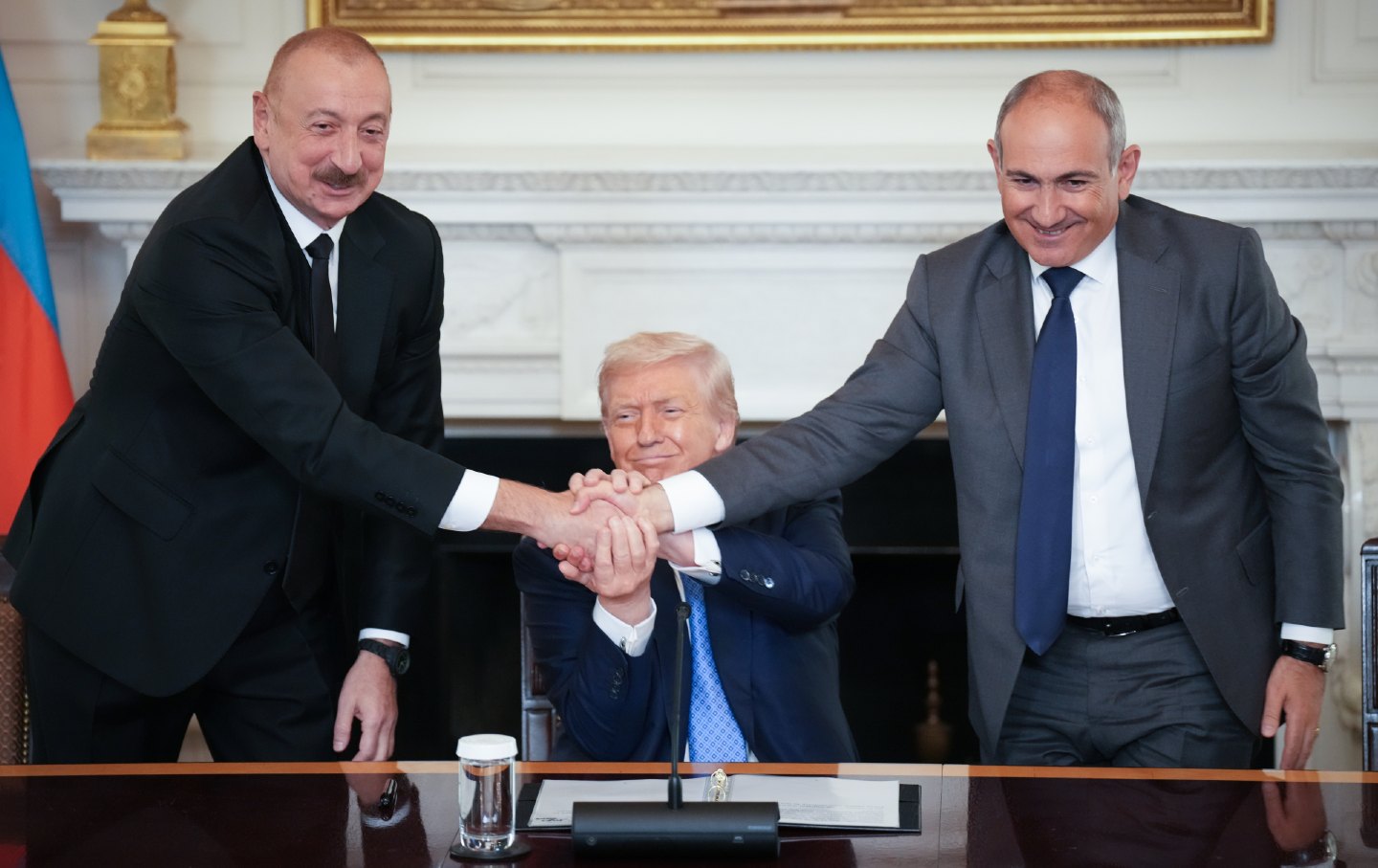
The government’s most recent endeavors only underscore this reality. In the Armenian town of Hrazdan, it has inaugurated a new Firebird AI data center, raising concern among local activists over the potential environmental impact of such a project. In the south, on the Iranian border, President Trump’s TRIPP corridor, wholeheartedly backed by Pashinyan, envisions the country ceding part of its sovereign territory to a private US company for some 49 to 99 years. Most recently, the Armenian press revealed the architect of TRIPP to be Trump loyalist Aryeh Lightstone, a man who, through his role in the Gaza Humanitarian Foundation, is directly complicit in the Gaza genocide. Thus, the traditional threats facing Armenia from Turkey and Azerbaijan are now amplified by new neocolonial threats coming from the Trump administration and its allies.
On balance, the record of the Pashinyan government hardly looks “revolutionary,” let alone “democratic.” Indeed, it is often said in Yerevan that two Armenias coexist today—the Armenia of the ruling elite, constantly grabbing headlines with its various inane controversies, and the Armenia of the people, struggling to simply make ends meet. Unsurprisingly, the same can be said of Trump’s America today as well. As for the EU, the recent dance of its diplomats in ethnically cleansed Artsakh has come to symbolize the decline of the West itself. Truly, in the age of Trumpism, one would not be surprised to one day see Western elites follow their “performance” in Artsakh with yet another danse macabre in Gaza, Minab, or Havana.