A Message From 1930: Zion Cannot Be Built on Bayonets
A hope for a more just future echoes across the decades from the pages of The Nation magazine.
In a 2012 article for Commentary, “When the Radical American Left Loved Israel,” Ronald Radosh recalled the days in the 1940s when The Nation’s editor, Freda Kirchwey, made the magazine “a singular voice in behalf of the Zionist cause.”
It’s true that The Nation enthusiastically supported the creation of Israel. In late 1948, Kirchwey traveled to the new state and filed dispatches that were overwhelmingly approving—skeptical of outside criticism and woefully unbothered by the displacement of Palestinians and the occupation of their homes. Sara Alpern writes in her biography of Kirchwey that the editor’s son, Michael, recalled that while Kirchwey was interviewing a former Palestinian mayor of Jerusalem, Husayn al-Khalidi (uncle of the historian Rashid Khalidi), “she listened understandingly to Khalidi’s eloquent arguments; but it was as if she did not hear him. Her mind was already made up.”
A few articles from nearly a century ago complicate the story told by Radosh (and others). Though it was in favor of the idea of a Jewish state in Palestine, The Nation of the 1920s—under the editorship of Oswald Garrison Villard—recognized that Palestinian claims to the land were at risk of being trampled as the number of Jewish settlers increased. In August 1929, conflicts over access to the Western Wall in the Old City of Jerusalem escalated into Arab attacks on Jews throughout Palestine, killing 133, while 116 Palestinians were killed, mostly by British security forces suppressing the riots (although there were some counterattacks by Jews). The Nation condemned the violence but sympathized with Palestinians’ “bitter sense of dispossession” and understandable opposition to “any program of making the 90 per cent Arab land of Palestine the homeland of an alien people.” The editors added, “These are facts, this is a history which one has no right to forget, however intense one’s sympathy with the murdered Jews of Hebron.”
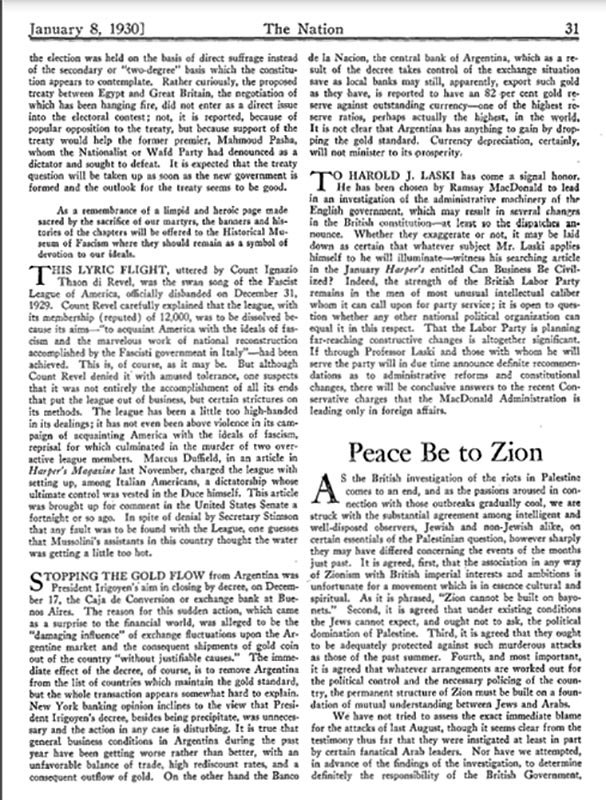
A few months later, another editorial, “Peace Be to Zion,” contended that “Zion cannot be built on bayonets.” It was wrong for Jews to expect “the political domination of Palestine.” Somehow, The Nation argued, “the permanent structure of Zion must be built on a foundation of mutual understanding between Jews and Arabs.” Subscribers had complained, but the magazine held firm:
Because we have tried to understand and explain, as far as we could, what lay in the background of the killings, many of our readers have apparently felt that we were inclined to condone the attacks on the Jews. Nothing could be further from the truth; we have nothing but reprobation for violence and murder, and sympathy for the victims. But we have no word to retract that we have spoken in defense of Arab rights; nor have the Arabs forfeited those rights by the misconduct of some of their number…. We once more assert that the only way for those who have been wronged in Palestine is the way, not of vengeance, but of forgiveness and reconciliation.