
“I Refused to Let the Genocide Steal My Dreams”
For these medical students in Gaza, completing their studies was an act of defiance.
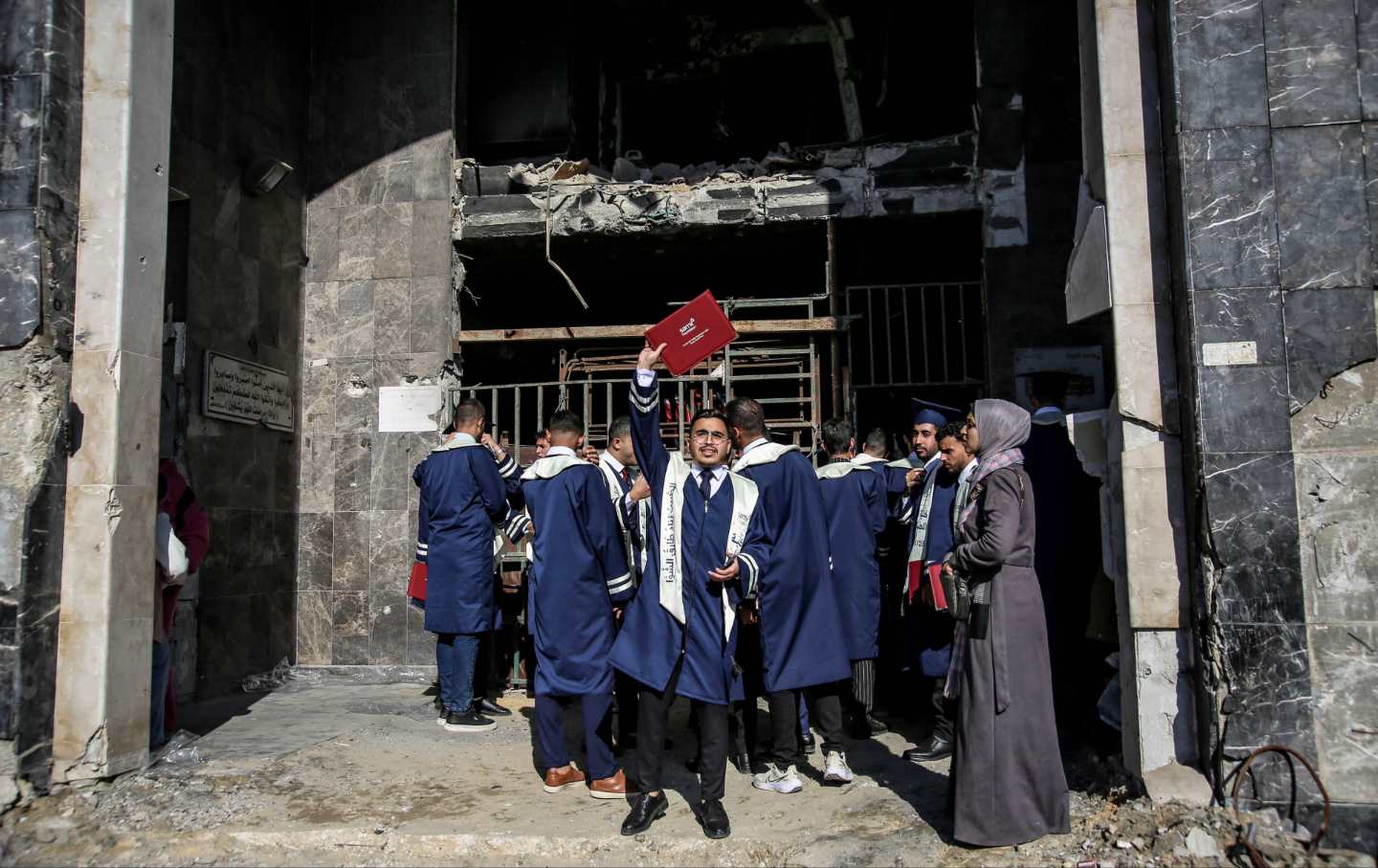
A graduation ceremony for 230 medical students at al-Shifa Hospital, in Gaza City, on January 3, 2026.
(Saeed M. M. T. Jaras / Anadolu via Getty Images)On January 3, 230 medical students from Gaza celebrated their graduation in the courtyard of the devastated Al-Shifa hospital, which was once one of the largest hospitals in the Gaza Strip. The ceremony took place amid destroyed buildings and damaged infrastructure—a powerful symbol of the refusal of Gaza’s healthcare workers to surrender even as Israel has tried to eliminate them.
Since the genocide began in October 2023, Gaza’s healthcare system has suffered unprecedented damage. According to the World Health Organization, hundreds of attacks have been carried out against health facilities, ambulances, and medical personnel. By early 2025, only about half of Gaza’s 36 hospitals were still even partially functioning, while the vast majority of medical facilities had been damaged or destroyed. Hundreds of healthcare workers, including doctors, nurses, and paramedics, have been killed during the war.
Al-Shifa Hospital itself has suffered endless wounds. Gaza’s Ministry of Health managed to rehabilitate parts of the hospital, but the scale of the destruction wrought by Israeli bombs remains too vast for Al-Shifa to return to normal operation.
Yet none of this prevented families, colleagues, and surviving hospital staff from gathering in Al-Shifa’s ruins to celebrate the graduation of a new generation of doctors.
Many of the graduates had continued their medical education despite losing family members, homes, or both. Among them was Dr. Ezzedine Lulu, who lost 20 members of his family, including his father, Samir, and his brother, Huthaifa. Their bodies remain under the rubble. Lulu received the devastating news of their deaths while he was besieged inside the emergency department at Al-Shifa, where he was volunteering.
Instead of stopping, the loss pushed Lulu to complete his studies. He later founded the Samir Foundation, named in memory of his father, to support medical students academically, financially, and psychologically. The graduation ceremony was held under the patronage of the Samir Foundation, led by Dr. Lulu, now a graduate himself.
Despite the destruction surrounding them, the graduates’ excitement during the ceremony was palpable. After six years of hard work, exhaustion, and persistence, especially during the last two years of war, they were finally doctors. They sang together, danced to Palestinian songs, and stood side by side to recite the Hippocratic oath in one unified voice.
But despite the celebration, pain was never far away. Many graduates broke down in tears throughout the ceremony. Families of students who were killed during the war attended, carrying framed photos of their sons and daughters—young doctors who never lived to witness their graduation. They sat quietly among the crowd, holding the images close.
Among the graduates was Aseel Nawas, 23. Her decision to study medicine began as a childhood dream.
“I always saw medicine as a noble and humane profession,” she said. “With time, it became more than a career; it became a message and a way to make a real difference, especially in a community that needs this role so much.”
The genocide deeply reshaped Nawas’s journey as a medical student. At its beginning, education stopped completely. “There was a full disconnection from studying because of how intense everything was,” she explained. “When we slowly returned, the connection was never the same.”
Aseel was in the second year of her clinical phase, when hospital-based training makes up most of the curriculum. But hospitals had turned into shelters and emergency centers, overwhelmed with wounded patients.
“There was no real space for lectures or proper training,” she said. “Most of the time, we were only observing, yet we were expected to perform at the same level in completely abnormal conditions.”
With the declining quality of education and training, Nawas relied heavily on her own efforts to keep going. “No one would give me an excuse if I fell behind, so I had to work harder on my own to make up for what was missing.” She trained at Al-Aqsa and Al-Awda Hospitals, where the lack of resources shaped every detail of her experience. “Even deciding to go to the hospital required long thinking, how will I get there, how will I come back?” she said. “During famine, my colleague and I once searched for something sweet just to get energy, and we found nothing.”
Her daily routine during the war depended on daylight and rare Internet access, and was pervaded by constant fear.
“I studied during the day because there was no electricity. Any moment with the Internet was precious. At night, studying was almost impossible not just because of power cuts but because night was the most frightening time. The bombing intensified, and the planes flew very close to our home.”
Continuing her education under bombardment, displacement, and shortages was never easy, but it became a conscious decision. “Sometimes, just continuing felt like a form of resistance; I refused to let the genocide steal my dreams,” she said.
Nawas recalled moments when she genuinely feared for her life, during air strikes, while commuting, and even inside hospital surroundings. On one occasion, her shift at Al-Aqsa Hospital was canceled after an explosion there.
“During my surgery rotation in my final year, I received the news that a colleague from my class was killed,” she said. “I started questioning whether going to the hospital was worth risking my life.”
The shortage of medical equipment and medications severely limited practical learning. “Many times, we had to rely on alternatives or just observe instead of practicing,” she said.
Popular
“swipe left below to view more authors”Swipe →One of her unforgettable experiences with patients was in the internal medicine department. “I saw young men in their early 20s diagnosed with serious illnesses,” she said. “Watching patients suffer in a place that cannot provide even basic treatment because of the siege felt like a slow death.”
Al-Shifa Hospital holds deep personal meaning for Nawas. It was where she had her first day of clinical training in her fourth year.
“I took a photo there and wrote, ‘First day of clinical training.’ It became our second home. We studied, laughed, learned, and spent most of our days there,” she said.
Graduating in its courtyard carried heavy symbolism.
“Al-Shifa witnessed pain, resilience, and endless attempts to save lives,” she said. “Graduating there is not the end of the road. It is the beginning of responsibility.”
For Nawas, being a doctor in Gaza today means far more than providing treatment. “People need support and reassurance,” she said. “To be a doctor here means to be a good human being. The genocide placed a much greater responsibility on us, not only medically but humanly as well.”
In a place where hospitals have been repeatedly attacked and the healthcare system pushed to the brink, the graduation of new doctors is not just an academic milestone. It is proof that medical education and the commitment to healing continue in Gaza, despite everything.
More from The Nation

Japan’s Far Right Is Courting Young Voters Japan’s Far Right Is Courting Young Voters
Sanseitō has attracted young voters through a robust social-media strategy, Charlie Kirk–like public speaking events, and anti-establishment messaging.
This AI Panic Is Nothing New This AI Panic Is Nothing New
In the 1940s, The Nation asked questions about the atomic bomb we’re asking of artificial intelligence today.

The Decades-Old Roots of Trump’s War on Iran The Decades-Old Roots of Trump’s War on Iran
An interview with historian Behrooz Ghamari-Tabrizi about the generations of US presidents who have tried to destroy the Iranian regime.

Emmanuel Macron’s Turbulent Exit Emmanuel Macron’s Turbulent Exit
Between a budget crisis and a cost-of-living squeeze, Macron is leaving a country feeling more insecure than ever—and ready to take to the streets.
Israel’s Election Can’t Fix What Netanyahu Broke Israel’s Election Can’t Fix What Netanyahu Broke
The fundamental problem is not the name of the prime minister, but rather the actions of the Israeli government and the urgent issues that need to be addressed.

The AfD’s Rise Isn’t Just About East Germany The AfD’s Rise Isn’t Just About East Germany
The Alternative für Deutschland has a stable national poll lead, including in the former West Germany. Its rise owes to much more than Eastern grievances.

