Israel’s Internal Contradictions
As Israel approached the one-year anniversary of October 7, it seemed to be at a crossroads, with two powerful blocs pulling in two different directions.
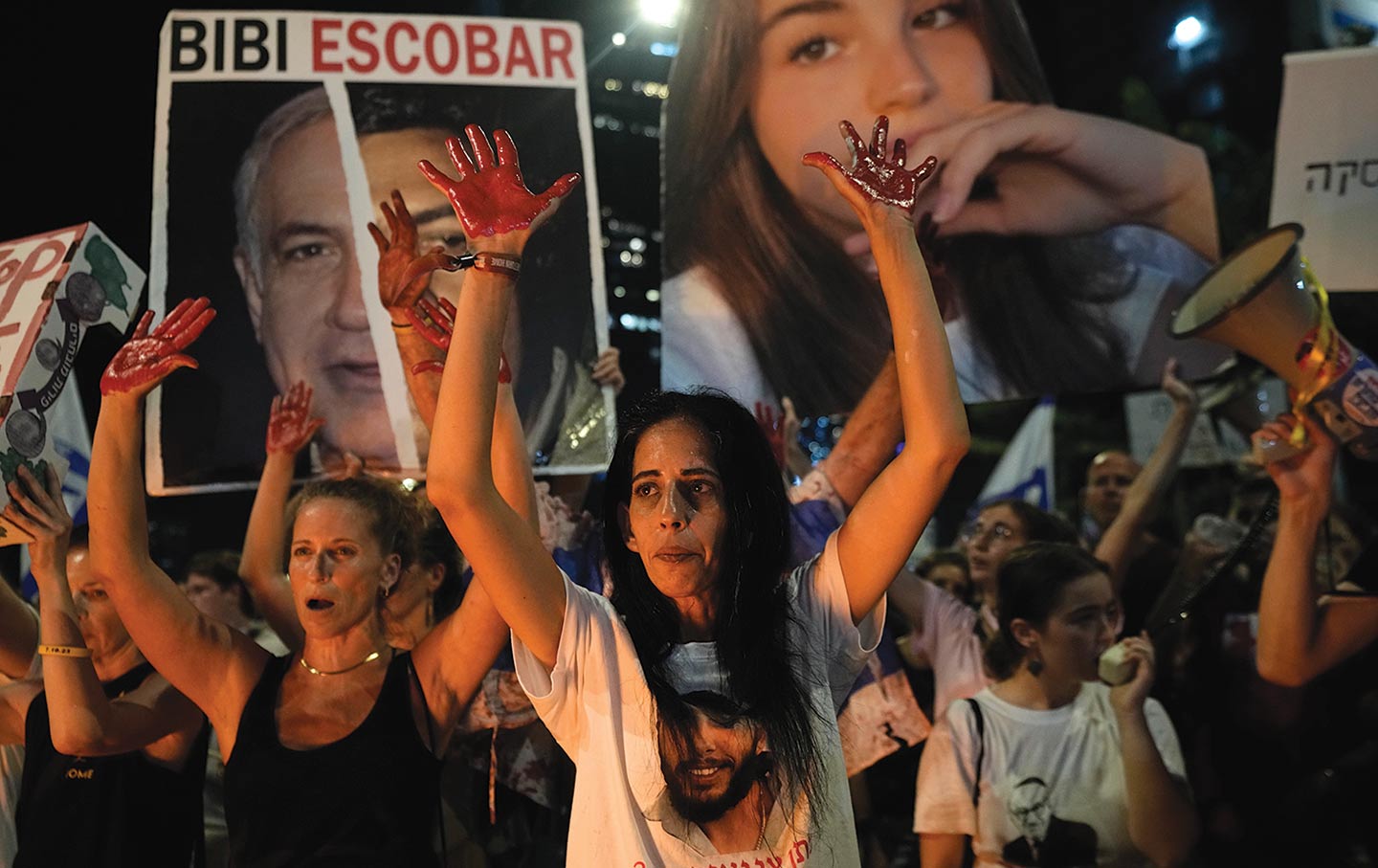
Deal now: Einav Zangauker, the mother of hostage Matan Zangauker, protests for his release.
(Tsafrir Abayov / AP Photo)
If you want to understand where Israel is at almost a year into its longest war, you might start by looking at two very different figures: Giora Eiland and Einav Zangauker. Eiland, a retired major general, is the former head of the Israeli National Security Council and has long been considered one of the most prominent “intellectuals” among the not very intellectual Israeli security apparatus. A frequent TV commentator, he does not come from a religious-messianic background, is a vocal critic of Benjamin Netanyahu and his politics, and generally presents as a moderate, sober thinker. Yet from the beginning of the war, Eiland led the way by calling to destroy Gaza. “The State of Israel has no choice but to make Gaza a place that is temporarily, or permanently, impossible to live in,” he wrote in one opinion piece. In another, he stated: “The people should be told that they have two choices; to stay and to starve, or to leave.” The remark earned him a mention in the International Court of Justice’s January ruling that found it “plausible” that Israel has committed acts that violate the Genocide Convention.
Since making those early pronouncements, Eiland has continued to take a brutal line toward Gaza—endorsing starvation, welcoming the prospect of disease outbreaks and epidemics, and pressing for aggressive military action. Most recently, he helped spearhead the “Generals’ Plan”—a proposal, backed by other well-known retired officers, for an operation that would begin with Israel declaring the whole of Gaza City and its surroundings a “closed military area,” giving its estimated 250,000 remaining residents a week to evacuate, and then treating those who stay as “Hamas terrorists” who will have to surrender or face death. The reason for the proposal: Almost a year after Israel launched its bloodiest attack ever on Gaza and on the Palestinian people as a whole, killing at least 40,000, driving almost 2 million from their homes, and leveling most of the Gaza Strip, Eiland and his military friends believe that Israel has not done enough—that it has been “too soft” on the Palestinians. And the Israeli political class and media agree.
And yet, as popular as Eiland’s views may be, he does not speak for all Israelis. Einav Zangauker represents the current mood of the country at least as well as Eiland does. Zangauker’s son, Matan, was kidnapped on October 7 and is being held in Gaza. Zangauker is a resident of Ofakim, a small town in southern Israel, that was overrun during Hamas’s murderous attack. She describes herself as a Likudnik, as do the overwhelming majority of Ofakim residents.
Yet Zangauker is today the undisputed leader of a huge wave of protests calling for a deal with Hamas that would include the release of the Israeli hostages in exchange for the release of Palestinian prisoners held by Israel as well as a ceasefire in Gaza. In her direct and unapologetic way, she not only attacks Netanyahu in the harshest of words, calling him a “murderer” responsible for the killing of Israeli hostages—both those who have already died in captivity and those who may yet die because Netanyahu is blocking any deal—but she also dismantles his rhetoric: from his claims that Israel can achieve “total victory” to his latest invention, that the survival of Israel depends on its forces remaining in the Philadelphi Corridor between Egypt and the Gaza Strip.
In her grief, anger, and despair, Zangauker embodies the feelings of many Israelis, hundreds of thousands of whom poured into the streets at the end of the summer demanding a “deal now.” They are all tired of waiting for the hostages to be freed, tired of seeing them return home in body bags, and tired of the state of anxiety in which so many of them have lived for almost a year. “Make a deal, finish the war, fix the country,” tweeted Yair Lapid, the head of the opposition, who until recently had adopted many of Netanyahu’s slogans.
With Eiland on one side and Zangauker on the other, Israel finds itself at a crossroads—one that could determine the fate not only of the Israeli hostages and the people in Gaza but also of the broader Middle East. Take one path, and there is endless war; take the other, and there is the possibility of “normality.” And yet, as deep as the divisions are between the two sides, there is one crucial matter on which they are fundamentally aligned: Neither side includes Palestinians as part of their equation. The Israeli public is not distressed by the violence its military is inflicting on Gaza; nor are they concerned about future relations with the Palestinians.
This void should raise serious doubts about whether Israel can find its way to a true and lasting resolution to the horrors of the past year, no matter which path it takes. A ceasefire is a must, but it is only the beginning.
This article was written before Israel launched its attacks on Lebanon.