Trump’s Attack on the Supreme Court Was Unhinged Even for Him
The president went on a wild rant alleging that the justices who struck down his tariffs were part of a vast global conspiracy to destroy him.
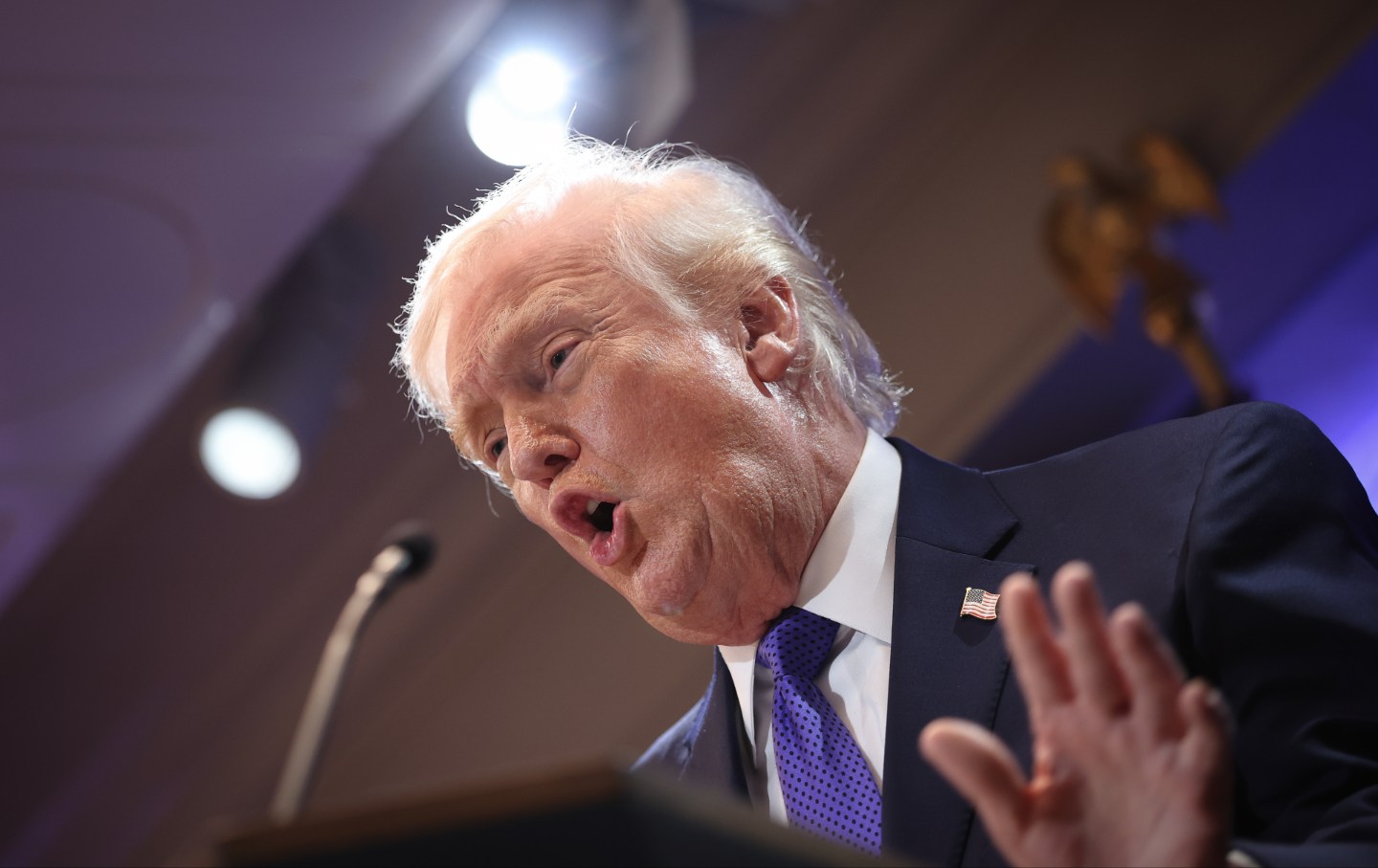
Donald Trump answers questions during a press briefing at the White House on February 20, 2026.
(Kevin Dietsch / Getty Images)In a press conference on Friday, President Donald Trump brought down the curtain on his bold “Liberation Day” tariffs agenda in much the same way he ushered it in—with a rolling litany of grievances against foreign economies allegedly ripping off the United States, a misleading characterization of trade deficits as zero-sum attacks on American prosperity, and fantasy-driven word-pictures of “strong and powerful” US business owners miraculously restored to their entrepreneurial prime by the sheer force of Trump’s presidential will. The only notable addition to this exercise in magical economic thinking was Trump’s attack on the Supreme Court, which had earlier gutted his tariff regime in a 6–3 ruling joined by, among others, two of Trump’s appointees to the court, Neil Gorsuch and Amy Coney Barrett.
“I’m ashamed of certain members of the court, absolutely ashamed of them for not having the courage to do what’s right for our country,” Trump said, in an ominous use of the rhetoric he deployed against his first-term vice president, Mike Pence, on January 6, 2021. Trump also found time to revive his pet lies about the supposedly stolen 2020 presidential election, which he tied to an equally nonsensical conspiracy to deny him lifelong maximum executive power, and—what amounts to the same thing in his mind—to render the United States a cringingly weak economic force, battered by rival powers determined to “treat us very badly.”
After offering a pro forma attack on Democrats as a congeries of villains who are “against anything that makes America strong, healthy, and great again,” including rank perfidies “having to do with voting,” Trump then took his court-bashing to an even wilder level. The parallel threats of hostile economic infiltration from without and anti-Trump sabotage from within prompted Trump to suggest that the court had succumbed to unspecified “foreign interests” in an effort to undermine America’s God-given economic sovereignty. “You can’t knock their loyalty,” he said grudgingly of the Democrats, “but you can with our people.… The court has been swayed by foreign interests and by a political movement that’s far smaller than people think”—a claim backed by no more evidence than he managed to adduce in support of the stolen-election fantasy. The conspiracy-mongering hung so thickly in the air of the White House briefing room that Trump officials conspicuously dimmed the lighting, as if to conjure an air of menace right out of The Phantom of the Opera, a standby on Trump’s rally playlist.
Ironically, one of Trump’s swipes at the court—“People are being obnoxious, ignorant, and loud, and certain justices are afraid of that”—is actually a fine summation of the Roberts court’s dismal record of prostration before the MAGA agenda, from its delusional executive immunity ruling to its all-out war on voting rights to the kneecapping of whatever remains of the regulatory state. Yet, in Trump’s persecution-ridden worldview, Amy Comey Barrett and Neal Gorsuch have been seduced by the siren song of “political correctness,” part of a retrograde conservative movement made up of “fools, RINOS, and lapdogs to the Democratic left.”
Trump’s extended aria of betrayal at the hands of his own appointees was especially unhinged given that he tried to make the case over the balance of his remarks that the court’s decision didn’t really affect his tariff regime at all, beyond slowing it down with new investigative and procedural requirements. The court found that the battery of tariffs Trump sprung on the world economy last spring were not legal under their cited authority, the 1977 International Emergency Economic Powers Act—but, as Trump noted, there are ample statutory and legal precedents to continue tariffs. The sticking point for him had been that these measures require sustained inquiries to show economic or national security harms wrought by trading partners, while the Trump administration prefers to impose economic penalties through demagogic handwaving about fentanyl and immigration (the GOP’s congressional majority, always happy to sit obligingly on its hands, never seems to enter the frame).
Trump also didn’t mention that the new legal authorities his administration is mustering to keep his tariffs going typically seek to impose deadlines of 150 days on those tariffs. That frustrates the real appeal of tariffs for Trump: manipulating them to reward his cronies and to punish his critics. So, bizarrely, Trump tried to peddle his stab-in-the-back narrative about the Roberts court at the same time as he enthused that the ruling—and especially an obsequious dissent from Brett Kavanaugh, whom Trump duly hailed as a “genius”—would allow him to impose tariffs on a still greater scale. He also praised the ruling for bringing much-needed “certainty” to business conditions in the United States. (Trump being Trump, he of course didn’t mention that all the uncertainty the economy is contending with was generated by him and his lickspittle economic team.)
Even by Trump’s usual standards, his briefing room tantrum was grievously detached from reality. The economic golden age he continually claims credit for is a receding mirage: In the final quarter of 2025, the American economy grew at an anemic 1.4 percent, while inflation, stoked by the consumer taxes enacted under Trump’s tariffs, has leveled up to 3 percent. American workers and consumers are accordingly not falling into line behind Trump’s patent-medicine-grade claims on behalf of his tariffs. A new ABC News/Washington Post/Ipsos poll finds a 64 percent majority of respondents disapproving of Trump’s tariff regime, with just 34 percent supporting it. Overall approval of Trump’s handling of the economy isn’t much better; an NPR/PBS/Marist survey finds 59 percent disapproving—the highest number of Trump’s second term—and only 36 percent in favor. With those kinds of numbers, it’s no wonder that Trump is glomming onto an incoherent narrative that a foreign-run Supreme Court is simultaneously undermining the economy and grandiosely empowering him. Perhaps, at next week’s State of the Union address, he’ll blame the actual Phantom of the Opera.