
How Reactionary Zionists Became the New Birchers
We are seeing a kind of modern-day John Birch Society with Zionist characteristics. I call it the Jonah Birch Society.
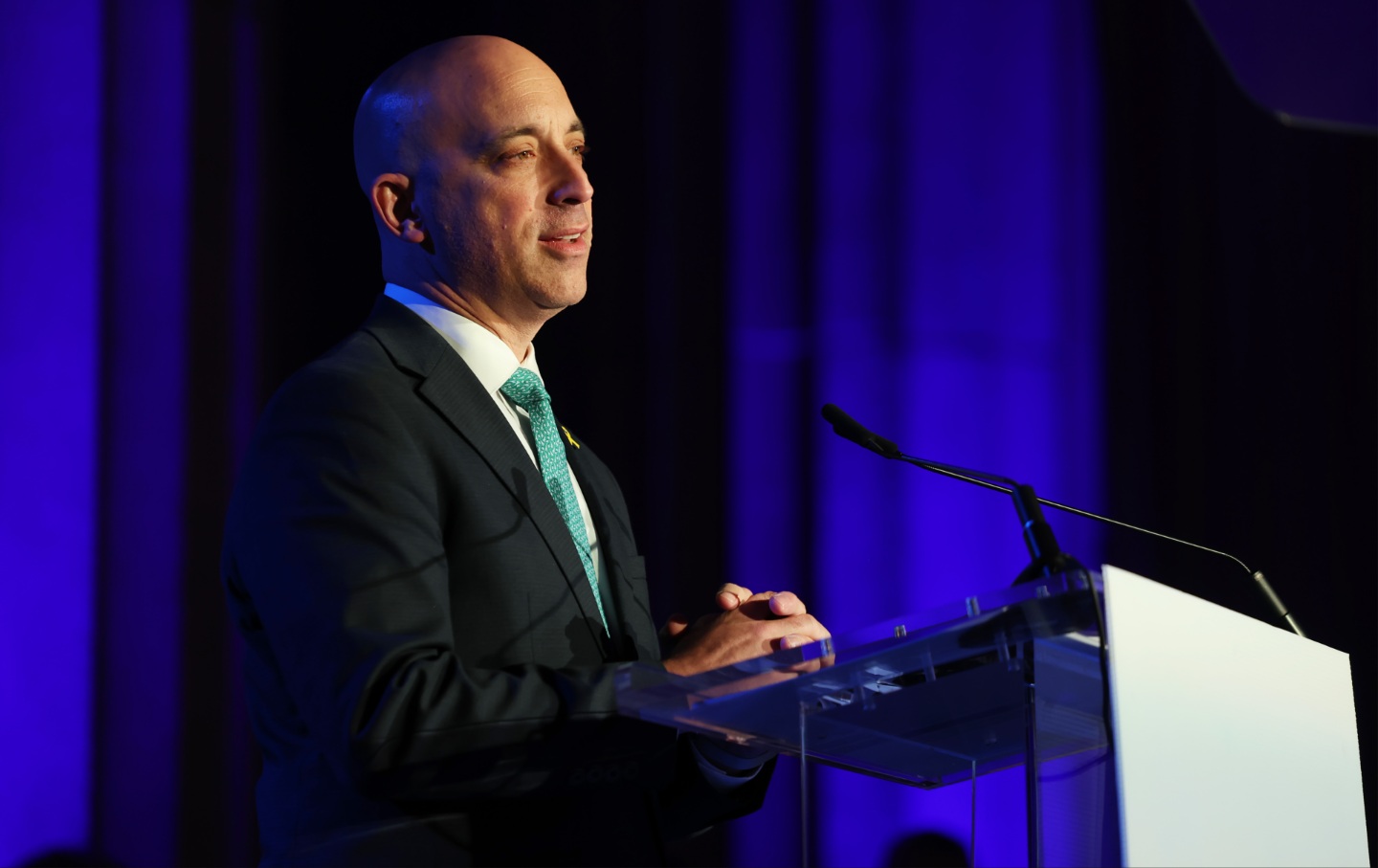
Anti-Defamation League CEO Jonathan Greenblatt.
(Tasos Katopodis / Getty Images for ADL)The University of Washington Jewish Alumni Association is a new kind of alumni group. It isn’t raising money or providing continuing education. It isn’t a social network of graduates, meeting up at sporting events or trading professional contacts. It is an advocacy organization—it even endorses political candidates—but it does not advocate on behalf of the university. Rather, it advocates for Israel, and it does so by attacking UW, where I teach. To join, interested recruits must provide their name, e-mail address, and answer “Are you a Zionist?” The options in the drop-down menu are “Hell yes,” “Of course,” “Maybe,” and “No.” Applicants must also provide a “reference for security verification.”
Unlike the university’s actual alumni association, established in 1889, the UWJAA formed just recently, in the summer of 2024—after the dismantling of the school’s Gaza Solidarity Encampment that spring and shortly before UW’s board of regents met to discuss an Israeli boycott and divestment proposal from student activists. To call the UWJAA an organization would be an overstatement. Its political activity—which mostly consists of backing MAGA-aligned Republicans and the Trump administration—would be prohibited if it were a formal alumni association of a public university. But of course it is not trying to be.
A scroll through the UWJAA’s X account reveals persistent attacks on university students and faculty. Those attacks often get attention. This past January, the group claimed that Aria Fani, an Iranian scholar critical of US and Israeli policy toward Iran, was “teaching party-line propaganda” and demanded his firing. Two months later, Fani was removed as director of the university’s Middle East Center after he shared further criticism of the United States, Israel, and Zionism on center listservs.
The UWJAA is a morbid symptom of a larger sickness in American political life—the same condition driving efforts like Canary Mission, the website that doxxes pro-Palestine faculty and students, and JewBelong, the too-clever-by-half billboard campaign by New Jersey marketers Archie Gottesman and Stacy Stuart. All of these groups are part of a constellation of largely secretive organizations using astroturfed pressure campaigns to drive a reactionary assault on pro-Palestine activism, higher education, free speech, and the left.
These efforts—which have been supercharged by the surge of pro-Palestine activism in response to Israel’s genocide in Gaza—fuse the historically antisemitic conspiracism of the American far right with the panicked but aggressive militancy of reactionary Zionism. Together, these forces make up a kind of modern-day John Birch Society with Zionist characteristics. I call it the Jonah Birch Society.
Like the original John Birch Society, the Jonah Birchers live in a universe of constant, impending doom, where every institution is secretly colluding with or under the spell of an all-powerful enemy that threatens the foundations of the United States itself (and Israel). But where once fringe cold warriors saw communism around every corner, today’s delusional conspiracists are reordering the world with similar zeal against an all-pervasive antisemitism they use to tarnish anyone to their left. And like the first Birchers, the Jonah Birchers are backed by deep-pocketed donors who appeal to a frightful and often suburban common sense. Theirs is a culture war in the purest sense, waged primarily through media aimed to keep their supporters vigilant and their opponents afraid. The result is a blend of antisemitic assaults on the left and the public good, which is presented as a necessary defense of Jews—even and especially against Jewish critics, whom Jonah Birchers deride as “Kapos” or “As-a-Jew Jews.”
Even while the Jonah Birchers take advantage of modern-day technology—Canary Mission, for instance, connects Jewish-American donors to a transatlantic network of operatives on behalf of Israel—their core playbook is boringly old-fashioned. As Matthew Dallek describes in Birchers: How the John Birch Society Radicalized the American Right, the John Birch Society was a social movement focused not just on policy but on politics too. Birchers used lectures, media, and connections to police to turn nonsensical delusions into a national common sense. One of the organization’s favorite tactics, in fact, was to put up billboards—most notoriously, one of Martin Luther King Jr. at Highlander Folk School, or what the Birchers called a “communist training school.” Decades later, JewBelong also puts up billboards, emblazoned with trollish lines like, “You don’t have to go to law school to know that anti-Zionism is antisemitism,” and “Remember when college was for losing your virginity, not your mind?” (JewBelong’s only real addition to the conspiracist repertoire is to make the billboards hot pink.)
Dallek notes that Birchers were particularly adept in “their ability to weaponize defeat” in “what they described as an end times contest for the very soul of the United States.” Thus, they were able to recruit new members even while losing many of their policy objectives. Immigration quotas fell around the time civil rights were enshrined in law, and the all-encompassing need to root out communism lost its sting with the fall of the Berlin Wall and Soviet Union. Yet the John Birch Society not only marched on but worked its way deeper into the heart of contemporary Republican politics by insisting that its vigilance was the only thing preventing civilizational collapse.
While the original John Birch Society diffused its ideology from one organization into the modern GOP through a combination of front groups and grassroots connections, the new Birchers are driven by a shared ideology that is already distributed across several organizations. Some, such as the Anti-Defamation League, which covertly spied on the John Birch Society in the 1960s in an attempt to take down the hate group, have public membership and government contracts. (As Emmaia Gelman shows in The Anti-Defamation League and the Racial State, the organization’s long-standing anticommunism paved the way for its contemporary obsession with anti-Zionism.) Yet the beating heart of Bircherism remains in the anonymous fringes where every criticism of US military funding to Israel or poll showing declining support for the Jewish state is proof of a vicious “blood libel” that heralds the next Hitler.
The John Birch Society said that even general turned president Dwight Eisenhower was a communist and it sought to impeach Earl Warren because of his support for civil rights. Its contemporary offspring have called, sometimes successfully, for the firing of university presidents and faculty, and for the suspension, blacklisting, or even deportation of student activists. Canary Mission played a key role in the arrests and attempted deportation of Palestinian student activists, and other Jonah Birch Society avatars have cheered the blacklisting, suspension, or firing of pro-Palestine students and endorsed other elements of Trump’s nativist border policy, in spirit if not in tone. Deborah Lipstadt, the Holocaust historian turned pundit and antisemitism envoy under Joe Biden, said that she is “not opposed to the administration rescinding the student visas of some of the people that they’re rescinding the student visas of. But I just think it should be done properly, according to the laws of the country.”
The John Birch Society won by losing: Mocked as fringe, its steady presence at the suburban grassroots nevertheless ensured that its hyper-capitalist, Christian-nationalist, paranoid worldview would maintain a steady foothold in Republican politics. Yet, unlike the original Birchers, the contemporary equivalent has been eagerly welcomed into the top echelons of power. Their cynical and increasingly unmoored claim to be fighting antisemitism has led many leaders of universities, civil and religious institutions, and politics to tolerate Bircherite antics.
The University of Washington, for instance, has stayed silent on the dubious origins and harassing tactics of the UWJAA and has thus far allowed a parallel effort, UW Bridges for Change, to present itself as a legitimate university enterprise for confronting antisemitism, complete with university branding and address. But the latter group is run by people with no scholarly expertise on antisemitism—it is led by an epidemiologist who has recommended that Israel-advocacy groups help set university policy on antisemitism and boasts of faculty members from “Medicine, Public Health, Law, Business, and more”—and operates in partnership with the UWJAA to host speakers who extol Zionism, denigrate student activism, and criticize the American university as an engine of antisemitism. Other universities have greenlighted the development of ideologically motivated “antisemitism centers” that similarly lack any connection to scholarship on the topic but serve right-wing ideological ends.
The Jonah Birch Society rules through a mix of intimidation and buy-in from powerful figures. The fear of federal investigations, pulled funding, or lost accreditation has made most university leaders unwilling to uphold their educational mission, while decades of Zionist orthodoxy has muddled the concept of antisemitism in American politics. Institutions that have fallen under the sway of the Jonah Birch Society, from universities to religious institutions to the American political establishment itself, are in crisis. Capitulation to Bircherite attacks has emboldened, not lessened, their severity.
Popular
“swipe left below to view more authors”Swipe →Yet if the original Birchers won by losing, it’s possible that their present-day adherents might lose by winning. Young Americans are pulling away from Israel in record numbers. Nearly half of Jewish Americans under 35 support a binational state in Israel, making them functionally opposed to Zionism. Nascent efforts such as the Emergency Campaign to Support Higher Education and the National Campus Jewish Alliance join long-standing organizations like the American Association of University Professors in upholding free expression, critical inquiry, and multiracial democracy. The defensive efforts to protect faculty, students, and staff from the baseless harassment of the Jonah Birch Society is part of broader effort to rescue universities from decades of austerity and administrative bloat—an effort to secure a “New Deal for Higher Education.”
These efforts have precious few allies in the ranks of university administrators. But they may be the best hope for saving the American university. For what the now-defunct Southwest Jewish Press observed in 1964 remains no less true today: “You can’t talk to a Bircher.” You’ve got to defeat him.
Become a Sustaining Donor This September
Between the reemergence of right-wing red-baiting and Donald Trump’s use of the chilling National Security Presidential Memorandum–7 to criminalize left political organizing, we’re seeing McCarthyism reborn before our eyes.
This assault on democracy cannot be ignored or wished away. Resisting it requires bravery in the face of threats and repression, a steadfast commitment to the truth, and the unwavering belief that we can—and will—overcome this darkness.
We must have an independent media that sets the record straight, unearths corruption and abuses of power, and advances a politics of justice and dignity for all if we’re to win this fight.
That’s why I’m writing to you today. This September, The Nation needs to add 100 monthly donors to sustain our progressive journalism. Your contribution makes the next investigative report, the next truth-speaking column, and the next pathbreaking essay all possible.
I hope you’ll support our work with a recurring donation today. If you donate $10 or more a month, we’ll send you a brand new “Hands Off the Free Press!” sticker to recognise your commitment to our cause. Please, donate today.
Onward,
Katrina vanden Heuvel
Editor and Publisher, The Nation
More from The Nation

When Texas Sex Ed Falls Short, Gen Z Women Turn to Social Media When Texas Sex Ed Falls Short, Gen Z Women Turn to Social Media
A 2025 study found that 70 percent of adolescents sought reproductive health information through social media platforms.

Justice for Macklemore Justice for Macklemore
The rapper has been dumped from Ed Sheeran’s tour for saying “free Palestine.” That’s a disgrace.

We Are Living Under Roy Cohnian Logic We Are Living Under Roy Cohnian Logic
The political fixer created a career for himself as a self-promoting, ubiquitous hustler. Like Trump, he got away with it by having the right friends.

Time Has Run Out for AI Risk Deniers Time Has Run Out for AI Risk Deniers
The recent spate of reports about the technology’s destructive power underline two prime directives: Be afraid, and regulate aggressively.
Yale’s President Has Become a Shameful Collaborator With Trump Yale’s President Has Become a Shameful Collaborator With Trump
Maurie McInnis has the power to stand up to the administration. Instead, she’s caving.

The Fissures and Fractures Behind the Right’s Pink Facade The Fissures and Fractures Behind the Right’s Pink Facade
After Roe was overturned, some young women are turning more hard-line on abortion—but others are fleeing conservatism altogether.

