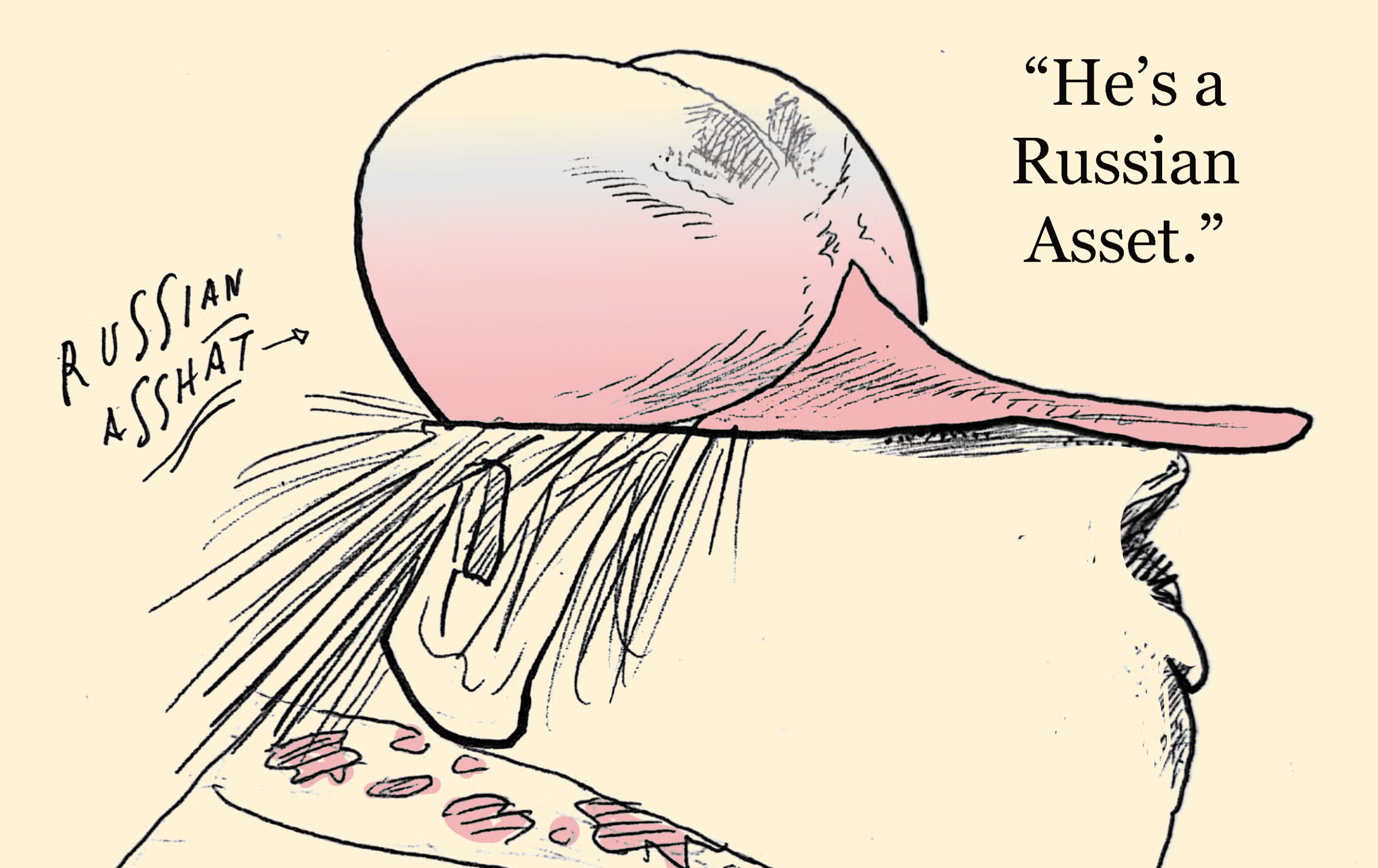
Donald Trump Has Lost It
At one of his final midterm rallies, the president showed just what a spent political force he has become—and what little grip on reality he still has.
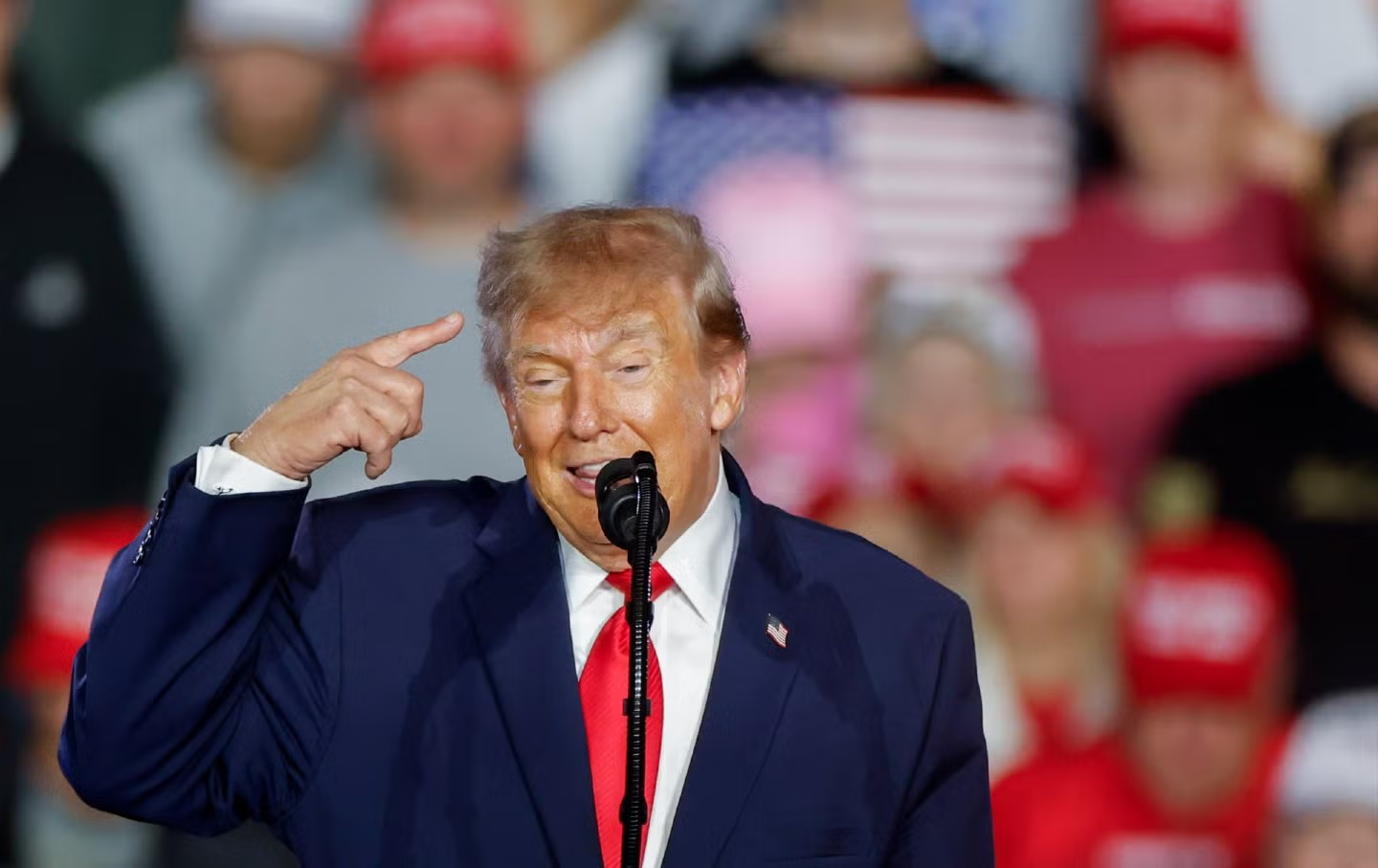
US President Donald Trump speaks during a campaign event in Dubuque, Iowa, US, on Sunday, Nov. 1, 2026.
(Kamil Krzaczynski / Bloomberg via Getty Images)
DUBUQUE, IOWA—“It’s pure fricking genius.”
Donald Trump was, of course, describing himself—or rather his rhetorical stump style, which had been trained on the crowd of MAGA faithful assembled here at Dubuque’s Five Flags Center for more than an hour. He’d been complaining about how his wife Melania wants him to be less demonstrative at the rally podium—less dancing, no more impersonations of female weightlifters getting bested by transgender competitors. The First Lady, Trump protested, wants him to be “more presidential,” which prompted him to do an impersonation of a typical campaign stiff: “Ladies and gentlemen of Iowa, it is a great honor to be with you this evening.” (The impression came across a good deal like House Speaker Mike Johnson, who did a cameo turn at the podium during Trump’s performance.)
Trump then gleefully went through a series of weird angular gesticulations to simulate his slantwise narrative style—the string of non sequitur grievances and resentful old-rich-guy refrains that he dubbed “the weave” during the 2024 campaign. But that descriptor has graduated, midway through his second term, into the work of a maestro.
This was one of the last Trump rallies in the 2026 midterm cycle—which is to say, one of the last Trump rallies we will ever need to care about, given that the president is hurtling towards lame-duck status. The president’s stylings on the stump had revolutionized American politics a decade ago. Now, like a good Midwest county fair touring band, Trump had revived many of his oldest MAGA hits. He laid into the “sick people” on the press risers at the back of the room, insisting that “they are the biggest threat to our country.” He railed against Abdul El-Sayed, the Democratic Senate nominee in Michigan, dubbing him a “jihadist” and “Communist” and proudly explaining why he’s repeatedly given his first name as “Mohammed.” (It’s something he does for “certain reasons,” he said, in a strained effort to make gutter bigotry sound somehow cagey, before gleefully announcing that he does it “because I’m the president.”) He lobbed kindred racist attacks against Minnesota Democratic Rep. Ilhan Omar, whom his Justice Department has targeted with a bogus authoritarian raid and investigation, as well as Somali immigrants; like any washed-up antiwoke comic, he said “I hope I don’t say anything too controversial” to set up his pet anti-Somali refrain: “We don’t want them here.” There were also extended riffs, even now, about Joe Biden’s cognitive failings, the de rigueur reminder that Trump has “aced” three cognitive exams himself, and some talk about Kamala Harris’ woeful turn as overseer of immigration policy at the White House—all key issues for him and essentially nobody else.
It was hard to see how any of this translates into fricking genius, though. I was in the upper levels of the stadium, and several of my seatmates were straining to make out just what Trump was talking about—especially when he went into digressive genius mode, dilating on optimal flagpole design and golf masters as models for political achievement (yes, really).
Last week, the GOP briefly canceled the rally in favor of a virtual gathering, which would ostensibly be a bigger draw (an objective that makes zero sense for an event meant to generate excitement and boost turnout for state and local politicians). Then, the party reversed course, perhaps understanding how weak the move would make Trump look. The Five Flags is a small facility—it boasts ads in the corridors for a February performance of a Pink Floyd Tribute band, “Think Floyd”—and it was reasonably full, despite the event’s bait-and-switch scheduling..
Trump came on stage 90 minutes late—long after all the GOP candidates in this suddenly purplish battleground state had delivered their own versions of the stiff-politician election-eve pitches. During the protracted stretch of dead air, the crowd began to get restive and bored; the playlist of classic rock standards began repeating, and at one point, people began swaying their phones in flashlight mode in time to Sinead O’Connor’s Nothing Compares 2 U—a singularly odd spectacle after the state’s gubernatorial GOP nominee, Zach Lahn, inveighed against the depraved and murderous character of liberal culture warfare; this was, after all, a performer best known for tearing a photo of the pope in half on live television. There was a palpable mood of the agitprop starting to lose interest in itself.
A very different brand of Kulturkampf was announced, in any event, ahead of Trump’s appearance. There was a video of white-jumpsuit Vegas-era Elvis—a performer the crowd had already heard at least a half-dozen times over on the soundtrack—delivering a demented medley of “Dixie” and “The Battle Hymn of the Republic.” Near the end of the mashup, the camera lingered uncomfortably on a Black flautist in the Elvis ensemble delivering the closing strains of “Dixie.” A nearby diehard MAGA supporter must have noted my goggle-eyed expression and volunteered, “That was really weird.”
Not as weird as the next video entry: the 2024 rally chestnut called “God Made Trump,” delivered as a riff on radio Paul Harvey’s address “God Made a Farmer,” but shot through with the militant messianic imagery of the New Apostolic Reformation. The video starts with an AI-manipulated version of Harvey’s voice announcing “On June 14, 1946, God looked down on his planned paradise and said, ‘I need a caretaker,’” and goes rapidly downhill from there, depicting Trump as an ax-wielding mortal foe of wolves, vipers,the deep state, and the fake news.
It all made for an abrupt shift of tone from the autopilot classic rock playlist, but it didn’t really come anywhere near a closing campaign argument. Iowa is facing many pressing economic and political challenges—from the soaring price of diesel and fertilizer in the wake of Trump’s war in Iran to overlapping crises in cancer and water quality to the declining standing of the state’s formerly distinguished public education system. Senate GOP nominee Ashley Hinson has belatedly positioned herself as an opponent of the Iran war, after voting in favor of it seven times in the House, in order to stay competitive with her upstart Democratic rival, state representative Josh Turek. Lahn has broken ranks with deregulatory Republican orthodoxy to demand investigations into the cancer and water crises.
Trump, not surprisingly, didn’t mention any of these problems, or GOP proposals to address them; his prescription for electoral victory in Iowa appeared to be Worship me harder. So he stayed firmly and gleefully within his comfort zone of deriding Democrats as “lunatics” hellbent on spreading communism and forcing sex changes on the children of unwitting God-fearing parents. He made desultory promises that gas prices would come down shortly after the midterms—presumably by resuming the same large-scale attacks on Iran that have already caused those prices to skyrocket while completely failing to defeat the Islamic Republic. He reprised his bribery pledge of $5,000 to every voter who will preserve and expand the GOP majorities in Congress. But he relied mostly on more video footage to drive home the theme of the GOP 2026 campaign: “craziness versus common sense.” One scattershot set of supercuts sought to dramatize the socialist orthodoxy and transgender fetishes of the Democrats, while another highlighted the alleged open border excesses of the Biden White House, and dwelled on the lurid details of murders and sexual attacks from undocumented immigrants. By the time the second video kicked in, people in my section and many on the main floor began to leave. They’d seen this show before—and besides, they could watch Fox News in the comfort of their home, without having to see Elvis hymn the Confederacy or Donald Trump cosplay as Jesus.