Trump and RFK Jr. Are Making Cancer Great Again
Public health funding cuts are risking the progress the nation has made in fighting and preventing many forms of the dreaded disease. But few people know it yet.
Trying to cover the news in Trump’s America is like trying to get work done in a sleazy, glitzy casino: It’s beyond overstimulating. You can hear the clatter of billionaires getting richer on government slot machines, while the stock market roulette wheel spins and the DOGE boys toss dice at the craps table to decide what to cut and whose data to breach. There are lounge acts, like Homeland Security Secretary Kristi Noem’s recent torture porn, and the stylings of President Trump himself, only this week talking about asking freed Israeli hostages if their Hamas captors “showed them ‘any kind of love’ or even ‘a meal on the side…like what happened in Germany?’” Meanwhile, casino manager John Roberts tries to spot bad behavior from a balcony above the floor, and (intentionally?) misses a lot of it.
We are all trying to make sense of all the nonsense, but it’s almost impossible. At least a writer can choose one thing to focus on, unlike my friends on cable networks, and today, I’m choosing cancer.
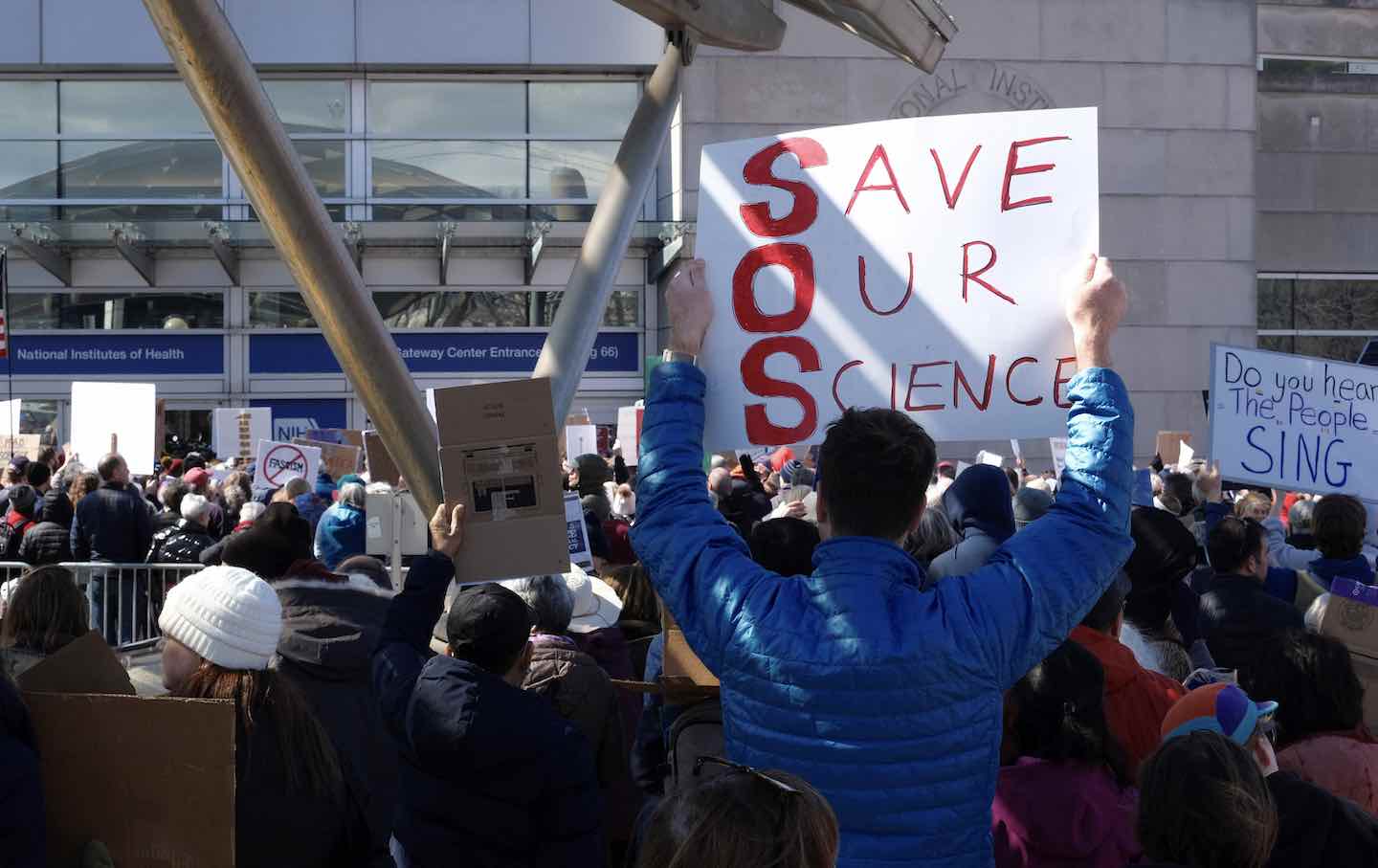
Amid all of the news about tariffs and federal staffing cuts and deep corruption, it’s easy to look past things like the big National Institutes of Health cuts. But the harm from these cuts will, sadly, outlast so many of us. The NIH, which has fired a reported 1,200 staffers under DOGE orders, is the largest funder of cancer research, annually providing about $8 billion in cancer science funding. Scientists, doctors, and advocacy groups are terrified, but so far public reaction is muffled.
“The White House and DOGE have entered the war on cancer,” Talking Points Memo editor Josh Marshall wrote on Sunday, “on the side of cancer.”
Last week CBS News reported on a stage IV colorectal cancer patient who qualified to enter a clinical trial “that was going to be her last-chance effort to slow the spread of her cancer,” Anjee Davis of Fight Colorectal Cancer told the network. “Her trial was about to start when NIH funding was pulled overnight, and the trial was canceled,” she said. “That’s just one example. There are countless others.”
Researchers worry that clinical trials already underway will be paused or stopped entirely by funding freezes and outright cuts.
Cancer and other healthcare researchers say that grants have been held up by bizarre edicts that prevent grantees from communicating directly with NIH staff. Committees that oversee such research have been stalled, by similar communications edicts. Meetings are mysteriously canceled. The Cancer Therapy Advisor, an online resource and quarterly publication mainly for chemotherapy professionals, reports that 6,800 fewer NIH grants have been awarded than at this time last year—a difference of nearly $2 billion.
The problem isn’t just NIH cuts. The White House’s war on leading research institutions like Columbia University has resulted in millions of dollars of cuts. The Columbia-affiliated Herbert Irving Comprehensive Cancer Center saw $5 million in losses. Meanwhile, Pentagon cuts are closing Defense Department centers dedicated to cancer research—the GOP Congress gets an assist there, because the budget it just passed took specific aim at the cancer programs. In March, Trump honored a young brain cancer survivor at his address to Congress; NIH budget cuts so far stalled by a court would slash funding for the doctors and the treatment center that saved the boy’s life.
Health and Human Services Secretary Robert F. Kennedy Jr. has said nothing about the cuts. Instead, in March he directed the NIH’s National Cancer Institute to flag for review any publications or manuscripts dealing with 23 “controversial” topics including “vaccines, fluoride, peanut allergies, autism,” according to ProPublica. On Monday, he told the Centers for Disease Control and Prevention to stop recommending fluoride in water systems, which has been a pillar of public health policy for decades. “We will have a lot more people with dental disease than we have now, a lot more dental caries, or cavities,” doctor and University of California–Berkeley’s John Swartzberg told The Washington Post. “It’ll impact everybody, but mostly those people who do not have access to dental care.”
Josh Marshall makes the excellent point that the world of cancer patients and their families is dense with networks of mutual support and may reach people who aren’t on progressives’ e-mail lists. “There are pre-existing networks and communities of concern waiting to hear this urgent message and they are, at present, not hearing it,” he wrote.
These people, mobilized, could make the next “Hands Off” protest twice as big. But the first task is getting the information in front of them. Hats off to the media organizations doing that.