
Trans Healthcare Is Under Siege. These People Are Fighting Back.
A nonprofit is trying to get the FDA to approve crucial methods of gender-affirming care. Its battle will be even more important in Trump’s second term.

Hundreds of trans men and women, activists and supporters rally outside the Supreme Court Building in Washington, DC, on December 4, 2024.
(Marvin Joseph / The Washington Post via Getty Images)In the 26 US states where gender-affirming care for young people has been criminalized, trans+ individuals are forced to work around the law, or submit to medical detransition. Families have been separated, as loved ones move to states where their healthcare is still legal. These sanctioned attacks on an entire community’s health, fueled by manufactured suspicions of a youth-corrupting trans “agenda,” go increasingly unopposed by legal systems, medical organizations, and the public.
The Research Institute for Gender Therapeutics (RIGT), a nonprofit group, is pushing back on the medical front. It’s seeking FDA authorization for trans+ pharmaceutical treatments as a means of defense against anti-trans laws. Its work has just begun, but it’s already gaining ground.
After RIGT proposed a study to gain formal approval of estradiol (a type of estrogen) as a feminizing agent, the FDA responded with detailed feedback on how to make that a reality, marking a major step on the road towards a series of firsts for the trans+ community. Despite estradiol’s being widely prescribed as a gender-affirming treatment, this use has yet to gain FDA approval. But the agency has officially recognized the need for a treatment development program, and trials for estradiol have been approved.
Trans+ people are currently using estradiol, testosterone, and medicines used as antiandrogens or hormone blockers off-label. While it is a common practice within the medical community, FDA approval will provide clear guidance to medical professionals in treating gender incongruence, and alleviate fear of potential risks behind unapproved uses for medication.
“The lack of registrational-quality clinical studies and associated FDA approval is frequently cited by proponents of anti-trans legislation as a basis to ban or restrict care,” RIGT cofounder Brad Sippy said.
Sippy’s fellow cofounder Nicole LaRocque added, “These legislative efforts intervene between doctors and patients, criminalize care, and increase negative outcomes, minority stress, and stigma for this marginalized population.”
Responsible, trustworthy research confirms time and again that the most effective treatment for gender incongruence is to pursue transition. Trans+ people who are validated and supported in their identities and medical needs largely see their physical and mental health improve.
It’s no reach to say that gender-affirming care has bettered many lives. Showing the community they’re seen for who they are, through treatment that affirms and helps manifest the internal reality of their gender, can make all the difference—even in the face of transphobia, whether within or beyond medical spaces.
Reading the evidence, it’s clear that bans on gender care put more people’s health in danger than medically upheld gender-affirming hormone therapy (GAHT) ever could. The number of people affected is only growing, as more of the US and global populations publicly identify as transgender, nonbinary, or otherwise nonconforming to the sex they were assigned at birth.
Even so, it seems the introduction of new forms of GAHT—developed, tested, and intended for that purpose—is essential to its defense against detractors emboldened by false information. FDA approval could protect access to GAHT by scientifically verifying its safety, and eliminating a key dog whistle in its mainstream media denouncement and government sabotage.
Founded in 2023, RIGT is a response to gender-affirming care’s urgent vulnerability to state law restrictions, founded by parents and families. In 2021, Arkansas became the first state to pass a law banning gender care for minors. Though the law was struck down by a federal judge the year RIGT was established, it led to the wave of laws that now make around half of the country statutorily unsafe for trans+ people and those who would support them.
“The founders were concerned about the medical and social discrimination their loved ones and other gender diverse individuals face, discrimination which often relies on the lack of FDA approval for gender-affirming therapies,” Sippy said.
The distance the organization has already come is proof of the power cisgender allies have to make positive change. As RIGT’s director of communications, Leo Caldwell encourages others to speak up. “When you see legislation, policies, or anything related to the trans community that seems off—use your voice. When cis people hear other cis people stick up for trans folks, it has a huge impact.”
Along with bringing together world-renowned experts in gender care and drug development in the drive for FDA approval, RIGT hopes to “advocate for the equitable treatment of gender diverse individuals in general clinical research and standard medical practice.”
Popular
“swipe left below to view more authors”Swipe →Unlike some more vocal cultural touchstones for LGBTQIA+ advocacy, such as the public demonstrations of ACT UP to raise awareness of AIDS, RIGT prioritizes quietly doing the work. While it gathers funding for its estradiol development program, it’s backing the greater inclusion of trans and gender-diverse people in all clinical trials, not just those pertaining to gender-affirming care.
Trans+ people’s inadequate representation in clinical research overlooks the fact they have above-average experiences of anxiety and depression, as well as higher rates of chronic illness and disabilities. Without research acknowledging these experiential overlaps and welcoming exploration, it may never be medically recognized that gender-nonconforming people need intentional, inclusive provision throughout healthcare systems. While such basic rights to physical, mental, and emotional wellness are ignored, the impacts of prejudice cannot be healed.
If FDA approval is won for all treatments, the RIGT then plans to publish its research, working with experts in the medical community to update treatment guidelines. Collaborations like these would encourage changes to medical education that reflect the distinct experiences of trans+ people, and their right to fully inclusive care.
The political climate in which this will happen has changed drastically. Donald Trump has promised nationwide bans on gender-affirming care, and erasure of all programmed trans+ recognition, from day one of his second term. Some Democrats have been misguidedly blaming trans “pandering” for Kamala Harris’s loss, sparking arguments over whether the party should stop advocating for trans women and girls in sports. Terry Schilling, leader of the anti-LGBTQ American Principles Project, has admitted that the “women’s sports” matter was merely a gateway to broader public anti-trans dialogue, intended to make “opponents of the LGBT movement comfortable with talking about transgender issues.” Democrats’ dropping their stance against trans sports bans could easily pave the way for broader crackdowns.
But despite the political uproar, Sippy says, “RIGT is a medical research organization and was established to be administration agnostic. Like the FDA, RIGT is an organization grounded in science. We will conduct our programs consistent with FDA’s feedback and the standards of medical care for gender-diverse populations, as endorsed by the American Medical Association and the Endocrine Society.”
The sheer number of US states banning gender-affirming care and Trump’s threat to take prohibition nationwide have made this a matter of emergency. But the FDA’s positive reception to RIGT’s proposals proves there are still ways to defend the basic human rights of dignity and autonomy.
Support independent journalism that does not fall in line
Even before February 28, the reasons for Donald Trump’s imploding approval rating were abundantly clear: untrammeled corruption and personal enrichment to the tune of billions of dollars during an affordability crisis, a foreign policy guided only by his own derelict sense of morality, and the deployment of a murderous campaign of occupation, detention, and deportation on American streets.
Now an undeclared, unauthorized, unpopular, and unconstitutional war of aggression against Iran has spread like wildfire through the region and into Europe. A new “forever war”—with an ever-increasing likelihood of American troops on the ground—may very well be upon us.
As we’ve seen over and over, this administration uses lies, misdirection, and attempts to flood the zone to justify its abuses of power at home and abroad. Just as Trump, Marco Rubio, and Pete Hegseth offer erratic and contradictory rationales for the attacks on Iran, the administration is also spreading the lie that the upcoming midterm elections are under threat from noncitizens on voter rolls. When these lies go unchecked, they become the basis for further authoritarian encroachment and war.
In these dark times, independent journalism is uniquely able to uncover the falsehoods that threaten our republic—and civilians around the world—and shine a bright light on the truth.
The Nation’s experienced team of writers, editors, and fact-checkers understands the scale of what we’re up against and the urgency with which we have to act. That’s why we’re publishing critical reporting and analysis of the war on Iran, ICE violence at home, new forms of voter suppression emerging in the courts, and much more.
But this journalism is possible only with your support.
This March, The Nation needs to raise $50,000 to ensure that we have the resources for reporting and analysis that sets the record straight and empowers people of conscience to organize. Will you donate today?
More from The Nation

In Memoriam: the Rev. Jesse Jackson (1941–2026) In Memoriam: the Rev. Jesse Jackson (1941–2026)
The civil-rights activist and founder of the Rainbow PUSH Coalition changed what’s possible in politics.

The Real Reason Americans Love Guns The Real Reason Americans Love Guns
With a weak social safety net, a gun offers a false sense of personal power and security.

The Endless Hypocrisy of Bari Weiss The Endless Hypocrisy of Bari Weiss
She claims to be a free speech champion. But as her actions at CBS News keep showing, she seems to think free speech should run only in a rightward direction.
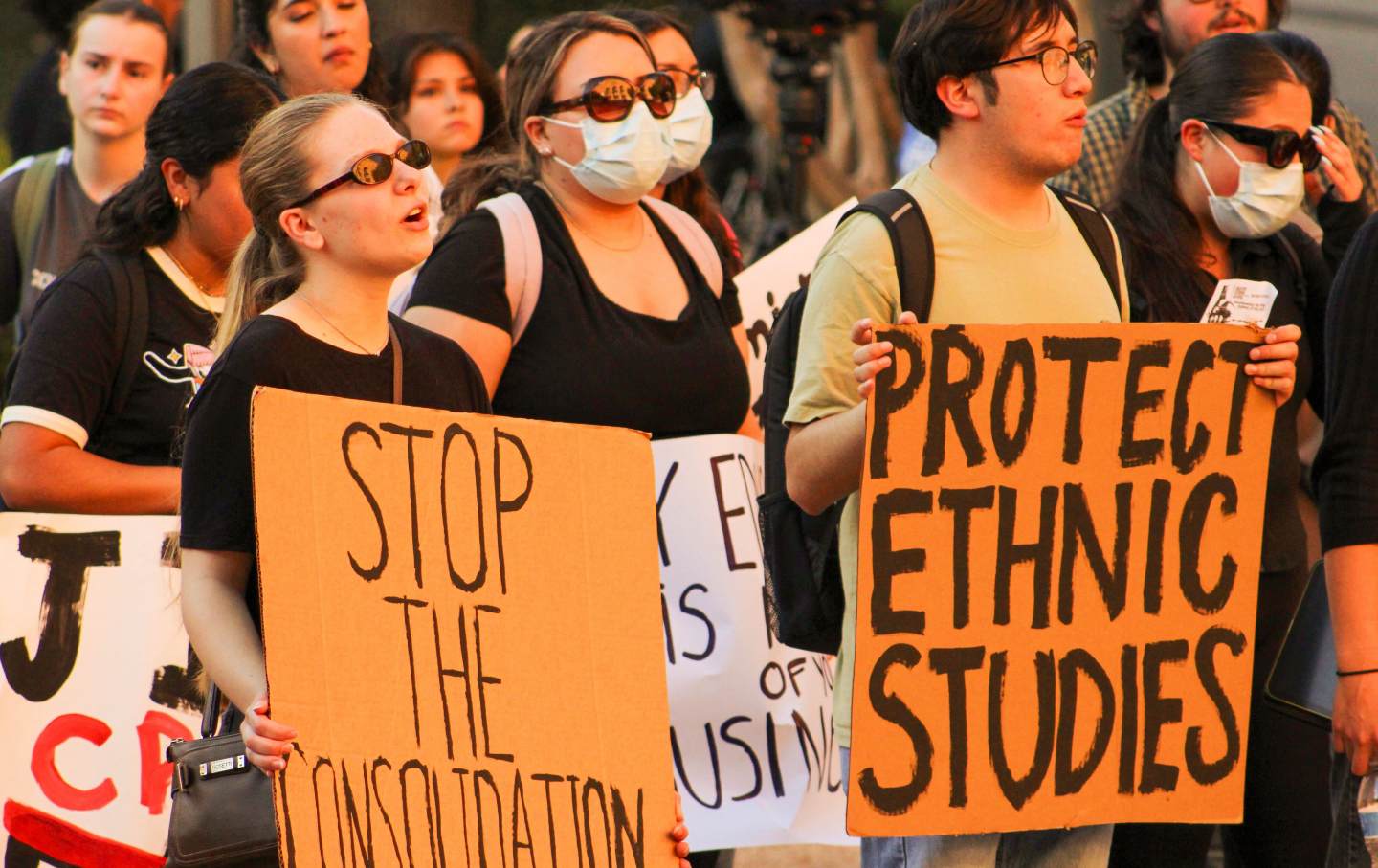
What Will Be Left After the University of Texas Destroys Itself? What Will Be Left After the University of Texas Destroys Itself?
UT-Austin has collapsed its race, ethnic, and gender studies into a single program while a new policy asks faculty to avoid “controversial” topics. But the attacks won’t end there...

The Corporate Media Is Head Over Heels for the Iran War The Corporate Media Is Head Over Heels for the Iran War
Donald Trump’s attack may be surreal, unjustified, and illegal. But that’s not stopping the press from turning the propaganda dial way up.

The Disturbing History of ICE’s “Death Cards” The Disturbing History of ICE’s “Death Cards”
The Vietnam-era practice is yet another example of ICE agents thrilling to the brutality they have been encouraged to cultivate.

