How New Title IX Rules Leave Sexual Assault Survivors in the Lurch
The Biden administration’s updates to the regulations have laudable aims, but one blind spot leaves victims vulnerable to retaliatory lawsuits.
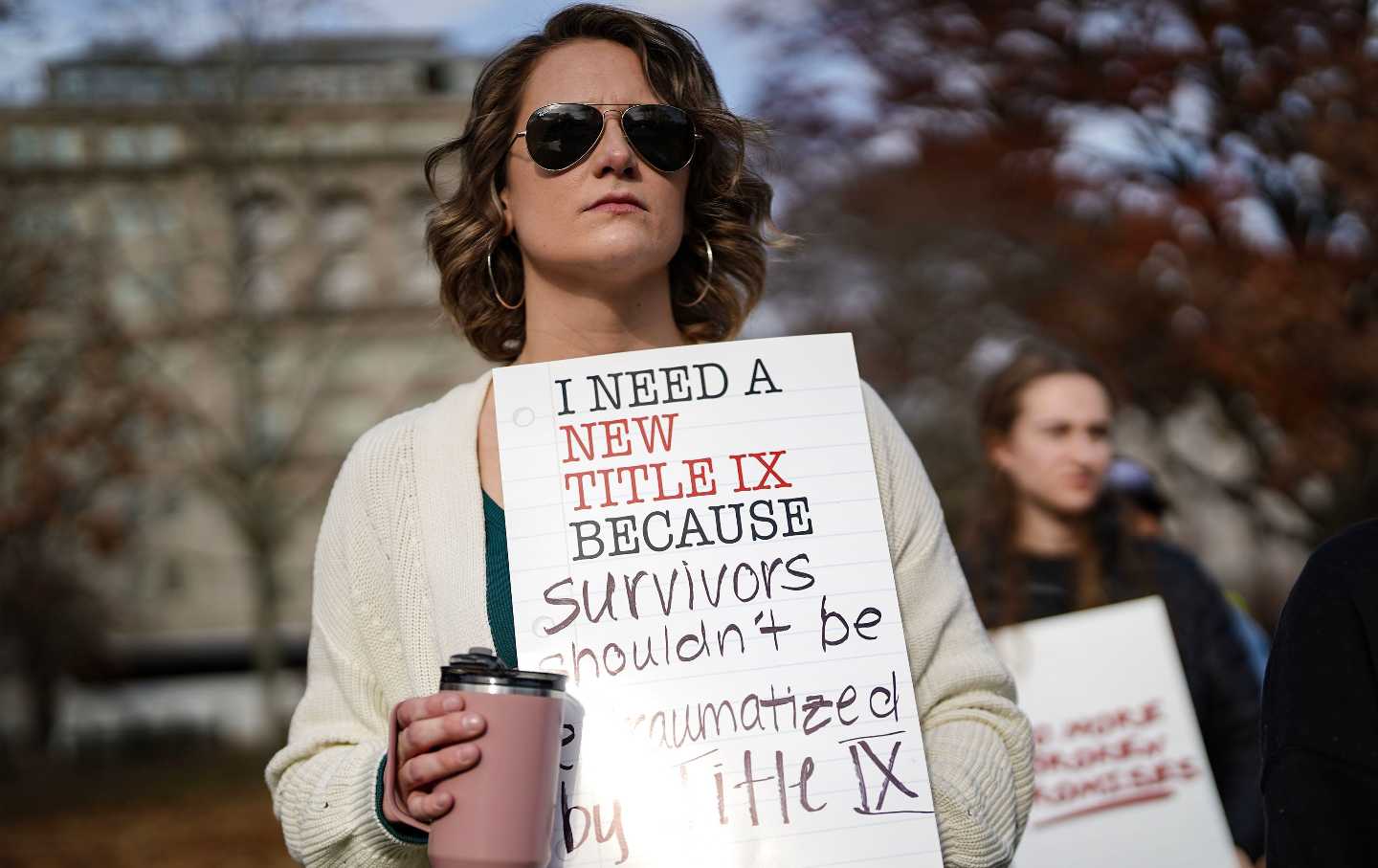
On Friday, the Biden administration finalized updates to Title IX, a civil rights law that bans sex discrimination in schools that receive federal funding and outlines how schools must adjudicate sex discrimination and abuse complaints. The political debate around the changes has focused largely on the issue of gender identity, which the amended regulations now clarify is a protected category. But public debate over the new rules has largely overlooked a key question in Title IX enforcement: Should schools require live cross-examination of victims who come forward with sexual assault complaints?
The new Biden rules have modified the protocols governing assault testimony in line with trauma-informed models of cross-examination—yet they remain woefully silent on the growing legal backlash against victims of sexual assault who testify. In 2021, United Nations Special Rapporteur for Freedom of Opinion and Expression Irene Khan noted that women who publicly make accusations of sexual violence “are increasingly subject to defamation suits or charged with criminal libel or the false reporting of crimes.”
To understand the full repercussions of the failure to address this issue, it’s important to revisit the difficulties survivors face in providing testimony in sexual assault cases. The US legal system has always assumed that cross-examination of a witness is the most effective tool for revealing false accusations. But scientific research shows that this is simply not true in situations where the witness has suffered a trauma. Numerous studies show that many victims of sexual abuse experience hyperarousal and emotional flooding as they face their assailants—and the impact of these recurring trauma symptoms often make them appear less credible than they in fact are. So a paradox exists at the heart of Title IX sexual assault proceedings: Here, cross-examination ill serves the fundamental mandate of truth-seeking in legal inquiries. Because cross-examination can trigger a traumatic response, it potentially hinders the search for truth.
Friday’s revised Title IX regulations, at least in part, attempt to address this nuance. Under section 106.46(g) of the revised rules, each party is allowed the option to appear in separate rooms, using technology like speakerphones and listening devices. The regulations also prohibit cross-examination questions “that are unclear or harassing of the party being questioned” (§ 106.46(f)(3)). So, unlike the 2020 Title IX regulations proposed by Trump’s secretary of education, Betsy DeVos, postsecondary schools are no longer required to permit a live hearing with in-person cross-examination for all sexual harassment complaints.
At first glance, this aspect of the new regulations appears to be trauma-informed and capable of advancing the laudable aim of shielding victims from abusive or traumatizing cross-examinations. However, a closer look reveals that the regulations suffer from a damaging omission: They do nothing to counter the growing threat of defamation actions against Title IX complainants who give evidence under this modified form of cross-examination.
This is not by any means a hypothetical or abstract threat. In June, the Connecticut Supreme Court ruled 7-0 that former Yale student Jane Doe could be sued for defamation by her assailant, Saifullah Khan. Doe had testified about her assault before Yale administrators in a Title IX proceeding that used the modified cross-examination techniques bolstered by the new Biden regulations. Although survivors are granted immunity against defamation claims for analogous allegations made in criminal prosecutions, the Connecticut court ruled that no such immunity applies to a survivor’s Title IX accusations if the accused was not provided a right to traditional cross-examination.
That’s the reasoning Khan pursued when he filed his defamation suit; his legal team contended that because Yale’s Title IX process was only “quasi-judicial”—in other words, it did not allow Khan to directly cross-examine Doe—her allegations didn’t qualify for legal immunity.
Khan v. Doe is poised to be the first in a wave of defamation suits that target sexual assault victims in secondary schools and college campuses. In September, the Colorado Court of Appeals applied the same reasoning to a Title IX case brought by Benjamin Gonzales, a student at Evergreen High School in Jefferson, Colorado. Like Khan, Gonzales claimed his right to sue his alleged victims and their mothers for defamation since Evergreen’s Title IX process didn’t allow for in-person cross-examination. And according to a survey by Know Your IX, a survivor justice legal advocacy group that supports students, 23 percent of student survivors who reported their assaults said either the person they accused of assault or that person’s attorney threatened to sue them for defamation. Nineteen percent said they were warned by their school of the possibility of a defamation suit, and 10 percent have faced “retaliatory complaints” filed by their assailants. All of this has an inevitable and substantial chilling effect on victims, who can no longer feel empowered to seek safety, justice, and access to equal education.
The short-term impact of the new Biden rules will deliver much-needed support to sexual assault victims who are vulnerable to retraumatization as they give evidence for their claims. But without the added assurance that their testimony is immune from retaliatory defamation actions, the longer-term effects of the new policy could prove catastrophic. It is long past time for the legal system to acknowledge the simple truth that in-person cross-examination undermines the goal of establishing the factual record in cases of sexual assault. For the Biden regulations to act as the trauma-informed guidelines they aspire to be, we need companion laws to prevent devastating future lawsuits that will silence victims.
Support independent journalism that does not fall in line
Even before February 28, the reasons for Donald Trump’s imploding approval rating were abundantly clear: untrammeled corruption and personal enrichment to the tune of billions of dollars during an affordability crisis, a foreign policy guided only by his own derelict sense of morality, and the deployment of a murderous campaign of occupation, detention, and deportation on American streets.
Now an undeclared, unauthorized, unpopular, and unconstitutional war of aggression against Iran has spread like wildfire through the region and into Europe. A new “forever war”—with an ever-increasing likelihood of American troops on the ground—may very well be upon us.
As we’ve seen over and over, this administration uses lies, misdirection, and attempts to flood the zone to justify its abuses of power at home and abroad. Just as Trump, Marco Rubio, and Pete Hegseth offer erratic and contradictory rationales for the attacks on Iran, the administration is also spreading the lie that the upcoming midterm elections are under threat from noncitizens on voter rolls. When these lies go unchecked, they become the basis for further authoritarian encroachment and war.
In these dark times, independent journalism is uniquely able to uncover the falsehoods that threaten our republic—and civilians around the world—and shine a bright light on the truth.
The Nation’s experienced team of writers, editors, and fact-checkers understands the scale of what we’re up against and the urgency with which we have to act. That’s why we’re publishing critical reporting and analysis of the war on Iran, ICE violence at home, new forms of voter suppression emerging in the courts, and much more.
But this journalism is possible only with your support.
This March, The Nation needs to raise $50,000 to ensure that we have the resources for reporting and analysis that sets the record straight and empowers people of conscience to organize. Will you donate today?