
The Musicians Taking the Fight for Trans Lives to Church
The story behind Trans Requiem.
The Musicians Taking the Fight for Trans Lives to Church
The story behind “Trans Requiem.”
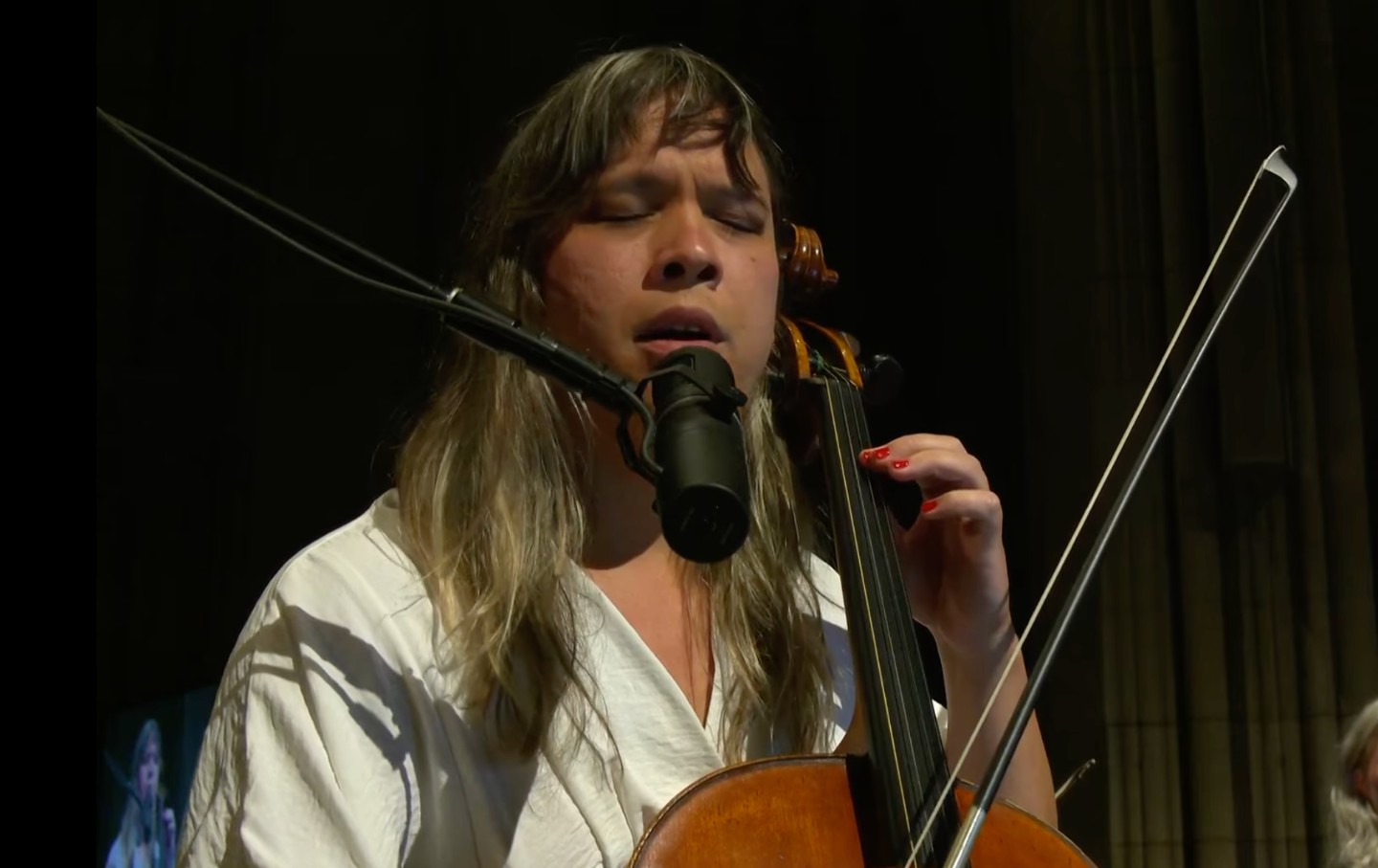
Andrew Yee performing at the premiere of Trans Requiem at NYC’s Trinity Church on September 18, 2025.
(Trinity Church / YouTube)In the moments before the September premiere of composer-cellist Andrew Yee’s Trans Requiem (a recording of which was just released on New Amsterdam Records), the sanctuary of New York City’s Trinity Church was resonant with tuning instruments—interspersed with a beeping metal detector. That sound felt, to me, like a reminder both of relative safety and potential danger.
Earlier, when I arrived at the church, I had felt relieved to see no protesters. But then I felt silly. Surely, I thought, a classical concert would be niche enough to go under the radar. Still, I reminded myself, this was a large gathering centering trans experience in a place of worship. With each beep, I couldn’t help but imagine the worst: What if someone had a weapon?
I wish I could say that, with the first chords of Trans Requiem, these anxieties dissipated. But that wouldn’t be entirely true. Trans Requiem doesn’t distract from current realities. It mourns them in real time.
A requiem is traditionally a musical setting of the Catholic funeral mass. However, Yee considers Trans Requiem to be “more of a secular-style mass, even though the location is in a church.” Nevertheless, she said, “if people want to accept this mass in a religious manner, they’re welcome.”
Considering the fraught relationship that the trans community often has with Christian institutions, it is especially moving that Trinity Wall Street commissioned Trans Requiem. Before the September concert, Trinity vicar Michael Bird said that he has many times been asked why an Episcopal church would put on such a piece, to which he always replied, “How could we not?”
Yee’s Requiem is scored for string orchestra, choir, and two vocal soloists, in this case, soprano Breanna Sinclairé and tenor Katherine Goforth—both trans women, “one with a high voice and one with a lower voice,” said Yee.
At the September performance, two cello sections sat on either side of the stage, an arrangement that produced a dark, bass-heavy sound in contrast to the silvery voices in the choir. Yee led from one of the cello sections, providing back-up for conductor Melissa Attebury.
Yee, who is the founding cellist of the Attacca Quartet, turned to composition relatively recently. Two years ago, the Queer Urban Orchestra premiered Yee’s Briefly Gorgeous for chamber orchestra, based on the novel by Ocean Vuong. More recently, Or, The Whale, a co-composition with Caroline Shaw based on Herman Melville’s Moby-Dick, was released on Platoon. At around 40 minutes, Trans Requiem is Yee’s most ambitious work to date.
It is especially ambitious considering that, by writing a requiem, Yee situates herself in terms of a canon that includes Wolfgang Amadeus Mozart, Giuseppe Verdi, Johannes Brahms, Gabriel Fauré, and Benjamin Britten.
In terms of other requiems, Yee feels most connected to Brahms’s A German Requiem, which Brahms once said could have easily been titled “a human requiem” because of its universality. But Brahms’s Requiem was also deeply personal, written after the death of his mother and of his mentor Robert Schumann. Handpicking from the Lutheran Bible, Brahms created a text in vernacular German that remained spiritual but didn’t mention an afterlife, instead providing solace for the living.
“I don’t want to compare my piece to his,” said Yee, “but in the same way that Brahms wrote A German Requiem, this is A Trans Requiem. This is my experience.” Trans Requiem is also “a human requiem” in that it shows the humanity of a group that is being increasingly dehumanized.
However, while composing, Yee tried not to listen to other requiems, as she didn’t want their earworms influencing her unconsciously. “I’m just not going to write a ‘Dies Irae’ better than Verdi’s,” she said.
Though Trans Requiem doesn’t include a “Dies Irae,” it does include a “Requiem,” “Kyrie,” “Lux Aeterna,” “Libera Me,” and “In Paradisum.” These Latin texts are interspersed with English ones, mostly written by Yee herself, except for “Death Before Detransition,” which sets a poem by J. Jennifer Espinoza.
“Death Before Detransition” starts, spitting and spinning, in the lower strings. It is as if the underworld has opened up. You might not realize, at first, that the choir is singing in English: “You will have to pry /my gender from my cold /dead hands /and even then /all you will hold / is an idea I carved / into the side of the world / with fire.” It’s a rare moment in Trans Requiem when grief turns, briefly, to anger.
Yee, who began composing the Requiem after Trump’s reelection, said that she was “literally mourning those we’ve lost in the trans community.” However, the piece is “also mourning the loss of protections and support that we had not that long ago.”
In “Light,” which precedes the “Lux Aeterna,” Yee was inspired by “three-sentence obituaries on social media for trans folks.” These made her think about who gets to be grieved in a traditional manner. Primarily, “Light” honors Cecilia Gentili, the late trans activist, whom Yee describes as “a hero and a friend.” In this movement, avalanches of sound interrupt Yee’s speaking voice, like a life cut short.
In “Lux Aeterna,” Sinclairé’s voice is bright and buzzy, like a high-efficiency bulb, whereas Goforth’s voice is round and rich, like candlelight.
The loss of legal protections is alluded to in “I Am Afraid,” which, sung by Sinclairé, is about fearing for one’s physical safety. “I Am Afraid” is Yee’s take on the “Libera Me,” which, she notes, is “the only text from the traditional mass that was written in first person.” The Latin text reads “full of terror am I, and trembling.”
Another source of mourning suggested by Trans Requiem is the “social death,” or dehumanization, of trans people. Yee’s “Would You Have Mercy?” reinterprets the “Kyrie eleison” text as begging for understanding from a hateful stranger on the street. As the orchestra retreats, Yee accompanies herself on cello: “If I promised to pretend to be a boy again…”
Now, nearly a year later, listening to New Amsterdam’s recording of Trans Requiem’s premiere brings to mind new losses such as that of Juniper Blessing, as well as countless trans women of color whose deaths have gone unreported. In March, the Lemkin Institute for Genocide Prevention issued its latest warning about anti-transgender laws and rhetoric in the United States as being indicative of the early stages of a genocide.
One comment on a YouTube video of Trans Requiem reads: “I listened to part of it when you first performed it, then I listened again after Kansas came out with its horrible act towards trans people.” By the time this article goes to print, there will be something new to grieve.
But “a requiem for transness isn’t necessarily one that is only about sorrow,” said Yee. Indeed, there is something like redemption in “In Paradisum,” the final movement. “In Paradisums are usually sung by a crystal-clear high voice,” said Yee. “But people with lower voices deserve paradise as well.”
Though the word “angelic” is usually reserved for those with high voices, Goforth embodies it in this movement, intoning the final word “Requiem” like a hum.
By coincidence, the same September night as Trans Requiem premiered—perhaps as Goforth’s note was still hanging in the air—the New York Philharmonic was playing a different kind of elegy: Symphony No. 1 by John Corigliano.
Though Corigliano’s Symphony is not technically a requiem, as it does not follow the structure, it is easily the most-played composition memorializing AIDS. (There are a handful of true AIDS requiems, including James Adler’s Memento Mori.)
The movements of Corigliano’s symphony honor friends who died of AIDS. But because the piece is wordless, a listener might not realize this without looking at the program. By writing in mostly-tonal style that appeals to the emotions, Corigliano implores listeners to care about the plight of people with AIDS.
In a 1993 article on “AIDS & Classical Music,” the journalist K. Robert Schwarz quotes Corigliano as saying, “Music’s greatest gift is that it is non-verbal, and so it can also be totally non-threatening to people who could be threatened by this sort of thing.”
Trans Requiem is doing something similar, though not identical, with regards to trans lives. Yee’s Requiem, like Corigliano’s, is tuneful and accessible. But Trans Requiem also has words—pointed and powerful ones, at that.
What also differentiates Yee’s Requiem are the moments, such as in “Would You Have Mercy?” that almost resemble indie folk. These code-switches, at first jarring, are actually the most daring. Here, Yee is, like Brahms, speaking to us in the vernacular.
Schwarz, who would later die of AIDS in 1999, wrote in his article that the classical music world was relatively slow to respond to the disease, even though it ravaged the community as much as any other. It wasn’t until the 1990s, well into the epidemic, that composers began writing music about AIDS.
Popular
“swipe left below to view more authors”Swipe →By contrast, Trans Requiem is a musical response to a catastrophe that is still in its earlier stages. But what happens when you take classical music—a medium that some might argue can have limited relevance—and use it to make a statement of the utmost relevance?
First of all, classical’s music’s ability to stay under the radar could be a strength in terms of resistance. Yee’s concert didn’t get targeted or shut down, whereas a more popular concert might have.
Second, by using the medium of classical music, Yee is historicizing. She is saying that this moment, and that trans people, are historically important. It is through the requiem’s form and musical language that Yee is able to achieve such a level of emotionality.
In her Vogue opinion piece “Trans Lives Should Matter While We’re Still Here,” Grace Byron quotes Douglas Crimp’s call for both “mourning and militancy” when it came to AIDS activism in 1989. Byron writes, regarding trans rights, that “Even as we keep fighting…we have to let ourselves grieve.”
For the trans people that are listening, Trans Requiem creates a space for mourning so that we may keep fighting for our lives. And for others listening, Yee makes a plea for her own humanity, as well as for the humanity of trans people everywhere.
In her liner notes, Trinity’s director Melissa Baker calls Trans Requiem an “act of musical testimony.” If Trans Requiem is “testimony,” what is it saying? Perhaps something like what Yee said in our interview: “I want to be with my family. I want to play music. I want my life to be blissfully uneventful. I’m not trying to do anything radical. I’m just trying to live my life.”
Become a Sustaining Donor This September
Between the reemergence of right-wing red-baiting and Donald Trump’s use of the chilling National Security Presidential Memorandum–7 to criminalize left political organizing, we’re seeing McCarthyism reborn before our eyes.
This assault on democracy cannot be ignored or wished away. Resisting it requires bravery in the face of threats and repression, a steadfast commitment to the truth, and the unwavering belief that we can—and will—overcome this darkness.
We must have an independent media that sets the record straight, unearths corruption and abuses of power, and advances a politics of justice and dignity for all if we’re to win this fight.
That’s why I’m writing to you today. This September, The Nation needs to add 100 monthly donors to sustain our progressive journalism. Your contribution makes the next investigative report, the next truth-speaking column, and the next pathbreaking essay all possible.
I hope you’ll support our work with a recurring donation today. If you donate $10 or more a month, we’ll send you a brand new “Hands Off the Free Press!” sticker to recognise your commitment to our cause. Please, donate today.
Onward,
Katrina vanden Heuvel
Editor and Publisher, The Nation
More from The Nation
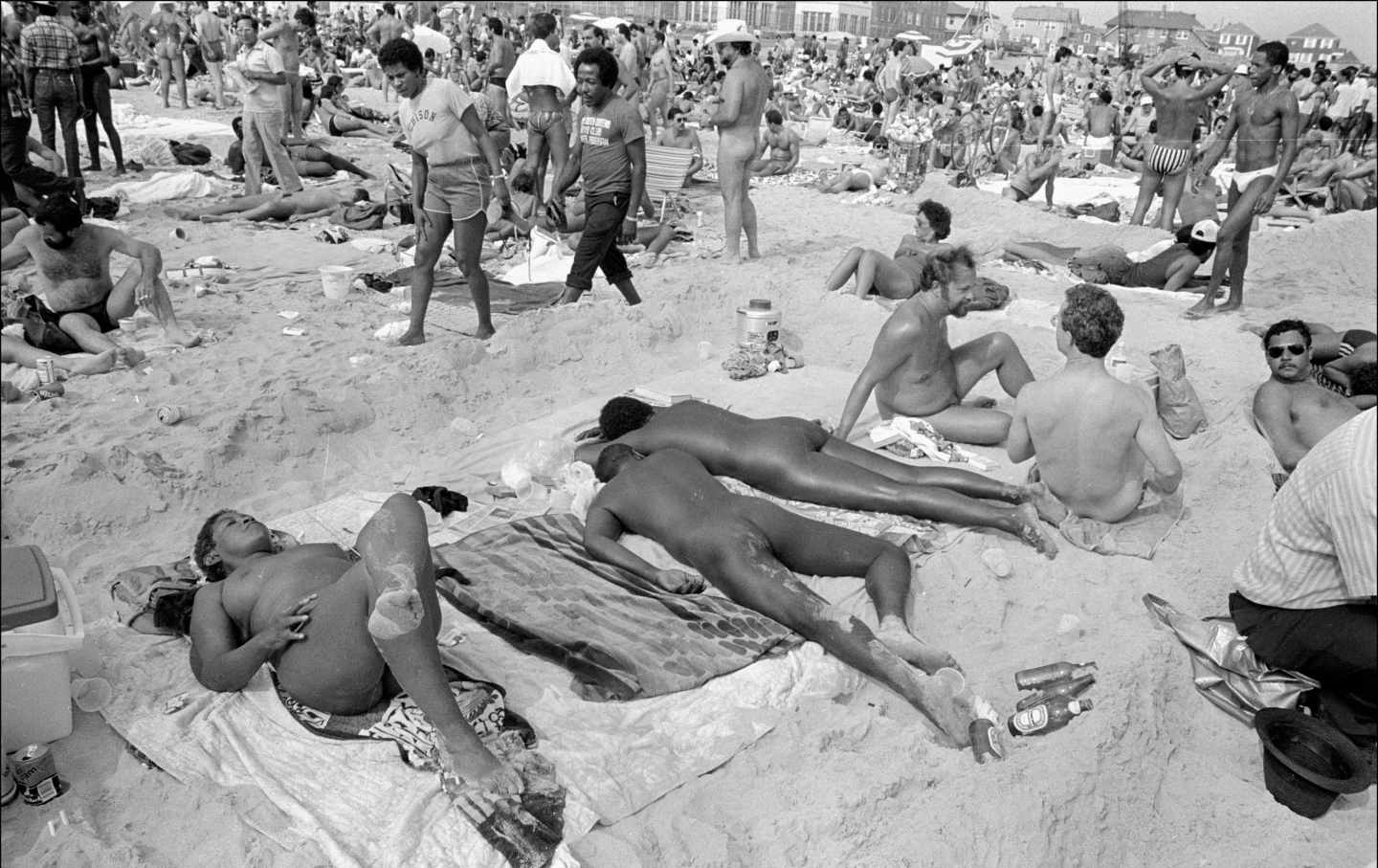
What Remains of Riis? What Remains of Riis?
A new members’ club has revived Riis Park’s long-vacant bathhouse, reopening old questions about whom the People’s Beach is really for.

When Texas Sex Ed Falls Short, Gen Z Women Turn to Social Media When Texas Sex Ed Falls Short, Gen Z Women Turn to Social Media
A 2025 study found that 70 percent of adolescents sought reproductive health information through social media platforms.
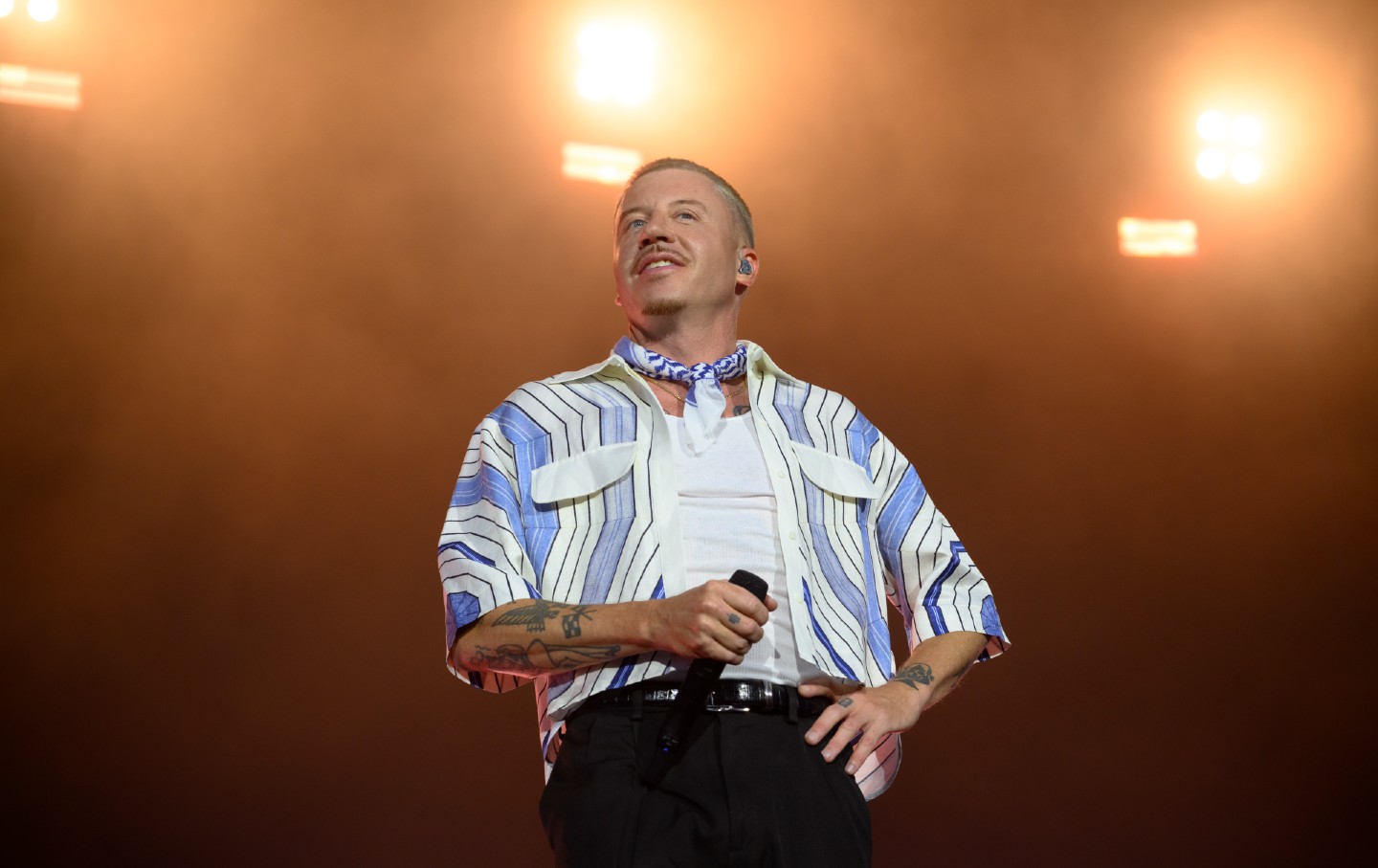
Justice for Macklemore Justice for Macklemore
The rapper has been dumped from Ed Sheeran’s tour for saying “free Palestine.” That’s a disgrace.

We Are Living Under Roy Cohnian Logic We Are Living Under Roy Cohnian Logic
The political fixer created a career for himself as a self-promoting, ubiquitous hustler. Like Trump, he got away with it by having the right friends.

Time Has Run Out for AI Risk Deniers Time Has Run Out for AI Risk Deniers
The recent spate of reports about the technology’s destructive power underline two prime directives: Be afraid, and regulate aggressively.
Yale’s President Has Become a Shameful Collaborator With Trump Yale’s President Has Become a Shameful Collaborator With Trump
Maurie McInnis has the power to stand up to the administration. Instead, she’s caving.

