The Supreme Court Has Agreed to Protect Drug Users
As long as they’re packing heat.
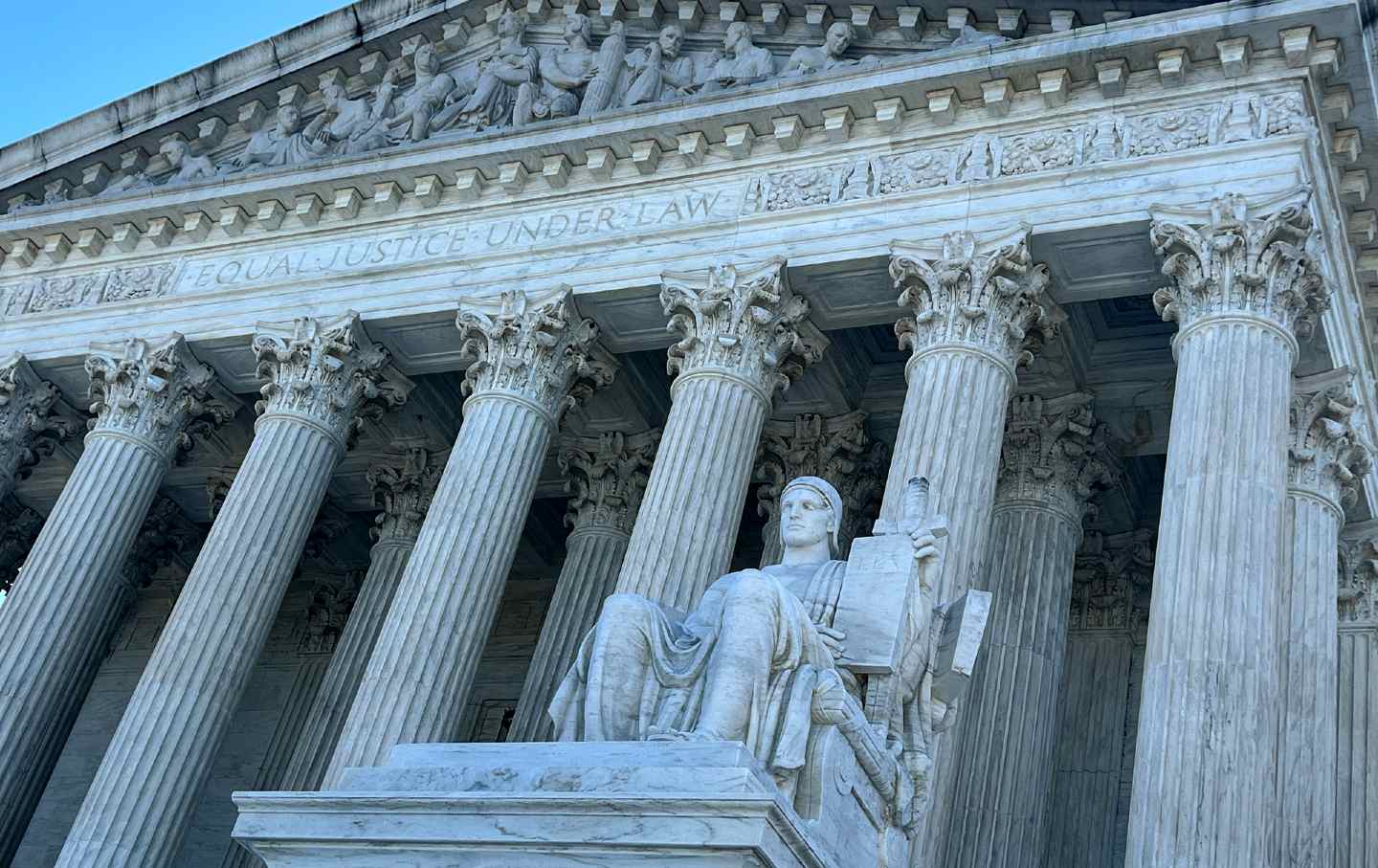
The statue Guardian or Authority of Law, above the west front plaza of the US Supreme Court Building.
(Chip Somodevilla / Getty Images)The Supreme Court continued its crusade to Mad Maxify this country’s gun laws on Thursday, but this time it did it by also making things easier for drug users. In a case called US v. Hemani, the court ruled that habitual users of illegal drugs cannot be deprived of their guns. They expanded gun rights and drug rights in the same ruling. It’s a progressive ruling, because it inhibits the ability of the state to incarcerate harmless drug users—and a MAGA ruling because it means more people will die from preventable gun violence. It’s a real double-edged assault rifle: Even when the Supreme Court does something good, it covers itself in blood.
The case arises from the government’s harassment of a man named Ali Hemani. Hemani was born in Texas, but his family is from Pakistan. That shouldn’t matter, but given that we live in a racist country, it’s almost certainly the reason Hemani and his family were investigated in 2022 for suspected “terrorism-related activities.” (I must say once again that Joe Biden should have fired then–FBI Director Chris Wray on his first day in office.) The FBI searched his house. Hemani cooperated, surrendered his licensed handgun, and actually pointed the agents to his stash of marijuana. He told the agents that he smoked pot habitually. The government found no evidence of “terrorism.”
Did federal agents apologize to Hemani for their mistake and bigotry? No, of course not. Instead, six months after the search, Hemani was charged under a statute known as USC 922(g)(3) for “knowingly possessing a gun in his home while being an unlawful user of a controlled substance.” Hemani fought the charges, arguing that the law violated his Second Amendment rights.
While most people have never heard of Ali Hemani, most people have heard of Hunter Biden. A part of this law was the basis for his prosecution; the difference is that Biden was prosecuted as a drug “addict,” while Hemani was charged as a drug “user.”
The Supreme Court decided, 9–0, to significantly limit the law, at least as it applies to drug users, though the justices were hardly unanimous in their reasoning. Under the Supreme Court’s most recent violent precedent, all 21st-century gun regulations must be able to cite some kind of historically analogous gun law that was in operation in the 18th century in order to be considered viable. It’s a profoundly stupid standard that has already proven to be intellectually unworkable, but that’s where the Republicans have put us. In defending the Hemani charges, the government argued that the historical analogues to Section 922(g)(3) were various laws that prevented “habitual drunkards” from keeping their guns. Justice Neil Gorsuch, writing the majority opinion, ripped that analogy to shreds. He argued, quite rightly, that the habitual drunkard laws applied only to people who needed to be jailed or institutionalized. There is no historical precedent for taking the guns away from average American alcoholics.
That makes sense to me. Don’t expect me to believe that the rabble of farmers and yokels who turned into American revolutionaries thought, “Hey, let’s start a war against a global superpower,” while stone-cold sober. I will always believe that the American Revolution would have been impossible without bourbon.
The problem with Gorsuch’s opinion is that there was an easier and better way to reach the right outcome for Hemani without delving into the annals of how sauced Samuel Adams was when he got people to throw tea into Boston Harbor. Justice Ketanji Brown Jackson wrote a concurring opinion (joined by Justice Sonia Sotomayor) that proposed deciding the case with “familiar questions.” Questions that the court used to ask before the current bloodthirsty regime. Like: “How severe is the law’s burden on Second Amendment rights? Does the government have a strong interest in preventing firearm possession by those ‘who pose a special danger of misuse’?”
In this case, it would have been a straightforward inquiry: Do habitual marijuana users pose a special danger of misusing guns? I think we all know the answer to that. We’d be a safer society if habitual marijuana use was required of gun owners. Maybe then more people would choose to shoot up a school… tomorrow.
Jackson’s formulation would also avoid the problem I presume some conservatives will have with Gorsuch’s ruling—which is that it keeps guns in the hands of drug users who they believe probably shouldn’t have access to guns at all. Section 922(g)(3) refers to all controlled substances, not just weed. Gorsuch doesn’t make any distinction between controlled substances or their potential differences. At the same time, while he doesn’t say that people can wield guns while using controlled substances (thank whatever gods still exist), he does say that having a controlled substance and having a gun is not automatic grounds for a crime. That means this ruling is great for crack and meth users looking to protect themselves. It’s great for drug users of all stripes. And it’s especially great for drug dealers.
I am unbothered by weakening Section 922(g)(3). That’s because the law is most often used in cases like that of Hemani, or Hunter Biden, where the government wants to put someone in jail but has no evidence of a real crime. It’s used against drug dealers who are busted with a dime bag and a licensed Glock. You can’t get them on a gun charge, and a misdemeanor drug charge is trivial, but you can put a person away for up to 15 years on a Section 922 violation. This law is a huge part of the carceral state.
I think mass incarceration is bad. Because of this, I think that Section 922(g)(3) is a bad law. It essentially allows the state to incarcerate people who have committed a minor infraction (drug possession) simply for exercising their rights—which in this case is their right (as made up by the Supreme Court) to possess a firearm for self-defense. I don’t think people should be deprived of rights simply because they sometimes get high. I also, obviously, don’t think people should have a constitutional right to own guns without government regulation (I think we should take the gun and leave the cannoli, not the other way around). In this case, I would have preferred if the court didn’t even get to the guns question, because my ruling would have read: “Drug users shouldn’t go to jail for using drugs. IT IS SO ORDERED.”
But since Republicans insist on a nearly unfettered right to the ability to carry out mass shootings, drug users shouldn’t be excluded from the orgy of violence. That goes for users of all drugs: weed, meth, PCP, whatever the hell the writers of Black Mirror are on, I’ll defend it all. If we’re forced to pretend that the “right” to own a weapon of mass destruction is just like the right to read a book in a park, then taking whatever drug floats your boat cannot void your rights.
Of course, I would prefer to live in a world where everybody could get drugs and nobody could get guns. I prefer to live in a world where gun ownership is at least as regulated as car ownership. But that world is not being offered to me by Supreme Court justices. Instead, we have people like Justice Sam Alito. He wrote a concurrence in the case—joined by Justice Elena Kagan, of all people—which tried to reach the preferred ammosexual outcome of the case without adopting a maximalist position on drug use. He argued that marijuana use today is just like alcohol use. It’s a banal point, but he made it to try to leave space to charge people who use all the drugs that are not like alcohol and send them to prison.
Popular
“swipe left below to view more authors”Swipe →Congress can, of course, rewrite Section 922(g)(3) to criminalize only the controlled substances that white people dislike. One can imagine a revised statute that prevents, say, owning a gun while possessing crack—while simultaneously allowing wealthy powder cocaine users to have their bump and their assault rifle. Indeed, that sounds like exactly the kind of law establishment Democrats would support in their always-ruinious attempts to look “tough on crime.”
Such a new law would probably find purchase among the Republicans on the Supreme Court, except for Justice Clarence Thomas. Thomas wrote a concurering opinion, joined by no one, to argue essentially that all federal gun laws violate the Commerce Clause and should be overturned. I’d argue that Thomas should be prohibited from owning guns based on the insanity of what he writes while ostensibly sober, but, sadly, that would violate the First Amendment before we even got to the second one.
The Hemani ruling is a victory for gun addicts—and for drug users. It’s a victory for libertarians and for progressives. It’s a victory for the gun lobby and for anti-carceral activists. But the cost of that victory will be paid in blood. The Supreme Court got to the right ruling but it was based on the wrong question. They asked if more people should have guns instead of asking if fewer people should go to jail.
Marijuana use doesn’t kill people; gun use kills people. As long as the court remains addicted to guns, our society will continue to fail.
Become a Sustaining Donor This September
Between the reemergence of right-wing red-baiting and Donald Trump’s use of the chilling National Security Presidential Memorandum–7 to criminalize left political organizing, we’re seeing McCarthyism reborn before our eyes.
This assault on democracy cannot be ignored or wished away. Resisting it requires bravery in the face of threats and repression, a steadfast commitment to the truth, and the unwavering belief that we can—and will—overcome this darkness.
We must have an independent media that sets the record straight, unearths corruption and abuses of power, and advances a politics of justice and dignity for all if we’re to win this fight.
That’s why I’m writing to you today. This September, The Nation needs to add 100 monthly donors to sustain our progressive journalism. Your contribution makes the next investigative report, the next truth-speaking column, and the next pathbreaking essay all possible.
I hope you’ll support our work with a recurring donation today. If you donate $10 or more a month, we’ll send you a brand new “Hands Off the Free Press!” sticker to recognise your commitment to our cause. Please, donate today.
Onward,
Katrina vanden Heuvel
Editor and Publisher, The Nation