The Banality of Peter Thiel’s Evil
Newly unearthed details of the tech giant’s secret annual retreat show the malignity of his influence—and the mundanity of his ideas.
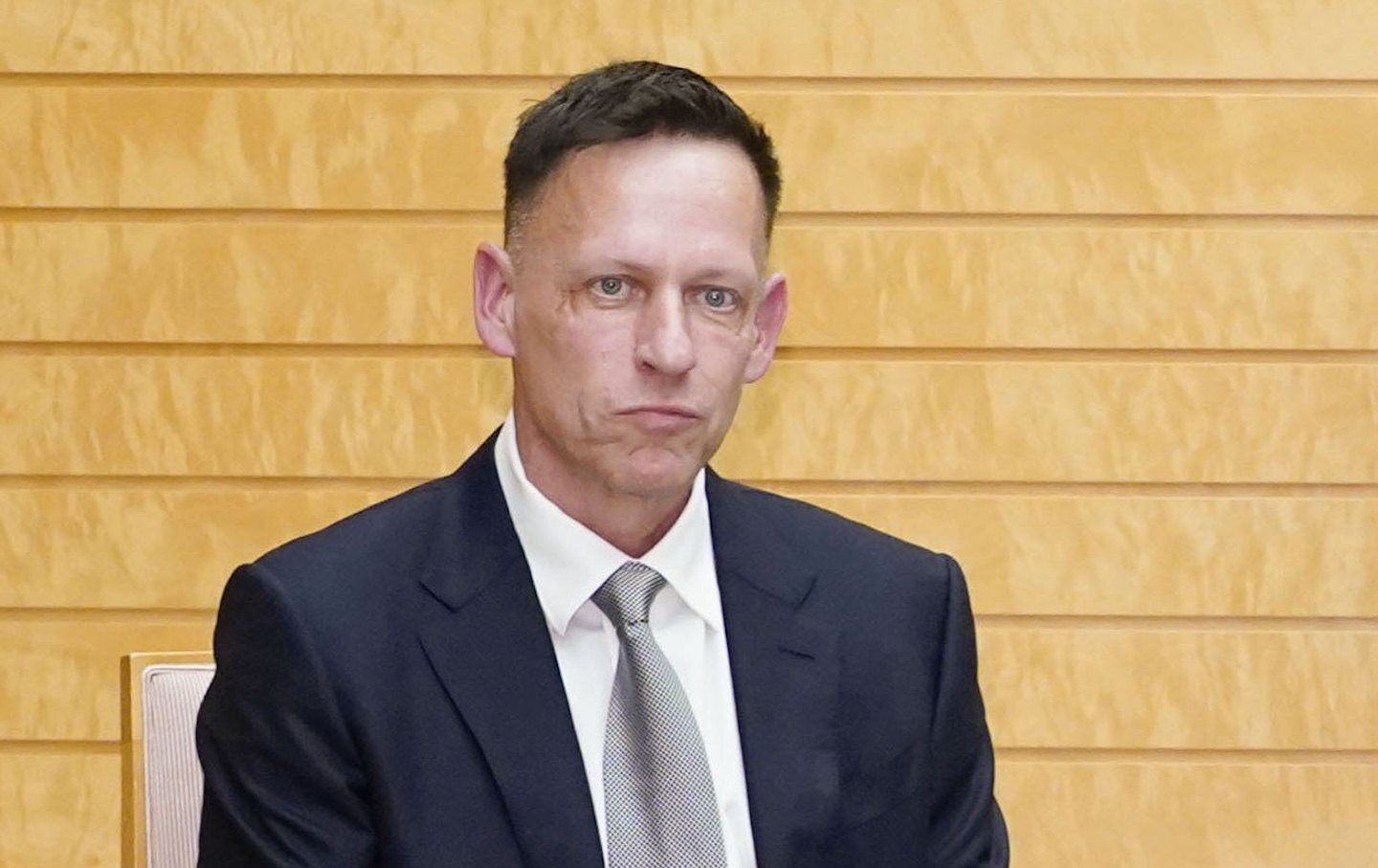
Peter Thiel in Tokyo on March 5, 2026.
(Kyodo via AP)For someone obsessed with the imminent arrival of the Antichrist and other doomsday scenarios, tech baron Peter Thiel sure is keen to place himself within the existing political order’s power elite. An early Silicon Valley recruit to the MAGA movement, Thiel donated heavily to Donald Trump’s first presidential campaign and spoke at the 2016 Republican National Convention. He then distanced himself from Trump’s 2020 campaign, but resumed his role as a MAGA kingmaker during the 2022 cycle, donating to 16 hard-right House and Senate candidates. And as his pet software and surveillance company Palantir continues to rake in massive government contracts from the second Trump administration, Thiel is already spending big to support the Republican House majority in this year’s midterms.
But electoral politics is just a small part of Thiel’s self-appointed purview as an aspiring thinker of big civilizational thoughts. Since 2006, the reclusive mogul has hosted a series of confabs called Dialog—a private, invitation-only gathering of global power brokers and influencer-types, funded by a cool $16,000 registration fee for participants. Reports of Dialog’s activities have been sketchy at best, since all the group’s sessions are held off the record, and its membership list has been jealously guarded from public view.
Until now, that is. On Tuesday, Wired magazine published a trove of leaked Dialog documents and information about the group’s membership. The leak includes the schedule for the group’s pending August retreat outside Dublin, Ireland. The subject matter gives the lie to the notion that Thiel’s vanity project is brokering any meaningful dialogue, in the sense of a probing exchange of opposing views. Instead, it seems closer to a list of trending topics on Truth Social: Session titles include “Money (Does?) Buy Happiness,” “Bring Back Nuclear,” “Navigating WWIII,” “Battlefield Technologies,” and, somewhat randomly, “How’s Your Sex Life?” “Other talks include ‘Build-a-Cult,’ moderated by the founder of the Christian networking site Pray.com,” write Wired correspondents Dell Cameron and Yulia Almazova, “and ‘Build-a-Party,’ run by a former White House national security official.”
This rather inert litany of money, armature-fetishizing, and right-wing praying and dating is pretty much par for the course in today’s MAGAfied tech elite. As Nation contributor Elizabeth Spiers has noted, people like Thiel embrace formulaic and banal models of intellectual inquiry because they live in a moneyed bubble of privilege that treats any passing bagatelle that flits across their brainpans as the stuff of world-conquering genius. “Our tech lords have long made a practice of outsourcing their thinking to the many people (and technologies) devoted to digesting difficult material and summarizing it for them,” she writes. “In their working lives, they then proceed to surround themselves with yes men and peers who affirm everything they say; the beta version of the cringy displays of great-leader sycophancy that break out in every Trump cabinet meeting was perfected in the boardrooms of Silicon Valley.”
I’ve borne inadvertent witness to this syndrome in Thiel’s case. Before he ascended the MAGA ranks, The Baffler, where I then worked as a senior editor, sponsored a debate between him and anarchist anthropologist David Graeber on the stalled character of technological innovation in late capitalism. After the exchange, the participants and several magazine contributors congregated for drinks; in this salon-style atmosphere, bereft of his usual retinue of sycophants and hangers-on, Thiel exuded a rigid air of barely submerged hostility, replying to conversational overtures in terse monosyllables. Whatever he was there for, in other words, it sure wasn’t dialogue.
This was entirely in line with Thiel’s profile as a moneyed intellectual bully. Like so many other members of his class cohort, he has militantly wielded his economic power to stamp out public discourse that isn’t his, or is otherwise averse to the interests of maximal tech-lord influence. He infamously bankrolled Hulk Hogan’s lawsuit that shuttered Gawker, acting out of his long-standing grudge against the site for outing him as gay. And he has now launched a media-harassment firm named Objection, which seeks to deploy AI in order to mass-produce lawsuits against journalists for offenses against MAGA and mogul vanity.
This all drives home what’s most noteworthy in Wired’s Dialog disclosures: While the group is strictly a nonstarter in terms of actual intellectual substance, it’s a telling indicator of how far Thiel’s self-obsessed portfolio of vendettas and bogus theorizing about the fall of civilization has migrated into the centers of global power. As Cameron and Almazova observe, the group’s membership rolls could easily double as those for the Bilderberg Group or the Trilateral Commission:
The registration records list General Alexus Grynkewich, NATO’s supreme allied commander Europe and the head of US European Command, who took the post in July 2025 and is recorded on the leaked list as having attended Dialog gatherings since 2021. The website directory names sitting Trump administration officials, two US senators, six members of the Paypal Mafia, a former Middle East chief of intelligence, and a sitting ambassador to the United States, along with the founders and directors of many of the country’s largest surveillance, data-broker, and advertising-data companies.
And that’s just the half of it. Wired also notes that these cozy confabs place the surveillance robber barons in the Thiel-Palantir axis of influence alongside key political figures notionally charged with overseeing or regulating their activities. The chairman of Dialog is one Auren Hoffman, who also presides over the identity-resolution company LiveRamp and the data location clearing house SafeGraph, “two of the most important suppliers in the consumer data economy.” Dialog’s membership rolls include both sitting US Treasury Secretary Scott Bessent, whose regulatory brief includes financial data, and GOP Texas Senator Ted Cruz, who chairs his chamber’s Commerce, Science and Technology Committee, which wields oversight authority for the Federal Trade Commission, which in turn regulates data privacy.
Unbelievably, it gets worse: “Palantir cofounder Joe Lonsdale, whose software runs case management for US Immigration and Customs Enforcement and data fusion for the Pentagon and intelligence community, is listed in the same society as Army secretary Dan Driscoll and Representative Jim Himes, the ranking member of the House Intelligence Committee, which oversees agencies Palantir contracts with.”
This is the real curriculum fueling the otherwise painfully shallow public discourse bearing the Dialog brand: Like similar overclass getaways at Aspen or Sun Valley, it affords ample networking and face time for self-anointed masters of the universe craving an audience of like-minded philistines. They all share an underlying worldview combining supreme personal self-regard with bouts of predator paranoia. As Cameron and Almazova write, a survey of members’ interests shows an obsession with the potentially disastrous fallout from the widespread adoption of AI—the technology that these same people won’t shut up about, or keep profiting from.
Asked on a sign-up form to predict the future, registrants returned again and again to the same theme: that AI will reorder work, war, education, and belief within a few years. Several foresee mass labor displacement and a swing back toward unions and government programs; others predict an “AI winter,” domestic terrorism targeting data centers, criminal defendants choosing AI lawyers over public defenders, or religious revival provoked by the disruption.
“Societal degeneration,” predicted one person, “will continue to accelerate.”
You can say that again—just as you can rest assured that everyone associated with Dialog will continue to profiteer wildly on that selfsame degeneration.
Become a Sustaining Donor This September
Between the reemergence of right-wing red-baiting and Donald Trump’s use of the chilling National Security Presidential Memorandum–7 to criminalize left political organizing, we’re seeing McCarthyism reborn before our eyes.
This assault on democracy cannot be ignored or wished away. Resisting it requires bravery in the face of threats and repression, a steadfast commitment to the truth, and the unwavering belief that we can—and will—overcome this darkness.
We must have an independent media that sets the record straight, unearths corruption and abuses of power, and advances a politics of justice and dignity for all if we’re to win this fight.
That’s why I’m writing to you today. This September, The Nation needs to add 100 monthly donors to sustain our progressive journalism. Your contribution makes the next investigative report, the next truth-speaking column, and the next pathbreaking essay all possible.
I hope you’ll support our work with a recurring donation today. If you donate $10 or more a month, we’ll send you a brand new “Hands Off the Free Press!” sticker to recognise your commitment to our cause. Please, donate today.
Onward,
Katrina vanden Heuvel
Editor and Publisher, The Nation