
The Social Critic Who Predicted Big Tech’s Dark Turn
Theodore Roszak and the perils of technocracy.
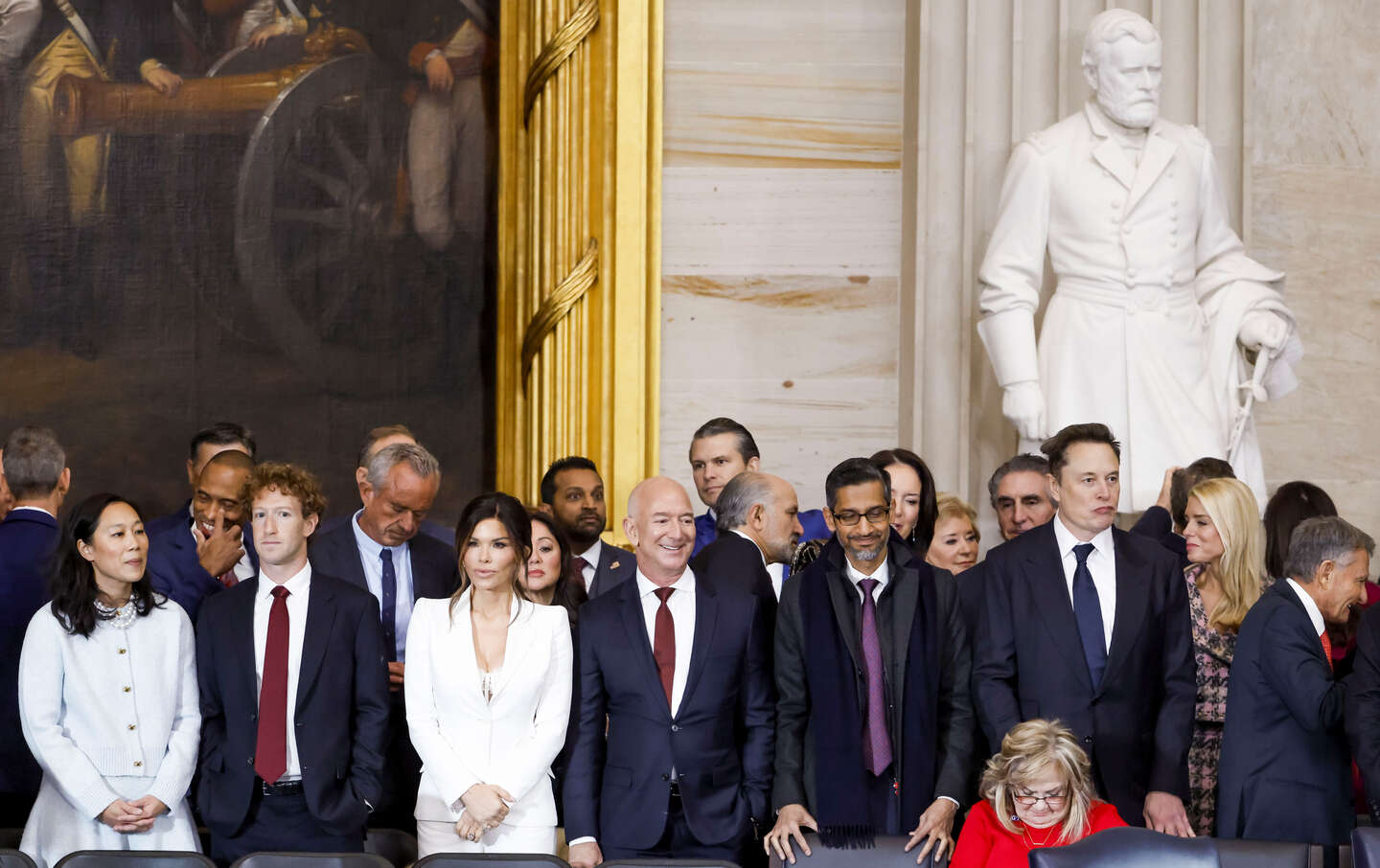
Priscilla Chan, Mark Zuckerberg, Lauren Sanchez, Jeff Bezos, Sundar Pichai, and Elon Musk during the 60th presidential inauguration in the rotunda of the US Capitol in Washington, DC, on Monday, January 20, 2025.(Shawn Thew / Bloomberg via Getty Images)
The nation’s tech barons, one of whom owns The Washington Post, were lined up like trophies at Trump’s inauguration. As we pondered that mise-en-scène and its implications, we thought about Theodore Roszak. In a series of articles for The Nation, the social critic and peace activist famously coined the term “counterculture,” but he also tagged its chief adversary the “technocracy,” which he defined as the corporate and technological regime that dominated industrial society. Now, decades later, the tech moguls were arranging themselves behind the most divisive figure in American politics.
When Roszak’s book The Making of a Counter Culture appeared in 1969, critics hailed it as an indispensable guide to youthful rebellion. Powered by the Baby Boom and postwar affluence, the counterculture was loosely united by its opposition to the Vietnam War and put off by the nation’s rampant materialism, environmental rapacity, and spiritual emptiness. Most media accounts denigrated the movement, but Roszak’s analysis, though critical, was deeper and more supple. He called out the counterculture’s rhetorical excesses, unforced political errors, and drug culture. “The young, miserably educated as they are, bring with them almost nothing but healthy instincts,” he wrote. Nevertheless, he endorsed their opposition to the technocracy. While most mainstream observers were dismissing hippies as kooks and reprobates, he cast them as the best hope for an alienated and denatured society.
Roszak argued that the technocracy and its cult of expertise weren’t susceptible to traditional leftist critique. “It is essential to realize that the technocracy is not the exclusive product of that old devil capitalism,” he claimed. “Rather, it is the product of a mature and accelerating industrialism. The profiteering could be eliminated; the technocracy would remain in force.” Its primary mission was “the relentless quest for efficiency, for order, for ever more extensive rational control.” Roszak also noted that the technocracy had a remarkable ability to co-opt rebellion. Indeed, it eventually absorbed a slew of countercultural innovations without breaking a sweat.
The technocracy was difficult to resist directly, but Roszak offered a modest proposal:
Where is the life-sustaining receptacle that can nourish and protect good citizenship? The answer is: You make up a community of those you love and respect, where there can be enduring friendships, children, and, by mutual aid, three meals a day scraped together by honorable and enjoyable labor. Nobody knows quite how it is to be done. There are not many reliable models. The old radicals are no help: They talk about socializing whole economies, or launching third parties, or strengthening the unions, but not about building communities.
It was more daunting than it sounded, but the counterculture was already taking up the challenge. Forsaking power politics and mindless consumption, young people turned their attention to new forms of community, livelihood, artistic expression, sexual identity, and personal growth.
The results were predictably mixed, and when observers began writing off the counterculture in the 1970s, Roszak noted that they often included “a snide disclaimer, a wised-up dismissal.” Yet countercultural themes continued to shape American society well into the 1990s. Roszak called the environmental movement “the most durable offshoot of countercultural protest,” but a stroll through an American city supports his larger claim. Organic groceries, yoga studios, farmers’ markets, recycling centers, and cannabis dispensaries can all be traced back to the rebellion that Roszak parsed.
In the 1980s, Roszak turned his attention to the digital strain of the counterculture. He was intrigued by Steve Jobs, who positioned Apple as the countercultural challenger to IBM, and by Stewart Brand, the Merry Prankster who previewed the advent of robotics, video games, the Internet, and artificial intelligence in Rolling Stone magazine. Roszak noticed that the digital freaks reflected and refracted much of the counterculture’s utopianism. “This generation swallowed computers whole, just like dope,” said Brand, who also predicted that new technologies would change the world more quickly and dramatically than any political movement.
Roszak, however, never accepted the notion that gadgets had superpowers over our most intractable problems. As wave after wave of high-tech enthusiasm washed over Silicon Valley, he detected a pattern:
In each of these cases, one sees the same assumption brought into play: The industrial process, pushed to its limit, generates its own best medicine. Out of the advanced research of the electronics, plastics, chemical, and aerospace industries, there emerge solutions to all our political and environmental problems.
Decades later, that assumption seems shakier than ever. Far from solving our problems, the tech industry is creating them at an alarming rate.
A global movement to rein in Big Tech is well under way, and the tech barons are banking on Trump’s protection. Many of them also argue that doubling down on technology is our only practical option. In “The Techno-Optimist Manifesto,” tech investor Marc Andreessen presents that idea as an article of faith: “We believe that there is no material problem—whether created by nature or by technology—that cannot be solved with more technology.” Elsewhere, Andreessen maintained that efforts to regulate tech, both here and abroad, have hobbled US companies working on artificial intelligence and cryptocurrencies. For that reason, he and his colleagues decided to support Trump. At the same time, Andreessen disparaged what he described as a resurgent New Left: “The most privileged people in society, the most successful, send their kids to the most politically radical institutions, which teach them how to be America-hating communists.” Impertinent youngsters, it seems, were once again challenging their elders.
Popular
“swipe left below to view more authors”Swipe →None of this would have surprised Roszak, who remained a techno-skeptic. Well before Apple’s “Think Different” campaign celebrated “rebels and troublemakers” such as Bob Dylan and John Lennon, Roszak claimed that major corporations were using technology to usher in a new era of advanced surveillance and control. The belief that new products would liberate their users, Roszak wrote in 1986, was little more than “an attractive hope.” For Roszak, the counterculture was admirable when it was resisting the technocracy, not assisting it.
Big Tech has been losing its shine for years, but for many Americans, its high-profile support for Trump is the final straw. Calling out the technocracy, and building communities outside its reach, once again feel like urgent priorities. For those who feel that way, Roszak’s intelligence, sanity, and faith in critical inquiry are refreshing. Five decades after the Death of Hippie, Roszak’s voice is outrageously alive.
More from The Nation

The Endless Hypocrisy of Bari Weiss The Endless Hypocrisy of Bari Weiss
She claims to be a free speech champion. But as her actions at CBS News keep showing, she seems to think free speech should run only in a rightward direction.
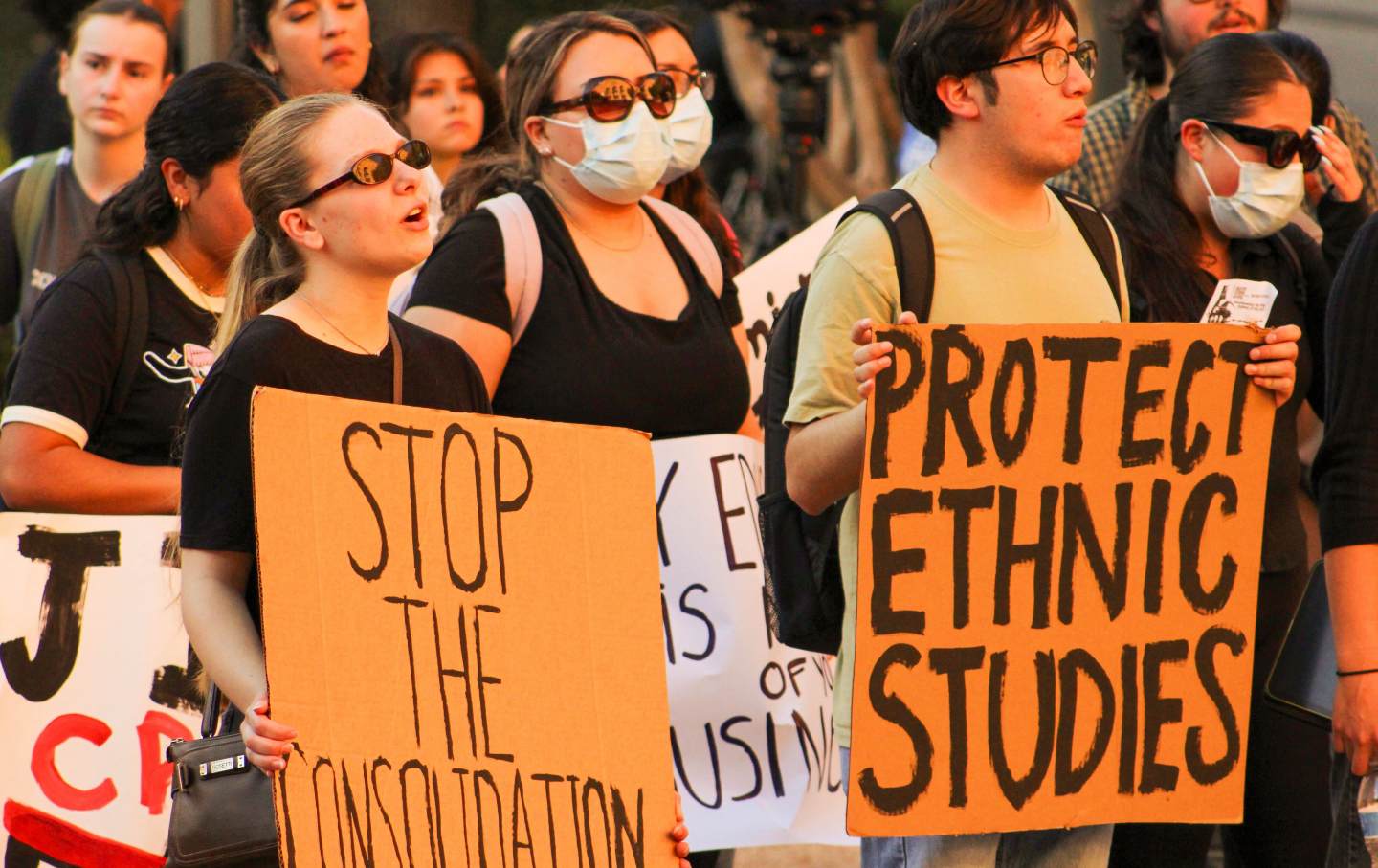
What Will Be Left After the University of Texas Destroys Itself? What Will Be Left After the University of Texas Destroys Itself?
UT-Austin has collapsed its race, ethnic, and gender studies into a single program while a new policy asks faculty to avoid “controversial” topics. But the attacks won’t end there...

The Corporate Media Is Head Over Heels for the Iran War The Corporate Media Is Head Over Heels for the Iran War
Donald Trump’s attack may be surreal, unjustified, and illegal. But that’s not stopping the press from turning the propaganda dial way up.

The Disturbing History of ICE’s “Death Cards” The Disturbing History of ICE’s “Death Cards”
The Vietnam-era practice is yet another example of ICE agents thrilling to the brutality they have been encouraged to cultivate.
The American Universities Programming Israel’s Killer Drones The American Universities Programming Israel’s Killer Drones
Industry partnerships in higher education are pushing STEM graduates into the business of weapons manufacturing and genocide profiteering.

The Red State–Blue State Healthcare Divide Is Dangerous for Everyone The Red State–Blue State Healthcare Divide Is Dangerous for Everyone
Whether or not you have access to independent, scientifically sound public health guidance may depend on how your state voted for governor.

