Last week, as I was walking to the used bookstore during my lunch break, a startling voice yelled at me. The voice was not human but, like Siri and many other digital assistants, it approximated a female voice and a “friendly” tone. “Hi!” it called out. “You are being recorded!”
The culprit was a large outdoor speaker attached to a security camera, both affixed beneath the cornice of a sleek, freshly opened sushi joint on Milwaukee Avenue, the main drag of Chicago’s trendy Logan Square neighborhood. The voice scared me, as I had believed I was alone. It came from above—a place voices on the street don’t usually come from. It (implicitly) threatened me. I’d done nothing wrong, and yet there I was, walking in public, only to find my mere presence equated with the potential to do harm.
It’s a high-traffic area, so I was far from the device’s only perceived threat. In fact, because it uses an indiscriminate motion sensor, the camera treats everyone who walks by the restaurant as a potential ne’er-do-well and automatically yells the same thing at them—a dog afraid of its shadow. This was not the first time I’ve experienced this kind of rude intrusion. During this past Christmas season, I went to a large Target to buy wrapping paper. Blaring from speakers across a massive parking lot, a similar message: “For your safety, you are being recorded.” Both this and the restaurant message are passive-aggressive. One delivers the notice with phony, feminized friendliness; the other, in an equally gendered role, uses a male voice to make a false and patronizing claim of safety. Both imply that the act of being in public space is inherently dangerous, and each, in their own way, suggests that I am—or could be—the source of the danger.
The panoptic bugbear known as the home surveillance camera is nothing new. However, for many years, the products were expensive due to the cost of video, and later the cost of digital storage. The advent of cloud computing meant such costs were no longer an issue, and the now-ubiquitous doorbell camera (and its many offshoots) was born. Having the power to surveil one’s property even in absentia is an alluring prospect. It’s also a predictable response to decades of “dangerous crime” rhetoric, the omnipresent American fear of hooliganism and property damage, and the corresponding cultural fantasy of vigilante justice.
Obviously, there are many downsides to surveilling one’s neighbors. Ring security cameras in particular have come under fire in recent years because of their “neighbors” feature—a kind of NextDoor for Ring users that allows them to send videos from their devices directly to law enforcement, which, as Wired notes in its edict “Why We Do Not Recommend Ring Cameras,” incentivizes increased racial profiling. To many in the United States, this may be a feature, not a bug. Regardless, the products remain popular despite the fact that there’s no evidence that using such a device increases public safety outcomes.
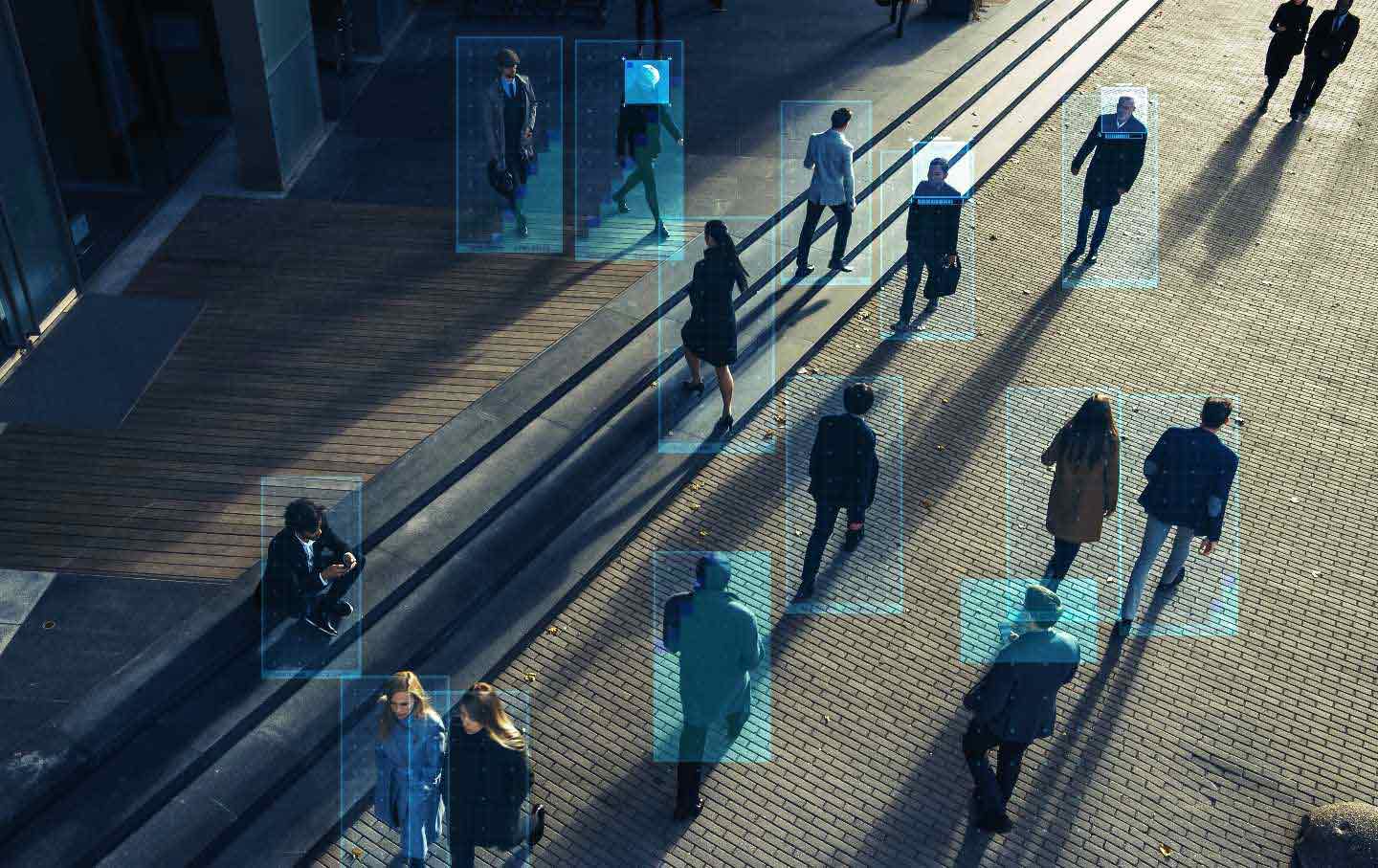
Many of the houses in my neighborhood, especially those built in the last five years, have these cameras. But the audio addition is not something I’d encountered until recently. In a world where everything we do is surveilled—whether that’s through cookies on the Internet, location tracking on our smart devices, or our own self-surveillance and scrutiny of others via social media—it is easy to forget that we are always being watched. The talking camera phenomenon reminds us. Loudly. It is an escalation of an already omnipresent aggression. It intrudes into our consciousness, induces paranoia and anger, makes us feel unwelcome in public life, furthers the idea that one’s private property extends beyond the stoop, and suggests that by owning property one has earned the right to curtail the rights of others. This is a net negative for society. When I shared the screaming camera incident on Twitter, the horror stories poured in: multiple cameras on every block creating a chorus of shrieks, cameras near trailheads “greeting” returning runners, and oversensitive sensors that turn quiet environments into squawking, aggressive ones.
Paradoxically, it is the public nature of the urban environment that incentivizes the use and proliferation of such a device. Urban property owners have fewer avenues than suburbanites do when it comes to turning their parcels into hostile sites of exclusion. Suburbs famously exclude by way of high fences, gated communities, neighborhood watch programs, homeowner associations, private police, and more. On an urban street, there is seldom a gated community, and buildings are rarely further than 50 feet away from the sidewalk. While urban realms do have ways to alienate—invasive highways, transit deserts, increased policing—at the end of the day it is not illegal for me or for anyone else to walk on the streets of Chicago. (Whether one’s right to walk those streets is respected is another, complicated story, but to make changes on that front, first we have to believe in the right itself.)
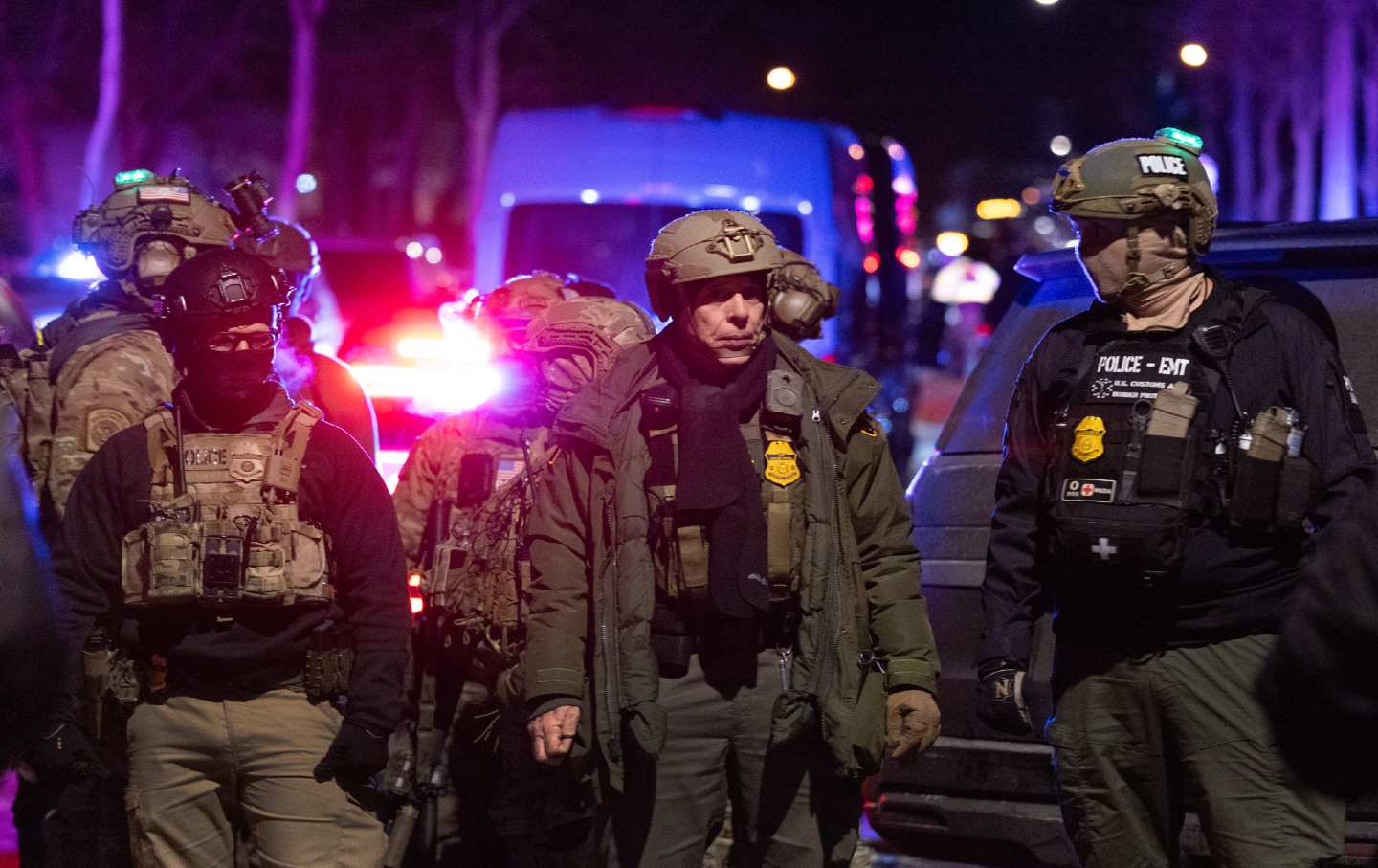
The talking camera is modeled on the policeman loitering on the street. Both take whatever personal insecurity we might feel as we navigate a neighborhood—that perhaps we are out of place or unwanted, anxieties that compound when adding factors like race and gender—and rub our faces in it. They target our dignity, making our right to be out and about in our city feel unearned.
One of the most beautiful, humanistic things about cities is that on the street one always has the potential to come in contact with both the everyday and the unexpected. By being in public, one joins the great human milieu of people trying to get wherever they’re going. This, of course, entails some vulnerability and requires a basic human trust, something that devices like the Ring camera actively erode. This was true of the silent version but the loud, threatening iteration is far worse. It’s one thing to have a misanthropic, nosy neighbor; it’s another to have one that harasses you for existing. Amid all the fraught discourse around NIMBYism, a device that yells “Not in my backyard!” at you is a little too on the nose.
Whatever you want to call it—suburban creep, techno-feudalism, NIMBYism—the yelling camera has no place in cities. (Neither, I would argue, does the silent one.) For all of the above reasons, they should be banned. If you remain unconvinced that they undermine civic decency, you can surely oppose a device that shouts at every person on a street where hundreds of people walk each day on a purely sensory basis as being intolerable noise pollution. Cities are public spaces, even if we increasingly behave otherwise (see: the prevalence of hostile architecture, the disappearance of public bathrooms and seating, and the violent anti-homeless sweeps across the nation, most viciously in San Francisco).
We seem to have less and less tolerance for other people.The cameras are a symptom of this trend toward misanthropy, this same privatization of everything, this inability to treat the public with good faith. These devices escalate this tendency because they presuppose that everyone is undesirable. Individual building owners are empowered to take matters into their own hands: They’re allowed, under the guise of private property, to intimidate passersby. If that doesn’t say enough about what kind of cities we’re building and living in, I don’t know what does.
Support independent journalism that does not fall in line
Even before February 28, the reasons for Donald Trump’s imploding approval rating were abundantly clear: untrammeled corruption and personal enrichment to the tune of billions of dollars during an affordability crisis, a foreign policy guided only by his own derelict sense of morality, and the deployment of a murderous campaign of occupation, detention, and deportation on American streets.
Now an undeclared, unauthorized, unpopular, and unconstitutional war of aggression against Iran has spread like wildfire through the region and into Europe. A new “forever war”—with an ever-increasing likelihood of American troops on the ground—may very well be upon us.
As we’ve seen over and over, this administration uses lies, misdirection, and attempts to flood the zone to justify its abuses of power at home and abroad. Just as Trump, Marco Rubio, and Pete Hegseth offer erratic and contradictory rationales for the attacks on Iran, the administration is also spreading the lie that the upcoming midterm elections are under threat from noncitizens on voter rolls. When these lies go unchecked, they become the basis for further authoritarian encroachment and war.
In these dark times, independent journalism is uniquely able to uncover the falsehoods that threaten our republic—and civilians around the world—and shine a bright light on the truth.
The Nation’s experienced team of writers, editors, and fact-checkers understands the scale of what we’re up against and the urgency with which we have to act. That’s why we’re publishing critical reporting and analysis of the war on Iran, ICE violence at home, new forms of voter suppression emerging in the courts, and much more.
But this journalism is possible only with your support.
This March, The Nation needs to raise $50,000 to ensure that we have the resources for reporting and analysis that sets the record straight and empowers people of conscience to organize. Will you donate today?