
In the Aftermath
Rebuilding Los Angeles after the fires.
How Should Los Angeles Rebuild After the Fires?
In the aftermath of this year’s catastrophic fires, architects and urban planners begin to consider how to rebuild.
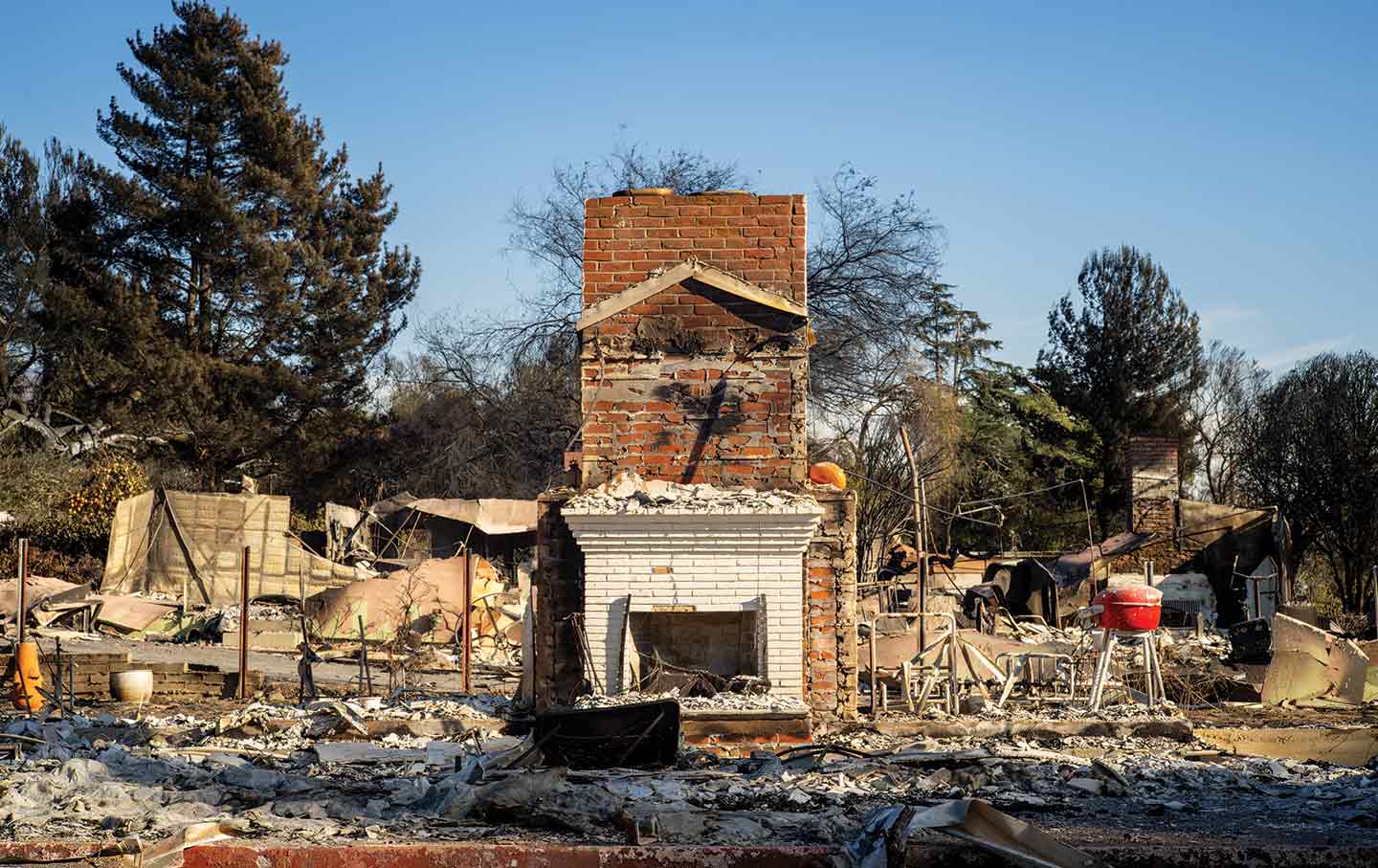
Altadena, California, after the January 2025 fires.
(Brandon Bell / Getty Images)
After an unusually dry autumn in which fires erupted in Brooklyn’s Prospect Park, on the New Jersey–New York border, and in the Catskills—one came within 12 inches of a friend’s home—I watched from a distance as firestorms ravaged portions of greater Los Angeles and read countless accounts of people fleeing their homes and losing everything—loved ones, pets, and belongings—to the wind-driven flames.
Even after it was all over, I was haunted by a social media post written by a woman who had lived in one of the two seaside mobile-home parks in Pacific Palisades, Palisades Bowl and Tahitian Terrace—vestigial enclaves of a modest beach lifestyle in an otherwise prohibitively expensive part of Los Angeles. The woman worked in the movie industry—maybe in makeup or costumes—and she lamented that she had lost not only her home but her entire community.
All I could think after reading her post was that there had to be a mechanism for rebuilding what was lost, not just the tangible homes but the connections between people formed over years of seeing each other every day—connections that may be even harder to repair or re-create than the homes themselves.
You’d think that replacing mobile or prefabricated houses would be relatively easy: Once the land was cleared and utilities restored, new units could simply be trucked in and plopped down. You may recall that after Hurricane Katrina, the battered landscape of the Mississippi Gulf Coast was filled with mobile homes provided by the Federal Emergency Management Agency, which became known as “FEMA trailers.” And Los Angeles Mayor Karen Bass, in one of the executive orders she issued during the fire, announced that “displaced residents can use recreational vehicles, tiny homes, modular structures or mobile homes” during the rebuilding process. But Bass’s order was meant for property owners—and most mobile-home dwellers in Pacific Palisades rent their lots.
There is also the fact that once that land is cleared, the property owners may want to sell it. After all, “before the fire,” as the Los Angeles Times noted, “the average home price in Pacific Palisades was more than $3.4 million.”
The idea of rebuilding the lost affordable housing—and especially of adding new affordable units—has also become politically contentious. Former mayoral candidate and billionaire real estate developer Rick Caruso, who has started a fire-recovery nonprofit called Steadfast LA, told the Los Angeles Times that “external interests” are behind the push for affordability in Pacific Palisades.
Meanwhile, the fire that raced through the Eaton Canyon, about 15 miles northeast of downtown Los Angeles, decimated Altadena, an unincorporated area adjacent to Pasadena. Altadena was home to another unique community, one formed decades ago by African Americans fleeing the Jim Crow South. The Eaton Fire, which began on January 7, destroyed more than 6,000 homes in Altadena, occupied mostly by middle- and working-class families, many of whom had been in those houses for generations. The fire also destroyed Altadena’s business district as well as many local institutions, including schools, churches, and synagogues, and killed 18 residents, mostly elderly.
So, again, the question is not just how to rebuild housing but how to restore these unique communities. In Altadena, as in Pacific Palisades, the answer is complicated by another factor: the fire and its aftermath coincided with the ruinous first months of the second Trump administration. In February, The New York Times reported plans to “all but eliminate the office that oversees America’s recovery from the largest disasters,” a section of the Department of Housing and Urban Development called the Office of Community Planning and Development, which has been instrumental in rebuilding after especially damaging storms like 2005’s Katrina and 2012’s Sandy. And by March, Trump’s secretary of homeland security was touting plans to eliminate FEMA as well. The federal spigot is not necessarily going to open this time around, and the spigot itself may be destroyed or privatized.
In mid-January, I received an e-mail from an LA-based nonprofit architecture studio called Office of: Office, which is headed by two women, Alejandra Guerrero and Elizabeth Timme. I had last heard from the studio several years ago when it was offering permit-ready plans for so-called accessory dwelling units—aka garage apartments or granny flats—that could be erected, sans red tape, in the city of Los Angeles. The architects’ goal at the time was to help less affluent homeowners build rental units that would contribute to their economic stability while lessening the shortage of affordable housing.
Their idealistic response to the Eaton Fire was therefore not surprising: “In line with our mission, we are offering our services pro-bono to residents of color who have been impacted by the fires in Southern California. These include: [architectural design and drawings], land use review and permitting, construction oversight and policy and advocacy.… We are providing this support,” they added, “for residents who have historically faced discrimination in housing, inequities in the built environment, and/or challenges in building generational wealth that may be at a disadvantage in their rebuilding efforts.”
Note that there is a substantial history of architects working to address housing loss caused by natural disasters or political upheaval. Architecture for Humanity, an organization founded in 1999 (though sadly shuttered in 2015), sponsored competitions in which (mostly) young architects came up with clever new types of shelter for survivors of earthquakes, hurricanes, or wars. After Hurricane Katrina devastated the Mississippi Gulf Coast, the leading New Urbanist architect Andrés Duany brought dozens of his compatriots to a ballroom in Biloxi, Mississippi, to draw up designs for an ambitious rebuild. These efforts were always heartfelt, though they only occasionally produced anything of practical value.
But Guerrero and Timme’s approach is different. For one thing, their method involves meeting individual property owners, trying to understand their needs, and working with them, one by one, to guide them through the complex process of building a home. “We didn’t think it was going to be a big deal to offer these predevelopment services,” Timme tells me. “And so a few days after the fire, we put out a post and an e-mail blast that we would be offering free design permitting overview, planning, and zoning advocacy support. And we were overwhelmed by how many people this resonated with.”
While it had initially seemed important to offer their services specifically to “residents of color,” given that Altadena was one spot where the non-white population “had historically the opportunity to become homeowners and build intergenerational wealth,” by March the studio was working with 120 displaced residents of all descriptions. The project was less about an “architectural agenda” and more about “stabilizing and preserving” people and “building the capacity of the homeowners” to make good choices. “What that really means,” Timme adds, “is that we’re acting like social workers.”
They’ll be helping their pro bono clients understand what insurance will cover and how to access other funding sources, such as disaster loans for homeowners from the Small Business Administration. Timme notes that “there are homeowners who need immediate stabilization that don’t have insurance, or their insurance is profoundly inadequate.” The majority, she says, only have enough insurance to cover 60 or 70 percent of what they’ve lost. And “for those homeowners” who “are over-insured, we’re not talking to them about the architectural style. We’re talking to them about adding density so that people who are going to be displaced can live in their yard or on their lot.”
Guerrero and Timme and their studio are not alone in their efforts to protect the working- and middle-class communities that had long characterized Altadena. Another pair of architects, the married couple Cynthia Sigler and Alex Athenson, are also looking to help people rebuild there. To that end, they incorporated a nonprofit, the Foothills Catalog Foundation, in the days after they’d fled their own home, half a block from the Altadena border.
“It seemed pretty hopeless—we had to come to grips with the fact that we might not have a home to go back to,” Athenson recalls. But the couple lucked out. “It really came down to the fact that the winds died down,” Sigler explains. And once they knew they still had a home, the pair began to focus on a way to offer a helping hand to their less fortunate neighbors.
Popular
“swipe left below to view more authors”Swipe →“We were trying to think of a mechanism that can help the masses or as many people as possible,” Sigler says. What they came up with was a return to the kit-house approach pioneered by Sears Roebuck during the first half of the 20th century. “The catalog homes were incredibly successful in building working-class and middle-class housing across this entire country,” Athenson points out. So now the pair are compiling a set of plans for the types of houses typically found in Altadena—ranches, Mission style, Craftsman bungalows—and working with other architects (and, ideally, builders) to streamline the design and construction process so that displaced residents can rebuild as quickly and easily as possible.
“What we’re looking at is a community of really diverse backgrounds and incomes,” Athenson says. The average Altadena home is roughly 1,500 square feet, about half the size of a typical homebuilder’s model, and so they’re aiming “for good design in that more modest scale,” Sigler adds.
To that end, Sigler and Athenson are working closely with local heritage societies and the Pasadena chapter of the American Institute of Architects to make sure they’re accurately representing the range of local housing types in their new catalog. The goal is to have a comprehensive set of pre-permitted plans for the types of houses that were lost and to distill each design into a kit of parts that, like the Sears Roebuck houses, can be built simply and quickly.
Of course, there will also be endless disputes about what should be rebuilt, particularly in commercial districts like downtown Altadena, where beloved local businesses were destroyed, or along Sunset Boulevard in Pacific Palisades, where apartment buildings with rent-controlled units burned down. Some communities will return, and others will not. What happens after a disaster like this (or any disaster, natural or man-made) is that the people who have lost their homes are suddenly thrust into a public debate about the most elemental aspects of what had once been their daily lives, a debate that can be bewilderingly political. Which makes me think that these small-scale efforts by local architects—not to whip up some magical or innovative architectural design, but instead to give those who have lost almost everything some control over their future—may be more transformative than they initially appear.
More from The Nation
Is Union Power Growing in Mamdani’s New York? Is Union Power Growing in Mamdani’s New York?
Following the Mamdani administration's talks with the CUNY faculty union, three professors have returned to class after losing their jobs for their pro-Palestine activism.

What Peter Thiel Saw in Jeffrey Epstein What Peter Thiel Saw in Jeffrey Epstein
In the extensive correspondence between the Silicon Valley venture capitalist and the late pedophile, both men expressed a deep aversion to democracy.

The Truth About Interracial Intimacy The Truth About Interracial Intimacy
In a new memoir, author Dorothy Roberts explores why interracial attraction can’t be disentangled from the larger forces of race, gender, and power that govern our world.

Bad Bunny’s Stunning Redefinition of “America” Bad Bunny’s Stunning Redefinition of “America”
His joyous, internationalist, worker-centered vision was a declaration of war against Trumpism.
Sunnyside Yard and the Quest for Affordable Housing in New York Sunnyside Yard and the Quest for Affordable Housing in New York
Constructing new residential buildings, let alone those with rental units that New Yorkers can afford, is never an easy task.

How Capitalism Transformed the Natural World How Capitalism Transformed the Natural World
In her new book, Alyssa Battistoni explores how nature came to be treated as a supposedly cost-free supplement of capital accumulation.

