
What Peter Thiel Saw in Jeffrey Epstein
In the extensive correspondence between the Silicon Valley venture capitalist and the late pedophile, both men expressed a deep aversion to democracy.
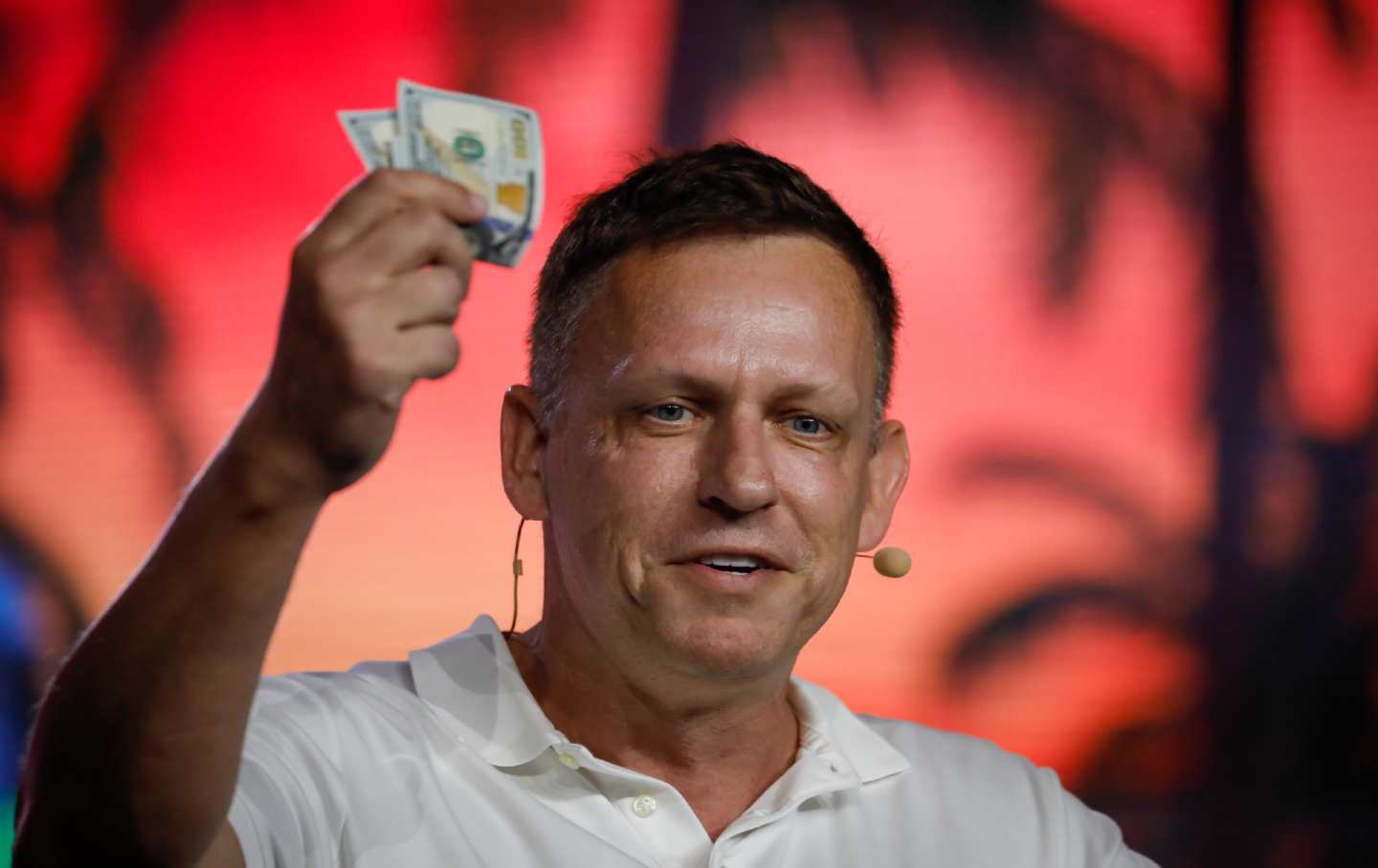
Peter Thiel brandishes $100 bills at the Bitcoin 2022 conference.
(Eva Marie Uzcategui / Bloomberg via Getty Images)It’s easy enough to understand the appeal of Jeffrey Epstein to some in the late pedophile’s vast circle of friends and quasi-friends. The scientists whom Epstein collected like so many Beanie Babies were charmed less by his supposedly witty repartee than by his money; some no doubt were also more titillated than horrified by the stories of his private life. Others in his circle, like Donald Trump and Woody Allen, shared his appreciation for women and not-yet women “on the younger side,” as Trump put it in a now-infamous New York magazine profile of his skeevy partying buddy.
But at first glance, it seems harder to explain the five-year friendship of Epstein and tech investor extraordinaire Peter Thiel, which began in 2014, long after Epstein’s pedophilic tendencies were widely known. Still, Thiel is all over the Epstein files; the two exchanged more than 2,000 messages over the years and met on multiple occasions. Epstein would ultimately invest some $40 million in venture capital funds managed by Valar Ventures, a firm cofounded by Thiel.
You might think that Thiel, who fancies himself a sort of philosopher king of the tech set, would find himself irritated by Epstein’s intellectual playacting. Epstein surrounded himself with academics in hopes that some of their intellectual glamor would stick to him. But what really interested him wasn’t ideas; it was sex, and he was known to regularly interrupt the conversations of his pet scientists with the query “What does that got to do with pussy?” (Needless to say, this is not a question Thiel, the first uncloseted gay speaker at a Republican National Convention, spends much time pondering.)
Thiel, whatever his deficiencies as a thinker, at least does the reading. He regularly pauses his ongoing pursuit of money to issue long and earnest disquisitions on the state of the world filled with learned references to dark philosophers like Leo Strauss and Carl Schmitt, the infamous Nazi apologist who’s undergoing a troubling revival on the groyper-infested MAGA right.
As their email exchanges make plain, Epstein and Thiel shared many of the same obsessions. Both had a certain disdain for the quotidian responsibilities that come with living in a society, like paying taxes: Epstein offered his clients advice on tax avoidance, and moved his operations to the Virgin Islands in part to escape the IRS; Thiel is currently helping to bankroll a campaign against a proposed wealth tax in California and talking about leaving the state in anticipation of steeper tax bills. Both were into life-extension and cryogenics (Epstein allegedly, Thiel for sure), though Epstein, hanging in his cell for a reported two hours after his death, clearly missed the window of opportunity to have his head and penis frozen, as he had evidently desired.
And both men shared a penchant for showing off the human capital their money could buy. Epstein, who seemingly made not the slightest attempt to hide his sexual proclivities from the world, was known to arrive at important academic meetings with a pair of “assistants” in his wake: young Eastern European women with model-level looks who seemed so out-of-place that female staffers at MIT worried (not unreasonably, as it turned out) that they were being trafficked. Thiel is also known for traveling with an entourage of what biographer Max Chafkin calls “disconcertingly attractive” young men, at one point surprising Steve Bannon when he and his entourage showed up at Trump Tower in late 2016 to work with the incoming president’s transition team.
Apart from these affinities of temperament, what really united this odd couple was a common political and ideological project. Both believed that civilization was collapsing and that democratic norms were failing. And both did their part to help bring about these apocalyptic fantasies. In 2016, just after a majority of Britons voted to leave the European Union, a seemingly exuberant Epstein e-mailed Thiel to announce that Brexit was “just the beginning,” hailing the breakup of the UK and continental Europe as a welcome “return to tribalism [and a] counter to globalisation.” It’s not hard to imagine that Thiel, who believes that international organizations are quite literally tools of the Antichrist, might have felt he had found a soulmate at last.
This same ideological alignment seemed to inform their shared enthusiasm for cryptocurrency, which was about far more than making money—though Thiel’s Founders Fund did turn a $20 million Bitcoin investment into a $1.8 billion profit, and managed to sell before one of the digital currency’s many meltdowns. It was about building financial infrastructure outside state control. In 2015, when the Bitcoin Foundation collapsed, a quick infusion of Epstein bucks brought the key developers (and control of the currency) to MIT’s Media Lab, which he partially funded. He met personally with the developers to discuss Bitcoin’s future.
Thiel was even more explicit about crypto’s political purpose. At a 2022 Bitcoin conference, he touted Bitcoin as a shot across the bow of the “finance gerontocracy that runs the country,” declaring that it would never be controlled by the government and throwing $100 bills at the crowd to mock fiat currency. Over the next few years, he also threw money at a number of crypto startups, including Bullish and BitMine Immersion Technologies. Both men saw crypto as a weapon.
For both men, these end-time and antigovernment obsessions were rooted in a shared belief that democracy had failed and needed to be replaced by rule of the capable few. This is where Epstein saw the Brexit revolution headed, and the subsequent consolidation of maximum power around the nihilistic and bigoted tantrums of Donald Trump has drawn the world that much closer to the moment of reckoning he foretold in his note to Thiel.
Epstein was remarkably frank about his Spenglerian outlook. In a 2019 interview with Steve Bannon, he disdained politicians as incapable nothings whose power depended on popularity rather than expertise. “Many of these world leaders become world leaders because they’re popular, but they don’t understand money,” he groused. “They’re not scientists, they’re not intellectuals, they’re not great thinkers. They’re great politicians.” In order to have true “stability and consistency,” we would need to put the world into the hands of businessmen.
Thiel has been equally explicit. In a now-infamous 2009 essay for the Cato Institute, he declared that “I no longer believe that freedom and democracy are compatible.” But he’d made the point in far greater detail in an earlier essay on Strauss, in which he argued that elites must use “esoteric” doublespeak to hide their true intentions from the masses who wouldn’t and shouldn’t understand the plans their natural-born leaders were making for them.
This wasn’t idle theorizing. Both men put substantial resources toward building post-democratic infrastructure: Thiel through Palantir’s surveillance systems and his advocacy of utopian exit strategies like seasteading; Epstein through funding scientists and cultivating government insiders, most notably former Israeli prime minister Ehud Barak.
Thiel genuinely believes the world is entering end times, the literal battle between the Antichrist and what’s called the katechon—the restraining force that holds back apocalypse. Drawing on Schmitt’s concept of the political enemy, Thiel has identified various candidates for this cosmic villain: first radical Islam after 9/11, then the Chinese Communist Party, and most recently “Luddite” environmentalists like Greta Thunberg and anyone else who might put any sort of restraints on technological supremacy. As Paul Leslie notes in a perceptive essay in Salmagundi, the specific identity of the enemy seems to be “less critical to [Thiel’s] purpose than the fact that there is a target.”
Popular
“swipe left below to view more authors”Swipe →In this framework, Epstein wasn’t a liability. He was a fellow accelerationist with useful connections and zero moral restraint. Schmitt convinced himself, at least for a time, that Hitler (yes, that Hitler) was the good katechon holding off the communist Antichrist. So it’s hardly surprising that a Schmittian like Thiel would be able to overlook Epstein’s moral depravity and see him as an ally in the fight against the Antichrist.
When those MIT staffers whispered about whether to intervene to help the Eastern European women Epstein brought to campus, they were witnessing something larger than one man’s depravity. They were seeing the infrastructure of post-democratic power: a convicted predator bringing what appeared to be trafficked women to an elite institution, while that institution took his money to fund Bitcoin developers and AI research.
For his part, Thiel didn’t just tolerate Epstein despite his crimes. He recognized him as a fellow traveler—someone who understood that democracy was ending, that hierarchy needed to be restored, that the masses were incapable of understanding anything about the world they lived in, and that people like them should position themselves at the center of whatever came next.
The difference between them wasn’t moral. It was tactical. Epstein may have preferred to talk about pussy, while Thiel stayed up late pondering philosopher Rene Girard’s concept of mimetic desire. But both were both asking the same question: How do we build a world where people like us have unlimited power and the rules don’t apply? Epstein couldn’t find an answer and died a pariah in a prison cell; Thiel, meanwhile, is continuing to hoard resources and audition katechons for the final battle ahead.
More from The Nation

The Culture of Experts and the Rise of MAHA The Culture of Experts and the Rise of MAHA
The left won’t win over rural Americans by condescending to them.

What’s It Like Inside a Data Center? What’s It Like Inside a Data Center?
Northern Virginia is laden with structures that house data for Fortune 500 companies. I went inside just one of those monstrosities that bothers its neighbors.
What Trump and Tucker Carlson Have in Common What Trump and Tucker Carlson Have in Common
Carlson has broken with Trump largely over the war in Iran. But on Ukraine and immigration, the two speak very much the same language.

The Jewish Case Against AI The Jewish Case Against AI
Haredi rabbis and the secular left agree: This technology is a threat to the entire social fabric.
The Fight for Educational Equality Is Also a Fight for a Just Supreme Court The Fight for Educational Equality Is Also a Fight for a Just Supreme Court
The court has severely weakened our ability to make an education system that fulfills the promise of Brown.
The Fall of “Scientific American” The Fall of “Scientific American”
When the Trump administration objected to the magazine's political coverage, its corporate owners stepped in. Now its future is uncertain.

