Public Health Needs a New Motto: No Apologies, No Surrender
It’s time we stopped flinching at the assaults of the far right—and started fighting back.
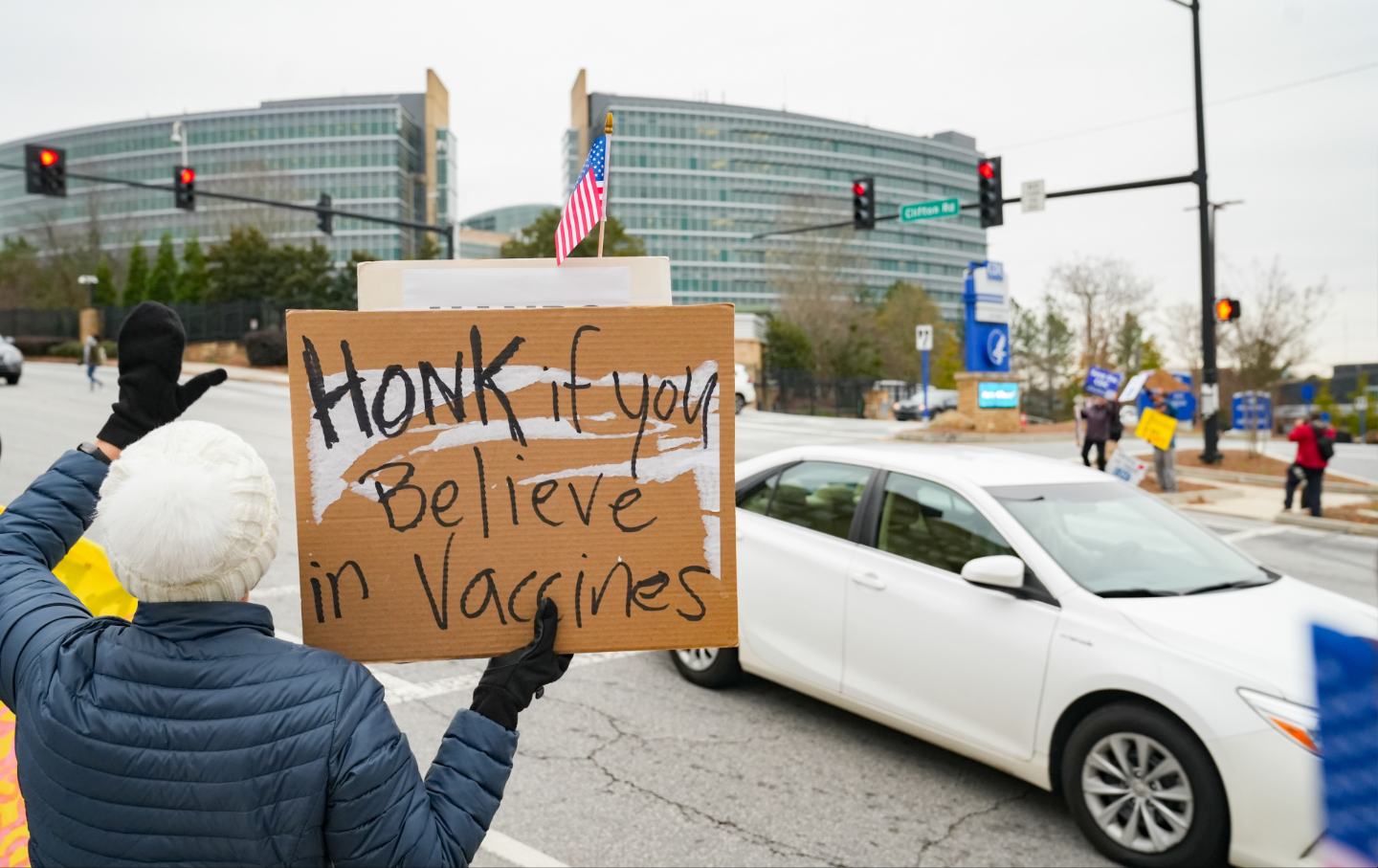
Demonstrators outside the Center for Disease Control (CDC) headquarters in Atlanta, Georgia, US, on Thursday, Dec. 4, 2025.
(Megan Varner / Bloomberg via Getty Images)Over the past year, I’ve noticed a pattern among some of my colleagues in public health, biomedical research, and the university settings in which I work.
It’s a strange, reflexive tic: Faced with bad-faith criticism from malign actors, we shrink back, saying, “Oh, it’s not you. It’s me,” and walk onto their terrain with accommodation in our hearts.
Some may think that, faced with the full fury of the far right, some kind of retreat is the only option. But walking further and further into the mouth of the Leviathan only serves to make you dinner for a very large fish.
In public health, the reigning trope is that over the past five years, we have lost the trust of ordinary Americans, largely coinciding with the response to the Covid pandemic. It’s an uncritical analysis that we eat up like candy—I have been in so many discussions and heard so many talks about how we need to “regain” or “rebuild” trust—and I think we have to stop and reflect for just a moment.
David Wallace-Wells wrote a piece in The New York Times that may indicate that our own conventional wisdom about these matters may be wrong:
The poll, published in The Argument with the headline “The Covid Political Backlash Disappeared,” showed that respondents largely supported mitigation policies, at least in retrospect. Despite conventional wisdom about public health resentment and liberal overreach, mitigation policies do not appear to have disproportionately cost the Democrats, who were graded more positively than Republicans in their handling of the pandemic and rated more highly on matters of personal health; despite criticism about school closures so pervasive that national Democrats now reflexively apologize for them those closures are still seen by most as having been largely necessary at the time; and although the pandemic experience has damaged confidence in vaccines when it comes to routine shots, the country remains pretty anti-anti-vaccine, with 77 percent of respondents telling The Argument’s pollsters they’d advise friends to follow the standard vaccination schedule and only 15 percent saying they’d advise against it.
What Wallace-Wells doesn’t mention here is that much of the conventional wisdom about “public health resentment and liberal overreach” was also the product of a manufactured smear campaign by the right. I’ve written about this before, and Walker Bragman and Alex Kotch have chronicled the far right’s hijacking of the war on Covid since the beginning. Yet too many of my colleagues are like small mammals hypnotized by snakes—mesmerized into submission, in this case, by far-right rhetoric. Yes, we can all agree that public health needs criticism, an analysis of the response to the pandemic included, but we can do better without going belly-up. We’ve got to stop apologizing for the work we do, and take a far less naïve view of the criticisms of public health and separate what is real and substantial from what is ginned-up agit-prop.
While some university presidents (at Michigan, Penn and elsewhere) have rolled back DEI programs, Democratic politicians like Gavin Newsom and Pete Buttigieg have decided that trans Americans are politically expendable, and some liberal pundits like Ezra Klein are pushing for (more) Democratic pro-life candidates, in public health and biomedicine, these are issues on which we have to move from “no apologies” to “no surrender.”
Race, gender, and sexuality may be a third rail of American politics for some, but for those of us in public health and biomedicine, these issues are central to our work, and improving the health and well-being of Americans depends on facing them head-on. Jay Bhattacharya, the director of the National Institutes of Health, has made it a mission to destroy research on health disparities in America, even as he speaks out of both sides of his mouth by praising work “that advances the health and well-being of minority populations.” Thousands of grants for work looking at the interaction of race and health outcomes across the country have been terminated. RFK Jr. has slashed the budget and staffing at offices that address minority health in the US at the National Institutes of Health, the Food and Drug Administration, the Centers for Disease Control and Prevention, the Centers for Medicare & Medicaid Services, the Health Resources and Services Administration, and at the Substance Abuse and Mental Health Services Administration. Yet, as Mary Bassett, the former health commissioner of New York City and now a professor at the Harvard School of Public Health, has said: “There hasn’t been a single year since Colonial America that the population of Black America hasn’t died younger and died sicker than white America.” Research on and programmatic work to rid us of these gross inequities in health outcomes has to remain a priority for us in public health and biomedical research; otherwise, we are practicing a form of apartheid-style science, where only white lives matter.
And this leads us to DEI programs that are meant to ensure that we address the barriers to opportunities in our field. This is an indispensable goal for at least two reasons. The first one is simply pragmatic—we do not know where new insights will come from, so we need to actively recruit talent from every quarter. Pretending that everyone starts their journeys from the same place in our society is farcical. Access to opportunity in the US is tied to race and ethnicity, income, and family background, and it is not a level playing field. As Stephen Jay Gould said in The Panda’s Thumb: “I am, somehow, less interested in the weight and convolutions of Einstein’s brain than in the near certainty that people of equal talent have lived and died in cotton fields and sweatshops.” In a world that has just experienced the worst epidemic in a century, and with the effects of climate change only getting worse, we need everyone off the bench and in the fight. And having a more diverse workforce in public health and biomedicine is important for another reason: There are key discoveries in health disparities that have come from Black and brown researchers, including uncovering the problems with race-adjusted scoring for kidney function, the danger for black mothers of maternal risk algorithms, and the complex issues associated with cardiovascular disease risk assessment among black patients and at the population level, the role of race in disparities in hypertension, diabetes, and all-cause mortality. In infectious diseases, my own field, it was W.E.B. Du Bois himself over a century ago who examined disparities in TB, syphilis, and pneumonia among Black Americans and ascribed these differences to social and economic conditions, discrimination, and racism.
On sexuality and gender? I work in HIV—the termination of grants and programs on LGBTQ health, particularly trans health, endangers lives full-stop. President Trump, in his 2019 State of the Union address, announced his landmark initiative to End the HIV Epidemic (EHE), and later that month the CDC announced that HIV prevention efforts had stalled out—EHE couldn’t have come at a better time. Almost seven years later, Trump has pulled the plug on LGBTQ health. Trans Americans have some of the highest rates of HIV in this country. Comprehensive care, including gender-affirming hormone therapy, is vital in stemming infections among this vulnerable group. Furthermore, gender-affirming care is “an integral determinant of trans people’s well-being.” Throwing trans people under the bus is bad medicine and bad public health and we should speak up on behalf of our trans sisters and brothers and call out attacks on this community when we see it. Trump and his cronies aren’t interested in the health and well-being of trans Americans; they see another set of people to demonize and target. Remaining silent is being complicit in this scapegoating, increasing health risks for close to 3 million of our fellow citizens. Finally, in the wake of Dobbs, millions of women are now at increased risk of suffering and death as abortion becomes illegal in state after state across the country. It’s a well-known epidemiological fact that legally induced abortion is far safer for pregnant people than childbirth. It isn’t even close: “the pregnancy-associated mortality rate among women who delivered live neonates was 8.8 deaths per 100,000 live births. The mortality rate related to induced abortion was 0.6 deaths per 100,000 abortions.” No matter what you personally think about abortion, interfering with the medical care of pregnant people is a bad public health move. Given that close to a quarter of all women in the US access abortion care in their lifetime, state restrictions on this vital part of medical care risk lives.
All of these are issues we must hold the line on, not cave over. The instinct to meet people halfway, to compromise, is not a terrible one. But when compromise is the goal in and of itself, it turns out you stand for little or nothing. In the case of the struggles for the future of public health and medicine in this country, this desire to placate the far right has too many people simply shifting their own views to the right. That is, the compromise isn’t really a compromise at all when it’s a one-way affair; it’s a capitulation. So many millions of lives are at stake right now, thanks to policies coming out of this administration. Giving in is giving these people up. And these people are those we have pledged to serve—whether we’re healthcare workers or on the frontlines of public health. We can try to justify this kind of accommodation in any way we want, but in the end, it’s hard to see it as anything but a Judas kiss.
Support independent journalism that does not fall in line
Even before February 28, the reasons for Donald Trump’s imploding approval rating were abundantly clear: untrammeled corruption and personal enrichment to the tune of billions of dollars during an affordability crisis, a foreign policy guided only by his own derelict sense of morality, and the deployment of a murderous campaign of occupation, detention, and deportation on American streets.
Now an undeclared, unauthorized, unpopular, and unconstitutional war of aggression against Iran has spread like wildfire through the region and into Europe. A new “forever war”—with an ever-increasing likelihood of American troops on the ground—may very well be upon us.
As we’ve seen over and over, this administration uses lies, misdirection, and attempts to flood the zone to justify its abuses of power at home and abroad. Just as Trump, Marco Rubio, and Pete Hegseth offer erratic and contradictory rationales for the attacks on Iran, the administration is also spreading the lie that the upcoming midterm elections are under threat from noncitizens on voter rolls. When these lies go unchecked, they become the basis for further authoritarian encroachment and war.
In these dark times, independent journalism is uniquely able to uncover the falsehoods that threaten our republic—and civilians around the world—and shine a bright light on the truth.
The Nation’s experienced team of writers, editors, and fact-checkers understands the scale of what we’re up against and the urgency with which we have to act. That’s why we’re publishing critical reporting and analysis of the war on Iran, ICE violence at home, new forms of voter suppression emerging in the courts, and much more.
But this journalism is possible only with your support.
This March, The Nation needs to raise $50,000 to ensure that we have the resources for reporting and analysis that sets the record straight and empowers people of conscience to organize. Will you donate today?