
The Pork Oligarchs of Iowa Have Local Politicians in Their Pockets
Jeff and Deb Hansen spend hundreds of thousands to keep the state friendly to their business.
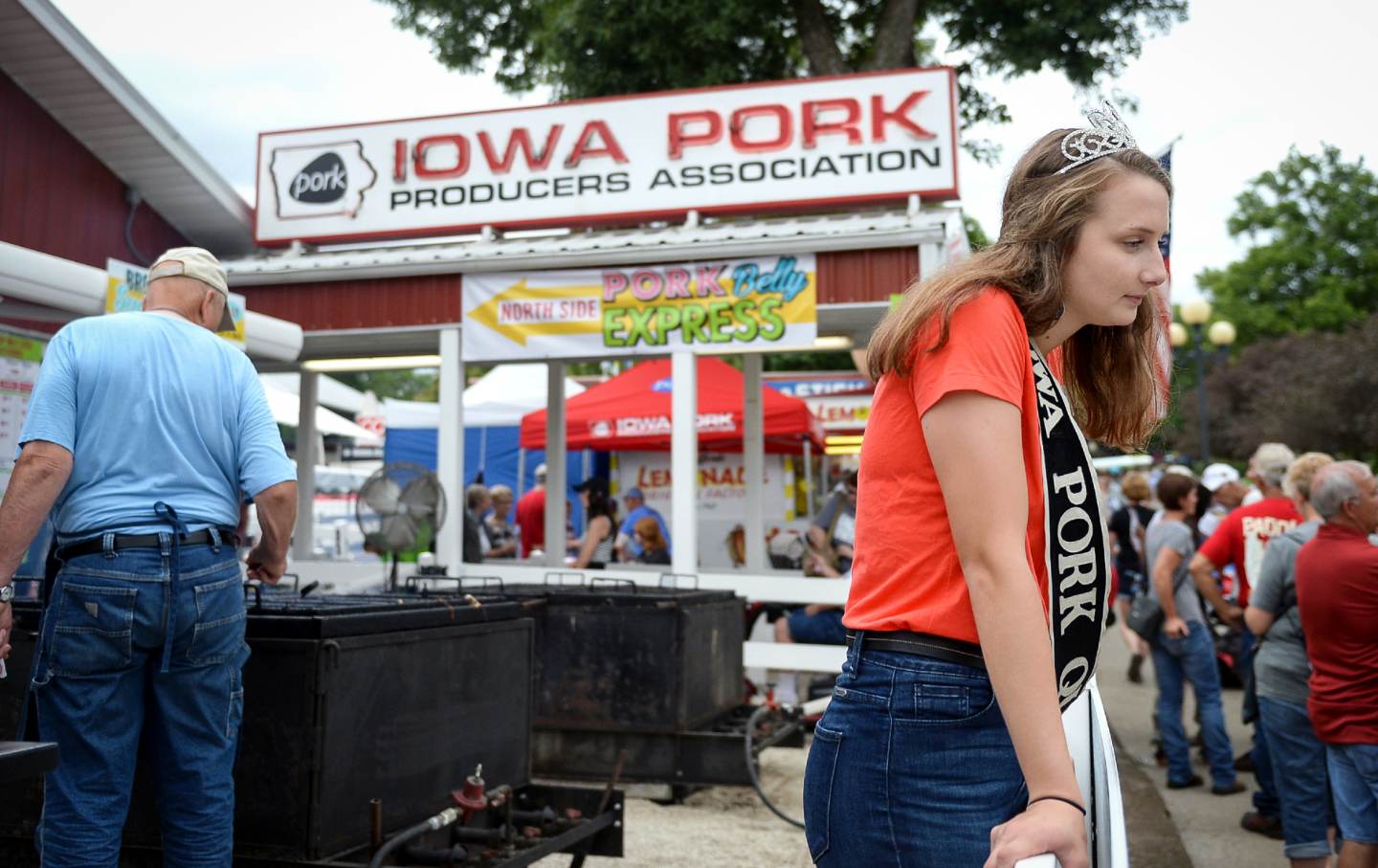
There are about 75 million pigs being raised on farms in the United States, with about a third of that total in Iowa, the nation’s top hog state. Jeff and Deb Hansen founded Iowa Select Farms, now the largest pork producer in the state, in 1992. The Hansens offer a case study in how regional oligarchs can deploy their wealth, political influence, and charitable giving to defend their enterprises from local, state, and federal regulation. Through their capture of Iowa’s political apparatus, the Hansens drive national pork policy.
The pork industry has been consolidating since the 1990s, with a 70 percent decline in the number of farms with hogs, according to the US Department of Agriculture. Large conglomerates have steadily replaced the smaller integrated farms that once used modest amounts of waste from their hogs and other animals as fertilizer.
Watching the consolidation of the poultry industry, the Hansens first became successful manufacturing concentrated animal-feeding operations (CAFOs). Large production sheds, known as “confinements,” hold up to 2,500 sows, which are pumped full of antibiotics to help them survive their cramped, windowless existence. CAFOs generate colossal amounts of manure waste, forming gargantuan anaerobic lagoons that foul the air and pollute local water supplies around the farm.
By the early 1990s, the Hansens’ CAFO business was bringing in $90 million a year. “After steadily expanding their confinement-building business,” writes Iowa native Austin Frerick, the author of Barons: Money, Power, and the Corruption of America’s Food Industry, “the Hansens decided they could also make money by raising their own hogs.” Starting with a herd of 10,000 sows, Iowa Select Farms grew into the country’s fourth-largest hog producer, with roughly 260,000 sows.
You can smell these hog-raising operations from miles away, much to the detriment of their neighbors. In 2003, the company settled a lawsuit filed by residents of Sac County, who complained that a farm with 30,000 hogs produced foul odors, noxious gases, and swarms of flies. An expert witness for the plaintiffs testified that the farm produced as much waste as a city of 90,000 to 150,000 people.
The Hansens’ wealth has since increased, from $272 million in 2024 to an estimated $1 billion in 2026, according to Wealth-X. But from their 7,000-square-foot mansion in a leafy, gated neighborhood in Des Moines, the Hansens don’t notice the excrement. Nor do they smell the manure lagoons from their private jet (rumored to be emblazoned with the name When Pigs Fly).
In 2020, pork prices plummeted as the Covid-19 pandemic disrupted the market. Iowa Select Farms responded by exterminating thousands of hogs. According to The Intercept, the company shut off the CAFOs’ ventilation systems, suffocating and overheating the pigs as ammonia gas from the manure lagoons lingered in the air. Video cameras recorded the death throes of these terrified, sentient animals, and a whistleblower reported being ordered to “euthanize” the surviving pigs with captive bolt guns.
In the 1990s, as the political pressure to regulate CAFOs increased, the Hansens fought to shape legislation in the Iowa Legislature aimed at establishing guardrails for the industry. Passed in 1995, the resulting bill stripped away the power of county boards of supervisors to deny construction permits for CAFOs, a blow to the local control of land use. The law permits CAFOs to be constructed as close as a quarter-mile from residences, a distance that does little to diminish the odor and flies or the environmental harms such as groundwater contamination.
In subsequent years, the Hansens have discouraged the further regulation of CAFOs by donating hundreds of thousands of dollars to politicians. They’ve contributed over $300,000, for example, to Iowa’s Republican governor, Kim Reynolds, making Deb Hansen her top individual donor. They’ve also worked to keep the state’s entire congressional delegation subservient to the pork industry.
As with many other oligarchs, the Hansens’ charitable giving serves as a taxpayer-subsidized extension of their private power. In 2019, Governor Reynolds attended a gala for the Deb and Jeff Hansen Foundation, where she auctioned off a private lunch and tour of the Iowa Capitol with her. The winning bid of $4,250 came from Gary Lynch, another Iowa hog baron and GOP donor. (The largest charitable donation listed by the Hansens’ foundation in its most recent filing is $317,760 to the Iowa Pork Producers Association. The same year, it gave $25,000 to Children’s Cancer Connection.)
Fortunately, some are challenging the Hansens’ exploitative brand of agriculture. In 2018, California voters passed Proposition 12, which establishes baseline animal-welfare standards for farms and for products sold in the state. For example, Prop. 12 mandates cage-free systems for hens and a minimum square footage for breeding sows.
The pork industry has sued multiple times to stop Prop. 12, but in its 5–4 ruling in National Pork Producers Council v. Ross, the Supreme Court upheld the law. The Iowa Pork Producers Association is now attempting to overturn what US Representative Ashley Hinson (R-IA) has called “blue-state bacon bans.” In July 2025, she introduced the Save Our Bacon Act, which would prohibit states from passing laws like Prop. 12. All four members of Iowa’s congressional delegation are sponsors.
In a 2025 op-ed in The Washington Times, Hinson extolled states’ rights. “One of the most effective ways to tackle bureaucratic bloat is to decentralize power from Washington and bring agencies closer to the communities they serve,” she wrote. But the Save Our Bacon Act enshrines the Hansens’ evident lack of concern for public health and animal welfare as the de facto federal standard. Oligarchs and their enablers like to sing the praises of local control—except when it interferes with their power and profits. States’ rights for me, but not for thee.
Become a Sustaining Donor This September
Between the reemergence of right-wing red-baiting and Donald Trump’s use of the chilling National Security Presidential Memorandum–7 to criminalize left political organizing, we’re seeing McCarthyism reborn before our eyes.
This assault on democracy cannot be ignored or wished away. Resisting it requires bravery in the face of threats and repression, a steadfast commitment to the truth, and the unwavering belief that we can—and will—overcome this darkness.
We must have an independent media that sets the record straight, unearths corruption and abuses of power, and advances a politics of justice and dignity for all if we’re to win this fight.
That’s why I’m writing to you today. This September, The Nation needs to add 100 monthly donors to sustain our progressive journalism. Your contribution makes the next investigative report, the next truth-speaking column, and the next pathbreaking essay all possible.
I hope you’ll support our work with a recurring donation today. If you donate $10 or more a month, we’ll send you a brand new “Hands Off the Free Press!” sticker to recognise your commitment to our cause. Please, donate today.
Onward,
Katrina vanden Heuvel
Editor and Publisher, The Nation
More from The Nation

How Trump’s Crackdown on Speech Has Damaged the Student Press How Trump’s Crackdown on Speech Has Damaged the Student Press
I serve as editor in chief and president of The Stanford Daily. Our newsroom has keenly felt the effects of Trump’s campus crackdown, which is why we sued the federal government.

Nationalize Spotify Nationalize Spotify
Music streaming platforms have way too much control over musicians and music lovers. It’s time to rein them in.

What’s the Matter With Effective Altruism? What’s the Matter With Effective Altruism?
President Trump has decried the techbro creed for indulging in AI doomerism, but its excesses are far worse than that.

As Morale Sags, More Military Service Members Are Having a Crisis of Conscience As Morale Sags, More Military Service Members Are Having a Crisis of Conscience
According to multiple GI rights organizations, service members are inquiring in unprecedented numbers about seeking conscientious objector status.

What Remains of Riis? What Remains of Riis?
A new members’ club has revived Riis Park’s long-vacant bathhouse, reopening old questions about whom the People’s Beach is really for.

When Texas Sex Ed Falls Short, Gen Z Women Turn to Social Media When Texas Sex Ed Falls Short, Gen Z Women Turn to Social Media
A 2025 study found that 70 percent of adolescents sought reproductive health information through social media platforms.

