Covid Contrarianism Has Crossed the Aisle
The Great Barrington Declaration, criticized by scientists and libertarians in 2020, is now a playbook for those on the right and the left.
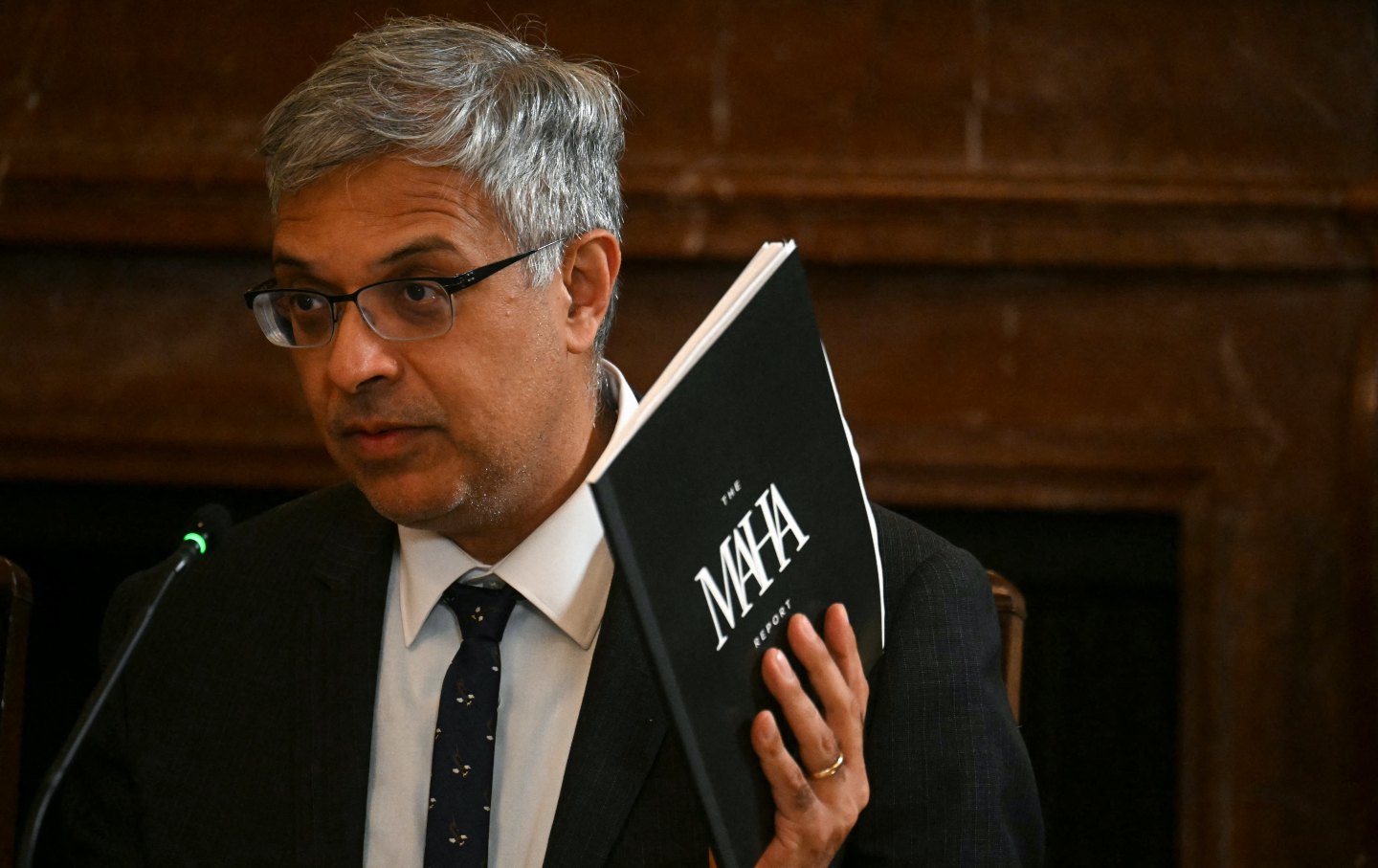
Director of the National Institutes of Health Dr. Jayanta Bhattacharya holds up a copy of a MAHA (Make America Healthy Again) health report during a MAHA Commission Event.
(Jim Watson / Getty Images)Idon’t like to linger on the past, nor do I enjoy fighting old battles when there is so much to do right now. But I stumbled upon a strange piece this past weekend on a garden party in the United Kingdom for Curtis Yarvin, the crank philosopher who seems to be everyone on the techno-fascist right’s—from JD Vance to Peter Thiel to Marc Andreessen—favorite person at the moment. The author of the piece on Yarvin tells us cheekily: “the thing about this new scene: you don’t have to be uncool to be rightwing anymore.” Reading the article with my mouth agape, I stumbled across these concluding words: “While the alt-right largely came about as a reaction to the excesses of a relatively small group of ‘social justice warriors,’ the dissident right has sprung up in the aftermath of the massive social experiments of 2020-21: enforced mass lockdowns, enforced vaccination, enforced white guilt.”
While the entire tale reads like some of the revelers may be pining for the real party days at Berghof in Berchtesgaden, the invocation of the pandemic as the origin story of the “new, new right,” is worth digging into, even if it means we have to dig up memories we’d rather forget.
By now, it’s clear that the Trump administration’s bureaucrats on health are filled with ranks of Covid contrarians, from Jay Bhattacharya at NIH, to Marty Makary at FDA, even if the strings are being pulled by Christian nationalist and sadist Russ Vought at OMB and a baby-bear-dumping lesser Kennedy at HHS.
Though the Covid contrarians now in power style themselves as free-thinking iconoclasts—Galileos for the 21st century, their participation in the absolute gutting of the NIH and other federal health agencies, the dismantling of the US’s vaccination programs from top to bottom, and the installation of cranks and grifters to key committees on clinical care and public health shows them to be something quite less heroic: a mix of Lysenko and the Gang of Four, with a taste for pseudo-science, vengeance, and political purges. To stay with the garden party theme—you don’t linger at the affair unless you like what is being served and enjoy the company. It’s clear these fellas are all in.
And this is where things get weird. Look around the party and you may see some of your friends. For the past year, Covid contrarianism has been getting a revival in the most unlikely circles—among the liberal cognoscenti. For scientists watching in dismay, it’s a rewriting of history. The story goes something like this: We overreacted to Covid; only the old and infirm were ever vulnerable; the measures taken, particularly what we call non-pharmaceutical interventions, such as social distancing and surgical masks, didn’t work; and we should have been far less stringent in our approach. This of course is high-Covid contrarianism, recycling the Great Barrington Declaration, which was criticized by scientists and even the prominent libertarians you might have expected to support it in 2020, but in 2025 is the ur-text for a lot of what is being written now. Today, Bhattacharya and his friends who authored the Great Barrington Declaration have more fans than ever not only on the right but also among the left-of-center, with no greater champions than Steven Macedo and Frances Lee at Princeton University, whose book, In COVID’s Wake, has been celebrated by many who should know better. Macedo and Lee were enthusiastic champions of Bhattacharya’s nomination as NIH director, certain that he got things right all along, proclaiming in their endorsement:
If the country had had more scientific leaders like Dr. Jay Bhattacharya—and more who were willing to listen to him—our policymaking could have been based more on evidence and less on hubris. During the pandemic democracy’s “truth-seeking” institutions were infected by politics, partisanship, and dogmatism. What we need now is a strong dose of fresh thinking and institutional reform from experts prepared to challenge the reigning consensus and renew our commitment to the basic values of science and liberalism.
But here’s the rub. The assumptions and conclusions of the Great Barrington Declaration were wrong in 2020 and are still wrong in 2025. When Macedo and Lee were challenged on the substance of their critiques by actual epidemiologists and clinicians in a prominent literary journal, the Boston Review, they dug in, suggesting there is no proof that anything outside of vaccination saved lives during the pandemic and that mitigation efforts did more harm than good. There is no debate here for them: They are certain they are right. Perhaps an ounce of humility and uncertainty might be in order here. Studying what happened during the pandemic has methodological challenges for a start, and there is an enormous amount of literature that tries to measure the effects of mitigation efforts that they casually dismiss. Making categorical claims should raise suspicions, particularly in scientific discourse.
In the Boston Review’s roundtable, Macedo and Lee’s claims starts to circle back in on themselves, relying only on those sources who already share their opinions, including Bhattacharya’s co-authors on a debunked seroprevalence study and a journalist who was part of the official video for the launch of the Great Barrington Declaration in 2020. In their rebuttal to their critics, they hang particular credibility on 2024 study by Bhattacharya’s Stanford peer Eran Ben-David, which, according to this duo, represents the “most credible datasets tracking the pandemic around the world and [which aims] to give an authoritative assessment of how the imposition and lifting of restrictions affected outcomes within those jurisdictions.” Yet this study raised more than few eyebrows when it came out leading one of Ben-David’s other Stanford peers to retort:
While we identify multiple potential errors and sources of biases in how the specific analyses were undertaken that are also relevant for other studies employing similar approaches, our most important finding involves constructing a counterexample showing that causal model specification-agnostic multiverse analyses can be incorrectly used to suggest that no consistent effect can be discovered in data especially in cases where most specifications estimated with the data are far from causally valid.
Far from authoritative, this counterpoint raises questions about the soundness of the methodologies used by Ben-David and points to Macedo and Lee’s overconfidence in their own judgment on the evidence. When Macedo and Lee bring up “the widespread suppression of the possibility—now likelihood—that the virus spilled out of a lab,” which simply isn’t supported by the data, it’s clear this is a case of sophisticated, motivated reasoning, wrapping up all the Covid contrarians’ greatest hits tied with a pretty bow of a Princeton pedigree. For Macedo and Lee, the Covid contrarians were right about everything.
So why bring all this up now? I think the pandemic helped lift the fortunes of the new, new right—but not in the way you might think. From the start, far-right and conservative donors and think tanks were keen to exploit the trauma of the pandemic for political gain. Walker Bragman and Alex Kotch were covering this as early as 2021 and walk through in detail how conservatives were eager to shape the debate on the Covid response, on masking, school closures, stay-at-home orders. In addition, many of the Covid contrarians, including Bhattacharya, used the pandemic to build their relationships to the new, new right and found a new home among them. The Great Barrington Declaration was a product of this conservative coming together, propped up by the American Institute for Economic Research and the Brownstone Institute, and championed by far-right Jeffrey Tucker, who when not complaining about Covid restrictions was waxing sentimental about child labor and cigarettes for teens.
But over the past few months, we’ve had commentators on the right, in the center, and on the center-left praising In COVID’s Wake as a must-read and reiterating the associated talking points as a revelation. In doing this, they have helped to make public health and biomedicine into a scapegoat for a nation’s trauma. Instead of focusing on the effects of a virus, we’ve found something more human to blame—the scientists and public health officials who “got it all wrong.” After a gunman shot nearly 500 rounds of ammunition into the Centers for Disease Control and Prevention last week, it’s clear that the demonization of the experts from the Covid contrarians and their supporters doesn’t just undermine our nation’s public health response; it can also lead to political violence.
It doesn’t take much convincing to make the case that the Covid pandemic was a national tragedy. Over a million people are dead, and the pandemic continues to sicken, disable, and kill. Five years on, it is not like the common cold. It’s akin to having another year-round flu epidemic always with us. And yes, our response to the pandemic was and has been muddled and is nothing to crow about. Remember, we had the highest per-capita excess deaths among the G7. Yet it is hard to believe that in 2025, we have pundits keen to “look back at a deadly pandemic and ask, ‘could we have done even less?’” Macedo and Lee will surely say they were just offering up some hard truths, but given the scientific critiques of their analyses, the long-standing critiques of those they cite, the reliance on a distorted history of those early months of the pandemic, and finally their deep cuts from the Covid contrarian playbook, their work is more of an exercise in clever ideological recycling than scholarship. As with the garden party in Surrey, they’ve proved that “you don’t have to be uncool to be rightwing anymore.” Everybody is invited into the club.
Become a Sustaining Donor This September
Between the reemergence of right-wing red-baiting and Donald Trump’s use of the chilling National Security Presidential Memorandum–7 to criminalize left political organizing, we’re seeing McCarthyism reborn before our eyes.
This assault on democracy cannot be ignored or wished away. Resisting it requires bravery in the face of threats and repression, a steadfast commitment to the truth, and the unwavering belief that we can—and will—overcome this darkness.
We must have an independent media that sets the record straight, unearths corruption and abuses of power, and advances a politics of justice and dignity for all if we’re to win this fight.
That’s why I’m writing to you today. This September, The Nation needs to add 100 monthly donors to sustain our progressive journalism. Your contribution makes the next investigative report, the next truth-speaking column, and the next pathbreaking essay all possible.
I hope you’ll support our work with a recurring donation today. If you donate $10 or more a month, we’ll send you a brand new “Hands Off the Free Press!” sticker to recognise your commitment to our cause. Please, donate today.
Onward,
Katrina vanden Heuvel
Editor and Publisher, The Nation