
Jesse Jackson Jr. Summons His Father’s “Consistent Prophetic Voice”
“He took the ministry from Sunday morning, and he delivered it to the people,” the younger Jackson said.
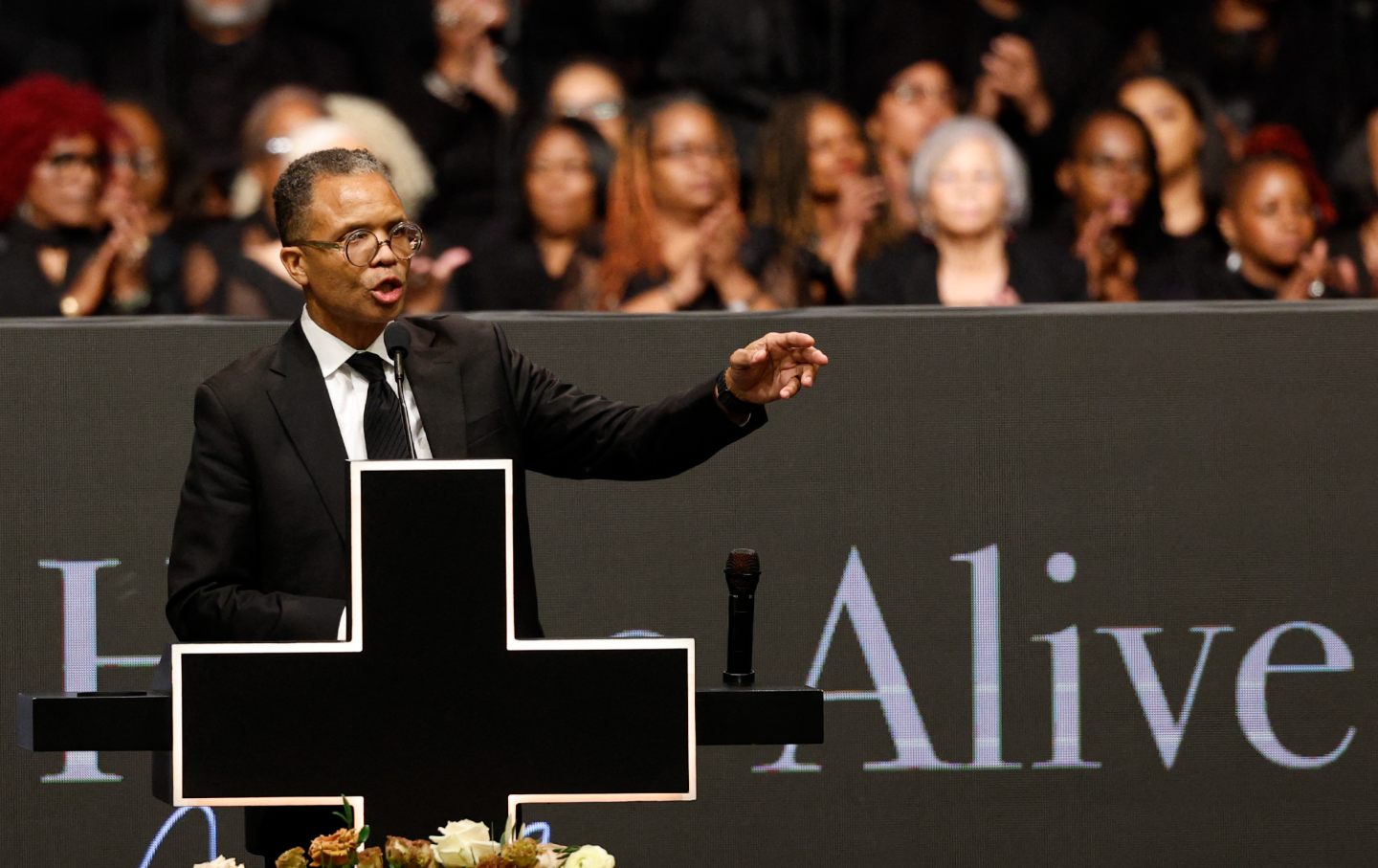
Jesse Jackson Jr. speaks at a public memorial service to celebrate the life of his father, the civil-rights activist Rev. Jesse Jackson, in Chicago, on March 6, 2026.
(Kamil Krzaczynski / AFP via Getty Images)Chicago—The most compelling message to be delivered during last week’s memorial services for the late Rev. Jesse Jackson came from the firstborn son of the veteran civil rights leader, who ushered in a new era of American politics with his 1984 and 1988 presidential campaigns.
During two remarkable days of eulogies, prayers and gospel music—beginning with Friday’s “People’s Celebration” at the 10,000-seat arena of the House of Hope church on Chicago’s South Side, and concluding with a more intimate gathering on Saturday at the headquarters of Jackson’s Rainbow Push Coalition—crowds listened to extensive remarks by former presidents Bill Clinton, Barack Obama, and Joe Biden, heard heartfelt reflections from pastors who had preached with the reverend for decades, and greeted visionary statements from Chicago Mayor Brandon Johnson and international leaders such as South African President Cyril Ramaphosa with warm and sustained applause. Yet it was former representative Jesse Jackson Jr. who went to a deeper place and captured his father’s legacy with a message that will linger.
Jackson Jr. recognized the full scope and character of his father’s mission as the country preacher who brought “a consistent prophetic voice” to struggles for economic, social, racial justice, and peace, over the course of more than six decades in the public eye. In a pair of addresses that were deeply rooted in his own Christian faith, and in his sense of urgency regarding the challenges facing forgotten people in both the United States and places such as Gaza, the younger Jackson spoke of his father as a transformative figure not merely in politics but in the daily lives of the Rainbow Coalition of humanity that he sought to raise up.
“He took the ministry from Sunday morning, and he delivered it to the people,” Jackson Jr. said of his father, a Baptist minister who urged millions of disenchanted and disenfranchised Americans to recognize that “I am somebody!”
“‘I am somebody’-ness is what Jesse Jackson is known for, not the ‘84 and ‘88 campaign and voter registration,” he said on Friday. “Jesse Jackson’s greatest contribution is not political. It is psychological.”
To illustrate the profound psychological impact of his father’s “Keep Hope Alive!” ministry, Jesse Jackson Jr. recalled the writings of philosopher and theologian Howard Thurman about his life in the segregated South of the early 20th century. The great thinker’s autobiography, With Head and Heart, is dedicated to an older Black man in overalls who encountered the young Thurman in a moment of desperation at a Southern train station. Thurman had been told that he needed a second ticket, which he could not afford, to bring along a case filled with his belongings—“the broken pieces of his life”—on the journey that was supposed to take him from Jim Crow Florida toward all the possibilities that extended from higher education. The older man pulled coins from his own pocket, bought the second ticket, and sent Thurman off to college and a distinguished career as a minister, academic, and author who profoundly influenced the Rev. Martin Luther King Jr. and other leaders of the civil rights movement. The theologian never got the man’s name, so his dedication read, “To the stranger in the railroad station in Daytona Beach, who restored my broken dream 65 years ago.”
For millions of Americans, and millions more around the world, said Jackson Jr., “the stranger came in the form and in the embodiment of Jesse Jackson…who restored our hope and changed the trajectory of our lives.”
That was a beautiful statement.
But the younger Jackson, who spoke movingly on Saturday about his own struggles in life, including health challenges and a federal investigation that derailed his political career and led to his incarceration over a decade ago, did not stop there.
Popular
“swipe left below to view more authors”Swipe →Even as he is mounting a strong campaign to return to Congress–in a March 17 Democratic primary for his old Second Congressional District representing Chicago’s South Side and suburban and rural communities that extend beyond it—Jackson Jr. rejected the politically cautious path. Instead, he recalled how his father had pressured presidents and senators, CEOs and billionaires, to do more for the people, at home and abroad, who did not share the power and wealth of the elites.
“To the political class that took up most of his time, Dad was a stranger awaiting a return phone call, reminding the political class of the urgency of the hour. That’s who my daddy was,” the younger Jackson said on Friday. “To the economic class…on Wall Street…he was the stranger.”
On Saturday, Jesse Jackson Jr. was even blunter.
While he gave warm and appropriate praise to a brilliant reflection on the life and legacy of their father by his younger brother, US Representative Jonathan Jackson (D-IL), Jackson Jr. offered a sharper review of the long-winded remarks from the former presidents who had spoken the day before.
“Yesterday I listened for several hours of three United States presidents who do not know Jesse Jackson,” he said, to knowing applause from the hundreds of civil rights movement veterans and Rainbow Coalition allies of the reverend who had gathered at the Rainbow Push headquarters. Speaking of his father, Jackson Jr. added, “He maintained a tense relationship with the political order, not because the presidents were white or Black, but the demands of our message, the demands of speaking for the least of these—those who are disinherited, the damned, the dispossessed, the disrespected—demanded not Democratic or Republican solutions, but demanded a consistent, prophetic voice that at no point in time sold us out as a people.”
That was not a narrow, politically calculated statement. Rather, it was a broad declaration of human truths—the truths that the Rev. Jesse Jackson made central to a long and generous mission that uplifted the lives of those who needed him most.
More from The Nation

What Are Democrats Prepared to Do if Trump Rigs the Election? What Are Democrats Prepared to Do if Trump Rigs the Election?
In this week’s Elie v. U.S, our justice correspondent challenges Democrats' lack of a plan if Trump steals the midterms. Plus: the most racist, and honest, AI add ever.

Ramaswamy’s Guide to a Better Vocabulary Ramaswamy’s Guide to a Better Vocabulary
Quotes of the Week.
Why Trump Is Embracing Vivek Ramaswamy’s Vile Ad Why Trump Is Embracing Vivek Ramaswamy’s Vile Ad
The president is leaning into the politics of toxic parenting.

The Shadow Knows The Shadow Knows
High-tech weapons, low-tech intelligence.
Tom Hayden’s Legacy and the New American Left Tom Hayden’s Legacy and the New American Left
It’s been 10 years since he passed away.
The Decades-Long Battle Within the Democratic Party Establishment Between the Heirs of Dean Acheson and Franklin Roosevelt The Decades-Long Battle Within the Democratic Party Establishment Between the Heirs of Dean Acheson and Franklin Roosevelt
The calamitous history of America’s wars of choice.

