
Prison Journalism Is Having a Renaissance. Rahsaan Thomas Is One of Its Champions.
Thomas and his colleagues at Empowerment Avenue are subverting the established narrative that prisoners are only subjects or sources, never authors of their own experience.
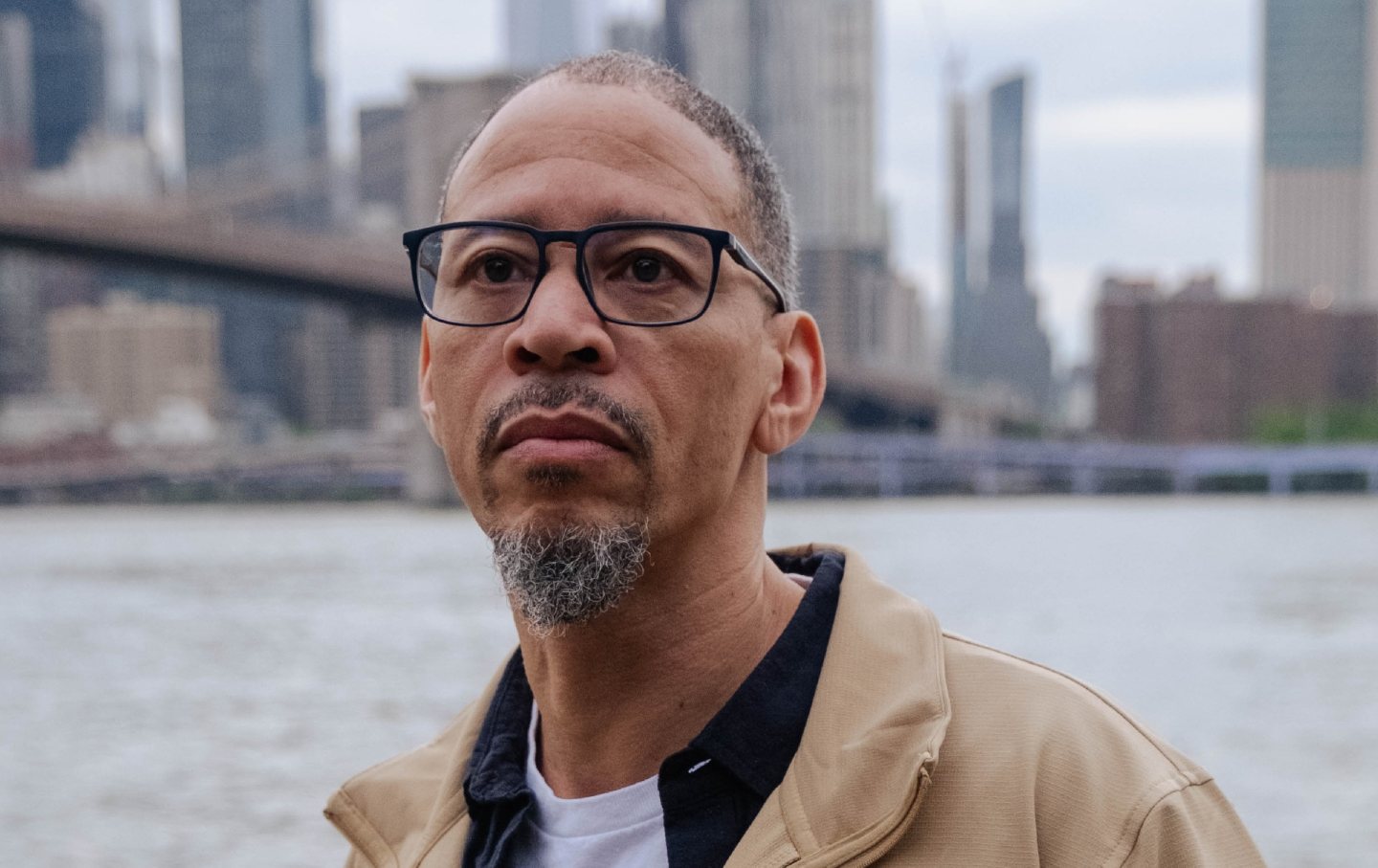
Rahsaan “New York” Thomas.
(Daniel Emunah)
On a sun-drenched Friday afternoon at the Museum of the African Diaspora in downtown San Francisco, the writer, podcaster, and filmmaker Rahsaan “New York” Thomas and I stand in front of a series of arresting portraits of black women, young and old, that the artist Mary Graham has painted on brown paper bags.“This is fire,” Thomas murmurs. He’s struck by the forthright gaze of the women in the portraits, “just how strong the faces are.”
When Thomas curated his first show with the museum in 2020, the only way he could experience the results of his work was by looking at photos and transcripts that his cocurator had printed out and sent to his cell at San Quentin State Prison. He was also able to learn about the response to his show through press coverage of it, one of the few opportunities for incarcerated people to vicariously experience the outside world. He had long believed that the reverse could be true, too: Incarcerated people’s writing, like the articles being produced at the San Quentin News, the monthly prison newspaper where he worked, might lead people on the outside to consider what goes on within prison walls. It had before—in 1970, the revolutionary writer George Jackson’s Soledad Brother, published while Jackson was at the same lockup where Thomas found himself half a century later, had caused a global sensation. But there were a few challenges, to put it mildly: communications services controlled by for-profit companies that charge exorbitant fees; the defunding of prison education programs; the institution’s capacity for surveillance and retaliation; little access to the sort of mainstream platforms that might reach an average reader; and a host of other barriers that effectively silence the 1.9 million people locked up in the United States on a given day.
Enter Empowerment Avenue, the collective Thomas started with the New York–based journalist Emily Nonko to connect incarcerated writers and artists to newspapers, magazines, art galleries, and museums like MoAD on the outside, is an effort to break down those barriers. It also helps to get them compensated fairly for their labor, a radical act in a system that usually pays prisoners just a few dozen cents an hour.
“When we started in 2020, there were very few publications that were looking for writing from incarcerated people, and there might have been none looking for reporting,” Nonko tells me over the phone. But just four years later, prison journalism is having a bit of a renaissance. Incarcerated writers are winning prestigious fellowships and appearing regularly in places like The New Yorker and Esquire; last year, Thomas’s former San Quentin News colleague Juan Moreno Haines, a talented investigative reporter, was named editor in chief of the publication Solitary Watch. That’s owing in no small part to Empowerment Avenue, which has helped everything from leftist magazines to traditional daily newspapers expand their notion of who can and should be contributing to their publication. Still, Nonko says, it’s an ongoing battle to ensure that writers are paid fairly and to convince editors to accept investigative reporting from incarcerated journalists in addition to personal essays. Earlier this year, for example, Empowerment Avenue publicly confronted The Guardian after discovering a new policy prohibiting commissions from behind bars.
Empowerment Avenue’s Visual Arts for Liberation program is run by Thomas’s colleagues Christine Lashaw and De’jon Joy, who are also milling around the gallery. Earlier this year, the organization held its second online exhibit with MoAD, a group show curated and populated with work by artists at California’s largest women’s prison. Lashaw, a longtime curator at the Oakland Museum, wants to eventually use the room Thomas and I are standing in, with the brown paper bag portraits, in a dedicated showcase for emerging artists. “We’ve been trying to figure out how to get off the Internet and onto the walls here,” she tells me.
Graham’s portrait series, Value Test: Brown Paper, references the old shibboleth that determined entry to a certain echelon of black society: only those with skin lighter than a paper bag. Thomas tells me that while his own light complexion granted him privileges that darker-skinned family members lacked, he also grew up being mocked as white by his peers—all the while suffering the same discrimination they did, simply because they grew up in a neighborhood like Brownsville. “The zip code 11212—that excludes me from opportunity. It makes car insurance costs three times more. It means no to housing. It means no to credit cards,” he says. “You’re being smacked around by obstacles that are invisible but every much as real as a solid brick wall.” Making art, he realized, could be an antidote to that sense of total exclusion that many in prison experience. It could also do something more tangible: provide people the chance to save some money so they’re not getting released, as he puts it, “in a desperate situation of $40 and a bus ticket and ‘Good luck out there.’”
If you’re not behind bars, art and writing are, of course, two of the least stable and lucrative ways to make a living. (“The art market is a beast that’s hard to crack whether you’re inside or outside of prison,” Lashaw says wryly.) The irony is that in prison, in California at least, those are the only two ways you can get paid, really paid—not just the $36 per month that Thomas used to make for his work at the San Quentin News.
Cognizant of this loophole, Thomas started freelancing for publications on the outside around 2014. One day in 2018, a friend convinced him to talk with a girl from New York who was at San Quentin for a breast cancer awareness walk. Nonko and Thomas hit it off. “She immediately wanted to figure out how to get us on bigger platforms, because we were just preaching to the choir [with the prison newspaper],” he recalls. With Nonko’s support, Thomas quickly began placing articles in mainstream publications, writing on everything from Covid to the role of “accountability” in the criminal legal system. His sentence was commuted in 2022, and by the time he came home the following February, he had been able to save enough money from freelancing to land on his feet and launch Empowerment Avenue as an independent organization.
The collective’s central task is to assist with the more pedestrian logistical challenges of trying to establish a career as a writer or artist while incarcerated: navigating prison communication apps like JPay, handling edits when your writer doesn’t exactly have access to Google Docs. (Nonko manages a team of volunteers, while, for now, Joy and Lashaw work directly with their cohort of 15 artists.) But the challenges are not purely practical. “They’re doing time. They’re trying to go to parole. There may be suffering in a multitude of different ways,” Joy tells me. “And so trying to work with somebody in that space, and also be there to hold space for them…we become kind of surrogate family.”
“They’re friends,” Lashaw says of the incarcerated artists she works with.“There’s no other way to do the work.”
Lashaw first encountered Thomas when she came into San Quentin with a group of curators. (“I knew once I saw the purple hair she’d be a perfect match,” he says, laughing.) Thomas and Joy met around the same time, when Joy came to work briefly at the San Quentin News before switching over to the prison’s coding program. The two seem to complement each other’s personalities: Thomas is animated and charismatic, bounding about the gallery cracking jokes and pacing out the approximate size of the prison hallway turned recording studio where he helped produce the hugely successful podcast Ear Hustle. Joy, laconic and measured by comparison, spends several minutes contemplating a work by Winfred Rembert, an artist who grew up in Jim Crow–era Georgia and was later imprisoned and forced to work on a chain gang. “Inside, we were always trying to find a way to work together,” Thomas says. They schemed up a TV pilot exploring the dynamics inside the prison’s media center (“There was just a lot of drama,” Joy explains), but it never got off the ground. After Thomas went home in November 2022 and started Empowerment Avenue, Joy learned that the organization had an open internship. After checking in with Thomas—“Would it be weird?” Joy remembers asking him—he came on board.
The three have an easy rapport that belies the fact that most of their work is online. At one point, the four of us cluster together inside a dark, narrow hallway, studying a vintage gumball machine filled with cowrie shells—Good Luck Totem, by the Nigerian Canadian artist Oluseye—as Lashaw muses on interactive exhibition design. When she tries the lever, a handful of shells shoot out, and she tries in vain to stuff them back inside as Joy and Thomas giggle. “CUT! CUT!” Thomas says, snapping into director mode. “Careful, Christine—I’m still on parole.”
Popular
“swipe left below to view more authors”Swipe →Joy and Thomas both go back to San Quentin regularly. “Half our artists are there,” Joy notes. He’s been home 18 months, and the first time he walked through the prison’s gates again was nerve-wracking. Now, he says, “it’s not San Quentin to me anymore. When I go in, it’s more about the brotherhood.” Thomas abides by the philosophy that everyone who gets out of prison should help free three more people. In a given week, he’s writing letters of support for friends inside, helping people navigate the parole process, or contacting lawyers on their behalf. “When I go in I’m bringing hope. I’m bringing updates,” he tells me. “I’m letting them know we’re not forgetting y’all.”
Empowerment Avenue’s remit is not explicitly political, and yet Thomas, Nonko, Joy, and Lashaw see their work as one arm of a larger struggle for liberation. To pick up your morning paper or walk into an art gallery and be confronted with the direct testimony of one of the millions of people in this country confined behind bars—it subverts the established narrative that prisoners are only subjects or sources, never authors of their own experience. Who knows what that might lead to? “Advocacy is in our heart—we want to protest, we want to rage against the machine, we want to let people know,” Thomas says. “The best way to do it is just tell the story.”
Support independent journalism that does not fall in line
Even before February 28, the reasons for Donald Trump’s imploding approval rating were abundantly clear: untrammeled corruption and personal enrichment to the tune of billions of dollars during an affordability crisis, a foreign policy guided only by his own derelict sense of morality, and the deployment of a murderous campaign of occupation, detention, and deportation on American streets.
Now an undeclared, unauthorized, unpopular, and unconstitutional war of aggression against Iran has spread like wildfire through the region and into Europe. A new “forever war”—with an ever-increasing likelihood of American troops on the ground—may very well be upon us.
As we’ve seen over and over, this administration uses lies, misdirection, and attempts to flood the zone to justify its abuses of power at home and abroad. Just as Trump, Marco Rubio, and Pete Hegseth offer erratic and contradictory rationales for the attacks on Iran, the administration is also spreading the lie that the upcoming midterm elections are under threat from noncitizens on voter rolls. When these lies go unchecked, they become the basis for further authoritarian encroachment and war.
In these dark times, independent journalism is uniquely able to uncover the falsehoods that threaten our republic—and civilians around the world—and shine a bright light on the truth.
The Nation’s experienced team of writers, editors, and fact-checkers understands the scale of what we’re up against and the urgency with which we have to act. That’s why we’re publishing critical reporting and analysis of the war on Iran, ICE violence at home, new forms of voter suppression emerging in the courts, and much more.
But this journalism is possible only with your support.
This March, The Nation needs to raise $50,000 to ensure that we have the resources for reporting and analysis that sets the record straight and empowers people of conscience to organize. Will you donate today?
More from The Nation

The Real Reason Americans Love Guns The Real Reason Americans Love Guns
With a weak social safety net, a gun offers a false sense of personal power and security.

The Endless Hypocrisy of Bari Weiss The Endless Hypocrisy of Bari Weiss
She claims to be a free speech champion. But as her actions at CBS News keep showing, she seems to think free speech should run only in a rightward direction.
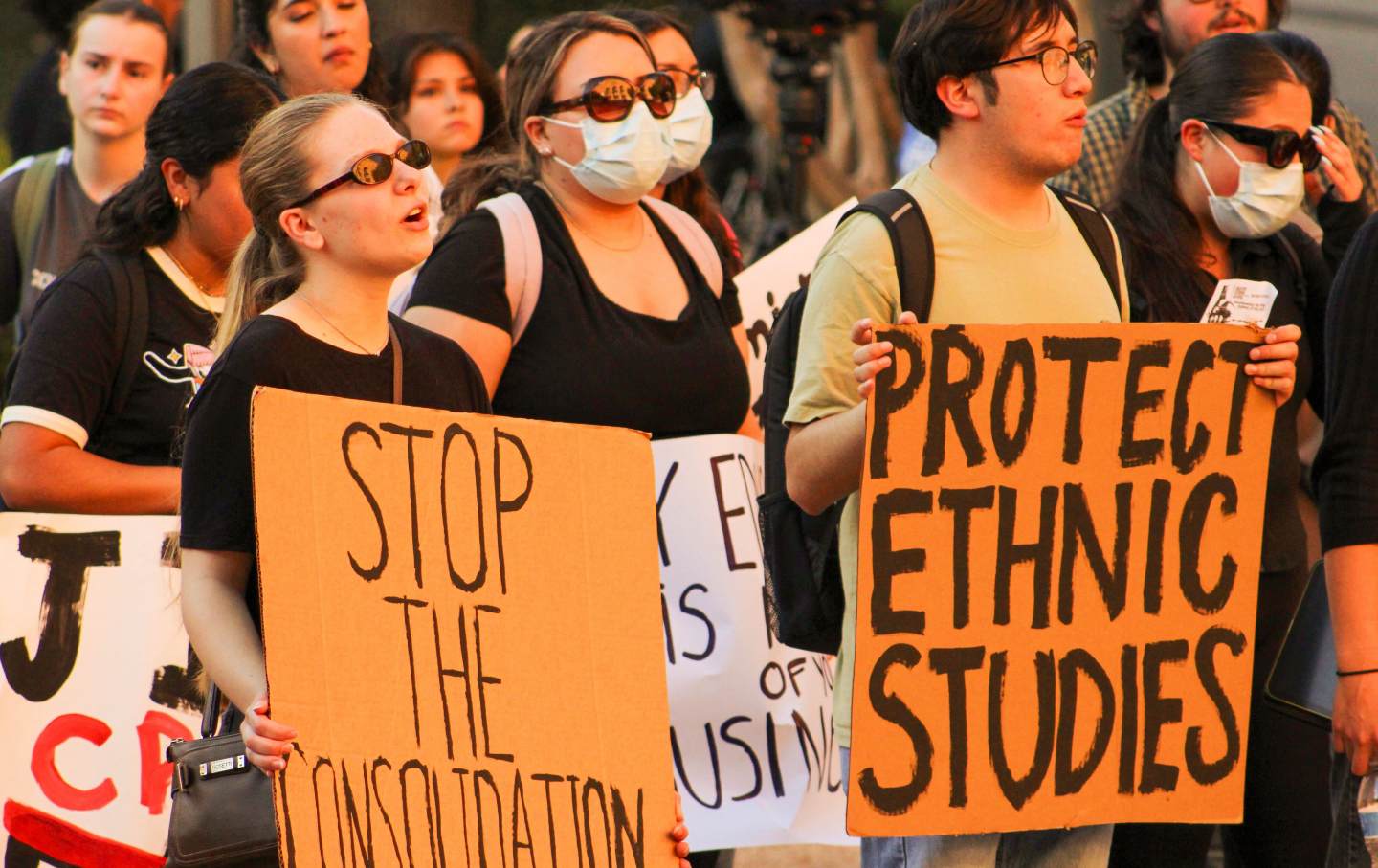
What Will Be Left After the University of Texas Destroys Itself? What Will Be Left After the University of Texas Destroys Itself?
UT-Austin has collapsed its race, ethnic, and gender studies into a single program while a new policy asks faculty to avoid “controversial” topics. But the attacks won’t end there...
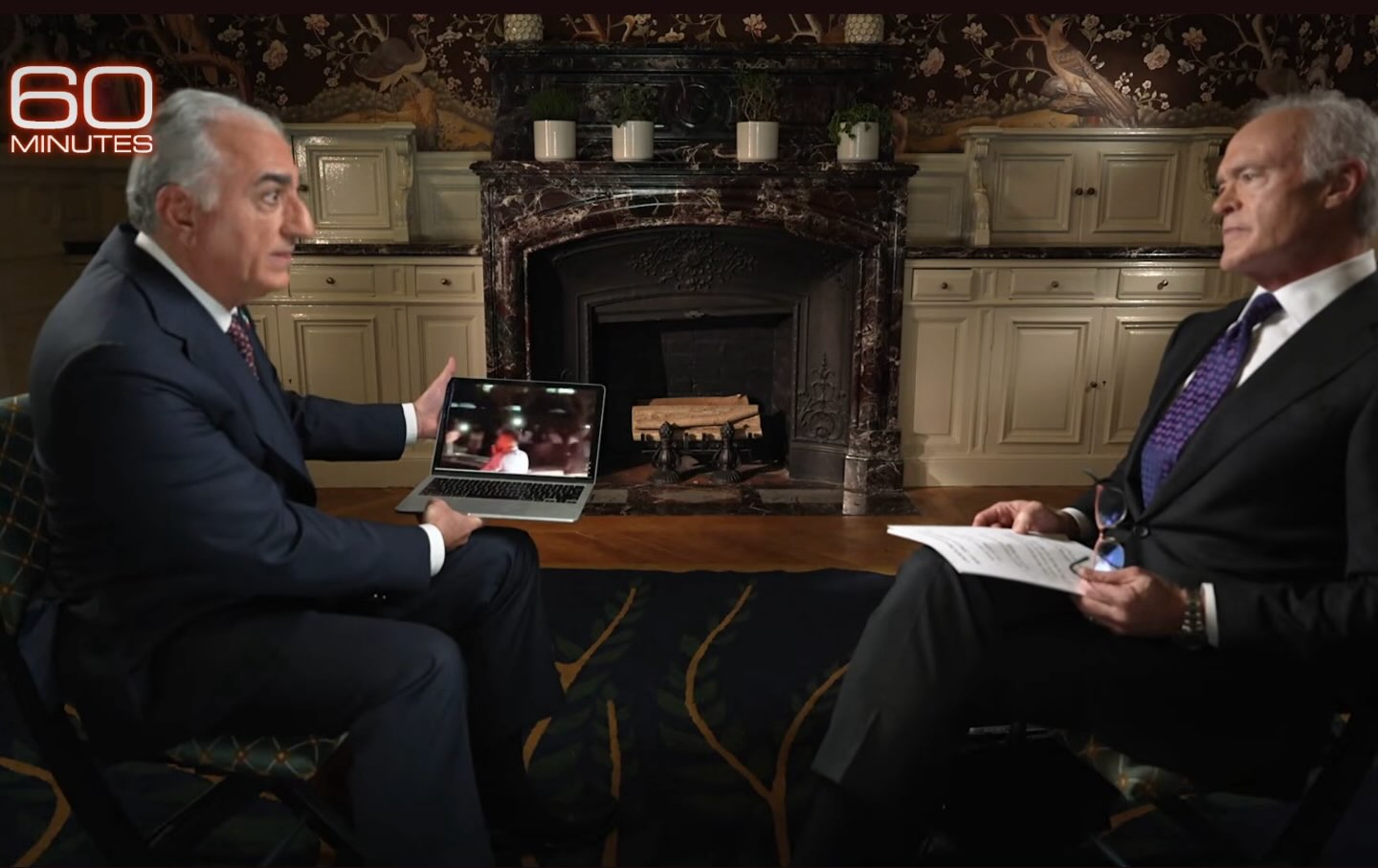
The Corporate Media Is Head Over Heels for the Iran War The Corporate Media Is Head Over Heels for the Iran War
Donald Trump’s attack may be surreal, unjustified, and illegal. But that’s not stopping the press from turning the propaganda dial way up.
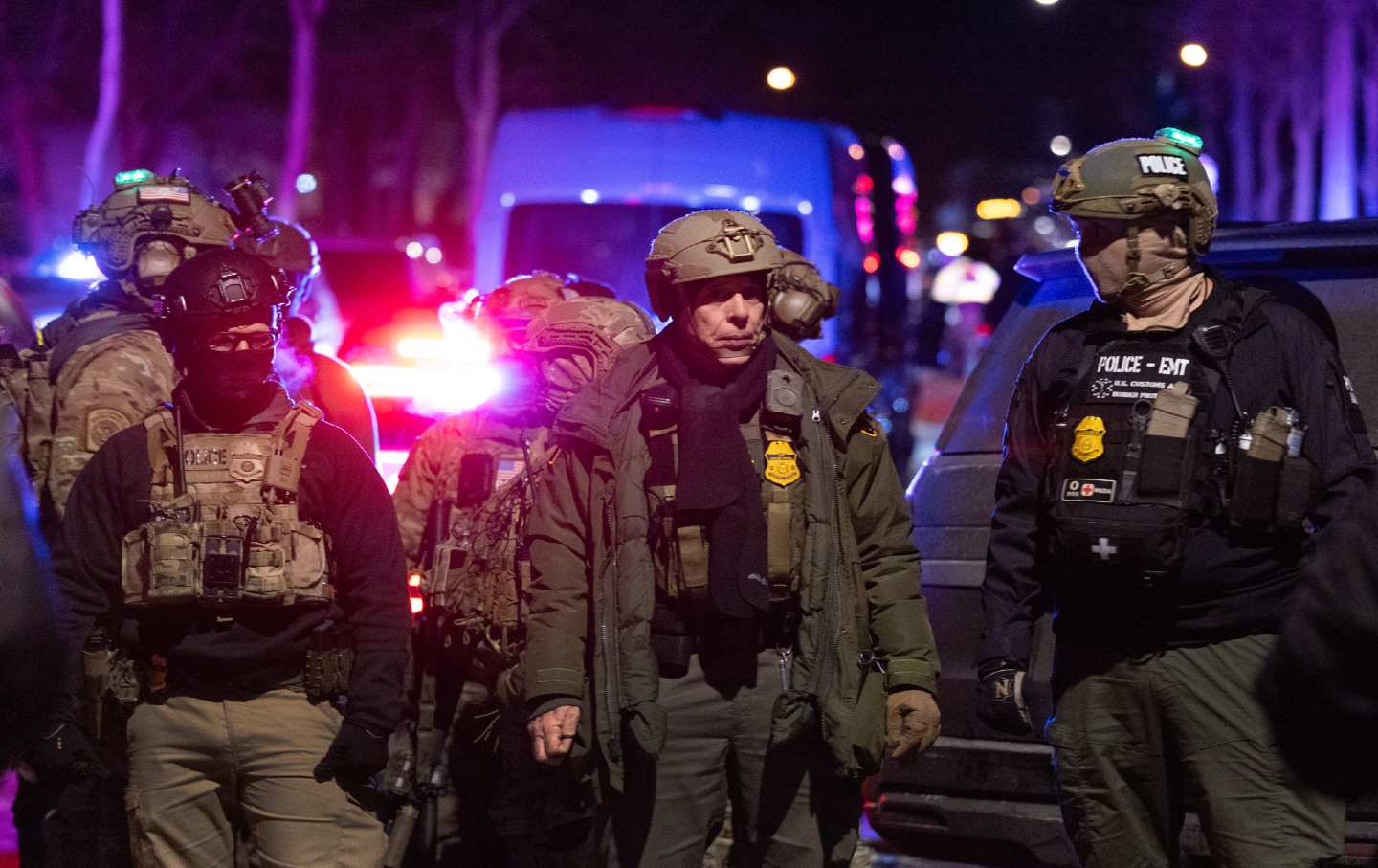
The Disturbing History of ICE’s “Death Cards” The Disturbing History of ICE’s “Death Cards”
The Vietnam-era practice is yet another example of ICE agents thrilling to the brutality they have been encouraged to cultivate.
The American Universities Programming Israel’s Killer Drones The American Universities Programming Israel’s Killer Drones
Industry partnerships in higher education are pushing STEM graduates into the business of weapons manufacturing and genocide profiteering.

