Nurses Are the Backbone of US Healthcare—and They’re Getting Screwed
A recent hospital stay reminded me of the incredible work that nurses do. So why are we making it harder for them to do their jobs?
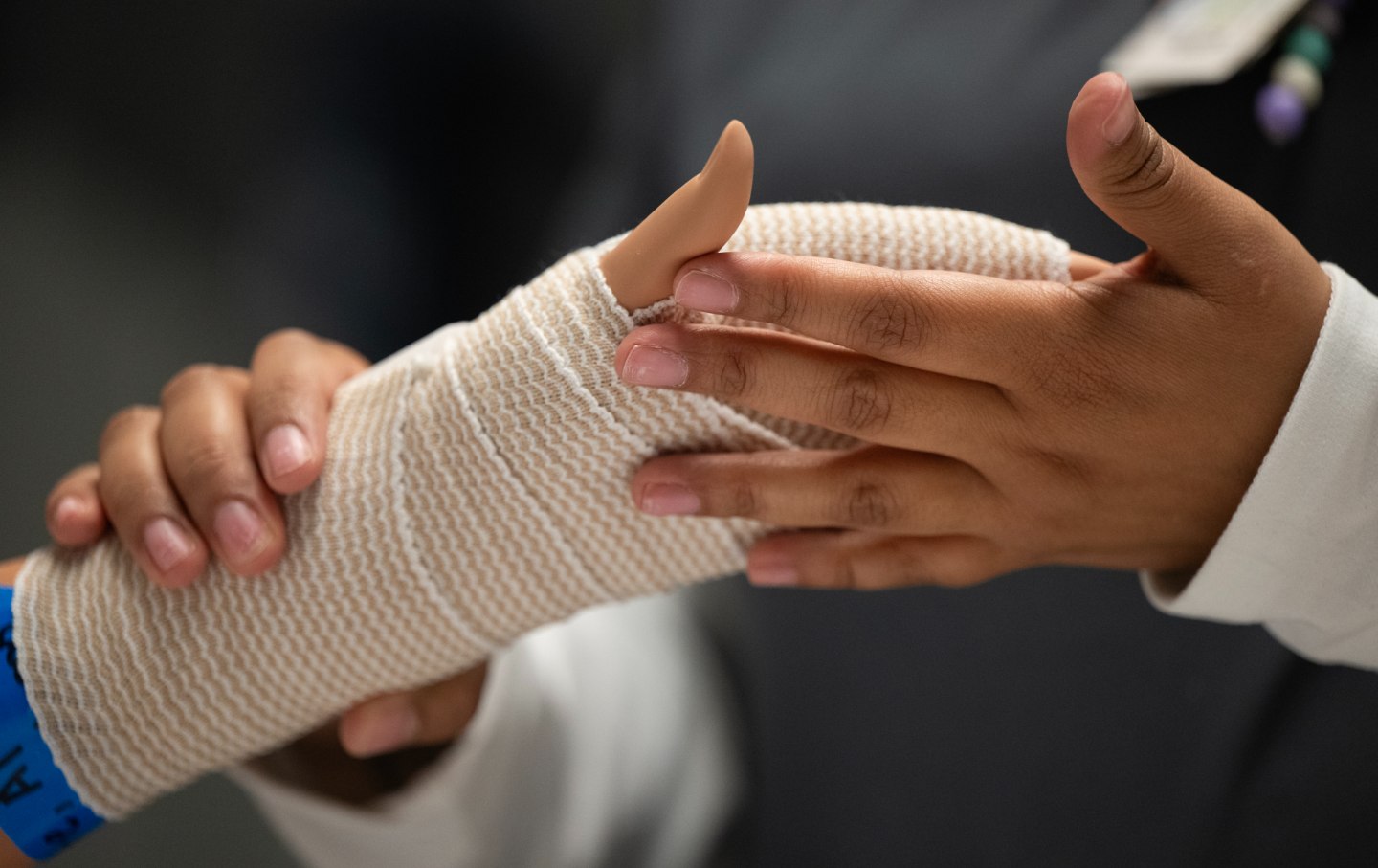
Red Rocks Community College student Ariana Lazo practices wrapping the wrist of a training manikin during a nursing skills lab class on Thursday, April 9, 2026, at the school’s Arvada Health Sciences Campus in Arvada, Colorado.
(Timothy Hurst / MediaNews Group/The Denver Post via Getty Images)I unexpectedly found myself in the hospital for six days last week, including a five-hour surgery last Monday. This was, to say the least, unusual. Though I work in public health, I don’t typically get anywhere near healthcare itself. Most of my experience of the healthcare system is in outpatient services to manage my antiretroviral drugs or deal with the chronic maladies of growing older. So, to find myself in a hospital room for almost a week was a new experience.
I have lots of thoughts about my stay, but one thing stands out to me: Nurses are care. I did see doctors, but they showed up in the mornings for brief visits—my life in room 954 on the day-to-day and night-to-night was in the hands of a dozen nurses. For six days, they were in and out of my room constantly: to take blood, check my vitals, make sure I was comfortable, attend to my symptoms, help me get to the bathroom, and deal with an infernal IV pump which kept going offline and beeping an alarm at all hours. I was probably the least sick person on the unit, but the nurses took care of me with the same measure of attention and solicitude as the worst off among us.
Nurses are the backbone of healthcare in America, and nursing is the largest healthcare profession, with more than 5 million registered nurses across the country. Yet, we still have shortages of nurses in the US and by 2035 these deficits will hit these states the hardest: Washington (26 percent shortage), Georgia (21 percent), California (18 percent), Oregon (16 percent), Michigan (15 percent), Idaho (15 percent), Louisiana (13 percent), North Carolina (13 percent), New Jersey (12 percent), and South Carolina (11 percent).
Of course, the Trump administration will always do the wrong thing on most matters. Just this month, the government published a final regulatory rule lowering the amount that graduate students can borrow from the federal government. The caps are based on whether a degree is considered a professional or graduate program. Students in professional programs can borrow up to $50,000 a year and $200,000 total, while those in graduate programs will face annual limits of $20,500 and a lifetime limit of $100,000. The list of professional programs includes pharmacy, dentistry, veterinary medicine, chiropractic, law, medicine, optometry, osteopathic medicine, podiatry, and theology. See anything missing?
Nursing has been tagged as a graduate degree, and advanced training in nursing can cost close to $80,000 a year—four times the new cap of $20,500. Nursing groups have rightly noted that this will force students to take on the burden of more expensive private loans or leave the profession entirely, endangering the future nursing workforce in America. Under this new regime, other key health professions—physician assistants, physical therapists and those in my profession of public health are also shuttled to graduate student status.
This new definition of professional degrees is not the result of a congressional mandate or expert advice. It’s the work of Secretary of Education (and Worldwide Wrestling Entertainment mogul) Linda McMahon and the Trump administration. Their rationale for the move is to cut down on student borrowing and to get universities to lower tuition costs, but to many it seems arbitrary and capricious. Why can future podiatrists and clergy, veterinarians and chiropractors, borrow twice as much as those who are going into nursing? It makes no sense. McMahon and her cronies completely ignored the tens of thousands of comments opposed to the new definition of health professions and bipartisan concern by Congress.
Moreover, 25 state attorneys general think the plan violates the Administrative Procedures Act, which has led them to sue the federal government to block this rule. The lawsuit also notes the impact on healthcare worker shortages, and in particular on rural communities, where master’s-level clinicians and advanced practice providers sustain access to care in these underserved places. McMahon is on the hot seat even with her own party, with Florida GOP Representative Randy Fine asking her two weeks ago: “Does it make sense for us to take a field where we have real shortages and create a situation where we may not be able to create the [healthcare workers] we need, where we already don’t have enough?” No, Randy, it makes no sense.
I feel immense gratitude and affection for the nurses that took care of me last week. But if we all want to thank the nurses in our lives, getting this rule rescinded would be the real gift. The future of nursing in America depends on it.