The New York Times Refused to Run Our Ad About the Gaza Genocide
“The New York Times” Refused to Run Our Ad About the Gaza Genocide
The paper told my organization that we couldn’t use the word “genocide” in a paid ad. So we walked away.
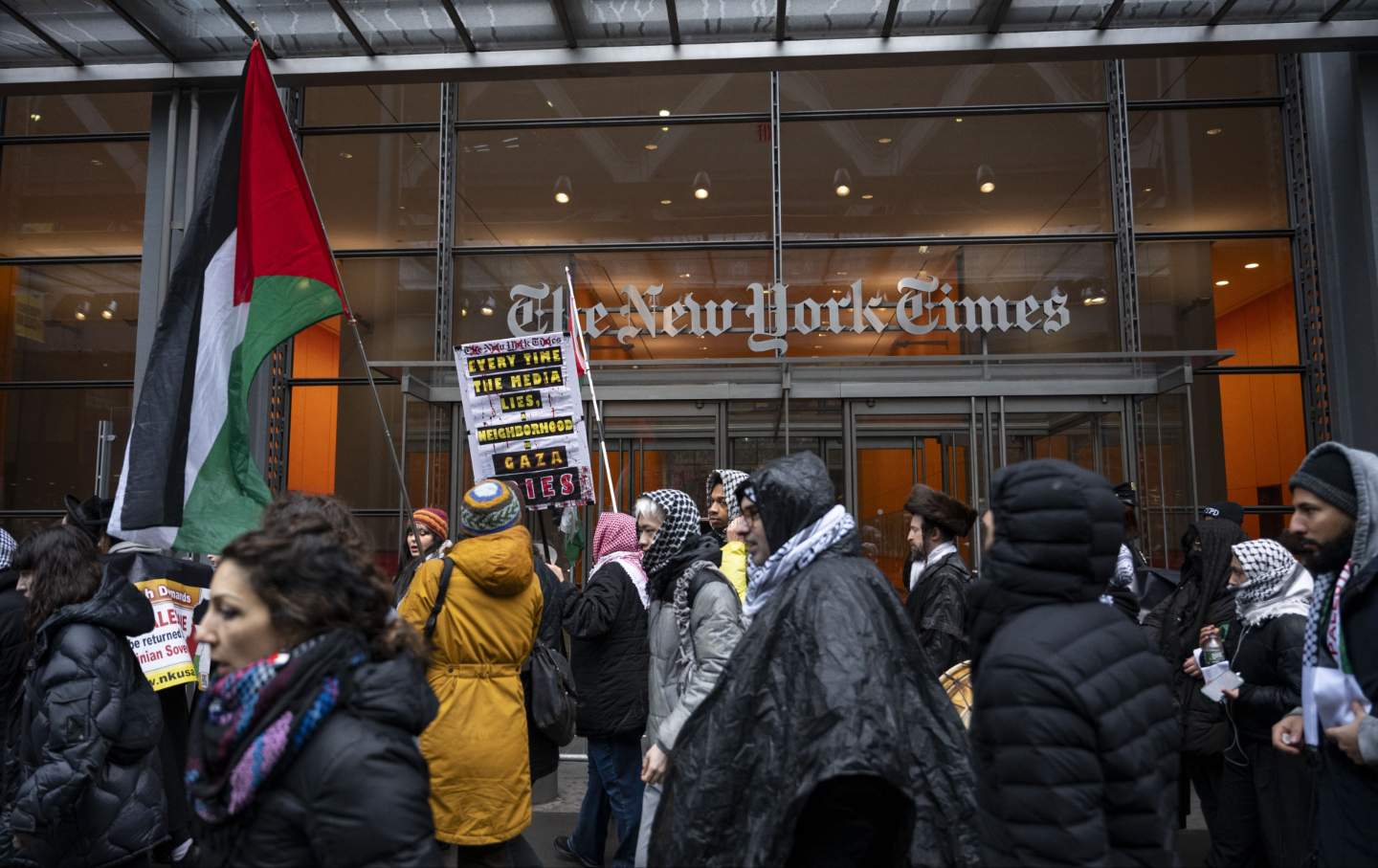
Pro-Palestinian demonstrators rally outside the New York Times building on January 18, 2025.
(Mostafa Bassim / Anadolu via Getty Images)On December 19, Human Rights Watch determined that Israel was committing genocidal acts in Gaza by deliberately depriving Palestinian civilians of water. Médecins Sans Frontières (MSF) published a report saying that what they had seen on the ground in Gaza was consistent with genocide. And the American Friends Service Committee (AFSC)—a Quaker organization where I serve as general secretary—received an e-mail from The New York Times rejecting our use of the word “genocide” in an ad slated to run on their platform.
Our ad read, “Tell Congress to stop arming Israel’s genocide in Gaza now! As a Quaker organization, we work for peace. Join us. Tell the President and Congress to stop the killing and starvation in Gaza.”
A representative from the Times’ advertising team suggested we use the word “war” instead of “genocide”—a word with an entirely different meaning both colloquially and under international law. When we rejected this approach and explained our reasoning, the Times sent us an e-mail that read in part: “Various international bodies, human rights organizations, and governments have differing views on the situation. In line with our commitment to factual accuracy and adherence to legal standards, we must ensure that all advertising content complies with these widely applied definitions.”
We feel a moral obligation to call a genocide by its name. We canceled the ad rather than modify our message.
International humanitarian law defines genocide as acts committed with the intent to destroy a national, ethnic, racial, or religious group, in whole or in part. The systematic violence and blockade that kills and starves Palestinians in Gaza aligns disturbingly with this definition. Human Rights Watch is just one of several human rights groups asserting that Israel’s war on Gaza is genocidal. Many others—most prominently Amnesty International—have reached the same conclusion, as have legal scholars, genocide scholars, and Holocaust scholars. And in January 2024, the International Court of Justice issued a provisional ruling that Israel’s actions in Gaza were “plausibly genocidal.”
Advertising teams at other major media outlets have allowed similar language; the same week that the Times rejected AFSC’s ad, The Washington Post ran an advertisement from Amnesty International that referred to Israel’s actions as “genocide.”
It’s difficult to believe that the Times was rejecting our language in a paid advertisement because of concerns over factual accuracy. It is an objective fact that Israel is denying water and other necessities of life to an entire population. To avoid naming that for what it is does not reflect a commitment to accuracy but an effort to control the narrative of those demanding justice for Palestinians at a time of urgent humanitarian crisis.
Moreover, the Times appears to have a double standard on this issue. In 2015, the paper was criticized by groups across the political spectrum for running a full-page ad from far-right Rabbi Shmuley Boteach that accused then–national security adviser Susan Rice of ignoring genocide after she criticized Prime Minister Benjamin Netanyahu. No international organizations or legal authorities have ever supported such a claim, and even pro-Israel organizations condemned it. When the language of genocide was leveraged against Palestinians, it seems the Times had no concern for accuracy.
The refusal to run our ad is even more galling because, unlike the Times, whose journalists are blocked from entering Gaza except during limited excursions while embedded with the Israeli military, AFSC staff have been on the ground in Gaza for decades. In 1948, the United Nations asked us to help with refugee relief in Gaza because of our experience rescuing and resettling both Jewish and non-Jewish refugees from Nazi Germany. Since October 2023, AFSC staff in Gaza have provided 1.5 million meals, hygiene kits, and other units of aid to internally displaced people, despite losing dozens of their own family members to Israel’s bombs and being displaced many times themselves. They witness daily horrors and continue to provide vital support despite immense suffering. Their firsthand accounts illustrate the urgent need for action. But this direct experience in Gaza was not compelling for the Times.
As a Quaker organization, we believe all people have an inner Light, and that supporting Palestinian rights and the rights of all oppressed people is a moral imperative. Peace requires more than just the absence of violence; it requires justice, dignity, and human rights for all. We will continue to elevate Palestinian voices and work for an end to occupation and genocide. This includes standing up against media censorship and skewed representation of the urgent realities on the ground. Refusal to engage with these realities is an outrageous attempt to sidestep the truth and perpetuates a narrative that favors silence over accountability.