
What Luigi Mangione and Daniel Penny Are Telling Us About America
When social structures corrode, as they are doing now, they trigger desperate deeds like Mangione’s, and rightist vigilantes like Penny.
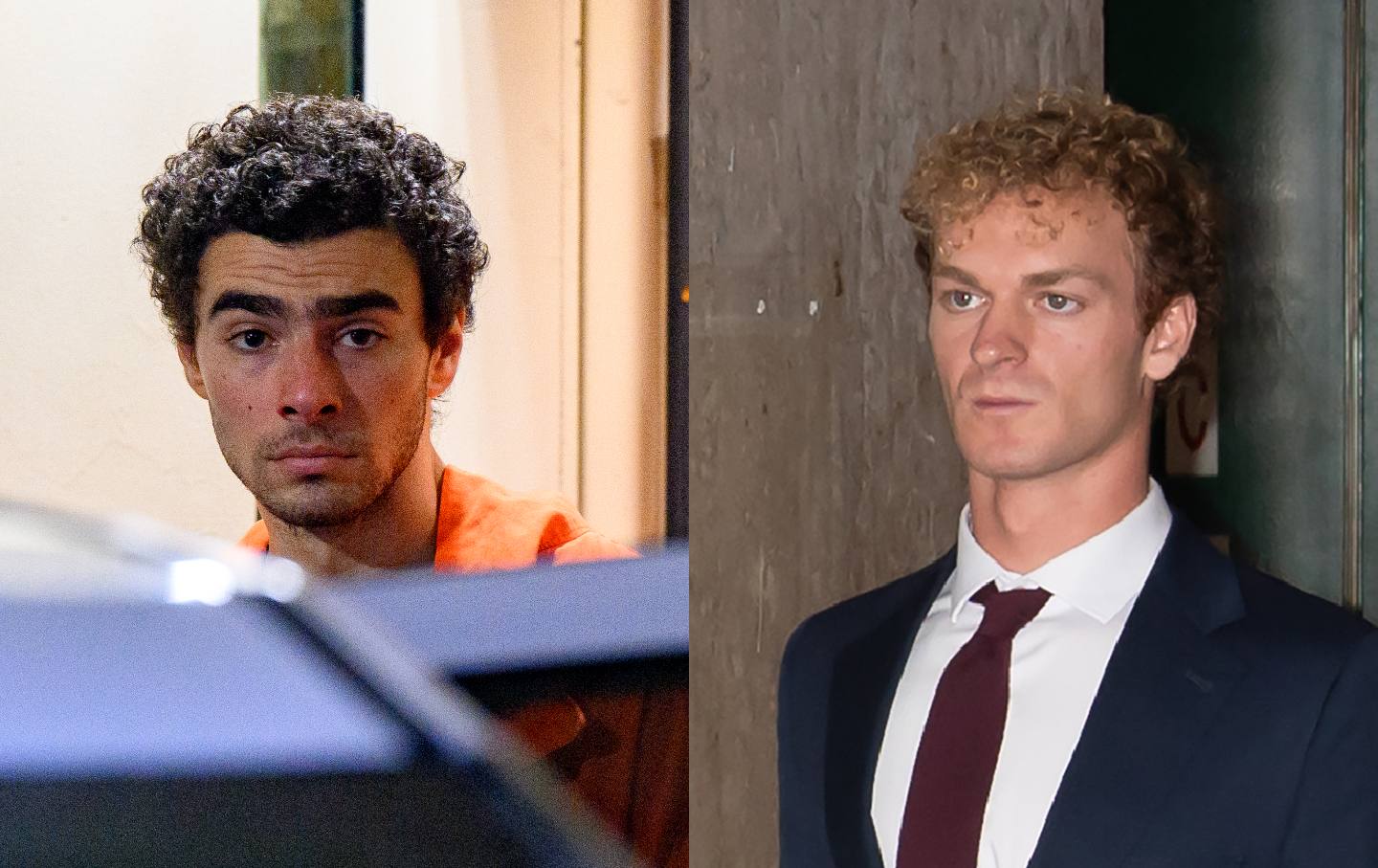
Brandishing a juvenile, chicken-scratch graph, right-wing pundit and neoconservative toady Scott Jennings offered a simple analysis during a recent CNN roundtable. “Here’s my chart: The good guys today, Daniel Penny. The bad guys, Luigi Mangione,” he proclaimed. “People on the left can’t seem to tell the difference between the good guys and the bad guys.”
Yes, Jennings’s crass and essentialist framing is baby-brained. But in linking Penny, who was acquitted this week in the killing of unhoused man Jordan Neely on a New York City subway in 2023, and Mangione, who has been charged with the murder of UnitedHealthcare CEO Brian Thompson, he was making a connection that’s worth examining.
After all, though they come from seemingly different philosophical places—and though the societal reaction to their actions has differed dramatically—there are similarities between Penny and Mangione.
Both are 26-year-old vigilantes who engaged in shocking public acts of violence. Their actions are very much open to partisan interpretation. The view of their conduct seems dependent on where you fall within the socioeconomic map. And though Mangione’s violence may feel more sympathetic than Penny’s, both are deeply entwined within the long history of American vigilantism—a history that has been detrimental to building relevant working-class politics. When social structures transition or corrode, as they are doing in the 21st century, they trigger deeds like Mangione’s or Penny’s—neither of which will satisfy the multitude of unresolved catastrophes that are unfolding.
For those on the hard right, Penny has become a kind of reactionary Batman, especially following his acquittal on Monday. (He will be a guest of Vice President–elect JD Vance’s at a football game this weekend.) In this deranged narrative, Penny should be hailed for his bravery because the government has ceded control of public spaces to a roaming horde of violent vagrants.
“Given the…thousands of untreated mentally ill drug addicts who are roaming the streets, it is a virtual certainty that every couple of days, every couple of weeks, one of them will assault an innocent pedestrian, possibly lethally,” Heather Mac Donald, a fellow at the right-wing think tank the Manhattan Institute and author of several pro-cop polemics, said in a Tuesday discussion with Megyn Kelly concerning Penny. “It’s not a chance, it is a certainty. And the city and state do nothing. They spend all their money on vanity left-wing projects.” Put more plainly, Mac Donald and her contemporaries believe that since the feckless administrative state has become ideologically corrupt, it’s up to the Daniel Pennys of the world to restore order.
By contrast, Mangione has become a Travis Bickle–esque hero for the millions of Americans enraged at the country’s healthcare system. But it’s not just the anti-capitalist left praising Mangione. More apolitical bystanders seem to view the assassination of a multimillionaire healthcare CEO as a performance of righteous justice. (This ideological muddle chimes with Mangione’s seemingly inchoate politics.)
Comment sections on right-wing content chastised any criticism of Mangione because, for many across the political spectrum, the tragedy of the hundreds of thousands of citizens who have and will die because of healthcare deficiencies is too blatant. And the fact that such deficiencies have been artificially inflated for profit by those like Brian Thompson makes Mangione’s vigilantism even more appealing to people.
Despite maintaining a social media profile rife with manosphere influencers like wellness crank Andrew Huberman and “heterodox” right-wing sycophant podcaster Lex Friedman, Mangione’s alleged homicide ironically falls into the anarchist tradition known as “propaganda of the deed.” In this theory of political change, violence is carried out against the ruling class in the hope of provoking a wider social insurrection.
Additionally, as articulated by anarchist theorists, this violence is morally virtuous and includes the added bonus of petrifying the elite. Famous examples that come to mind are the multitude of failed assassination attempts against oil baron John D. Rockefeller in 1914, the 1920 demolition of Wall Street by Italian anarchists, and the 1972 bombing of the Pentagon by the Weather Underground. Most notably, all were conducted during moments when left-wing political organizing was besieged by federal law enforcement.
While Mangione’s manifesto does not contain the radical fervor of his predecessors, the document echoes many of the same sentiments. “Frankly, these parasites simply had it coming,” Mangione writes. “The reality is, these [indecipherable] have simply gotten too powerful, and they continue to abuse our country for immense profit because the American public has allowed them to get away with it…. it is not an issue of awareness at this point, but clearly power games at play. Evidently, I am the first to face it with such brutal honesty.”
According to Mangione, because the healthcare industry engages in widespread pilfering and social murder with impunity, he was left with no other choice but to even the score. On a superficial level, Mangione seems to have succeeded: Healthcare firms have ramped up security and have begun removing photos of their C-suite vanguard from websites. And on Wednesday, New York City police warned healthcare executives that they had discovered an “online ‘hit list.’”
Penny’s behavior, meanwhile, echoes the more explicitly right-wing ethics of a long-held tradition of vigilantism—one that is often invoked in moments of political turmoil and change. During increased radical agitation in the late 19th century, everyday citizens were encouraged to violently resist left-wing mayhem believed to have been sparked by immigrant revolutionaries.
“If the communists in this country are counting on the looseness of our police system and the tendency to proceed against criminals by due process of law, and hope on that account to receive more leniency than in Europe, they have ignored some of the most significant episodes in American history,” an 1875 issue of the Chicago Daily Tribune trumpeted. “There are no people so prone as the American to take the law into their own hands when the sanctity of human life is threatened and the rights of property invaded in a manner that cannot be adequately reached and punished by the tortuous course of the law.”
This energy would be mobilized countless times in the 20th century. At the height of working-class crusades waged against capital in the late 1910s and early 1920s, wealthy business magnates would organize a litany of vigilante, reactionary paramilitary groups like the American Defense Society, the American Vigilant Intelligence Federation, the Black Legion, and the Knights of Liberty. These organizations were founded on the principle of “law and order” and “100 percent Americanism,” as the Constitution of one such group, the American Legion, expressed. The mission was “to combat the autocracy of both the classes and the masses.” In other words, the insatiable mob needed to be put down.
A more palpable, modern example of Penny’s lineage lies in the chaos that ensued during the Rodney King riots in 1992. Like Kyle Rittenhouse during the George Floyd protests, local Korean American business owners became right-wing icons when images emerged of them standing atop their property fending off looters and protesters with shotguns. In the dim caverns of the conservative mind palace, complex political emergencies like state-sanctioned brutality, unfettered financial corruption, and rampant social austerity melt away when viewed through the lens of “Good Guy vs. Bad Guy.”
Popular
“swipe left below to view more authors”Swipe →It’s best to understand the Penny and Mangione phenomena as being symptomatic of broader structural rot. Those at the highest echelons of power have allowed the intersecting crises of economic inequality, housing shortages, and lack of medical care to fester. That’s the kind of societal breakdown that other moments of vigilantism have often reflected. On the left, they’ve grown out of everything from the putrid working conditions of the early 20th century to the industrialized carnage of Vietnam. On the right, they’re rooted in backlashes whipped up during times of intense social upheaval.
We should be worried, however, that Penny’s murder may prove more influential politically than Mangione’s. Vigilante attacks against the unhoused are becoming more prominent as the politics of resentment continue to simmer. The same can be said for the likes of ad hoc border patrols who have recruited heavily to combat the manufactured threat of asylum seekers. With a second Trump term—and a likely exacerbation of the aforementioned crises—it wouldn’t be surprising if loyal right-wing forces were deputized against dissenters.
Meanwhile, Mangione may prove to be more of a generator of memes than of movements. The antidote that he may have sought if the left were stronger would have been labor-centered politics that prioritize mass organizing over individual acts of rage. It is at that site of collective action where we will ultimately topple the bloodsucking ghouls who operate our healthcare system—not through the undertakings of any one disaffected gunman.
More from The Nation

The Endless Hypocrisy of Bari Weiss The Endless Hypocrisy of Bari Weiss
She claims to be a free speech champion. But as her actions at CBS News keep showing, she seems to think free speech should run only in a rightward direction.
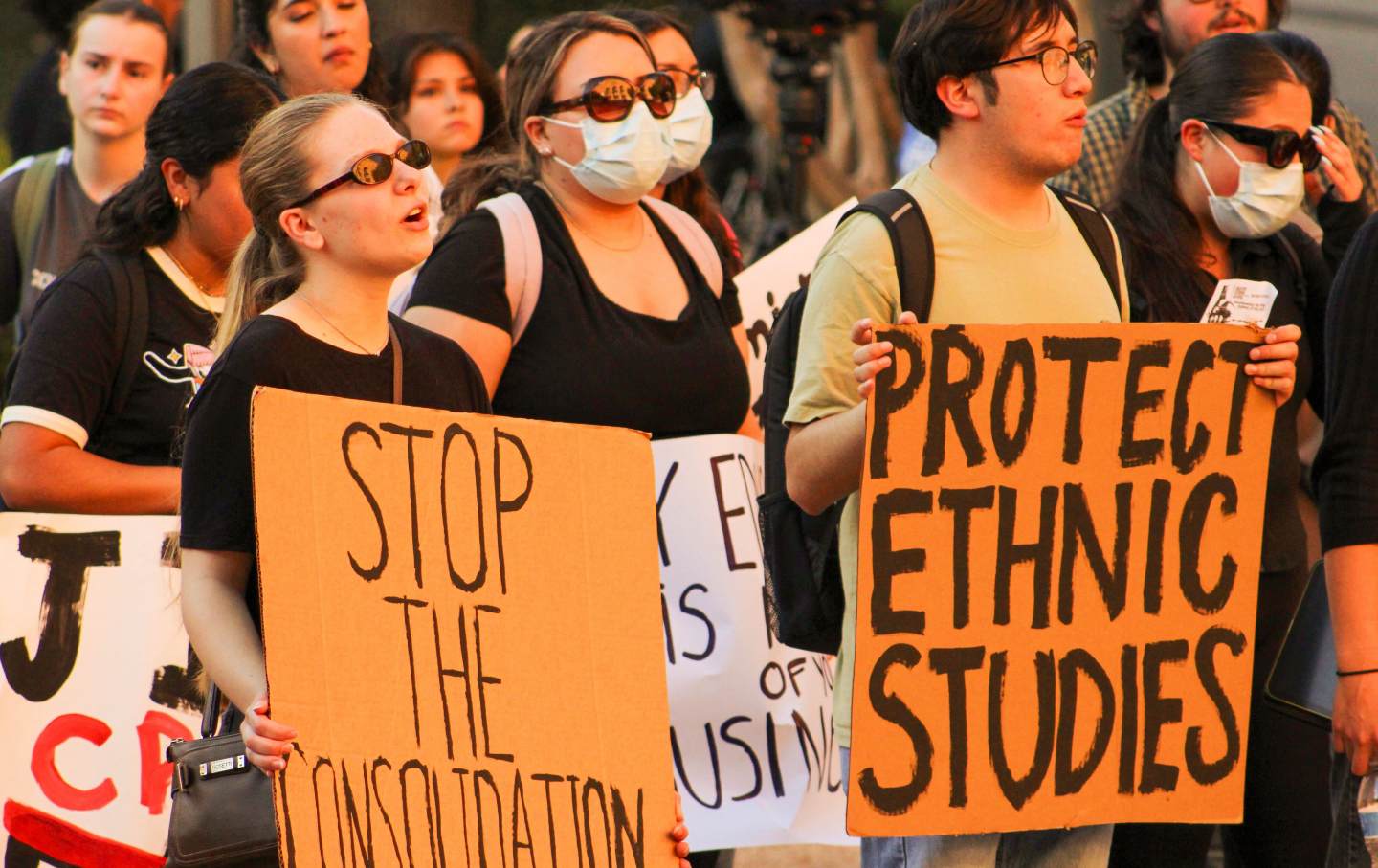
What Will Be Left After the University of Texas Destroys Itself? What Will Be Left After the University of Texas Destroys Itself?
UT-Austin has collapsed its race, ethnic, and gender studies into a single program while a new policy asks faculty to avoid “controversial” topics. But the attacks won’t end there...

The Corporate Media Is Head Over Heels for the Iran War The Corporate Media Is Head Over Heels for the Iran War
Donald Trump’s attack may be surreal, unjustified, and illegal. But that’s not stopping the press from turning the propaganda dial way up.
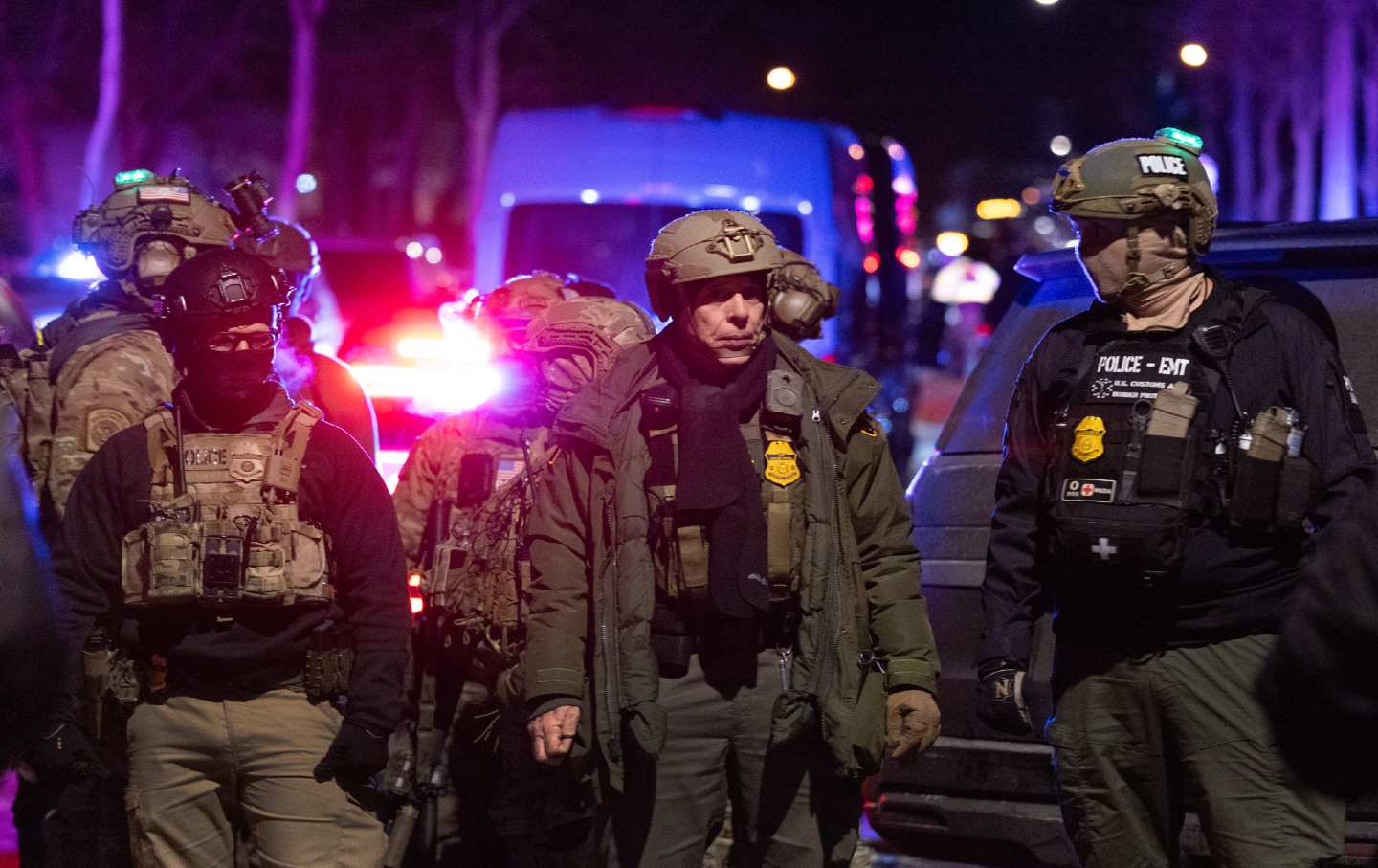
The Disturbing History of ICE’s “Death Cards” The Disturbing History of ICE’s “Death Cards”
The Vietnam-era practice is yet another example of ICE agents thrilling to the brutality they have been encouraged to cultivate.

The Red State–Blue State Healthcare Divide Is Dangerous for Everyone The Red State–Blue State Healthcare Divide Is Dangerous for Everyone
Whether or not you have access to independent, scientifically sound public health guidance may depend on how your state voted for governor.
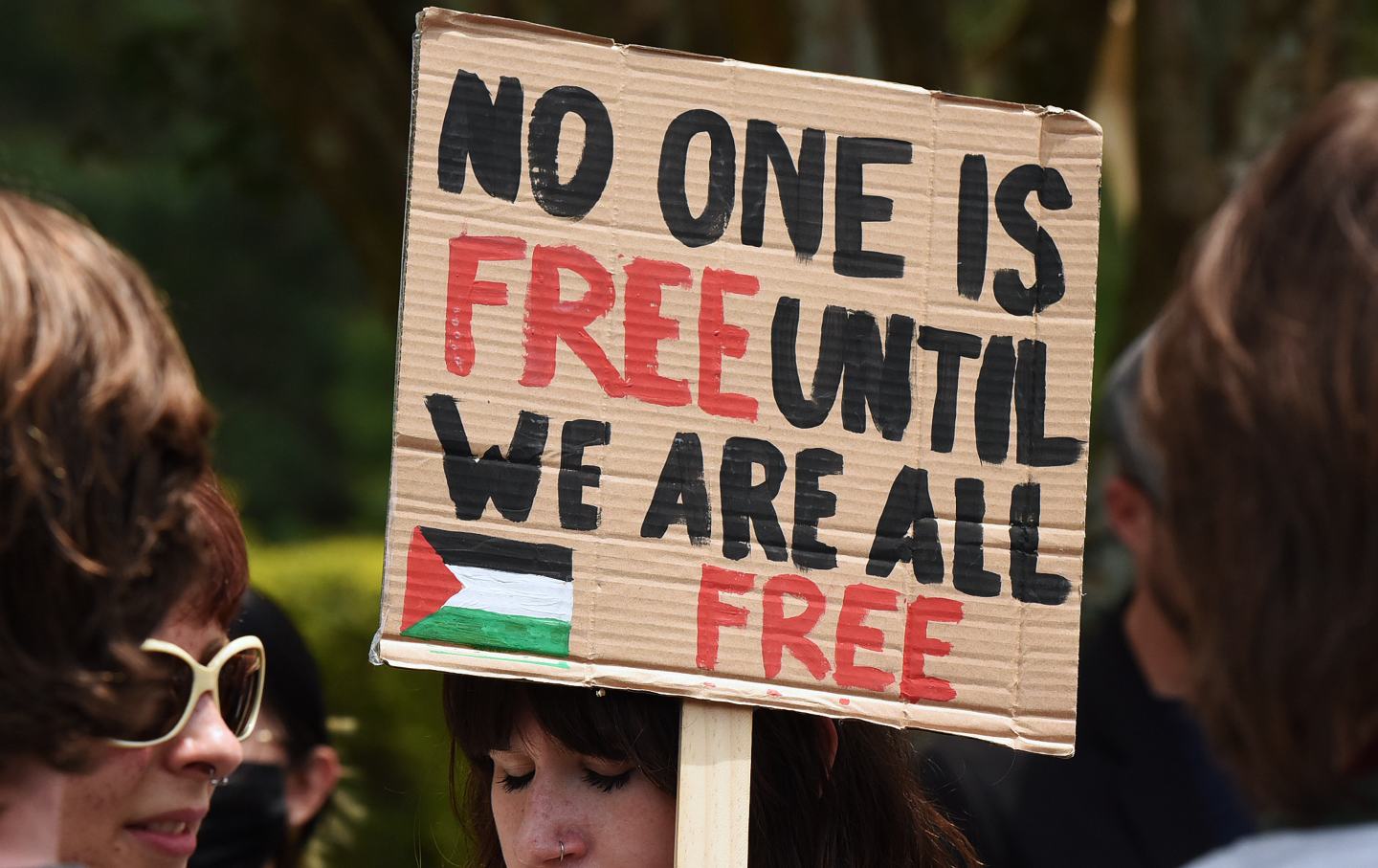
The American Universities Programming Israel’s Killer Drones The American Universities Programming Israel’s Killer Drones
Industry partnerships in higher education are pushing STEM graduates into the business of weapons manufacturing and genocide profiteering.

