
Should the Ivy League Pay Its Student Athletes?
With the rise in Name, Image, and Likeness compensation for NCAA student athletes, a 70-year-old Ivy League policy may be holding the league back more than ever.
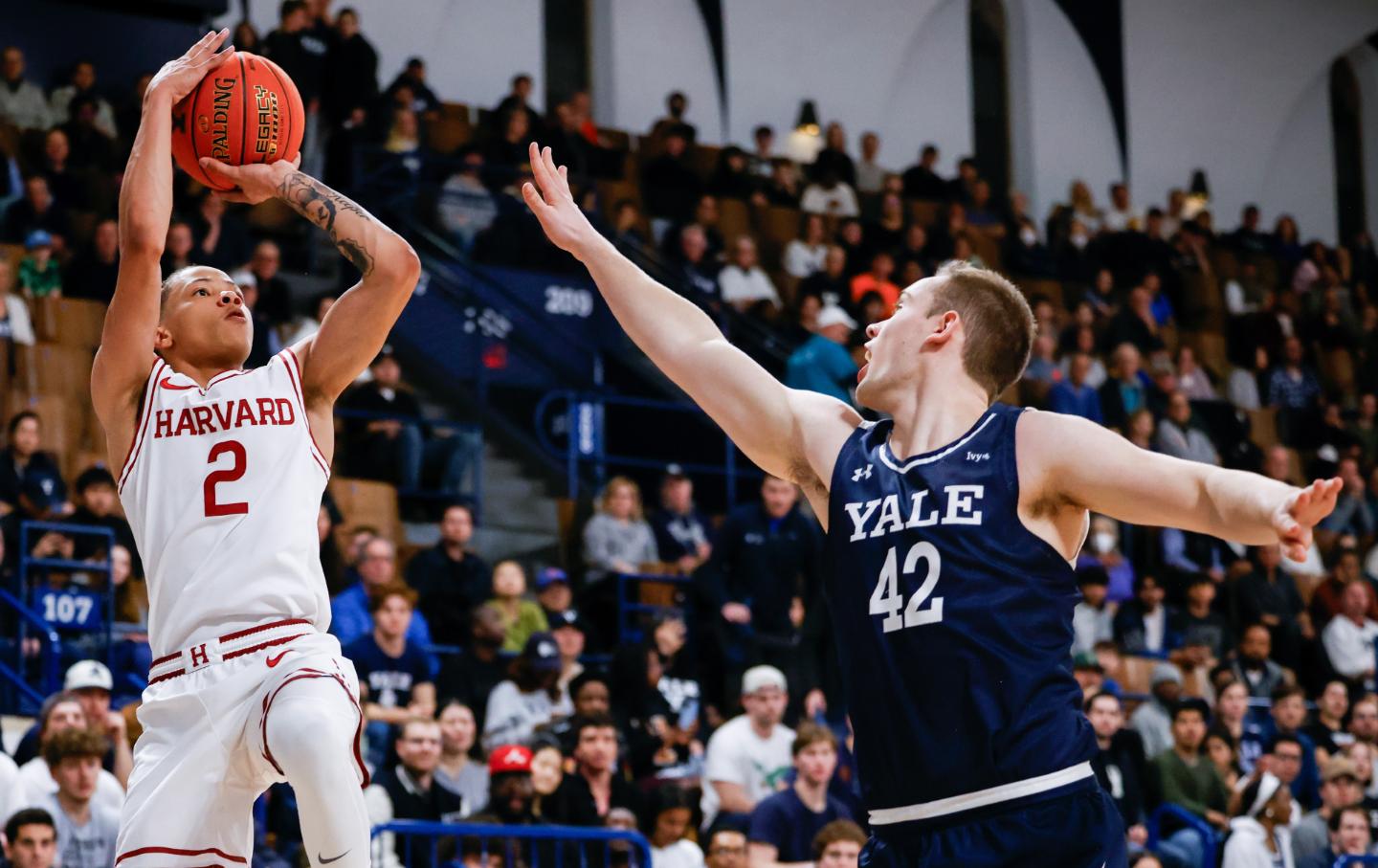
Harvard guard Malik Mack shoots past Yale forward Nick Townsend during an NCAA men’s basketball game in 2024.
(Julia Nikhinso / Getty)
Since 1954, no Ivy League school has provided athletic scholarships for any student-athlete. Now, the rise in student athlete compensation is forcing the conference to consider updating its archaic policy.
This past summer, the NCAA and its Power Five conferences made a landmark decision to not only provide more than $2.8 billion in damages and compensation for past and current student athletes dating back to 2016, but to implement a structure in which Power Five schools would directly pay their student athletes from a $22 million annual spending cap.
While this model is still awaiting a final settlement approval in April, the multibillion-dollar back pay would address three pending lawsuits: House v. NCAA, Hubbard v. NCAA, and Carter v. NCAA. This comes only three years after the NCAA implemented policy changes which effectively allowed student athletes to profit off their Name, Image, and Likeness (NIL) after a Supreme Court ruling rejecting an appeal of its antitrust lawsuit, NCAA v. Alston.
“Forty years ago, [the Supreme Court] agreed with [the NCAA] that amateurism is a social good and it should be allowed to protect amateurism through regulations that deny compensation to athletes,” said Jodi Balsam, a professor of sports law at Brooklyn Law School. “Over the last 40 years, [the NCAA] commercialized college athletics to such an extent that the concept of amateurism has become so diluted, it’s no longer a basis for granting the NCAA any kind of immunity to antitrust challenge.”
With this rule change came NIL collectives, independent groups that manage the money received from boosters—referred to as “Associated Entity or Individual” in the amended settlement—of a specific school to provide NIL opportunities for those student-athletes. The collectives have shifted the NIL landscape drastically due to the enormous amount of money that can be garnered and distributed along with the lack of a salary cap on how much money these student athletes can receive. These groups have made it possible for athletes such as the University of Tennessee’s Nico Iamaleava to be paid over $8 million in an NIL agreement before even touching the field.
Not every Division I student-athlete has reaped these benefits. In the Ivy League, not a single school has an NIL collective, making it one of three Division I conferences lacking this modern amenity.
After a memorable two seasons for Ivy League men’s basketball—with the Princeton Tigers’ Sweet Sixteen run and the Yale Bulldogs upsetting the Auburn Tigers—this past offseason saw the exit of most of the best talent in the conference: Ivy League Rookie of the Year Malik Mack, First Team All-Ivy member Danny Wolf, Tyler Perkins, Chisom Okpara, and Kalu Anya. These Ivy League standouts joined a staggering number of transfers that amounted to more than 10 percent of Division I basketball. While transferring from the Ivy League is common for a postgraduate year, due to the Ancient Eight’s policy against student athletes’ competing after undergrad, all five of these players transferred after at most two seasons.
“You can’t really tell an 18-, 19-year-old kid to pass up on $200,000 or $300,000. That’s money that they may not be able to see in their life,” said Columbia basketball alum Zavian McLean. “With the other alternative being pay to continue doing what you’re doing, it’s just not the same thing.” Additionally, McLean notes, some of these players transferred to “other prestigious institutions right outside of the Ivy League” to receive better compensation opportunities.
Last year, two Brown basketball alums—Grace Kirk and Tamenang Choh—filed a federal lawsuit against the Ivy League calling for student athletes to receive athletic scholarships as a form of payment around the same time the Dartmouth men’s basketball team attempted to unionize. Both cases failed to change the policy, although Kirk and Choh plan to appeal the dismissal decision from the District Court of Connecticut.
But with the talent that has fled the Ivy League and the amount of NIL money continuing to increase, Louisiana State University running back and Columbia football alum Tyson Edwards feels as though athletic scholarships are a sensible first step. “Trying to be a student athlete within the harsh academics that the Ivy League comes with—but then also having a schedule and everything that comes with being an athlete at the same time—makes it very hard,” Edwards said. “You’re not getting paid. NIL is very small. And support, compared to most places, very little. So it’s definitely hard to stay motivated.”
“If the Ivy League started offering scholarships…it would probably become one of the bigger conferences in the country, because what the Ivy League offers is second to none,” said Yale wide receiver Mason Shipp. “And the degree will carry you throughout your entire life. So on top of that, now, if you have the opportunity to go to that school for free, to play Division I athletics, and compete at the highest level, there’s really no reason for somebody not to come to the school.”
University leadership within the Ivy League has said that athletic scholarships could cause a detrimental shift in the academic standards the Ancient Eight upholds. If student athletes come to an Ivy League school to play a sport for free, they might not be treated like other students, and may not view academics in the same manner. “The Ivy League athletics model is built upon the foundational principle that student-athletes should be representative of the wider student body, including the opportunity to receive need-based financial aid,” Ivy League executive director Robin Harris told ESPN. “In turn, choosing and embracing that principle then provides each Ivy League student-athlete a journey that balances a world-class academic experience with the opportunity to compete in Division I athletics and ultimately paves a path for lifelong success.”
“I think that collectives are dangerous.… Not getting involved in the NIL space and not conforming to that has allowed the Ivy League to remain together and remain on the same page about all the things they stand for,” said Shipp. “Once you make those changes, the Ivy League potentially gets into a situation like the SEC where they’re looking to become a dominant conference, and they start expanding, or they start shrinking. And that’s when it becomes a scary thing for me, because there’s so much tradition.”
Reverence for tradition aside, certain stipulations could be put in place for scholarships to maintain the student-athlete experience in the Ivy League, said Edwards. “If you don’t meet the standards of your grades, you get the money taken away from you,” he said. “The people that go to the Ivy League…are smart students at the end of the day, and they care about their future.”
With both her parents working in factories and her father not working in the winter, it has been a challenge for Columbia women’s soccer alum Nata Ramirez to pay her spring semester tuition on time, resulting in financial holds that put her at a disadvantage for class registration. “I feel like with the full-ride scholarship, people don’t even have to worry about [the stress of paying tuition]. It also just makes you focus so much more on your academics and your athletics instead of having like all these other stresses come into your life about taking out loans, making these payments on time, etc.” Ramirez said.
The opportunity to play soccer at an Ivy League institution was impossible for Ramirez to turn down as a first-generation Colombian American. “You don’t see many first-generation athletes on the men’s or women’s soccer team,” she said. But with that decision came the harsh reality of need-based financial aid and grants not being able to address the stress of “the little bit” that she still had to pay for school.
The same stresses were felt by the mother of a prospective Columbia women’s soccer player of Mexican descent when Ramirez was hosting her daughter for a visit. While the athlete was fascinated by Columbia and its women’s soccer team, Ramirez recalls being bombarded with questions from the mother regarding the financial requirements of Columbia instead. “Kids in underrepresented communities and underprivileged places honestly can’t even consider going to an Ivy because of how expensive it is,” Ramirez said. “It’s kind of sad to know that people even take down that option before even bothering to apply.”
Popular
“swipe left below to view more authors”Swipe →“I’ve seen kids that have more talent than I did, had better academics, but due to the financial factor they weren’t given the chance,” Columbia men’s soccer player Bryan Cosman added. “The Ivy League in general, being basically a big golden ticket in life…they miss out on that because it’s only academic scholarships, and that’s so hard because you’re competing with kids all around the world and they’re just as smart.”
Cosman grew up roughly 20 minutes away from Ramirez in Lyndhurst, New Jersey. And with a similar upbringing, both agreed that athletic scholarships would not only increase the racial and socioeconomic diversity on Ivy League sports teams, but also would provide an opportunity for those of a lower economic background to utilize their athletic ability to enter spaces of higher socioeconomic status as well. “In the end, it kind of feels like a slap in the face, because all of these people being so gifted,” Cosman said. “It feels like you’re getting in a way, a disrespect, or it’s like, ‘Am I not good enough to go to your school?’”
In the absence of changes to the Ivy League athletic scholarship structure, McLean and Shipp have taken matters into their own hands. McLean created a site to sell his teammates jerseys, and Shipp helped facilitate NIL deals between local business and Yale student-athletes. “It wasn’t necessarily to make a profit. It was just to have a presence on campus, allow people’s families to be able to support their kids and their family who was out there playing,” McLean said. “To be able to maybe put a meal, to go get something to eat in my teammates pocket, because nobody was giving us any money.”
More from The Nation
Jalen Hurts Deserved Better. We All Do. Jalen Hurts Deserved Better. We All Do.
In a country that treats workers as expendable parts, Hurts’s playing through a blood clot is just the highest-profile example of the price workers pay in an oligarchy.
The Terrifying Future of States’ Criminalizing Pregnant People Is Already Here The Terrifying Future of States’ Criminalizing Pregnant People Is Already Here
The idea of charging people who have abortions with murder is gaining traction on the right. But a report finds that people are already being prosecuted for their pregnancy outcom...
The Supreme Court Is Coming for Affirmative Action—Again The Supreme Court Is Coming for Affirmative Action—Again
The high court has just accepted a case that takes aim at efforts to increase diversity at high-performing public schools.
My Family’s Dark, Hidden History With Institutionalization My Family’s Dark, Hidden History With Institutionalization
My great-great-grandfather was the namesake of an infamous institution for the disabled. From long-neglected records of the property, the lives of forgotten people were uncovered....
Smoke and Mirrors: The Right's Latest Attacks Against Trans People Smoke and Mirrors: The Right's Latest Attacks Against Trans People
The MAGA movement is redoubling its attacks on trans healthcare in an attempt to win votes this November.

Is Blockbuster Video the Answer to Our Digital Privacy Woes? Is Blockbuster Video the Answer to Our Digital Privacy Woes?
The Supreme Court is weighing whether a 1988 video-store law can be used to protect our digital privacy.

