How John Lennon and Yoko Ono’s “Imagine” Became the Refrain of Jimmy Carter’s Funeral
The late president celebrated the impact and influence of the song, which decries war, nationalism, and the excesses of capitalism.
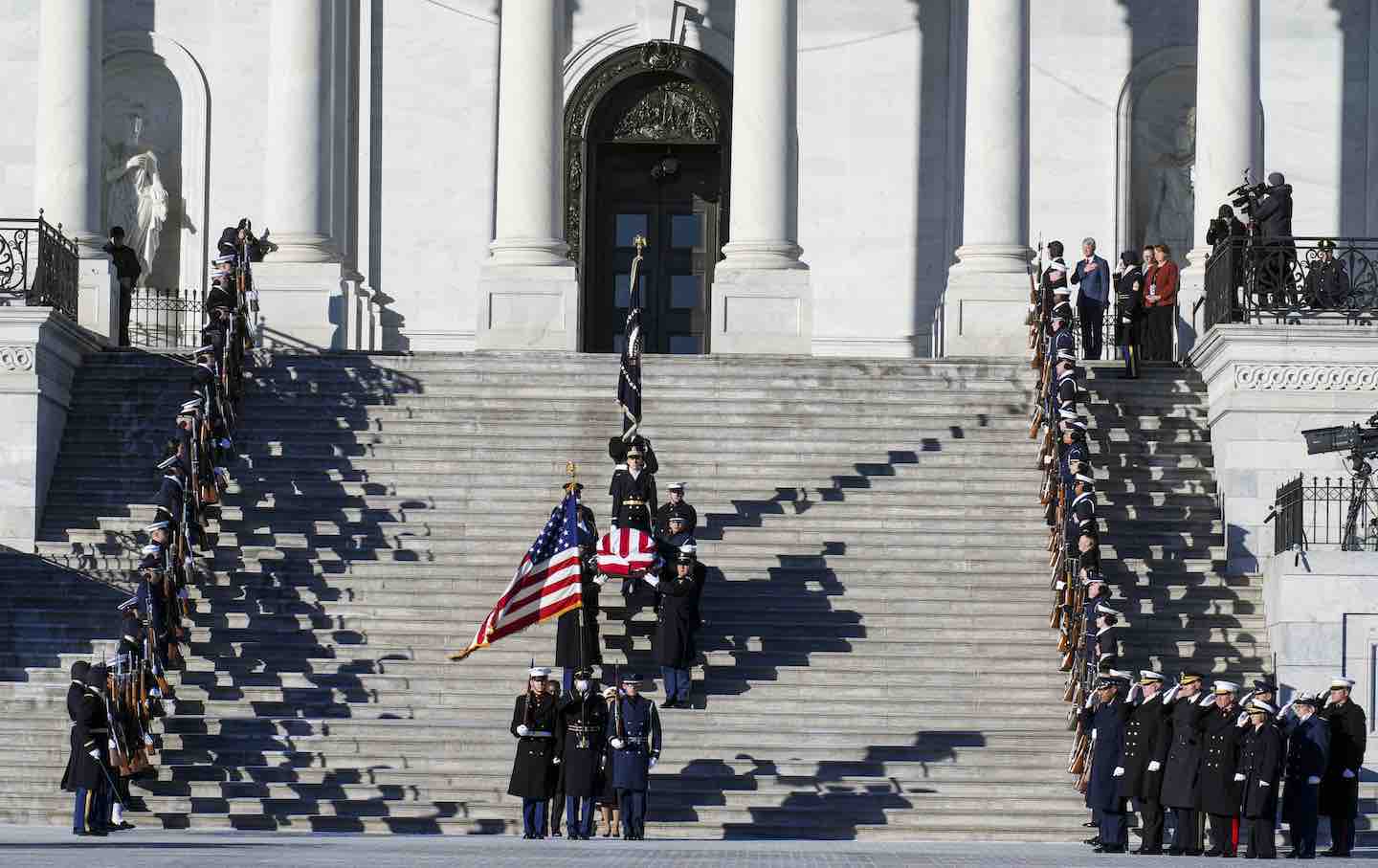
The body of the late former United States president James Earl Carter Jr. is taken from the United States Capitol after lying in state in the Capitol Rotunda on January 9, 2025, in Washington, DC.
(Jahi Chikwendiu / The Washington Post)
No American president, or post-president, thought more profoundly than did Jimmy Carter about the causes of war—and about the prospects for peace. So it should not have come as a surprise that the most compelling musical performance of the 39th president’s funeral on Thursday was a quiet rendering of a radical challenge to militarism, nationalism, capitalism, and the exploitation of religious differences for political purposes.
When country stars Garth Brooks and Trisha Yearwood sang John Lennon and Yoko One’s “Imagine” to the remarkable assemblage of domestic and international leaders that came together to honor Carter inside the National Cathedral on Thursday, the recital of the lyrics touched on the hope for a world without war that energized and inspired Carter during his presidency and in the 44 years that followed it.
The funeral service’s rich tapestry of devotional and secular music and soaring rhetoric highlighted Carter’s prophetic legacy as a uniquely engaged leader who, in the moving words of former US ambassador to the United Nations Andrew Young’s homily, dedicated his public service to seeking “peace on earth and goodwill towards all men and especially women and children.” It celebrated the former president’s dedication to diplomacy—from his White House work as the architect of the 1978 Camp David Accords between Israel and Egypt to his last years as an outspoken advocate of justice for the Palestinian people—along with his faith in the possibility of a world where swords might be beaten into plowshares. Lennon shared that longing, and he expressed it in the title song of his second solo album. The former Beatle and anti-war campaigner asked that a world, then torn by conflicts that extended from Vietnam and Cambodia to India and Pakistan to southern Africa, northern Ireland, and the Middle East, might “imagine all the people, living life in peace.”
Carter spoke more than once about his enthusiasm for the song. He delighted in the fact that “Imagine” had become a truly international anthem. “[I]n many countries around the world—my wife and I have visited about 125 countries—you hear John Lennon’s song ‘Imagine’ used almost equally with national anthems,” the former president said in a 2006 NPR interview. “So John Lennon has had a major impact on some of the countries that are developing in the world.”
Asked by the Associated Press about his favorite Beatles song when he was attending the 2007 Toronto International Film Festival for the debut of Jonathan Demme’s documentary, Jimmy Carter Man From Plains, at the time of the premiere of Across the Universe, a film framed by the music of Lennon, Paul McCartney, George Harrison, and Ringo Starr, Carter once again mentioned Lennon’s majestic solo song.
“My favorite is ‘Imagine.’ When I go to a strange country, Cuba and other places, in some of those nations, ‘Imagine’ has become [an unofficial] national anthem. If you go to Havana, for instance, you’ll see a statue of John Lennon,” he said, referencing the memorial in Havana’s Parque John Lennon. “When we go to a folk performance or a symphony concert or to modern American music, they always play ‘Imagine,’ and it’s one of my favorites just personally. If you listen to the lyrics closely, you’ll see that it’s against religion, it’s against national boundaries, it’s against nationalism, it’s against jingoism, but the impact it has on people is profound.”
Carter was not alone in his nuanced understanding of the song, which Lennon said was inspired and influenced by Ono, his wife and musical partner. (In 2017, based on interviews the former Beatle gave before his death in 1980, Ono received credit as a cowriter of the track.) Rolling Stone once described “Imagine” as Lennon’s “greatest musical gift to the world,” while David Fricke, one of the magazine’s most insightful writers, observed, “‘Imagine’ is a subtly contentious song, Lennon’s greatest combined achievement as a balladeer and agitator.”
The politics of the song sparked its share of controversy over the years, especially for lyrics that invited listeners to: “Imagine there’s no heaven / It’s easy if you try / No hell below us / Above us, only sky / Imagine all the people / Living for today,” and “Imagine there’s no countries / It isn’t hard to do / Nothing to kill or die for / And no religion, too.”
Despite the song’s global resonance over the years, there were social media posts on Thursday that criticized the inclusion of “Imagine” in Carter’s funeral. Critics suggested that it was an inappropriate pick for a celebration of the life of so passionate an evangelical Christian. Lennon recognized these sorts of concerns in his lifetime, as Beatles author and historian Kenneth Womack noted, when the Library of Congress added “Imagine” to its National Recording Registry in 2023. “Lennon also cited a Christian prayer book as part of the song’s impetus,” wrote Womack. “In June 1969, he had been gifted the book from comedian and civil rights activist Dick Gregory. As Lennon later explained to [interviewer David] Sheff, the book afforded him with the key concept about the nature of ‘positive prayer’ that would inform the composition of ‘Imagine.’ ‘If you can imagine a world at peace, with no denominations of religion—not without religion, but without this “my God-is-bigger-than-your-God” thing—then it can be true.’”
Carter, a progressive evangelical who spoke about how he sought to “apply my Christian faith much more regularly to my secular life,” was well aware of the song’s message, and of Lennon’s impact as a musician and political activist.
With Ono, the former Beatle had attended the celebrations of Carter’s inauguration as president in 1977. When Lennon was murdered in New York City in December of 1980, the Georgian who was finishing his single presidential term mourned the news, with an extended White House statement that observed, “It is especially poignant that John Lennon has died by violence, though he had long campaigned for peace.”
In his later years, Carter’s appreciation of “Imagine” was much in evidence. When Georgia Tech students surprised Carter and former first lady Rosalynn Carter with a rendition of the song in 2017, the former president rose to his feet and led the applause. At Rosalynn Carter’s funeral in 2023, Brooks and Yearwood—who have worked alongside the Carters on Habitat for Humanity projects—performed “Imagine.”
The song choices at both funerals reflected the musical tastes of the Carters and their family—along with messages they hoped to communicate.
Jimmy Carter was, as his grandson Jason Carter told the mourners at Thursday’s memorial, a practical idealist who “waged peace with love and respect” and who preached “the power of human rights… not just for some people but for all people.” He was, as well, a believer in the power of music who appreciated the global reach, and influence, of a song that concluded with the words, “You may say I’m a dreamer/But I’m not the only one/I hope someday you’ll join us/And the world will live as one.”