We Must Protect Higher Ed
The GOP and its allies are attempting to suppress freedom to teach, conduct research, learn, and engage in political dissent at universities and colleges across the US.
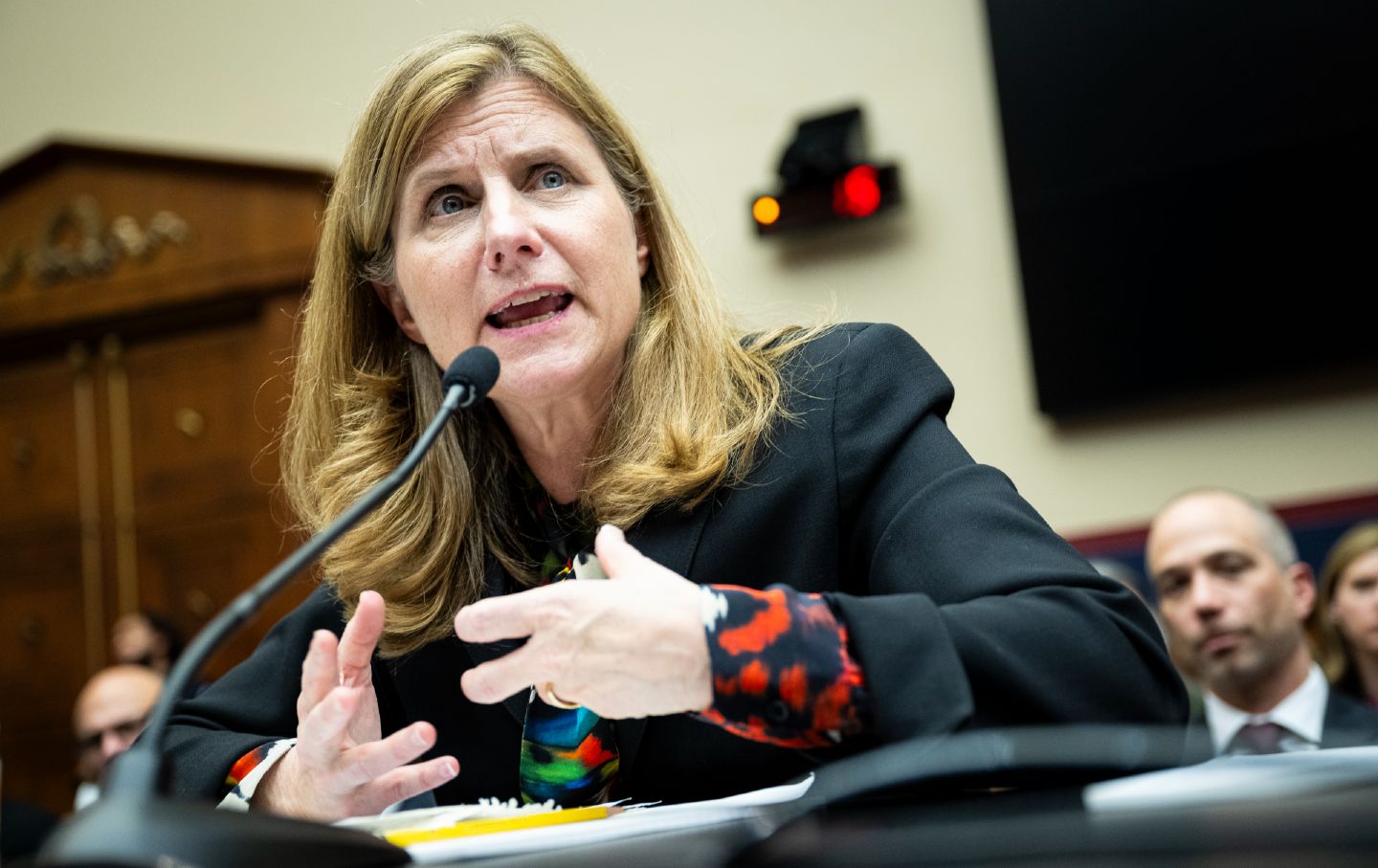
University of Pennsylvania President Liz Magill testifies during a House Education and Workforce Committee Hearing on holding campus leaders accountable and confronting antisemitism, at the US Capitol, in Washington, D.C., on December 5, 2023.
(Graeme Sloan / Sipa USA / AP Images)Antisemitism is undoubtedly on the rise in the United States: Elon Musk has supported neo-Nazis on the platform he controls; House Republican Elise Stefanik, among others, has promoted antisemitic “Great Replacement” conspiracy theories of the kind that inspired the Tree of Life synagogue shooting; and far-right PAC leader Nick Fuentes has called for the mass execution of “perfidious Jews.” Yet, last week, right-wing politicians led by Stefanik constructed a headline-grabbing spectacle to persuade the public that antisemitism festers primarily on Ivy League campuses. In a congressional hearing, Stefanik and her GOP colleagues on the House Education Committee opportunistically exploited fears about antisemitism—which are even more heightened given the disturbing rise in antisemitic, anti-Muslim, and anti-Arab incidents worldwide in the wake of the Israel-Gaza war—in order to attack their actual target: higher education itself. And they managed to claim at least one victory: Within days of the hearing, University of Pennsylvania President Liz Magill was effectively forced out of her job.
The GOP didn’t do this alone, though. The Republicans were joined by a group of unelected Penn trustees who successfully pressured Magill into resigning. The real purpose of this crusade became plain in a letter circulated among the trustees raising “questions” about unilaterally closing academic departments, changing faculty hiring criteria, and imposing a “Code of Conduct” to punish student speech. Such actions, led by a private equity billionaire, would amount to a hostile takeover of the university’s core academic functions. They would violate foundational university policies on shared governance and academic freedom, principles broadly recognized across US higher education as necessary to the functioning of a university and to its purpose in a democratic society.
Ivy League schools like ours receive disproportionate attention, but this is not a story about the Ivy League. What has happened at Penn is indicative of a larger, coordinated attack on higher education. The GOP and its allies are not merely interested in weakening and destabilizing elite schools, although they would certainly cheer that outcome. Their goal is to suppress freedom to teach, conduct research, learn, and engage in political dissent at universities and colleges across the United States—whether private or public, four-year or community college. For the sake of every student and every teacher in this country, we cannot let them succeed.
It is worth stressing that the entire congressional hearing centered on a falsehood. In the most sensationalized moment, Stefanik—one of the least credible authorities imaginable on antisemitism—asked Magill whether hypothetical calls for genocide against Jews would violate Penn’s policies. Such calls would be horrifying if they had occurred—and Magill’s clinical answer gave Stefanik exactly the weapon she was looking for—but, in fact, no one at Penn has called for genocide. While our campus and neighborhood have indeed seen disturbing antisemitic as well as anti-Arab and anti-Muslim incidents, the hearings focused not on those instances of actual bigotry but instead on protest slogans used in anti-war demonstrations. Committee members’ bad-faith questions raised specters of “violent protest,” when in fact the protests on our campus have been peaceful. Menacingly, Stefanik’s grandstanding about imaginary calls for genocide breathed new life into a misinformation campaign that originated in October, when Penn faculty and students demonstrated against the bombing of civilians in Gaza, and far-right social media accounts falsely claimed that crowds chanting against genocide were calling for genocide. Newspapers have credulously covered Stefanik’s exchange with Magill as though it concerned real calls for Jewish genocide rather than fabrications meant to discredit protest and provide a pretext for restricting speech.
In fact, the congressional hearing recapitulated months of distortions propagated by donors and lobbying organizations seeking to control what can be studied at US universities. At Penn, their efforts became public in September, when several tried to prevent the university from hosting a festival on Palestinian literature by falsely claiming that it was a platform for antisemitism. Since then, donors, lobbyists, and administrators have equated antisemitism with all research and teaching on Palestine and all criticism of Israeli policies, a dangerous conflation reinforced in a recent House resolution. They have repeatedly misrepresented the words of faculty and students who have voiced concern for Palestinian civilians and criticized the war—going so far as to claim that faculty who have publicly condemned Hamas were Hamas supporters and that groups protesting genocide were advocating genocide. Their defamatory attacks on our colleagues have done nothing to address antisemitism. Instead, they have threatened the ability of faculty and students at Penn and elsewhere to research, teach, study, and publicly discuss the history, politics, and cultures of Israel and Palestine. Witness, for instance, administrators’ attempts to block Jewish student group Penn Chavurah from screening an award-winning documentary by Jewish filmmakers critical of Israeli policies. These falsehoods have also endangered our colleagues’ lives, prompting an onslaught of death threats targeting those who have spoken out in anguish about the catastrophe unfolding in Gaza.
While the current attacks focus on elite universities, they are part of a broader assault on higher education, and on gains that social movements have won since the 1960s. In Florida and elsewhere, state legislatures have suppressed teaching on African American studies, postcolonial studies, US history, and gender and sexuality. Statements by Penn donors and members of Congress make clear that they aim to destroy diversity, equity, and inclusion policies in US universities. Tellingly, in a hearing supposedly about antisemitism, Joe Wilson (R–S.C.) asked President Magill out of the blue how many conservatives teach at Penn—a decades-old hobbyhorse among opponents of affirmative action, who depict improvements in diversity and equity as discrimination against conservatives.
These attacks strike at the heart of a university’s mission: to foster open, critical, and rigorous teaching and scholarship that can produce knowledge for the public good in a democratic society. That mission has already been undermined across the US by the corporatization of universities and the growth of contingent academic employment (now most of the instructional workforce) as a result of decades-long state defunding of higher ed. CEOs’ and politicians’ attacks further aim to silence political dissent far beyond university campuses.
The principle of academic freedom was first articulated a century ago by scholars who faced threats not unlike those we face today: donors and politicians who aimed to make universities serve private and political interests and who sought to suppress research, teaching, and speech they found inconvenient. Academic freedom was born to safeguard the integrity of research and students’ right to learn by ensuring that researchers and educators, not plutocrats or politicians, make decisions about curriculum and scholarship.
University presidents must defend the principles of academic freedom and faculty governance, which protect all universities’ educational mission. And they must correct what has become a dangerous myth suggesting that academic freedom and open expression are in any way contradictory to the fight against antisemitism. We intend to see that Penn’s next president lives up to these responsibilities.
Time is running out to have your gift matched
In this time of unrelenting, often unprecedented cruelty and lawlessness, I’m grateful for Nation readers like you.
So many of you have taken to the streets, organized in your neighborhood and with your union, and showed up at the ballot box to vote for progressive candidates. You’re proving that it is possible—to paraphrase the legendary Patti Smith—to redeem the work of the fools running our government.
And as we head into 2026, I promise that The Nation will fight like never before for justice, humanity, and dignity in these United States.
At a time when most news organizations are either cutting budgets or cozying up to Trump by bringing in right-wing propagandists, The Nation’s writers, editors, copy editors, fact-checkers, and illustrators confront head-on the administration’s deadly abuses of power, blatant corruption, and deconstruction of both government and civil society.
We couldn’t do this crucial work without you.
Through the end of the year, a generous donor is matching all donations to The Nation’s independent journalism up to $75,000. But the end of the year is now only days away.
Time is running out to have your gift doubled. Don’t wait—donate now to ensure that our newsroom has the full $150,000 to start the new year.
Another world really is possible. Together, we can and will win it!
Love and Solidarity,
John Nichols
Executive Editor, The Nation