The Harris-Walz Vision for Public Schools
Their agenda breaks with decades of Democratic thinking about education.
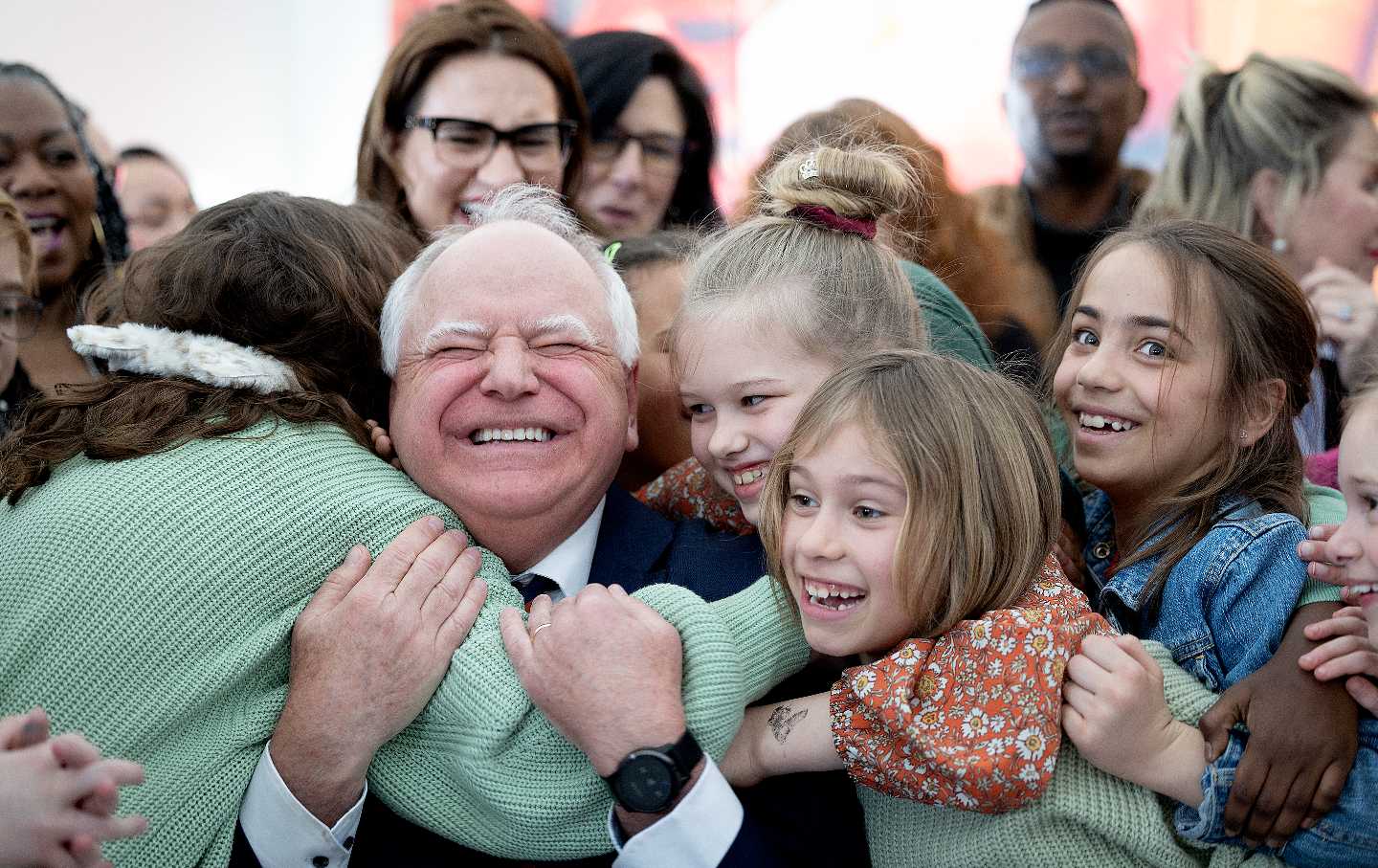
In an interview this summer, vice presidential candidate Tim Walz made the sort of blunt statement about poverty that has long eluded his fellow Democrats. “People are poor because they don’t have money,” Walz told Pod Save America, rattling off a long list of what he called “chain reactions” for children in America, including low performance in school. That vision is at the heart of the Harris-Walz populist economic agenda, but it also casts the education policy of a Harris-Walz administration as a means of supporting kids and families. This contrasts sharply not just with Republicans but also with previous Democratic administrations.
From the recently proposed $6,000 credit to support newborns in their first year of life to a universal school meals policy to provide every child with free breakfast and lunch regardless of income, the Harris-Walz education agenda is often inseparable from the campaign’s economic priorities. Both are part of what the candidates describe as a pro-family platform.
“It’s so refreshing to see real policy ideas that are actually targeted to the genuine problems and priorities of parents rather than this kind of culture-war vision about who is going to which bathroom,” says Jon Valant, the director of the Brown Center on Education Policy at the Brookings Institution.
The contrast with the goals of a second Trump administration couldn’t be starker. Eliminating the Department of Education—a GOP talking point for decades and a regular Trump promise on the campaign trail—would result in deep cuts to federal funding for under-resourced schools. Project 2025, the Heritage Foundation’s detailed policy blueprint for a conservative transformation of government, calls for a host of policy changes that would make education more expensive for families, including eliminating Head Start, shrinking the federal school meals program, and the eventual dismantling of public education.
But the emerging Harris-Walz education agenda, with its emphasis on supporting families outside of school, also breaks with decades of Democratic thinking about education. Since Bill Clinton, the party consensus has been that improving the nation’s public schools is the best way to lift kids out of poverty. Yet as inequality deepened and wages stagnated, the party pointed to those schools, and especially their teachers, as the problem, and competition and privatization as the solution. This way of thinking reached its apex under Barack Obama, who sold his get-tough-on-teachers policy as key to the nation’s economic competitiveness and oversaw an explosion of privately run charter schools.
The Harris-Walz vision is much different, positioning public education as one piece of a larger family support system, beginning with universal pre-K, including well-resourced public schools, and continuing through affordable college. That view doesn’t just represent a shift in “blue” thinking. It also puts Harris and Walz on a collision course with red states, which have been moving at rapid speed to privatize public education, often in the name of “parents’ rights.” Fourteen states have now passed legislation creating expansive—and expensive—voucher programs that allow parents to spend public funds on private schools, with little if any public accountability.
As these programs balloon, they are draining much-needed resources away from public schools, while crowding out spending on all kinds of social programs. Arizona, which enacted the largest voucher program in the country in 2022, recently slashed spending on water infrastructure projects to help close its $1.4 billion budget deficit, due largely to vouchers.
Since the onset of the Covid pandemic, Democrats have struggled to find much of anything to say about public schools. Defensive over school closures and caught off guard by the Republicans’ embrace of school culture wars, the Biden administration has often seemed rudderless on K-12 issues. Beyond Biden’s signature issues of expanding civil rights protections for LGBTQ students and student loan forgiveness—both of which have been stymied by the courts—it’s hard to point to a particular vision of what public schools should do, or indeed why we have them at all.
There are signs that the Harris-Walz approach will be very different. For one, Walz’s background as a social studies teacher and a coach, the epitome of a Midwestern normie, is a powerful rejoinder to the GOP’s fixation on teachers as groomers. And both Harris and Walz are the product of public schools, experiences that have clearly shaped their views about the importance of public education. Reminding Americans why we have public schools, and what we stand to lose if they go away, will require not just contrasting their education policy with the GOP’s platform of abandoning free, secular, taxpayer-supported schools, but also moving away from the legacy of the Democratic brand of education reform.
“Schools are more than just factories where we keep track of how well kids do on tests. They’re community entities,” says Noliwe Rooks, chair of Brown University’s Africana Studies program. “Public education is an audacious experiment that doesn’t exist in most places, and it’s worth protecting.”