
Is Nepal a Turning Point in Climate Coverage?
Even CBS News and Bari Weiss, who fired the outlet’s entire climate unit, have used Nepal as a watchword for environmental disaster.
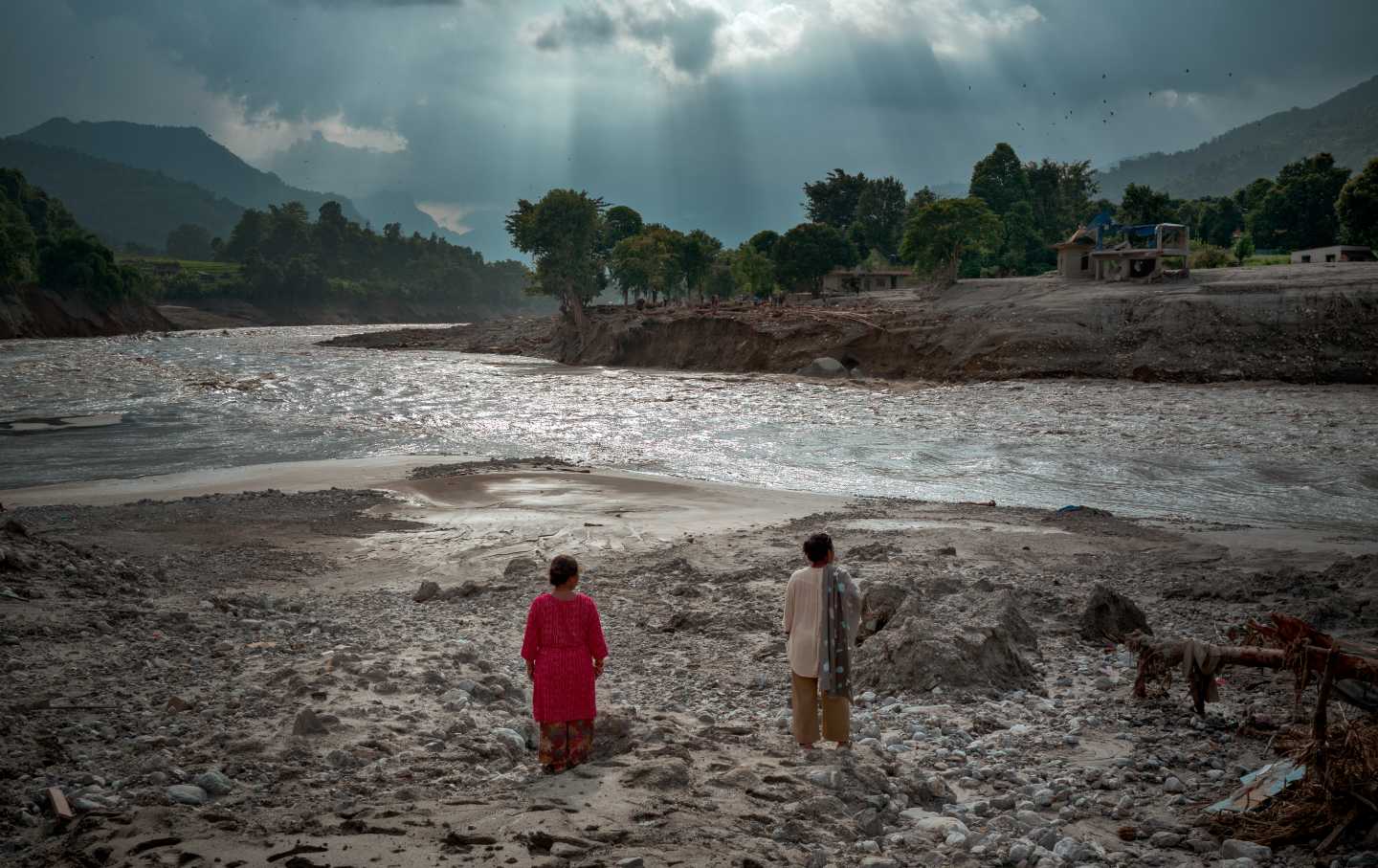
Women view the widened channel of the Trishuli River following flash floods on August 29, 2026 in Devighat, Nepal.
(Photo by Ezra Acayan / Getty Images)
It’s been slow coming, but news coverage of climate change may at last be turning a corner. For years, reporting on climate-related disasters—the superstorm Hurricane Helene that blasted the southeastern US in 2024, the mega-fires that torched Los Angeles in 2025, the record heat that has scorched Europe and Asia in 2026—rarely mentioned the term “climate change,” despite overwhelming scientific evidence linking such extreme events to human-caused global heating. This week, however, even formerly reticent news outlets are making the climate connection clear in their coverage of the deadly flooding in Nepal, where more than 1,100 are confirmed dead and an additional 4,000 are missing.
More of these disasters are sure to follow: Even with unprecedented emissions reductions, global temperatures will rise to at least 1.8 degrees Celsius above pre-industrial levels, the UN Environment Programme announced yesterday. As rising temperatures melt more glacial ice, “we can expect more and more of these events, a greater frequency, a greater magnitude,” said Alton C. Byers of the University of Colorado, Boulder, during a Covering Climate Now live conversation on the Nepal floods.
Meanwhile, The Guardian, Agence France-Presse, The New York Times, the Associated Press, Bloomberg, Deutsche Welle, and other outlets whose reporting has long reflected established climate science are suddenly no longer outliers. The shift is particularly striking among US television networks, whose climate coverage had declined by 35 percent during the first year of Donald Trump’s second term.
NBC News did not mince words in an August 28 report, with graphics that spelled out the climate connection: “Past 60 Years: Glacial Loss Increased 4X” and “Glaciers Less Stable Worldwide From Melting.” Even CBS News has noted, more than once, the climate connection to the Nepal disaster. (This despite a president, Bari Weiss, who has fired the entire CBS News climate unit, derided climate change in newsroom meetings as “woke,” and intervened to push the network’s reporting to the right on a range of topics, above all Israel.) Referring to the “glacial burst” that triggered the gargantuan flood that swept away buildings, roads, and bridges, CBS Evening News stated on August 26 that “experts believe this is linked to climate change.” On August 31, CBS’s morning news show interviewed scientist Daniel Swain while graphics broadcast to viewers: “Climate Change Impacting Extreme Weather Events, Shifting Global Sea Levels, Ecosystems, and Human Health.”
The Nepal coverage has demonstrated the importance of public officials speaking plainly, thus giving journalists a peg to make the climate connection to extreme events. Each of the Big Three US networks, CNN, the BBC, and other international news organizations headlined the statement by Nepal’s foreign minister, Shisir Kahnal, blaming the floods on global warming. Days later, Kahnal said that Nepal is demanding compensation from the world’s biggest emitters.
Such high-profile coverage predictably irritated the tiny but noisy band of bots and cherry-picking blowhards who still deny climate change. The opinion section of The Wall Street Journal, which has disparaged climate science since the 1990s, published an article on August 28 that studiously avoided engaging with the actual scientific expertise other outlets had cited. Instead, it accused “the Western media” of rushing to judgment by embracing its “all-purpose explanation for everything: climate change.”
The Journal’s accusation was hardly more persuasive than that of an online conspiracy theorist who tried to blame the Nepal floods on a research project in Alaska. The fact-checking unit of AFP, which delivers news to thousands of news outlets and government offices worldwide, quickly slapped down that absurdity: “AFP has repeatedly debunked claims that the High-frequency Active Auroral Research Program (HAARP) is to blame for extreme weather events, and scientists say manipulation cannot cause floods of this magnitude—instead pointing to human-caused global warming.”
Why the Nepal disaster has called forth more plainspoken climate coverage than usual is, at this point, unclear. The availability of stunning videos showing the awesome size, speed, and force of the floods was doubtless a factor. But that can’t be the sole explanation; the images of Helene’s ferocious winds and of Los Angeles hillsides engulfed in flames were no less eye-catching. Yes, the link between higher global temperatures and melting glaciers makes intuitive sense, but is it any more intuitive than the connection between higher temperatures and the extreme heat that has killed 35,000 people and counting in Europe this summer?
In any case, the question now is where climate coverage goes from here. Nepal’s floods are a textbook illustration of the stark injustice at the heart of the climate story: The people who did the least to cause the problem tend to be the ones who suffer the first and worst. As Bill McKibben noted on his Substack, The Crucial Years, “on average, Nepalis produce about four-tenths of a ton of carbon emissions annually, compared with about 14 tons for an American.”
At the COP28 UN climate summit in 2023, the world’s governments operationalized a Loss and Damage Fund to compensate victims of climate disasters. Contributions have been paltry, but The Nation reported this week that the fund’s board of governors was discussing whether to make an inaugural donation to Nepal as a symbol of why the fund needs to be fully capitalized. As journalists and newsrooms prepare to cover the COP31 summit in Turkey this November, the long-standing debate around climate loss and damage deserves our focused attention.
Nepal’s floods also highlight another aspect of the climate story: Who is responsible for all those losses, and who should pay for the damages? To date, most reporting has trod lightly on these questions, even though a handful of investigative exposés have made clear who the chief culprits are. “A 1981 internal memo written by the director of one of Exxon’s science labs said it was ‘distinctly possible’ that cumulative carbon emissions could eventually ‘produce effects which will indeed be catastrophic (at least for a substantial portion of the earth’s population),’” author Jeff Goodell pointed out the day after the Nepal floods.
Exxon and other companies hid that science for decades, instead pressing for ever-increasing fossil fuel production and consumption. If holding power to account is a core duty of journalism, then connecting the dots between Big Oil and the Nepal floods—and other coming disasters that Big Oil’s delaying tactics have made inevitable—is a good place to start.
More from The Nation
Abby Martin on the Climate Cost of US Empire Abby Martin on the Climate Cost of US Empire
The filmmaker discusses military pollution, her reporting in Hawai’i, and why the climate and antiwar movements belong together.
Trump Is Making Deals With Big Oil Trump Is Making Deals With Big Oil
Democrats and the press should be paying attention to how this pay-to-play behavior relates to the midterms
This Lawsuit Could Make Big Oil Pay for the Harm It’s Caused This Lawsuit Could Make Big Oil Pay for the Harm It’s Caused
The question is whether the Supreme Court will let it.

Germany and California Make Up an Environmental Superpower Germany and California Make Up an Environmental Superpower
The world’s third- and fourth-largest economies have pledged to environmental protections. Will others follow suit?

Gavin Newsom Comments on Climate Gavin Newsom Comments on Climate
On the sidelines of the UN General Assembly meeting and New York Climate Week, the California governor called AOC “the real damn deal.”

Cities as Climate Labs: Inside the U20 Summit Cities as Climate Labs: Inside the U20 Summit
Mayors at the Urban 20 Summit worked across borders to confront the climate crisis at the local level.

