
Confessions of an AI Editor
At the start-up I worked for, I was judged not by my ability to be a good reader but by my capacity to become one with a machine.
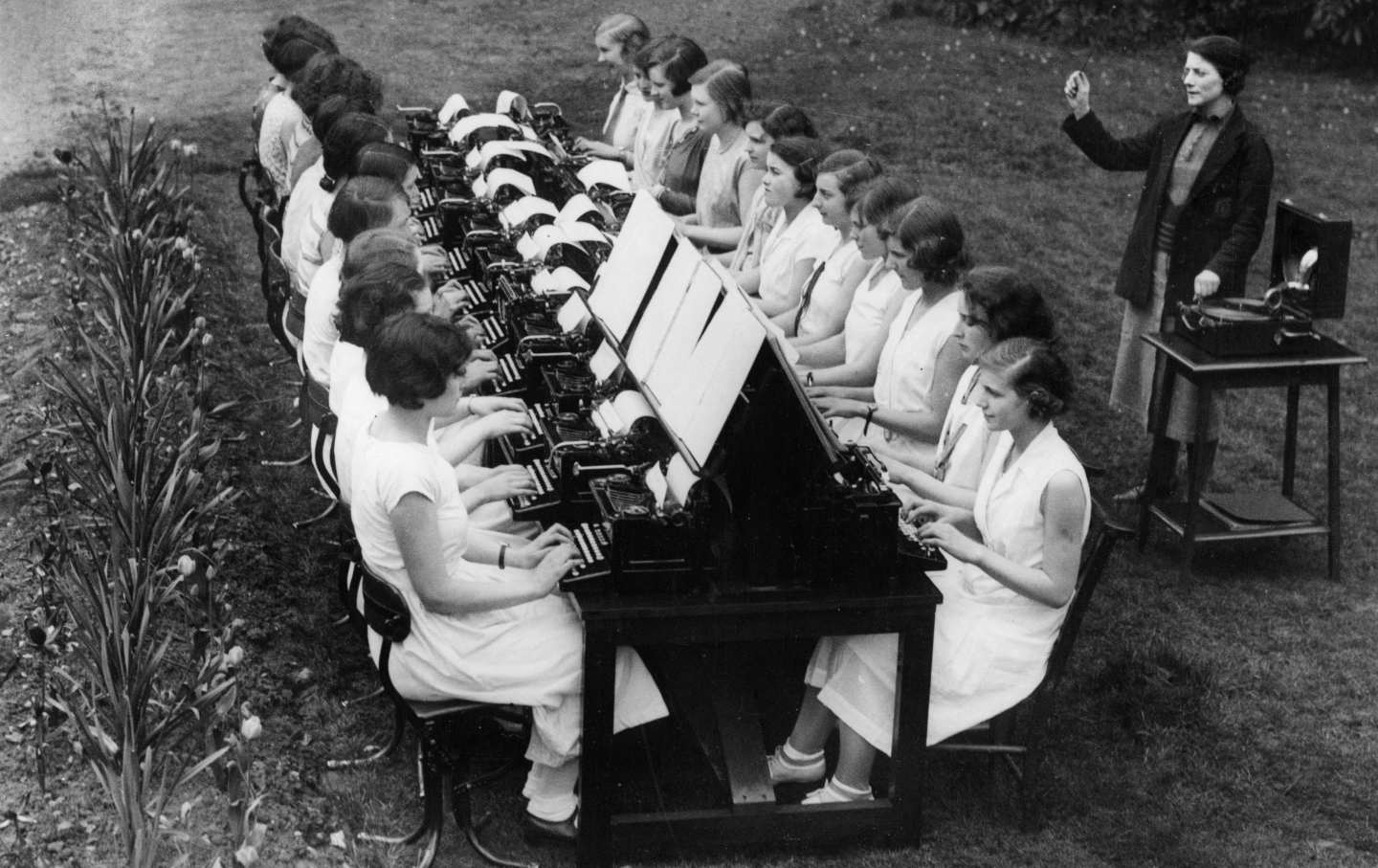
Outdoor typewriting class for secretaries, 1932.
(Imagno / Getty Images)It was ironic that the literary services start-up had been founded by an editor. But if you’d met her, that wouldn’t surprise you. The labor of editing, she believed, was arduous and its romanticization undeserved. To her, the taste of selection was the sole editorial virtue, everything else a chore. In her ideal world, each piece of copy would already come with tracked changes, leaving the prudent editor with little more than the discretion to press “Accept” or “Reject.” She would happily relegate the rest of the labor and presumed others would feel this way too. And so, when she created her company, she gave away all the “drudgery” to the thing, an artificial-intelligence tool. Like Pygmalion, she built it in her image, and like Pygmalion, she loved what she had wrought. Even if she might hesitate to call it flawless, it was preferable to the many entry-level copy editors who routinely sent in their CVs, eager to do her bidding. After all, the thing could produce an editorial memo in less than a minute. In a few seconds, it could parse a tangled paragraph and downsize it to a corporatized readability, or copy-edit a chapter in the time it takes to shift between browsers. “I taught it as I taught you,” my boss said. With her tool by my side, I could edit a piece of prose without so much as reading a line.
My boss would sit at her long, lonely desk for hours, the picture of a classic editor. Her rainbow-coded bookcase was the work of a handsomely paid book stylist who, I imagined, read only the spines. When I interrupted her, she would tap her glasses till they landed, precisely each time, on the edge of her nose, a compliment to the gravity of her downward glare. This editorial chic perhaps served to make the uncool, fraught endeavour of using artificial intelligence for the time-honored work of editing appear less offensive. At parties, I could never admit where I worked. It was like lying about a bad boyfriend.
The type of tool my boss’s company had created was christened, sometimes pejoratively, an “AI wrapper.” For a tool created by “wrapping” foundation models with an interface inviting enough to goad you into buying yet another subscription, “wrapper” is a fitting descriptor. All a company has to do to make one is pretty up the existing Big AI models. On the back end, the system instructions my boss had written would begin, “You are a diligent editor…,” and once you uploaded a manuscript onto the thing, it would answer with the disarming confidence of one. The first time I used it to line-edit a chapter of a book, the sight of the text being pressed into cohesion was spectacular.
In the initial days of the job, I’d judge the thing’s judgment and report back on any of its transgressions. As I occupied the lowest rung of the editorial ladder, I couldn’t even say that I was training it to replace me. When it was right, it was right, and when it was wrong, we were wrong: All the blame for its hallucinations was to be shared with the human who bungled the prompt my boss offered it.
My condition at the company became only more demoralizing when I tried to humanize the thing as a means of selling it to clients. (If I wanted to be a better editor, I also had to learn how to be a marketer, my boss reasoned.) Once, I called it my boss’s doppelgänger; other times, I pitched it as a patient, forgiving editor, one certain not to take forever to validate the writer. “Unless you run out of tokens,” I’d joke. “And, of course, you can bug it on the weekends,” my boss would say.
Although I was as compliant as workers come, I almost never read anything that one of our clients, a think tank, sent our way. I wasn’t equipped for the task; I’d never learned how to edit a policy paper. That was acceptable as long as I could pretend otherwise, a demonstration that came as easily as copying and pasting swaths of generated edits into a document.
A recent study in the journal Technology, Mind, and Behavior found that those who relied heavily on large-language-model tools felt no sense of ownership over the output they created with them. This could explain why any compliment to my editing occasioned a headache, as if I had yanked out a fistful of hair. Although I was great at my work, I was no good at it. I couldn’t have done it without the thing.
The fact that the thing possesses a style does not mean it’s a good style. After taking stock of human writing, it assesses recurring sentence structures and grammatical tools. Then it mistakes all the recurrences, such as the recurrence of em dashes, for a necessary characteristic of good writing. Whatever we now chastise as literary affronts for their likeness to AI-generated writing were, before AI, a kind of writing that could be considered forgettable, or writing that aspired to be, but was not quite yet, good. As Laura Kipnis has written in Wired, large language models, through which the thing routed its edits, favor “pseudo-profundities” like delve and dive. The side effect of fraternizing with AI as much as I was expected to do was that I started to see the hand of the machine lurking in things it could never, ever have touched. In his literary manifesto The World of Sex, for example, Henry Miller uses the word delve twice, smartly. But when I saw it in his prose, I was jump-scared.
At work, I was instructed to do away with all the telling platitudinal verbs, slipping an innocent choice in their place, sometimes even replacing the em dashes with commas. Even when endorsing the thing and being up-front about using AI, it couldn’t seem like you’d used AI.
I started to become disillusioned just as the thing started gaining popularity. We two sole employees and an intern were assigned to line-edit an entire 150,000-word PhD dissertation in no more than three days. As with many of our edits by then, it was to be completed piecemeal, as if the pages of the manuscript were sliding across a conveyor belt, each of us assigned to specific tasks.
When I told my boss the goal was impossible, she noted that this was probably because we expected to take as much time on it as a “manual editor” would. (It would appear that we were the “assisted” editors.) There was not even enough time to push back on the request: With the thing, we were compelled to work faster, even if it was making many dubious edits, as the mention of the thing slowing us down would always be regarded as a defensive reflex on our part.
I could not manage, let alone fathom, such proficiency, and so I didn’t read more than a paragraph of that dissertation while editing it. I yielded to the thing absolutely in order to deliver results as the efficient machine I was expected to be. Soon enough, anticlimactically, the writer’s message announcing their love of the edits was forwarded to me, with an addendum from my boss: “I said it was all you!” This clarification was a fiction: Those edits were never going to be mine.
In his 1948 lecture “Good Readers and Good Writers,” Vladimir Nabokov states that a reader who begins a book with a “ready-made generalization” in mind is reading it from the “wrong end…. Nothing is more boring or more unfair to the author.” Yet the prompt library of the thing was lined with phrases that worked with such generalizations. Each draft, it was assumed, warranted a homogeneous approach; the only demarcation was its form. (We even had a prompt to edit poetry.) As I worked, my ambivalence toward everything I edited swelled. I’d habitually run anything I was assigned to do through the models. (I was often asked to gut-check “with” them.) If I wasn’t swift enough, I was reminded that I should’ve been, for any holdup was objectionable when these tools exist. Any time I edited withthe thing, which was most of the time, the metastasizing impact lingered long after the injury of using it ended.
A good reader, “a rereader,” Nabokov writes, can take in the “artistic delight” of the writer. The thing, with its numb productivity, had neither the time nor the ability for this vaunted part of the exercise. Using it, I learned that anyone could engineer prompts. Even someone like me, with all my inexperience of the world, could hastily type something like “proptedit shrt story” into a chatbot interface and watch it reliably spew out a coherent prompt for editing a short story. I knew I wasn’t really editing, but at times I had to believe I was. At work, I often couldn’t allow myself to confront the thought that several prompts of roughly a few hundred words detailing how to approach any type of manuscript would never match years of editorial experience. That would’ve compromised the enterprise entirely.
We can, in theory, train the thing to sound like us. I wager, perhaps vainly, that it will never sound as much like us as we will come to sound like it. Because how an idea is articulated matters as much as the idea itself. Would writers want an editor who will gulp their sentences down and spit them back as prose of an equivocating indistinguishability?
In his foreword to Editor to Author: The Letters of Maxwell E. Perkins, John Hall Wheelock quotes the French critic Hippolyte Taine, who wrote that a “great editor” is “an artist whose medium is the work of other men.” The thing was designed to make the art of editing less taxing. An editor, in my boss’s theory, could use AI and still edit with rigor, still take the same amount of time as she otherwise would reading and rereading. It was the time to exercise “taste” that my boss wanted to give back to editors, and in the case of clients who used the tool, she did just that. Whether they used that extra time to further mold a promising writer or simply accelerate the production line, though, I don’t know.
What I do know is that the thing produced the addictive feeling of providing editorial attention without the fact of ever having to put in the hours required to actually do so. In the infrequent event of a client complaining about flat, uninspiring edits, we would never go back and do the work ourselves, but simply adjust the back-end prompt or switch the model assigned to it. Other times, we’d accuse the clients of vanity or oversensitivity. Usually, though, they left moderately pleased with the revised output.
Popular
“swipe left below to view more authors”Swipe →When I left the job two years ago, it was out of a selfish desire to stockpile the little conviction I still had in the value of my creative labor and my most necessarily complex abilities. I couldn’t even confess how morally repulsive I thought my role to be. And my leaving, of course, didn’t make a dent in the project of automation. With the thing, anyone on the precipice of acquiring skill will atrophy into an unskilled laborer before they’ve even had the chance to slip up.
When a technology is pitched, even if unpersuasively, as a democratizing entity, any counter-argument to its use is often dismissed as snobbish. But when the employment of this technology is detected in writing, it is often rightfully met with aversion. If those who are disadvantaged, be it by class or competence, were to rely on it unquestionably, it would only re-create, if not entrench, the preexistent pecking order.
When I’m writing, I don’t want to suspect that I sound like AI, and when I’m reading, I don’t want to suspect the writer of using it. This suspicion, I worry, turns the mind into mush, much the way the thing was likely to do. Although I’m now a fairly competent copy editor, I take hours longer than I’d like to. On the other hand, the thing made me, inadvertently, a better reader, by striving against its very being.
AI, in short, insults the writerly tradition. We need not, and should not, capitulate to the basest instincts of this lowly thing, and neither should we have to correct ourselves in anticipation of it. It is a dehumanizing way not only to read, but to be read. Worse still are those industries that believe the reader will read what isn’t written by a human. Perhaps she will, but perhaps she’s also not the reader one wishes to have. The good reader of a great writer, as Nabokov observes, tries “to grasp the individual magic of [the writer’s] genius and to study the style, the imagery, the pattern of his novels or poems.” Why would you resort to this delectably masochistic labor if the writer, or their editor, didn’t labor themselves?
More from The Nation
New Mexico’s Grand Experiment New Mexico’s Grand Experiment
Last November, the state made childcare free for children of all ages, for all families. The impact has already been profound. “I feel like I can breathe," one mother said.

Should Parents Be Convicted for Mass Shootings Committed by Their Children? Should Parents Be Convicted for Mass Shootings Committed by Their Children?
Given that our politicians are refusing to deal with the reality of gun violence, it’s tempting to say yes. But the ultimate responsibility for such violence lies elsewhere.
Anthropic Wants You to Be Kind to Claude Anthropic Wants You to Be Kind to Claude
…even as AI courts serial real-world disasters, defaces the environment with data centers, and is not about to return your empathy in kind.
“We Can’t Punish Our Way Out of This”: A Conversation on Meaningful Accountability After Cornell “We Can’t Punish Our Way Out of This”: A Conversation on Meaningful Accountability After Cornell
A discussion with Rebecca Solnit and Rabbi Danya Ruttenberg about what accountability should look like for survivors of sexual assault and rape.
Smoke and Mirrors: The Right's Latest Attacks Against Trans People Smoke and Mirrors: The Right's Latest Attacks Against Trans People
The MAGA movement is redoubling its attacks on trans healthcare in an attempt to win votes this November.
The Real AI Threat Is Already Here The Real AI Threat Is Already Here
Never mind some future apocalypse—AI is being used right now to cause enormous suffering.

