UCLA Is Now Nearly Unrecognizable as a University
A police attack on a documentary film screening is just one of the assaults on student freedoms that have turned UCLA into more of a fortress than a place of higher learning.
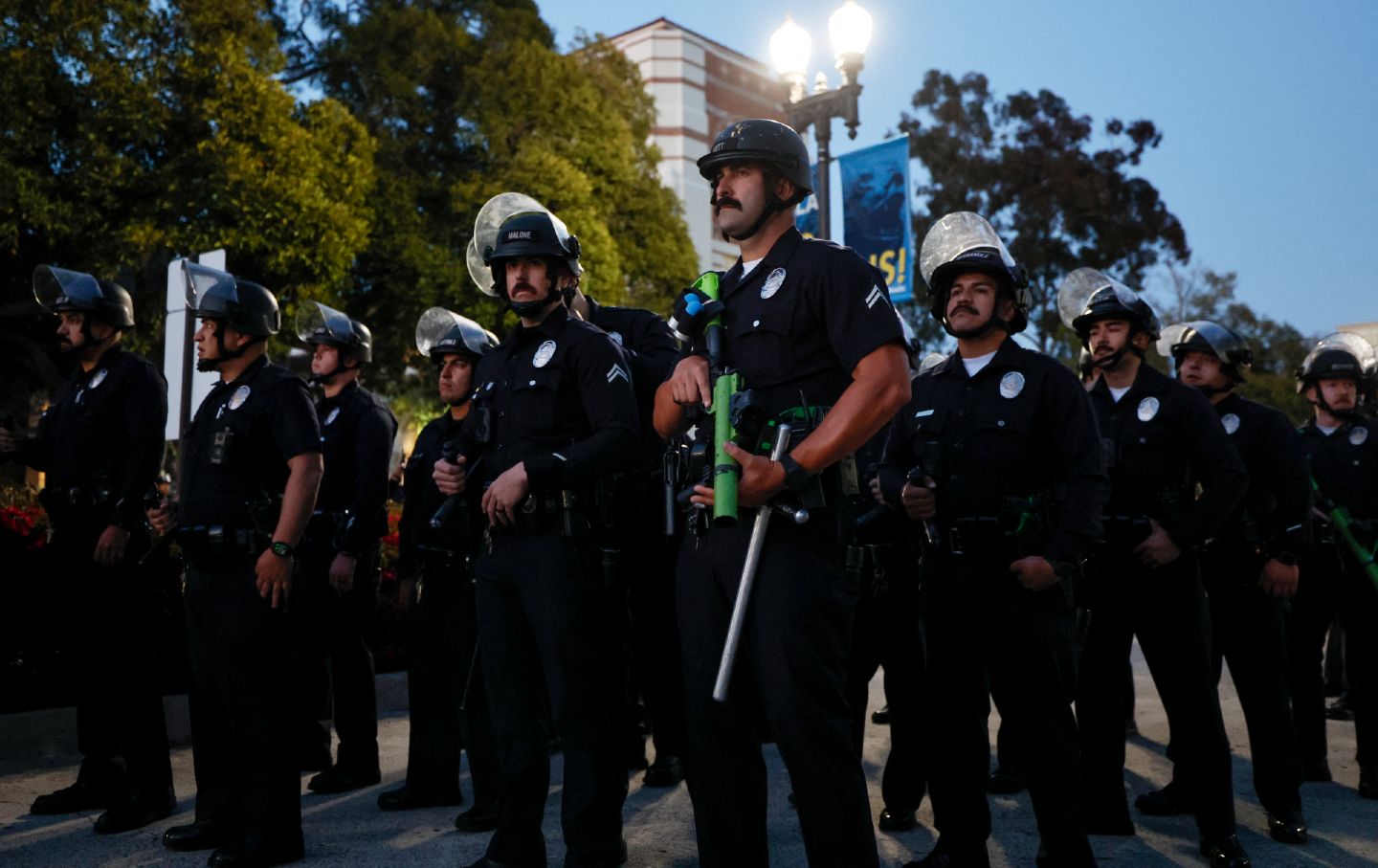
Police officers get into position as pro-Palestinian students demonstrate on the campus of the University of California, Los Angeles, on May 1, 2024.
(Etienne Laurent / AFP via Getty Images)On the evening of April 30, dozens of police officers raided an outdoor film screening on the UCLA campus. Wearing riot gear and holding projectile weapons, they stormed into an enclosed plaza circled by dormitories. As a helicopter hovered overhead, two officers rode motorcycles into this pedestrian-only area filled with students who scattered, panicked. For their trouble, the police confiscated a screen that was literally a sheet strung between two poles.
We, UCLA faculty who attended the screening and witnessed this attack firsthand, were appalled but not surprised. The film was The Encampments, a documentary about the Palestine solidarity encampments of spring 2024. It was the anniversary of the day that a mob of around 200 people wielding makeshift clubs, bear spray, and fireworks attacked the UCLA Palestine Solidarity Encampment. UCLA’s violent overreaction felt like both déjà vu and status quo.
The day after the 2024 assault, UCLA sent in hundreds of police in riot gear armed with truncheons, projectile weapons, pepper spray, and flashbang grenades to Royce Quad to tear down the encampment. They made hundreds of arrests. Subsequent protests and actions were met with similar shows of force. The sight of columns of police in riot gear marching in formation across campus became disturbingly familiar. Since then, patrols of hired security on bikes frequently roll past students walking to class.
Campus administration has refused to even consider what inspired these encampments in the first place and has ignored the students’ demands for UCLA to divest its financial holdings from companies that enable Israel’s genocide of the Palestinian people in Gaza. Instead, campus administration has dismissed or excused anti-Palestinian, anti-Muslim, and anti-Arab racism; pursued disciplinary charges against students, staff, and faculty; and refused to support or even acknowledge the study of Palestine. We have just learned that a lecturer and theologian who was arrested at the police sweep of the UCLA encampment has been fired for violations of campus time, place, and manner policies and insubordination for refusing to participate in a Human Resources investigation. This colleague was fired despite the dismissal of all charges by the city attorney. UCLA’s administration has made it clear that they prefer turning our campus into a fortress over conceding that there is an ongoing genocide in Gaza, much less divesting itself of its complicity.
Fast forward to April 24, 2025. In preparation for the anniversary of the first day of the encampment, dozens of police and security guards were stationed at Royce Quad. Nothing happened that day and police presence on campus gradually receded. But on the day of the screening, police and security personnel were back, blockading the entirety of Royce Quad with metal barriers, including entrances and exits from surrounding buildings. Foreshadowing what was to come later that evening, someone was arrested earlier that afternoon and charged with assault on an officer. One of the authors of this piece has seen a video of the incident in which a hired security guard (not a police officer) aggressively walks up to a person clad in a kaffiyeh and pushes a phone in their face. In response, the person pushes the phone away. That is what constitutes “assault” on an “officer” at UCLA nowadays.
By the time the screening was supposed to start, Royce Quad was blocked off, and student-affairs staff and police told student organizers that they could not set up in a nearby area. They then moved the screening to Bruin Plaza expressly because it is designated an “Area for Public Expression,” where events do not have to be registered in advance with the university. They created a makeshift screen by draping a sheet between two poles held by students that conformed to campus policies that require that displays cannot be affixed but must be hand-carried. Enforcing guidelines was never the point, though. As the screening began, a handful of police attempted to seize the screen and projection equipment but were rebuffed by the crowd. The police retreated, and the screening restarted. About 200 people, mostly seated on the ground, watched quietly. Around half an hour into the film, riot police started moving in. Student organizers roused the group and marched to a plaza in the residence-halls area. Police then raided the screening again, this time with motorcycles, triggering the chaotic scene mentioned above. They made two arrests that evening. The arrests were so violent that one of the arrestees was taken to the emergency room upon release to be examined for injuries.
The next day, UCLA Newsroom, the university’s in-house media and public relations office, released an unsigned statement about these events that is riddled with factual errors and misleading and unsubstantiated claims. The statement asserts that this film screening was somehow a danger to the campus community and that the police had “seized the unauthorized sound and video equipment … to maintain safety and enforce campus regulations.” It does not identify what regulations were violated or how a film screening might impinge on campus safety. It further claims, without offering any evidence, that the screening was unauthorized and that outside agitators had come to campus “to commit an act of violence.” The violence that it describes is a purported assault on a student and a police officer and the theft of some of the student’s belongings. We took video of a student, who later claimed to have been assaulted, pushing through a group of students. One of us has seen another video taken at the scene that shows that this same student instigated an altercation, thereby triggering a scuffle.
Beyond the absurdity of sending a battalion of riot police to seize a screen consisting of a sheet and two poles, the constant and extreme police and security presence on campus since last April has made our campus nearly unrecognizable as a university. It has become a fortress, and in so doing, it has profoundly changed what it means to be faculty here. Suppressing speech about Palestine—or in this case about student movements in support of Palestine—is now the priority of the university administration. It is the priority above the safety of our students, whom the administration allows to be beaten and fired at by police so long as those students wear kaffiyehs or express concern about the intensifying genocide in Gaza. It is a priority above even financial solvency, as the administration spends on the police vast amounts it claims UCLA doesn’t have despite a budget crisis in part due to Trump administration cuts to federal research funding. Most pressing for us as faculty, we see growing evidence that university administration prioritizes this above our academic mission to educate and to inspire critical thinking and engagement, which the screening of this documentary undoubtedly fulfills. When our university meets an activity as quotidian as a film screening with such an extreme show of force, what does it mean to be faculty?
We have decided that from within the fortress, we as faculty must free ourselves. We can build our own relationships with our students, joined not by an institutional connection but by our commitment to knowledge in the pursuit of justice. Today, on Nakba Day, which marks the genocidal expulsion of 750,000 Palestinians—half the population at that time—from their homes and their homeland in 1948, we attest that, by speaking truth to power, we work toward making state violence less possible everywhere, whether here on the campuses and streets of the United States or, more pressingly, in Gaza and all of Palestine.
Become a Sustaining Donor This September
Between the reemergence of right-wing red-baiting and Donald Trump’s use of the chilling National Security Presidential Memorandum–7 to criminalize left political organizing, we’re seeing McCarthyism reborn before our eyes.
This assault on democracy cannot be ignored or wished away. Resisting it requires bravery in the face of threats and repression, a steadfast commitment to the truth, and the unwavering belief that we can—and will—overcome this darkness.
We must have an independent media that sets the record straight, unearths corruption and abuses of power, and advances a politics of justice and dignity for all if we’re to win this fight.
That’s why I’m writing to you today. This September, The Nation needs to add 100 monthly donors to sustain our progressive journalism. Your contribution makes the next investigative report, the next truth-speaking column, and the next pathbreaking essay all possible.
I hope you’ll support our work with a recurring donation today. If you donate $10 or more a month, we’ll send you a brand new “Hands Off the Free Press!” sticker to recognise your commitment to our cause. Please, donate today.
Onward,
Katrina vanden Heuvel
Editor and Publisher, The Nation