What It Took to Save a Soccer Field in Palestine
Europe’s governing soccer body saves a pitch in the West Bank—but is it only because the Swiss Parliament is threatening to pull its tax exemption over its inclusion of Israel?
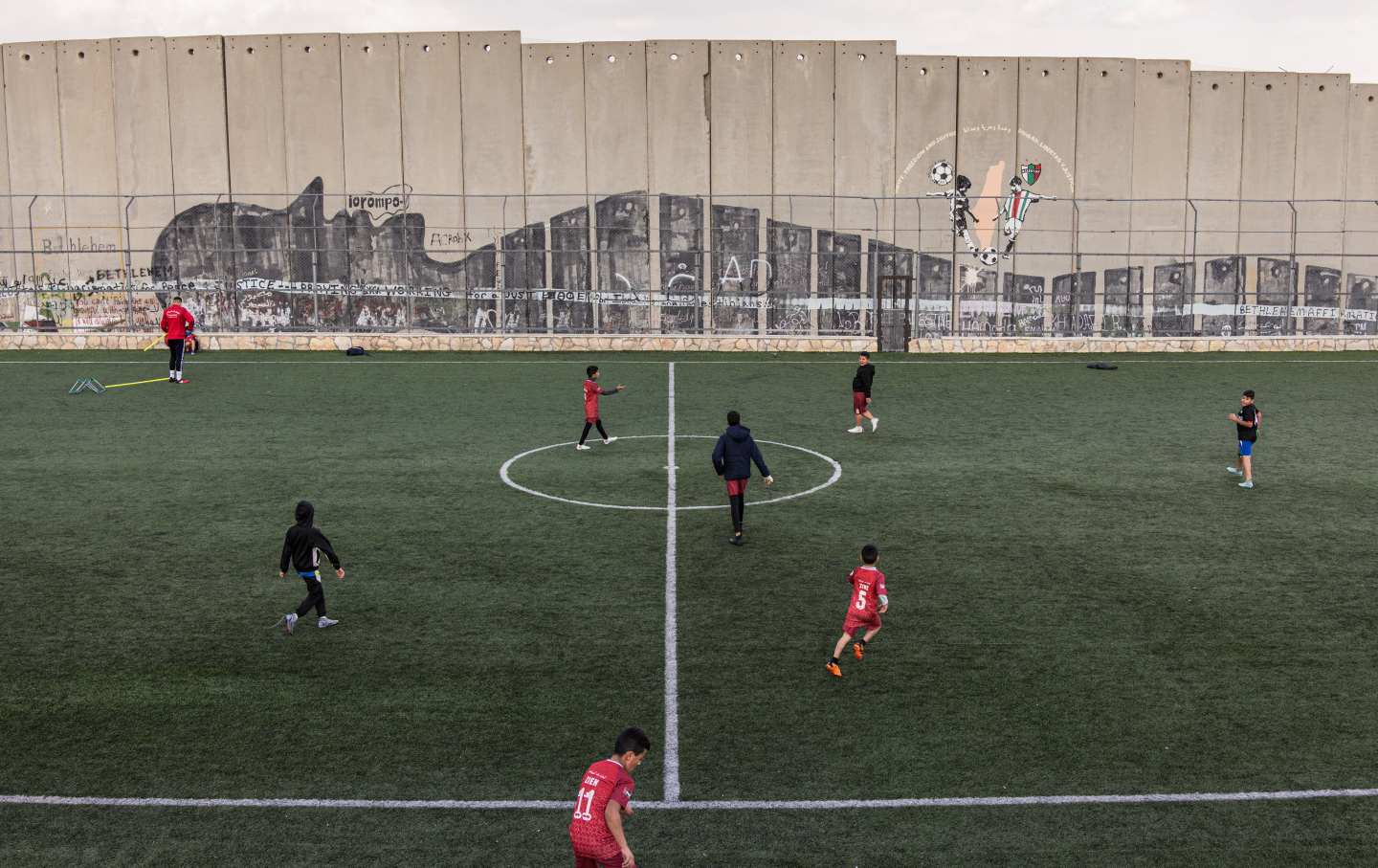
Displaced Palestinian youths take part in a training session at the Aida Refugee Camp’s football pitch, next to the separation wall outside Bethlehem in the occupied West Bank, on December 16, 2025, a few weeks after an Israeli military decision to demolish the field.
(John Wessels / AFP via Getty Images)In a victory for the Palestinian solidarity movement, Israeli soldiers and munitions will not reduce a soccer field in the occupied West Bank’s Aida refugee camp to rubble. In November, Israel announced its plans to demolish the Aida field, despite—or maybe because of—the fact that it is one of the few spaces in the area where kids can play and actually be kids.
The pitch is the only sports facility available to the residents of the Aida camp, and young people from the nearby Bayt Jibrin refugee camp also use the venue. Mohammad Abu Srour of the Aida Youth Center told The Nation, “The football pitch is much more than a sports field for Aida camp. It is also a community hub for families, youth, and social activities. For many children, it represents hope, stability, and a path toward opportunity through sport, education, and psychosocial support.”
In a letter obtained by The Nation, Aida Youth Center board director Munther Amira implored FIFA president Gianni Infantino to recognize that Israel’s decision to raze the field “is a clear and callous attempt to deprive Palestinians, including hundreds of boys and girls of a facility that is of critical importance to their physical and mental welfare.”
Infantino, the only sports official to attend the Summit for Peace in Sharm El-Sheikh, Egypt, last October where Israel and Hamas signed a ceasefire agreement, has been conspicuously quiet while Israel routinely violates the peace pact. But The New York Times reported that Infantino—alongside Aleksandr Ceferin, the head of UEFA, Europe’s governing body for soccer—stepped in, following the outcry, to help save the field from destruction. Palestinians are now awaiting final confirmation that the pitch will actually be saved.
Nick McGeehan, the program director for the human rights group FairSquare, told The Nation, “This intervention from FIFA and UEFA, is welcome and overdue, but it shouldn’t divert attention from FIFA and UEFA’s statutory responsibilities when it comes to the Israel Football Association and their long-standing violation of statutory rules.”
Abu Srour added, “Sports institutions such as FIFA and UEFA should intervene to protect children’s right to play, including the suspension of Israel from international sporting competitions, as was done previously with Russia and South Africa in response to serious violations.”
The planned destruction of the field barely registered on the US sports mediascape, even as the war criminal Benjamin Netanyahu has ratcheted up illegal land seizures in the West Bank. But Rachel Griffin Accurso—the popular US children’s educator known to the world as Ms. Rachel—stepped in where the sports media failed, joining kids in Aida via videostream to share her support, saying, “We need help to save this field!”
UEFA’s support to save the Aida refugee camp’s pitch didn’t come out of nowhere. Last August, Ceferin, UEFA’s president,Ceferin allowed a banner before the kickoff at the Super Cup final that read “Stop Killing Children—Stop Killing Civilians.” He was accompanied to the match by two children from Gaza, Palestinian refugees who had been relocated to Italy for medical treatment. UEFA officials also reportedly met last month with organizers from the Game Over Israel campaign to discuss the possibility of banning Israel from international competition. In the end, UEFA allowed Israel to continue to participate in World Cup qualifying matches.
But UEFA’s motivations may lie elsewhere. The news from FIFA and UEFA that Aida’s field would be spared, came the same day that a vote was due to take place in the Swiss Parliament also aimed at standing up to Israel’s genocide against the people of Gaza. Swiss politicians put forward a resolution to revoke the tax exemptions of UEFA. It leans on a 2024 advisory opinion by the International Court of Justice that ruled that Israel’s occupation of the West Bank and the Gaza Strip was unlawful. And yet UEFA continues to recognize soccer clubs in illegally occupied territories in the West Bank.
Popular
“swipe left below to view more authors”Swipe →The vote was delayed until January 27. If it passes, the Swiss government’s tax authority will give UEFA a deadline to justify allowing the Israel Football Association to continue to compete and explain how the group’s stance chimes with the conditions of tax exemption: fostering peace and combating discrimination. The resolution notes that UEFA moved swiftly to sanction Russia after its invasion of Ukraine, but hasn’t acted similarly when it comes to Israel’s decimation of Gaza and illegal annexations in the West Bank. It then takes aim at UEFA’s pocketbook, noting that it “has long benefited, despite its significant commercial activity, from a tax exemption granted specifically because international sports federations play an important role in promoting peace and combating racism and discrimination.”
Ahead of the vote, Richard Falk, the former UN special rapporteur on human rights in the Palestinian territories, told The Nation, “Revoking UEFA’s tax status will send the sporting world a needed message that even when the UN and prominent governments cast a blind eye to the cause of peace, justice, and law, the authorities of Switzerland will act to uphold their reputation as dedicated to the universal principles of a humane world order.”
Falk concluded, “It is a time of urgency where words alone do not meet the challenge to us all of the ongoing Palestinian ordeal; only action matters.”
Why, might one ask, does the European governing body for football oversee Israel, given the country’s location in the Middle East? The Israel Football Association originally belonged to the Asian Football Confederation, but after Indonesia, Sudan, and Turkey all refused to play 1958 World Cup qualifying matches against Israel, and other countries ramped up their own political pressure, the IFA was expelled in 1974. In the early 1990s, UEFA invited Israel to participate in its competitions, and in 1994, Israel became a full member of UEFA.
President Donald Trump has stripped the varnish off of liberal internationalism. But not everyone is accepting of such gangster governance. Soccer can be a means to show that a large army isn’t a license for domination. And as Swiss authorities have shown—and as a movement is demanding—soccer can also be a way to try to stop the violence.
Support independent journalism that does not fall in line
Even before February 28, the reasons for Donald Trump’s imploding approval rating were abundantly clear: untrammeled corruption and personal enrichment to the tune of billions of dollars during an affordability crisis, a foreign policy guided only by his own derelict sense of morality, and the deployment of a murderous campaign of occupation, detention, and deportation on American streets.
Now an undeclared, unauthorized, unpopular, and unconstitutional war of aggression against Iran has spread like wildfire through the region and into Europe. A new “forever war”—with an ever-increasing likelihood of American troops on the ground—may very well be upon us.
As we’ve seen over and over, this administration uses lies, misdirection, and attempts to flood the zone to justify its abuses of power at home and abroad. Just as Trump, Marco Rubio, and Pete Hegseth offer erratic and contradictory rationales for the attacks on Iran, the administration is also spreading the lie that the upcoming midterm elections are under threat from noncitizens on voter rolls. When these lies go unchecked, they become the basis for further authoritarian encroachment and war.
In these dark times, independent journalism is uniquely able to uncover the falsehoods that threaten our republic—and civilians around the world—and shine a bright light on the truth.
The Nation’s experienced team of writers, editors, and fact-checkers understands the scale of what we’re up against and the urgency with which we have to act. That’s why we’re publishing critical reporting and analysis of the war on Iran, ICE violence at home, new forms of voter suppression emerging in the courts, and much more.
But this journalism is possible only with your support.
This March, The Nation needs to raise $50,000 to ensure that we have the resources for reporting and analysis that sets the record straight and empowers people of conscience to organize. Will you donate today?