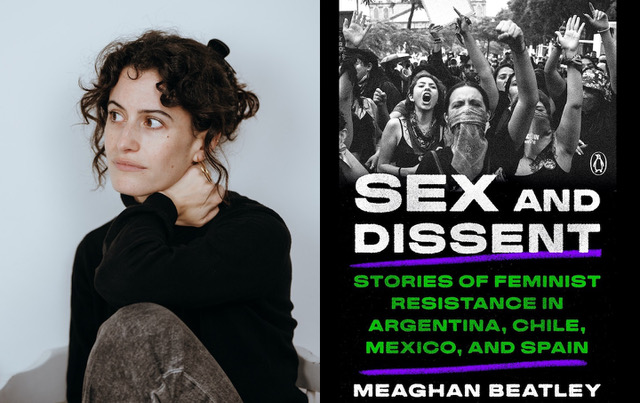
When Argentina legalized abortion up to 14 weeks of pregnancy in 2020, feminists around the world celebrated the victory. At the time, many of us living in extremely conservative Latin American countries that still maintained prohibitive and inhumane abortion laws couldn’t help but ask, “How did the Argentinian feminists do it?” That question formed the foundation for the Green Wave movement that spread across Latin America following Argentina’s historic win for abortion rights. Emboldened by their success, Green Wave activists have tried to replicate Argentina’s achievement to varying degrees of success in the years since.
In her new book Sex and Dissent: Stories of Feminist Resistance in Argentina, Chile, Mexico, and Spain, journalist Meaghan Beatley tries to answer the question of how the Argentinian feminist movement achieved such a monumental policy change. A French-American journalist who has reported on women’s rights in the US, France, Spain, Mexico, Argentina, and Chile, Beatley also explores precisely how their momentum inspired feminists in other countries to create and advance their own movements, which recognize the need not only for abortion decriminalization but also for public policy that addresses femicide, domestic violence, and women’s economic inequality.
Sex and Dissent is a product of a decade of on-the-ground reporting, starting in 2015 and spanning several generations of feminists across Argentina, Chile, Mexico, and Spain. The author examines the different local expressions of feminism, which are often intergenerational in Latin America, and how they relate to the global fight against an epidemic of violence against women. In taking a historical look at organizing strategies and community building methodologies, Beatley exposes both the longevity of feminist movements in the region and the social issues that have driven generations of women and girls to demand change.
At a time when the Latin American left is fighting against rising fascism and American imperialism, Beatley shines a hopeful light on what change is possible when the people unite around common goals that benefit the feminized working class. We spoke in early August, days after the book’s release, about her process writing the book, what American feminists can learn from Latin American feminists, and the growing threat of fascism in the continent.
—Nicole Froio
Nicole Froio: Your book spans stories across Argentina, Chile, Mexico, and Spain, over the course of several years. Could you talk about the process of putting this book together and how you connected the struggles of women across so many countries and across generations of struggle?
Meaghan Beatley: I didn’t necessarily realize how lucky I was to live in those places precisely at the time when there was this explosion in feminism in each of them. A few years ago, I realized, “Oh, this is actually kind of special. I should find a way to talk about all these movements because they are deeply interconnected.” And not just because of Spanish being the language that allows [the activists] to communicate with each other. As I explained in the book, I go off of the premise that this latest wave of global feminism, which we could call fourth-wave feminism, started in Argentina in 2015 with #NiUnaMenos.
As several of the characters [in the book] in different countries point out, some of the earliest beginnings of their own movements—whether in Chile or in Mexico or in Spain—looked at Argentina and said, “Let’s try to do something similar here,” obviously responding to their own context and history. I think the countries I look at—along with me being lucky enough to be there between the years of 2015 and 2020—are also countries in which we could see the most vibrant and effective feminist movements over the last few years. They’re where feminist movements had the biggest cultural and legal impacts.
In terms of including multiple generations, I thought it was really important to show the historical continuity between movements for democracy that spread all over the region, especially in the 1980s. Having stories from women who were active either in guerrilla movements in the late ‘60s and early ‘70s, or pushing for transitions to democracy in the late ‘70s early ‘80s, shows that there’s still an alignment between younger feminists and older feminists.
NF: In your introduction, you say you document these stories hoping to inspire American feminists to organize their own similar transformative movements in the US. Do you believe that is possible?
MB: The guiding question behind the book was: why were these movements able to be so transformative in Latin America, Spain, and why did this not happen in the US? And it’s not a question I can fully answer because I’m not really looking at North American feminisms, and that’s not my area of expertise.
But I do think that what makes Latin American feminisms stand out is the fact that it is rooted in an economic critique much more so than more popular feminism that we see in the US. American feminism does a great job of looking at culture and really targeting that. But at least its mainstream iteration doesn’t take that further step [of examining class dynamics], whereas Latin American feminist movements are inherently anti-capitalist.
I wanted to avoid making a value judgment and comparing movements because they exist to serve different purposes. But, yes, #NiUnaMenos and other movements that emerged around it in Latin America later are quite comprehensive in that they’re looking at economic systems and political systems. I don’t know if we see anything similar in the US. But I did mention in the introduction that in 2017 a group of feminists, including Angela Davis and Amy Fraser all pointed to #NiUnaMenos as an inspiration that could be used in the US to try to form a bigger resistance, especially against Donald Trump at the time, and the global right generally.
Popular
“swipe left below to view more authors”Swipe →NF: In the last five years, it really feels like liberal feminism has won in the US, meaning that a movement that was supposed to be transformative for everyone has been captured by a more capitalist individualism ideology centered around advancing individualism rather than building collective power. How can a feminist project for society both protect women’s rights to autonomy while not falling into the trap of individualism?
MB: What I found especially interesting about these movements that I was studying is how they are able to find a balance between those two things. Basically they’re saying: “we’re going to take bodily autonomy as the first step to tackle all of these other progressive issues.” Feminism shouldn’t stop at bodily autonomy, it shouldn’t just be about protecting women from domestic violence or ensuring reproductive choice. That’s just the first step.
These movements effectively communicate the fact that gender is at the heart of everything. It’s the first way that inequality exists. Even before class and race, gender was the first way that humans were divided. So it’s at the heart of everything, and you can’t really tackle economic inequality or racism if you don’t look at gender too. These movements are able to bridge that need between personal autonomy and collective action.
Recently this can be seen especially in Chile and Argentina—these movements bring all of this back to affordability, which now is becoming a main issue on the left, including in the US. And I’m not sure the left in the US is doing as good of a job connecting it to gender issues. If women don’t have any economic power, obviously they won’t have any freedom of choice anywhere else. So [autonomy and collective action] have to be connected.
NF: In your book, you write about the transformative feeling of being around other women fighting for women’s rights, in a physical space that has been organized by women. The success of these movements wasn’t just about whether things changed legislatively, but also about coming together after femicides, or to advocate for abortion rights, and how women felt about that coming together. Could you talk a little about the choice to write up these moments in this way?
MB: I discovered grassroots feminism when I moved to Argentina in 2013 and it was eye-opening. It was really special. I went to an encuentro nacional, and I had never been around so many women in my life. And it’s true, until you’ve experienced it, it is very easy to think that all of your concerns or questions are very individual things. And then to realize that they’re not—it changes your life. There are so many assemblies and encuentros, there are so many different vehicles for actually being around people and discovering different issues that otherwise you might not necessarily confront in your own life because you come from a particular social class. The fact that these movements exist in such a way that allows for this kind of communion, and that you have the opportunity to meet people face-to-face, in person, is very powerful.
NF: Your book shows how violence against women can be a catalyst for local movements to articulate that gendered violence is a global epidemic. Why do you think it is important to connect the local to the macro?
MB: The concern that I had in writing a book like this was that it would be too easy for people in the US or even Europe to say, “Well, femicide or gender-based violence is a macho issue that you only see in Latin America.” I think that’s a tendency that we see in those countries. So it was very important for me to make the point that this is absolutely a global issue that’s manifested everywhere. In fact, if you look at rates of femicide per capita, they’re lower in Argentina than they are in the US. So it’s definitely inaccurate to say that it’s more of an issue in certain parts of Latin America.
I think also what spurred me to get into the subject initially was in around 2015, 2016, when #NiUnaMenos was getting some media attention in the US and in Europe, I was a bit concerned by a lot of the framings. I can’t remember the exact wording, but there was one Reuters article that said it’s due to macho violence that makes women especially vulnerable to violence. And when you frame it that way, it makes it sound like something essentially Latin American, which isn’t accurate. Gender violence exists everywhere, and obviously there are different factors compounding it in different locations, but calling it something Latino or macho is completely wrong. So I think it was important in the book to make that quite clear.
NF: And of course, in the US, there is no legal concept of femicide. Do you think that also affects how Americans see gender violence in their own country?
MB: Absolutely. And the history of the word “femicide” is fascinating because it did originally exist in English, and then it was Latin American feminists who took it and expanded its definition to point out how it’s not just the murder of a woman because she’s a woman, it’s also state violence. It’s a state of impunity that allows this to happen.
This was a long battle that feminists, first in Mexico and then around the region, had to wage in order to get femicide to become a widely adopted term. And as you say, now that’s reflected in policy. I think that’s a huge difference between the US and Latin America, whether femicide is seen as a political issue. It’s politicized. There are laws addressing it in Latin America. That’s not the case in the US. The fact that the word doesn’t exist [in the legal system] means that the US is not looking at the murder of women as a political issue that should be addressed. It is just fodder for true crime, and I think that’s hugely problematic.
NF: In the book, you vividly describe the women in Argentina wearing the green bandanas that are a signature of their reproductive rights movement. Your descriptions inspired me to wear mine more often because those women emphasized the importance of wearing their beliefs openly. How effective do you think that this tactic was?
MB: I’m friends with a few Argentine feminists who handed me the bandana, and it was clearly such a source of pride. It’s wild how around 2018, everyone had them. Even mannequins in storefront windows had them. It was so ubiquitous, and fed into this real sense that this movement could be transformative.
But what also struck me is that I went back to Argentina in 2024 to do some reporting and met up with a few friends, they said they were now afraid to wear the bandana, ever since [Javier] Milei had been elected and there was such a reactionary backlash. I think the contrast between those two moments really shows how it was a very important moment.
In my book, I talk a lot about the Argentinian movement for abortion as a media story, as an effective media campaign. And I think the ubiquity of those green bandanas was part of this incredibly effective media strategy. They were everywhere, all over the press, and I think that partly convinced a right-wing president [President Alberto Fernández] at the time to say, “Okay, let’s go. Let’s open up a congressional debate about abortion.” There were several other reasons why [Fernandéz] did: his ratings were in the toilets, and he was trying to find something to redress his image. But it worked. Without this incredibly powerful image of thousands and at one point a million girls in the street wearing these green bandanas, I don’t know if that would have happened.
Become a Sustaining Donor This September
Between the reemergence of right-wing red-baiting and Donald Trump’s use of the chilling National Security Presidential Memorandum–7 to criminalize left political organizing, we’re seeing McCarthyism reborn before our eyes.
This assault on democracy cannot be ignored or wished away. Resisting it requires bravery in the face of threats and repression, a steadfast commitment to the truth, and the unwavering belief that we can—and will—overcome this darkness.
We must have an independent media that sets the record straight, unearths corruption and abuses of power, and advances a politics of justice and dignity for all if we’re to win this fight.
That’s why I’m writing to you today. This September, The Nation needs to add 100 monthly donors to sustain our progressive journalism. Your contribution makes the next investigative report, the next truth-speaking column, and the next pathbreaking essay all possible.
I hope you’ll support our work with a recurring donation today. If you donate $10 or more a month, we’ll send you a brand new “Hands Off the Free Press!” sticker to recognise your commitment to our cause. Please, donate today.
Onward,
Katrina vanden Heuvel
Editor and Publisher, The Nation