
Freeze AI!
The nuclear freeze movement’s lessons for taming AI.
AI is, in many ways, unprecedented. ChatGPT was adopted faster than any past consumer software. Anthropic’s revenue grew faster than any company at its scale. And the megaprojects of the past, Manhattan and Apollo, utterly fail to capture the scale of what I call the Obsoleting Project: the companies racing to replace us with machines. But stopping that Project doesn’t require us to reinvent the wheel. Instead, we should look to one of the most remarkable and overlooked mass movements of the 20th century.
In the 1976 primary, Ronald Reagan discovered that stoking unfounded fears about the Soviet Union’s looming nuclear supremacy made for great politics. While he still lost to Gerald Ford, Reagan had landed on a strategy that would contribute to his landslide victory four years later (running on the slogan “Make America Great Again”). He entered office in 1981 a longtime critic of détente and arms control. Reagan’s administration repeatedly indicated nuclear war wasn’t unthinkable. In one infamous comment, a defense official said the US could fully recover from an all-out nuclear war in “two to four years.” He promised, “Everybody’s going to make it if there are enough shovels to go around.”
Nuclear war appeared to be a real and present danger. It was into this belligerent climate—months before Reagan entered office—that Randall Forsberg, a defense analyst and MIT doctoral student, published a “Call to Halt the Nuclear Arms Race.” This bilateral freeze between the US and the Soviet Union would be enforced by a “ban on all further testing, production, and deployment of nuclear weapons and nuclear delivery vehicles.” Considering what the four-page manifesto set in motion, it makes for dry reading. But the actual ask was straightforward, especially compared to past advocacy efforts: “The vast majority of the public avoid ‘single weapon’ campaigns…which involve technical and quantitative arguments and which consist of unilateral measures.” The simplicity, ambition, and bilateral nature of her plan were assets—and she knew it: “Such a proposal would attract overwhelming popular support.”
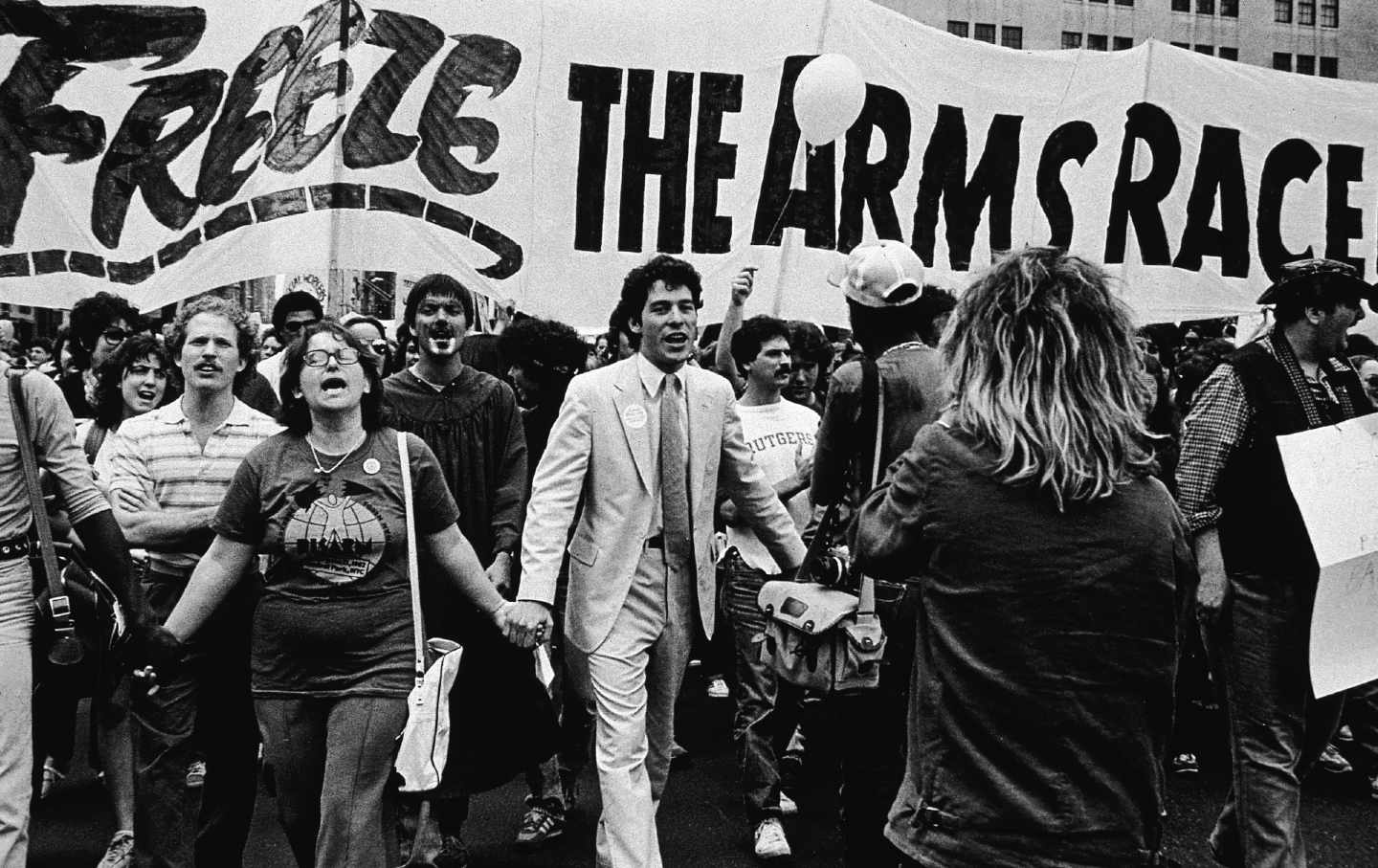
Her confidence, it turns out, was well-founded. Just over two years after Forsberg’s call was published, an estimated 1 million people marched to New York’s Central Park to rally for a nuclear freeze—then the largest protest in American history.
The ultimate big-tent, grassroots movement had started small. In 1980, as Forsberg’s freeze proposal began circulating, Massachusetts-based Vietnam draft resister Randy Kehler and other local peace activists placed a freeze proposition on the ballot in three western Massachusetts state Senate districts. It was approved by 59 percent of voters in districts Reagan carried, demonstrating the idea’s bipartisan appeal. Subsequent ballot propositions passed almost everywhere, in votes covering roughly one-third of the American electorate, then the largest referendum on a single issue in the country’s history.
While Freeze emerged out of leftist anti-war and antinuclear advocacy, it consciously sought bipartisan support, using widespread education campaigns to reach well beyond its base. According to Henry Maar’s history of the movement, Freeze!, the easy-to-understand concept radically democratized a nuclear debate long dominated by white guys with technical degrees. The president played an unwitting role, too. Reagan’s militarism inspired an improbable coalition—mainstream Democrats alongside radical pacifists, retired admirals alongside Hollywood celebrities, labor unions alongside balanced-budget hawks. Maar concludes that religious groups were disarmament’s most significant backers, highlighting the National Conference of Catholic Bishops as the Freeze’s “moral backbone.”
The campaign was buttressed by journalist Jonathan Schell’s seminal 1982 book The Fate of the Earth, which seriously explored the possibility of nuke-driven extinction, and The Day After, a 1983 ABC television movie depicting the aftermath of nuclear war that was watched by an estimated 100 million Americans. The filmmakers intended the film to be apolitical, but its wildly successful publicity campaign was spearheaded by a Freeze activist—without the knowledge or consent of ABC.
A leading pollster reported in October 1983 that Freeze was “the most significant citizens’ movement of the last century.” Polls showed 70 percent or more support for a bilateral freeze. And in Gallup’s “most important problem” survey, nuclear war was mentioned by 24 percent of people in December 1983, nearly quadrupling support from July and earning it the top spot. The massive jump in salience was likely due to the omnipresent discussion surrounding The Day After, which aired days before the December survey began.
The popularity of a freeze put Reagan in a tricky position. In April 1982, as support for the campaign was surging, the president used a national radio address to co-opt the movement’s energy, declaring that “a nuclear war cannot be won and must never be fought,” and “to those who protest against nuclear war, I can only say: ‘I’m with you.’” But internally, the administration was freaking out. Reagan’s communications director explained there was a “widespread view…that the freeze was a dagger pointed at the heart of the administration’s defense policies.” Months after his address, Reagan began baselessly characterizing the freeze movement as a Soviet plot. The FBI and CIA found no evidence for this claim (and, in fact, Soviet efforts to influence the movement had failed). National security adviser William Clark said it “may be the most important national security opportunity and challenge of [the Reagan] administration.” But Clark also wrote, “The fact that the activists have our attention should be kept secret.”
In 1983, a symbolic freeze resolution passed the House 278 to 149, but the real test came in the presidential race. Every major Democratic 1984 primary candidate endorsed a freeze, including the eventual nominee Walter Mondale. This made the 49-state victory of the one candidate not to embrace the movement seem like a referendum on the Freeze itself. Kehler, who first put the idea on the ballot, regretted aligning with politicians “who signed on only as an expression of their dissatisfaction with Reagan,” Maar writes. This also left the once-bipartisan issue heavily polarized.
But the president’s rebranding as the peace candidate wasn’t just spin. After seeing The Day After early, Reagan wrote in his diary that the film was “very effective & left me greatly depressed.” He resolved “to have a deterrent & to see there is never a nuclear war.” Mere days later, he commented to his secretary of state that “if things get hotter and hotter and arms control remains an issue, maybe I should go see [Soviet leader Yuri] Andropov and propose eliminating all nuclear weapons.”
The movement faded from cultural relevance without securing a formal freeze, but it was far from a failure. Reagan’s pivot gave Gorbachev the political room domestically to pursue the arms control agreements that initiated decades of dramatic reductions, ultimately shrinking both countries’ arsenals by more than 80 percent—far beyond what a freeze would have achieved. Maar also concludes: “While Reagan and Gorbachev both deserve credit for standing up to the hawks, the peace of the late 1980s was made possible by public demand and the political pressures of antinuclear activism.”
But perhaps the most remarkable detail is that the movement—following the peak of its power—nearly got much, much more than it asked for. The Nuclear Weapons Freeze Campaign strategically avoided demanding full disarmament, and Forsberg took pains to emphasize that her proposal would retain existing nuclear parity between the superpowers.
In a little-known episode at Reykjavík in 1986, Reagan and Gorbachev “came within a hair’s breadth of an agreement between the two leaders to begin the process of abolishing all the nuclear weapons in the world,” writes the esteemed historian of nuclear weapons Richard Rhodes. Tragically, the meeting collapsed after Reagan refused to give up his cherished Strategic Defense Initiative (“Star Wars”), even as Gorbachev was offering major concessions.
Popular
“swipe left below to view more authors”Swipe →Still, by shifting the political climate so dramatically, the movement created space for outcomes that would have seemed absurd just years earlier. This is worth remembering the next time someone tells you that an international treaty on AI is a pipe dream.
Nuclear weapons were the most important technology of the 20th century. The Freeze campaign proved that a simple, bilateral demand—backed by enough people—can bend even the most powerful nations on earth. Kehler observed that the Freeze campaign broke the hold of the “nuclear priesthood,” pulling millions of ordinary people into decisions that would shape whether they lived or died. Today, AI is dominated by a similar priesthood, one that has largely avoided movement politics in favor of wonky proposals and inside-game influence. But you don’t need to understand linear algebra to object to the Obsoleting Project. You just need a clear demand and the will to fight for it.
The Nuclear Freeze had some obvious advantages. The danger was undeniable. People had been organizing for peace and against nukes for decades. And nuclear weapons don’t earn monthly recurring revenue.
We might not have time for AI’s risks to become similarly undeniable to take the actions needed. But we have some advantages too. The Project’s dream—universal labor-replacing machines—doesn’t yet exist. AI’s risks rise with its capabilities and ubiquity, which are already being felt and resisted. And nukes don’t take people’s jobs by design.
It won’t be easy, but the ingredients are there for a mass movement unlike any the world has ever seen. Everyone has a stake in how AI develops—a reality that will become increasingly indisputable as the technology eats ever more of the world. And when Freeze was getting started, we were far closer to nuclear Armageddon than to abolition. But when the movement faded, we were on track to far exceed its wildest expectations.
Become a Sustaining Donor This September
Between the reemergence of right-wing red-baiting and Donald Trump’s use of the chilling National Security Presidential Memorandum–7 to criminalize left political organizing, we’re seeing McCarthyism reborn before our eyes.
This assault on democracy cannot be ignored or wished away. Resisting it requires bravery in the face of threats and repression, a steadfast commitment to the truth, and the unwavering belief that we can—and will—overcome this darkness.
We must have an independent media that sets the record straight, unearths corruption and abuses of power, and advances a politics of justice and dignity for all if we’re to win this fight.
That’s why I’m writing to you today. This September, The Nation needs to add 100 monthly donors to sustain our progressive journalism. Your contribution makes the next investigative report, the next truth-speaking column, and the next pathbreaking essay all possible.
I hope you’ll support our work with a recurring donation today. If you donate $10 or more a month, we’ll send you a brand new “Hands Off the Free Press!” sticker to recognise your commitment to our cause. Please, donate today.
Onward,
Katrina vanden Heuvel
Editor and Publisher, The Nation
More from The Nation

Is Platonic Co-Parenting the Future of the Family? Is Platonic Co-Parenting the Future of the Family?
Disillusioned with the nuclear family and apprehensive of tethering their reproductive futures to the bleak hellscape of modern love, young people are seeking a different way.

How Trump’s Crackdown on Speech Has Damaged the Student Press How Trump’s Crackdown on Speech Has Damaged the Student Press
I serve as editor in chief and president of The Stanford Daily. Our newsroom has keenly felt the effects of Trump’s campus crackdown, which is why we sued the federal government.

Treat Spotify Like a Public Utility Treat Spotify Like a Public Utility
Music streaming platforms have way too much control over musicians and music lovers. It’s time to rein them in.

What’s the Matter With Effective Altruism? What’s the Matter With Effective Altruism?
President Trump has decried the techbro creed for indulging in AI doomerism, but its excesses are far worse than that.

As Morale Sags, More Military Service Members Are Having a Crisis of Conscience As Morale Sags, More Military Service Members Are Having a Crisis of Conscience
According to multiple GI rights organizations, service members are inquiring in unprecedented numbers about seeking conscientious objector status.
What Remains of Riis? What Remains of Riis?
A new members’ club has revived Riis Park’s long-vacant bathhouse, reopening old questions about whom the People’s Beach is really for.

