
The Bald Eagle Perfectly Embodies America’s Flaws
Our national bird isn’t what we believe it to be—but it is the perfect bird for an imperfect country.
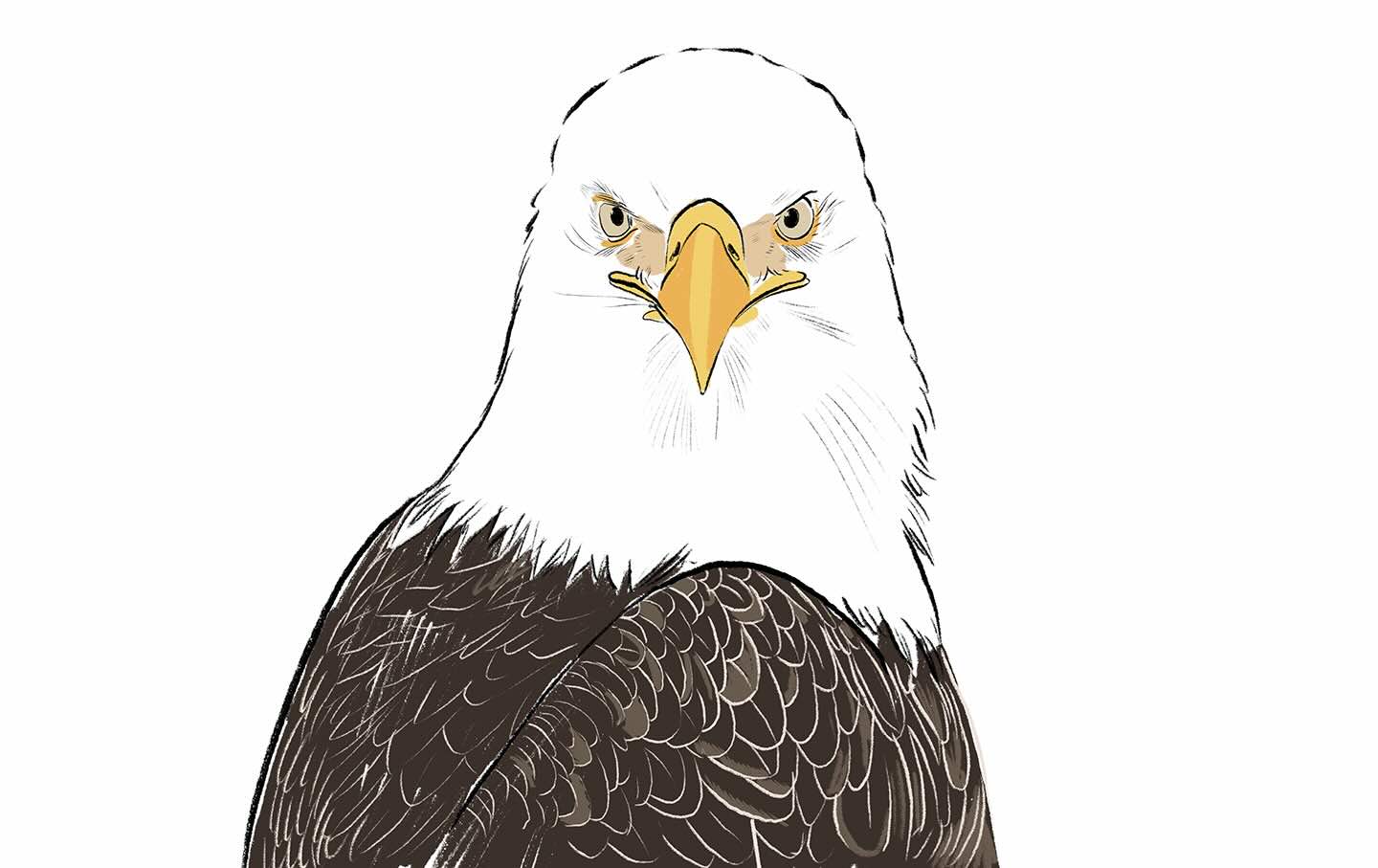
For over two centuries, the United States has invested its identity in the bald eagle as a noble apex predator, but the eagle of our national imagination distorts the real bird along lines that parallel our country’s deepest flaws. In truth, the bald eagle is a larcenous opportunist that gets by on brute strength. It issues no defiant scream. Yet we as a nation have come to identify a set of virtues in the bald eagle that we claim for ourselves—when, in truth, they are virtues we both lack.
Since 1782, the bald eagle has served as a ubiquitous symbol of the country’s defiant sovereignty, though it wasn’t officially the national bird until President Joe Biden signed a law declaring it as such in 2024. American settlers sought to distinguish their culture from Europeans’ through appeals to nature. In this Romantic context, the historian Jack E. Davis wrote in his 2022 book The Bald Eagle, the bird embodied colonial visions of a rugged, sublime, and endemically American wilderness. The bald eagle linked exceptional biodiversity to American exceptionalism.
Among the eagle’s other traits, its scream quickly gained mythic standing. From the Revolutionary War and the Civil War to World War II and beyond, Americans have revered the bird and its scream as a symbol of military might. But the eagle’s real voice is a Trumpian “snickering laugh expressive of imbecile derision,” in the words of one ornithologist.
Not all early Americans admired the bald eagle. Benjamin Franklin’s chief complaint was that the eagle was “too lazy to fish for himself.” Bald eagles indeed feast on whatever they can find with as little effort as possible. They prefer fish, often pre-killed—if not caught by an osprey, then spent after spawning, struck by dam turbines, or suffocated in hypoxic waters.
Many disdained the bird’s “bad moral character,” as Franklin put it. Some criticisms were anthropomorphic, even personal: The early American naturalist William Bartram, writing on the eve of the country’s escalating colonization of the continent and aggression abroad, condemned the eagle as an “execrable tyrant.” The bald eagle, he wrote, “supports his assumed dignity and grandeur by rapine and violence, extorting unreasonable tribute and subsidy from all the feathered nations.” Unfair to the bird, certainly, but Bartram’s words would prove a fitting account of the country it represents.
The bald eagle’s scavenging and kleptoparasitism justified its persecution throughout the 19th and 20th centuries. With the endorsement of federal authorities, the ranchers and hunters who settled the frontier poisoned, trapped, and shot eagles that they blamed for stealing livestock and game. By 1930, Nature magazine observed that “it is rare that a killer of our eagle is punished in any manner,” even as a headline in Popular Science warned, “The American Bald Eagle Is Near Extinction.” By World War II, protecting the eagle became patriotic: Davis quotes one Texan as saying that “a person who would kill a bald eagle would trample the flag in the mud.”
The fear of losing the eagle intensified in the mid-20th century—perhaps because of how we were losing the eagle. The pesticide DDT caused birds to lay eggs with thinner shells, which often broke, sometimes beneath the incubating mother. You didn’t need to be an augur to note the inauspicious symbolism of the nation’s avian avatar crushing its future under its own weight. The empire’s symbol could even be read as a symptom of mid-century reproductive anxiety. E.B. White fretted that “the bird of freedom,” thanks to chemists and farmers, “is sterile.”
Crushed eggs, oiled sea life, and burning rivers drove an environmental movement popular enough that, during a two-year span, the federal government enacted the Clean Water Act, the fledgling EPA’s DDT ban, and the Endangered Species Act. State programs took eaglets from healthy populations in Alaska, the Great Lakes region, and Florida and reintroduced the birds to areas where the species had been extirpated. By the time of the Bicentennial in 1976, recovery efforts had begun to turn the bald eagle’s trajectory around. Populations grew gradually, then exponentially.
“Rising from the past and reclaiming its place in nature,” Davis wrote, the eagle emerged as a symbol of American environmental triumph. In 1999, President Bill Clinton announced plans to remove the bald eagle from the endangered-species list. By 2007, when the Fish and Wildlife Service officially delisted the species, its population in the contiguous US was doubling as quickly as every eight years.
The eagle, saved, could return to the symbolic realm. Crowds gathered to admire recovered populations in places like Wabasha, Minnesota, where eagle flocks fished in the Mississippi River. Volunteer eagle watchers there founded the National Eagle Center to educate the public about the bird, its history, and “the significance that the Bald Eagle holds for those who serve and have served our nation in the military.” (Perhaps saying more than they meant to, veterans would tell the former CEO of the center that the eagle was the symbol of what they did for the country.)
Despite the bald eagle’s long history as a symbol, it wasn’t until 242 years after the adoption of the Great Seal of the United States, which depicts it, that the eagle was officially declared the national bird. After a lifetime spent accumulating eagle memorabilia, Preston Cook retired to Wabasha around 2017 and shared his collection with the National Eagle Center. Davis sat down with Cook in September 2020—a moment the author charitably characterized as one “when the nation was deeply divided”—over glasses of Eagle Rare bourbon. What the country needed, Davis would later recall, was “a palliative moment of bipartisanship.” Cook, a former San Francisco real-estate investor, saw a solution when he realized that the bald eagle had never been officially named the country’s national bird.
Today, this response to the summer of 2020 may come off as fatuous, but it would find a sympathetic ear in the next president. Joe Biden was likewise anxious to gloss over the year’s uncomfortable reckonings around the nation’s very real divisions. In November, he closed a platitude-crammed victory speech by invoking a saccharine eagle-themed hymn: “Together—on eagle’s wings—we embark on the work that God and history have called upon us to do,” he intoned.
He would eventually enact Cook’s vision in the final days of his presidency. Just ahead of Christmas in 2024, a lame-duck Biden signed a bill designating the bald eagle as the official bird of the United States.
Critics in the early American republic who “believed that the bald eagle was just about right” as a symbol, Davis writes, “that its thieving and brutish ways and alleged moral laxity said everything that could be said about the American character,” have been vindicated by the ensuing centuries.
The bird itself, to be clear, is guilty of no such sins for its survival strategies. But the morals a human culture projects onto wild animals reveal where its own values lie.
Indigenous societies across North America venerate the bald eagle in a wholly different register. Martial prowess is one of this eagle’s virtues, but Indigenous people don’t admire it just for dominating enemies. Instead, it is widely seen as embodying a communion between people, land, and creator. Rather than the power and nobility that early American elites invested in their country’s symbol, the bravery and wisdom that Indigenous people attribute to it transcend the nation-state context. Seen this way, the bald eagle carries significance beyond anthropocentric morality, soaring so high that, by some accounts, it crosses into the heavens.
Popular
“swipe left below to view more authors”Swipe →For the descendants of immigrants or settlers, this eagle is not ours to choose. What we should pursue is a regard for the bald eagle that motivates a more responsible national comportment: appreciation for all ecological roles, scavengers included; stewardship of the environments that produce and sustain biological diversity; humility and compassion without condescension toward nonhuman and human neighbors.
Any attempt to imbue the United States with virtues the bald eagle lacks emphasizes by omission habits that better represent the country’s shameful conduct. The United States as it really is—not as anyone wishes it were, not as it could be—is well embodied by the bald eagle.
More from The Nation
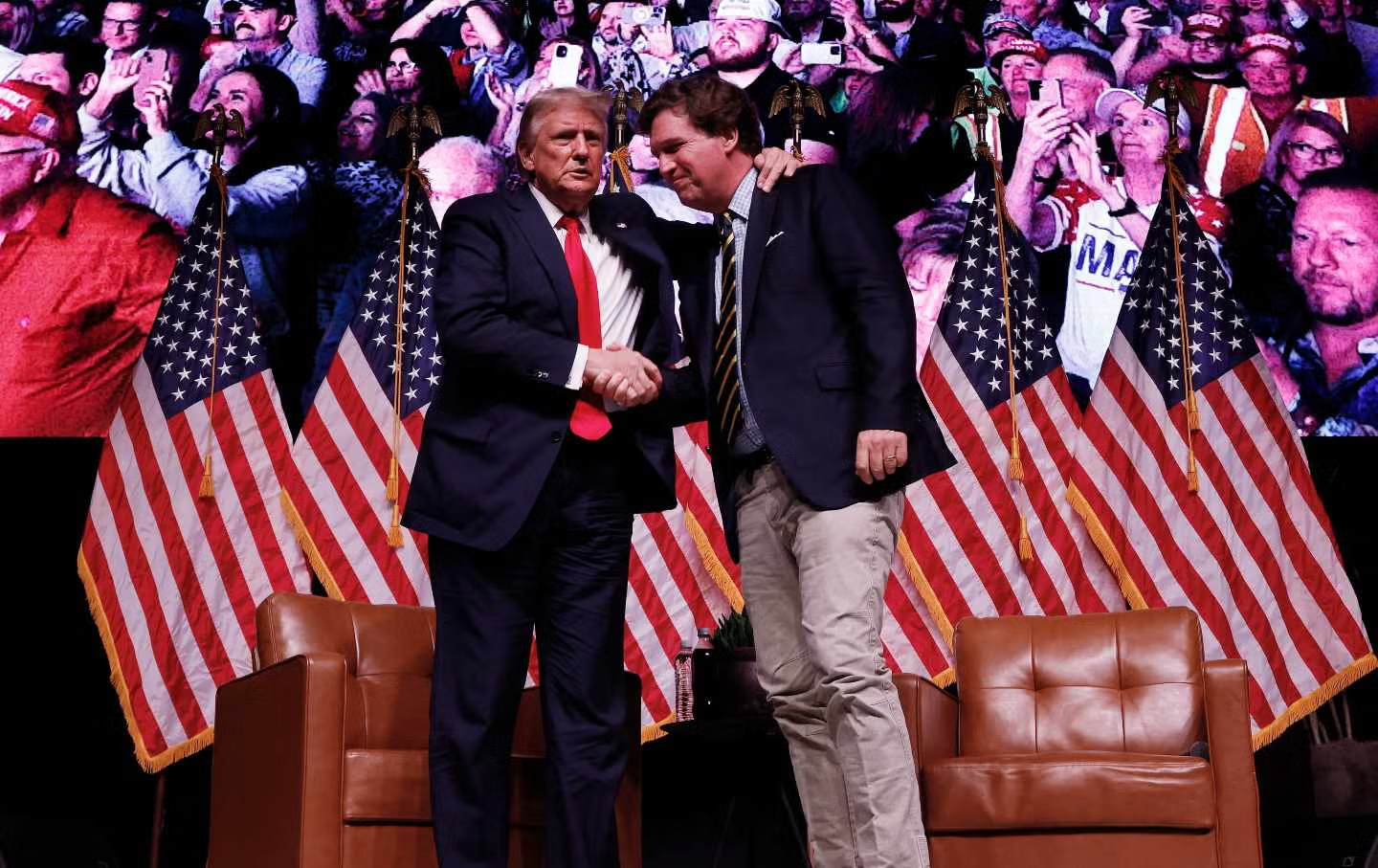
What Trump and Tucker Carlson Have in Common What Trump and Tucker Carlson Have in Common
Carlson has broken with Trump largely over the war in Iran. But on Ukraine and immigration, the two speak very much the same language.

The Jewish Case Against AI The Jewish Case Against AI
Haredi rabbis and the secular left agree: This technology is a threat to the entire social fabric.
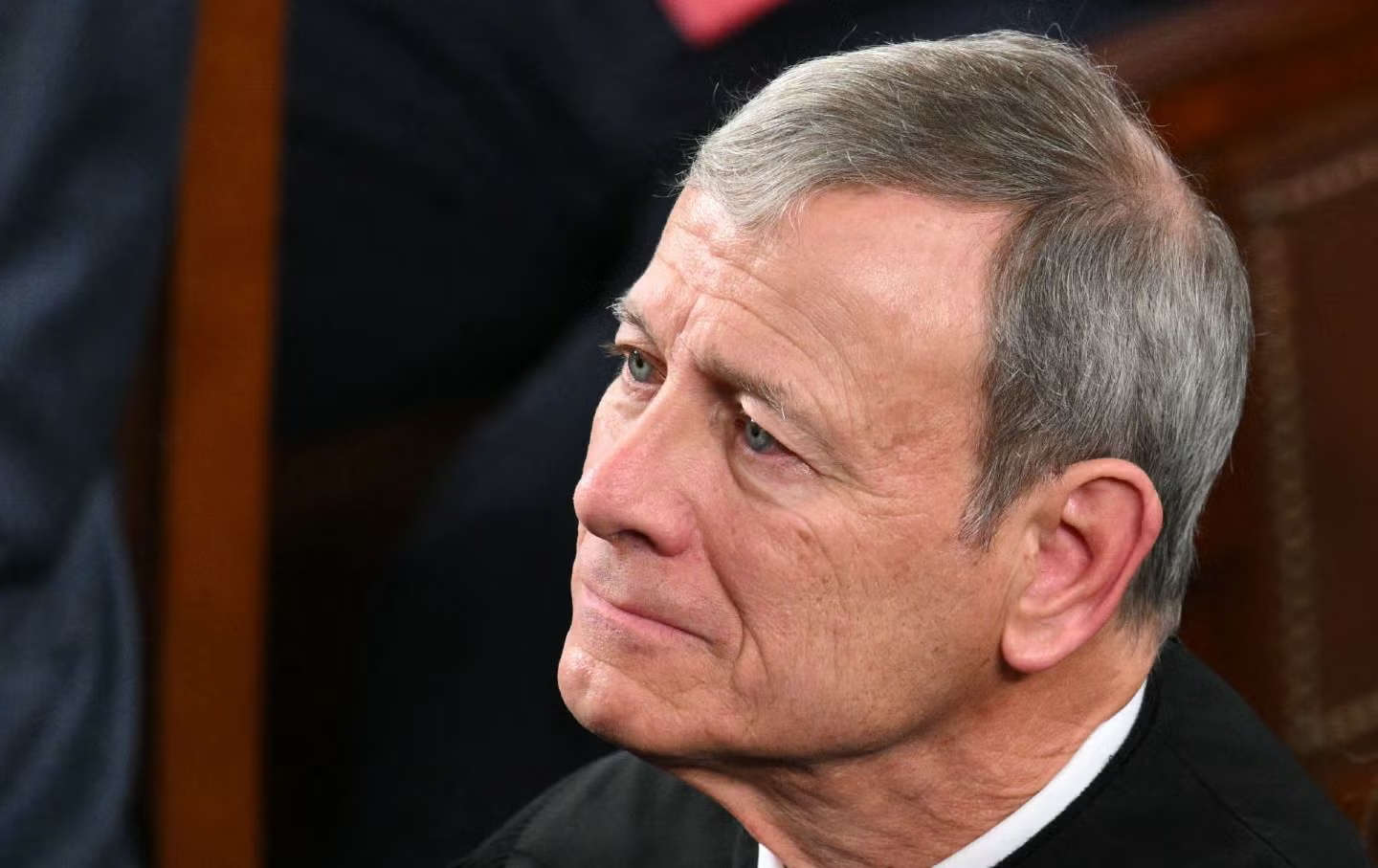
The Fight for Educational Equality Is Also a Fight for a Just Supreme Court The Fight for Educational Equality Is Also a Fight for a Just Supreme Court
The court has severely weakened our ability to make an education system that fulfills the promise of Brown.
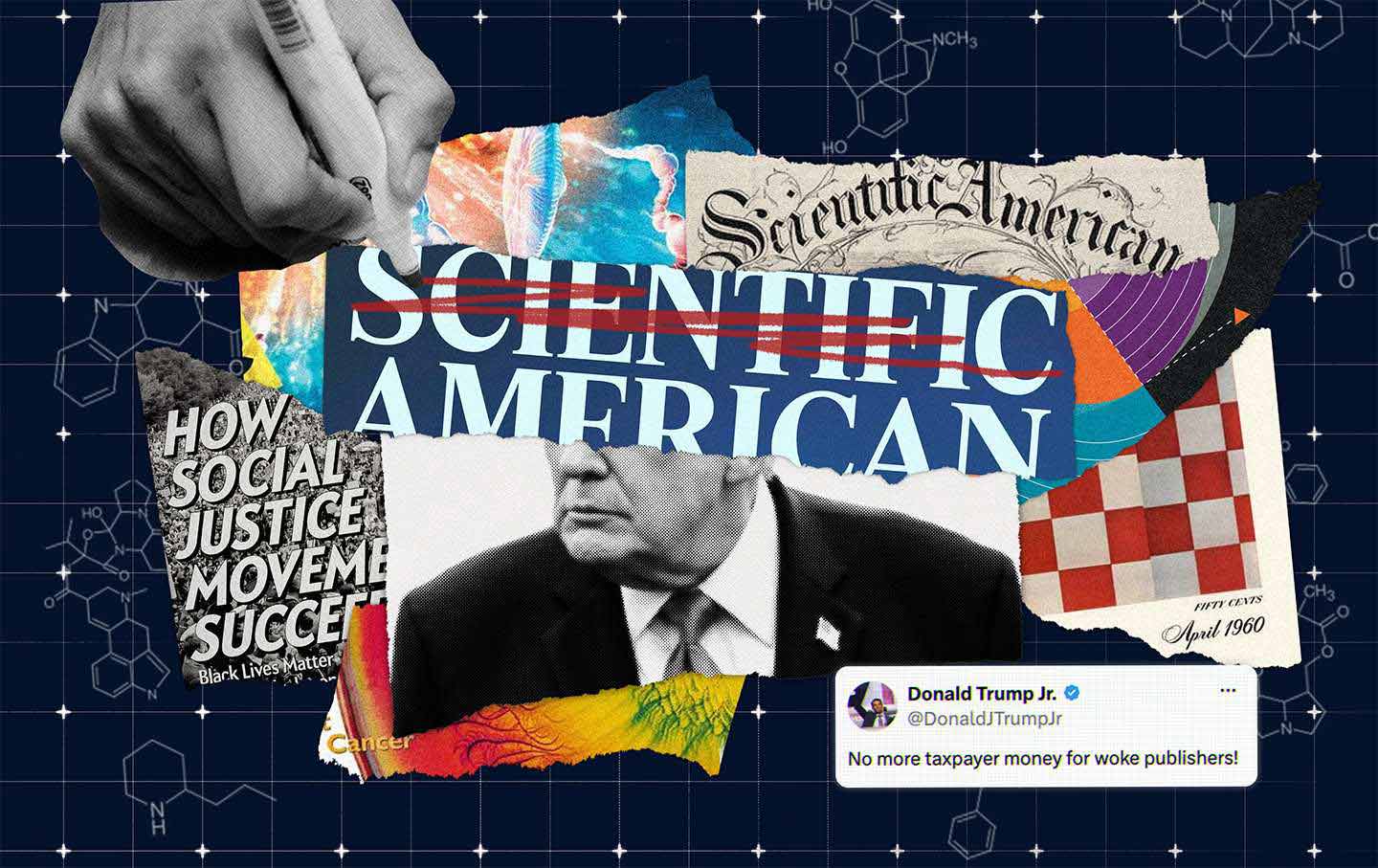
The Fall of “Scientific American” The Fall of “Scientific American”
When the beloved science publication got too political, its corporate owners stepped in. Now its future is uncertain.

The Bookstore Revolution in Taiwan’s Conservative Heartlands The Bookstore Revolution in Taiwan’s Conservative Heartlands
After Taiwan legalized same-sex marriage, gender-themed bookstores are working to build the social acceptance that the law alone couldn’t deliver.

Jalen Hurts Deserved Better. We All Do. Jalen Hurts Deserved Better. We All Do.
In a country that treats workers as expendable parts, Hurts’s playing through a blood clot is just the highest-profile example of the price workers pay in an oligarchy.

