The Age of the Assassination Meme Is Here
Our online era is being defined by a digital haze of shitpost-y, weirdly specific memes that toe the line between satire and watch list.

It starts, as most things do, with a joke. A man speaks into the camera, phone angled just so we get a little too much chin.
He says: “When it happens, I don’t care how it happens. But I’m saying, when it happens, it’s gonna feel like Christmas. I’m gonna take the day off work. Maybe the whole week off. And then I’m gonna take that day off every single year.”
The video has 227,000 likes and over 1.3 million views. The top comments read: “I just hope it’s recorded so I can watch it over and over again”—31,000 likes; “I’m buying a newspaper that day and framing it”—25,000 likes.
No one says what “it” is. They don’t have to. That’s the magic of the phrase. Everyone brings their own subtext. You think it’s about Elon Musk. Someone else thinks it’s about Donald Trump. Another thinks it’s about landlords, or billionaires in general, or maybe just vibes. Vague enough to post. Specific enough to mean something.
Keep swiping. A fan edit of Luigi Mangione set to George Michael’s “Careless Whisper” pops up. The saxophone solo hits as courtroom stills dissolve into paparazzi flashes.
Then, a man earnestly performing a dance to the opening number to Wicked—the one about the Wicked Witch being dead—in his living room, full jazz hands, feet squeaking across a hardwood floor. The caption: rehearsing my choreography for when it happens. The implication, again, left to the viewer. Political assassination as Broadway number. Mass catharsis as cabaret.
This kind of thing—call it assassination discourse—has come to define the Internet lately. A digital haze of shitpost-y, weirdly specific memes that toe the line between satire and watch list. Images of cartoon characters armed to the teeth. A screenshot of a Google Maps pin on someone’s home address. An image of characters from Spongebob Squarepants pointing with the caption Let’s kill him. All of it delivered with the plausible deniability of irony. It’s not a threat. It’s just a joke.
Except when it isn’t.
In Indiana, a man is arrested for posting about Elon Musk. The posts are not what you’d call subtle. The first post identified in the affidavit is from December 6, 2024, when the account replied to a post by Musk with: “We’re gunning you down, next Muskrat.” The authorities call it felony intimidation. The defense will likely say that he was joking, or at least joking-adjacent.
No one is surprised.
This is the part we’ve all silently agreed on: the understanding that you can go viral and then go to jail in the same 48-hour window. The Internet is both playground and panopticon. There is, in fact, a line, but it’s invisible, movable, and typically enforced by humorless bureaucrats.
And it’s not just anonymous posters getting flagged. In February, Representative Robert Garcia, a sitting member of Congress, got a letter from the US Attorney for the District of Columbia after saying on CNN that we need to “bring actual weapons to this bar fight” to protect democracy against noxious figures like Elon Musk. Anyone with a brain could tell what he meant: policy, oversight, pressure. But no. The DOJ sent him a letter asking him to clarify whether he was threatening Musk, who is an “adviser” to the administration.
A congressman gets formally cautioned for hot air on cable news. That’s where we are. The line between rhetoric and criminality is no longer about intent. It’s about tone. Mood. Whether the wrong person reads your metaphor the wrong way on the wrong day.
The exception, of course, is if you’re on the right. Then you can call for civil war, or in Musk’s case say publicly on your social media platform that it is an inevitability. You can break into the Capitol dressed like a corny Viking and get pardoned by the president. The state isn’t anti-violence. It’s anti-unsanctioned violence. Murder is only inappropriate if it happens in the wrong direction.
I was recently doxed for a video where I said, vaguely and with a sort of half-sincere intonation, “You should do that thing you’re thinking about doing.”
Which, to be clear, could mean anything. Water your plants. Call your senator. Liberate the people. Whatever. And I didn’t mean anything specific. But the clip was picked up by a popular right-wing account, the kind that collects videos from people like me and reposts them without context for the purpose of stoking rage. The kind that tells on you to an audience of a million deranged shut-ins, reactionary suburban moms, and retired desk cops.
And just like that, my inbox filled up with helpful messages suggesting I kill myself, find God, or both. Which is funny, if you think about it. I got accused of inciting violence, then received threats of violence. For a video where I said nothing specific. The people offended by my ambiguity responded with stunning specificity. “Treasonous and deserves the death penalty,” they said. “Arrest, imprison.” With my full legal name, attorney number, even where I practice. He won’t be so smug when it happens.
There it is again. When it happens. Always in the future tense. Always looming like a storm that might never come. Or might come tomorrow, carrying an AR-15.
Here is the thing about political speech online: It doesn’t really work the way political speech is supposed to. There are algorithms, and these algorithms reward a particular kind of escalation. The shitpost that walks like a duck, quacks like a duck, but insists it’s actually a platypus made of irony.
You cannot post “People are suffering and it is the result of structural inequality, imposed by the rich and powerful” and expect it to go viral. You can, however, post something like “Mr. Musk, please kill yourself sir” and get 50,000 likes (before being banned, of course).
There’s a word I keep coming back to: metabolize. As in, the way digital culture metabolizes rage. Breaks it down into a sharable format. Reconstitutes it as content. There’s this mass of energy that is dispersed in this form, like letting out a loud fart. It is, in some ways, remarkably de-motivating to positive action.
What’s interesting, or depressing, is how government officials have responded to this. Not with change. Not with policy. Not with any real attempt to understand the source of the anger, the despair, or the hollowed-out humor that fuels this whole ecosystem. The response has been surveillance. Prosecution. Suppression. Watch what you say, they tell us, even as they do nothing about what we’re saying it about.
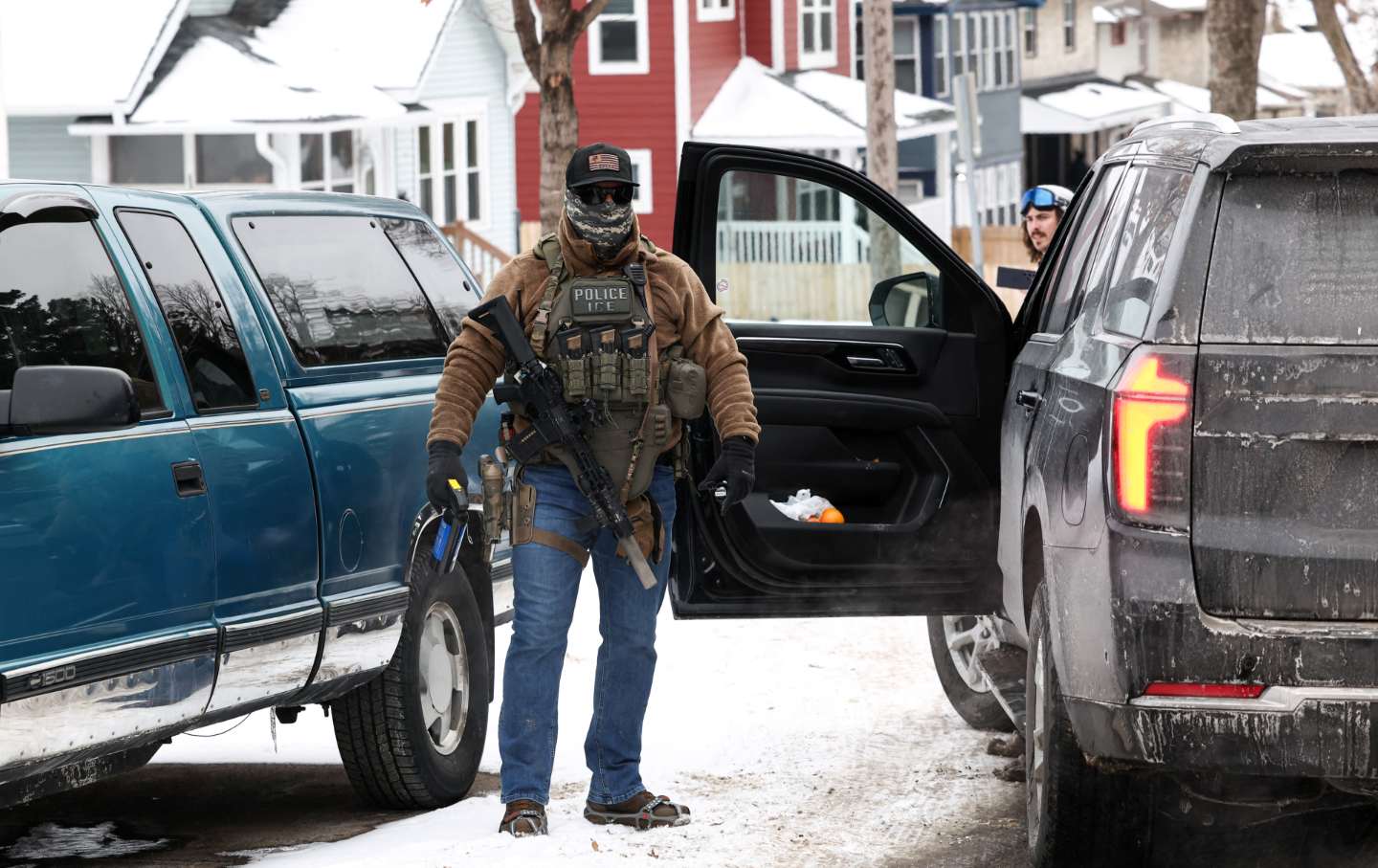
Students are being snatched off sidewalks by masked, unidentified armed agents; jailed for writing op-eds critical of policies. In some cases, people are deported to overseas prisons after being misidentified as gang members when in reality they have no criminal records, are married to American citizens, and have American children. Academics expressing themselves are forced to flee, out of fear of being detained and sent to a Salvadoran prison. The net is getting wider, and it’s not just catching edgy trolls who took it too far anymore.
You get the sense they’re less worried about a revolution and more worried about a particularly viral TikTok. One that’s just coded enough to skate past moderation, just vague enough to go unnoticed by the FBI intern watching your account from a desk in Quantico.
None of this feels real—not real enough to take seriously in the traditional sense, anyway—but it is real. Real enough to hurt someone, real enough to ruin your life. Like a bad dream you can’t wake up from. They’re seeking the death penalty for Luigi Mangione. Twenty years for a 24-year-old in Colorado who set fire to some Teslas. Oh look, there’s a new popular trend where someone in the comments is posting Elon Musk’s live flight information. “Assassination coordinates,” Musk calls them.
Popular
“swipe left below to view more authors”Swipe →This isn’t new. There’s a long history of jokes as subversion, gallows humor as protest. But there’s something uniquely modern about the way assassination “discourse” has become, for lack of a better word, ambient. Not quite satire. Not quite sedition. A feeling. A refusal to say what you mean, because meaning things can actually be dangerous.
And yet people do mean things. Some of them, at least. The line between the person who’s joking and the person who’s serious has never been thinner. Never more porous. Sometimes it’s the same person; sometimes it’s you.
At the heart of all this, I think, is a kind of dissociation. A refusal, or maybe an inability, to process the enormity of everything. The climate is collapsing. Fascism is rising. Healthcare is a game show. We are all screaming into the void, and the void is replying with a link to a merch store.
In that context, is it really so surprising that people make jokes about violence? That the language of Internet memes and murder has started to overlap? That the phrase when it happens is both a threat and a hope and a prayer?
I don’t know what happens next. That’s the thing about “it.” You’re never quite sure what “it” is. A joke? A revolution? A knock on your door?
But I do know this: The jokes don’t radicalize us. They defang us. They absorb the rage, the despair, the moral clarity that should lead to action, and turn it into something that gets shared and then vanishes into the feed. We scream, we feel a little better, and then we go make lunch.
Two or three centuries ago, if someone destroyed your community, stole from you, and let your children die, you and the townspeople might light a torch and go to their house. Now we open our phones, make a video, share a post, and move on with our day. The revolution becomes a bit. A looping saxophone solo over a slow zoom on Luigi Mangione’s face.
Somewhere, right now, a teenager is making a video of a cartoon character holding a sniper rifle with the caption He’s not making it to 2026.
And it’ll get 1.2 million likes.