
The Divisions Mamdani Commands Are About to Be Battle-Tested
The New York mayor draws flack from the Catholic press, holds his own for now with the NYPD, and will have to twist arms in Albany.
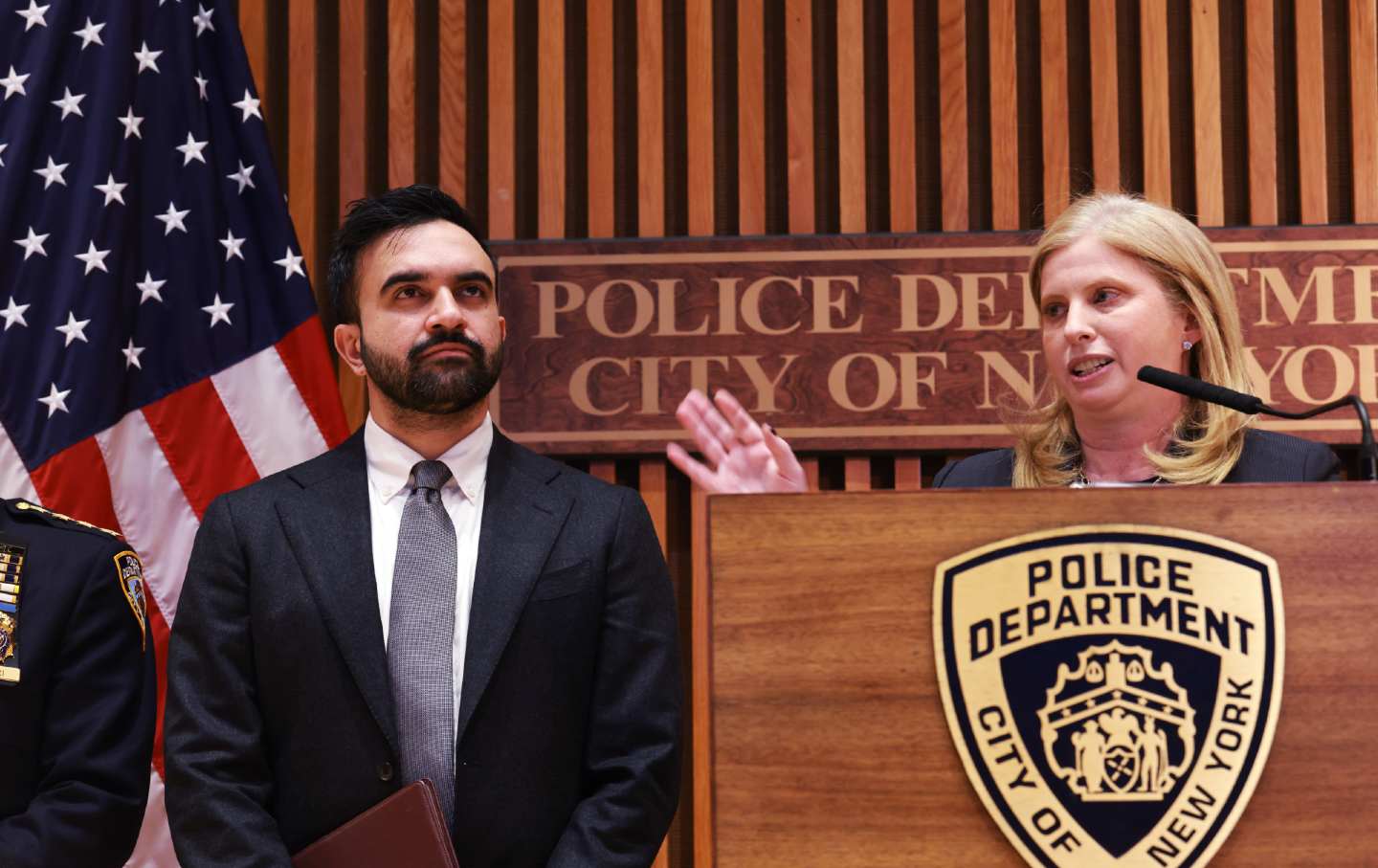
Friends for now: New York Mayor Zohran Mamdani and NYPD Commissioner Jessica Tisch at a January news conference.
(Spencer Platt / Getty Images)According to Winston Churchill’s The Gathering Storm, French Foreign Minister Pierre Laval approached Joseph Stalin with the suggestion that that making life easier for Catholics in the Soviet Union would be a good way of ingratiating himself with the Vatican. “The Pope?” Stalin replied, “How many divisions has he got?”
The quotation came up naturally enough last Friday, when Mayor Zohran Mamdani presided over his administration’s first Interfaith Breakfast. New York Public Library President Anthony Marx, whose building played host to the gathering, concluded his welcoming remarks by referencing the Trump administration’s violent sieges on American cities: “The ICE will melt.”
Mamdani reminded the audience that, for him, interfaith dialogue was more than just a slogan: “I was raised in New York City as a Muslim kid with a Hindu mother. I celebrated Eid-al-Fitr and Eid-al-Adha with my family, with diyas in Riverside Park for Diwali.” But the murders in Minneapolis were also very much at the front of the mayor’s mind. Shifting from Deuteronomy 10, which commands us to “love the stranger, for you were strangers in the land of Egypt,” to the more apocalyptic language of the Book of Revelation, Mamdani condemned ICE in biblical terms: “They arrive as if atop a pale horse, and they leave a path of wreckage in their wake. People ripped from their cars. Guns drawn against the unarmed. Families torn apart…. If these are not attacks upon the stranger among us, what is?”
The room responded warmly to the mayor’s reaffirmation of New York’s sanctuary city status, but anyone under the impression that Gotham was about to adopt “Kumbaya” as its official anthem need only have consulted that day’s headline on the Catholic League for Religious and Civil Rights’s website: “Mamdani Stiffs Catholics for Third Time.” Citing the absence of a Catholic priest at the mayor’s inauguration as well as from the breakfast program, the league pronounced the third strike against the Mamdani administraton: the mayor’s failure to attend the installation of Archbishop Ronald Hicks that same day, despite the ceremony’s taking place just “a short walk up Fifth Avenue” at St. Patrick’s Cathedral.
Whatever the other claims on the mayor’s schedule, this looked very much like an unforced error by the new administration. New York is home to some 2.5 million Catholics. That makes Catholicism the city’s largest single denomination, and its adherents one of its biggest voting blocs.
Catholics also play a dominant role in the culture of New York’s uniformed services. One of the reasons the invasion by 2,000 ICE agents was so devastating to Minneapolis is that city has only 600 uniformed police officers. Even after recently doubling in size to 22,000 agents, ICE is still significantly outnumbered by the 33,000 uniformed officers of the NYPD. Which means that, should border czar Tom Homan ask himself “How many divisions does New York’s mayor have?,” the answer would be “More than you command.”
But that, of course, assumes that the police respect the mayor’s authority over their department—which in New York City is far from a foregone conclusion. I can still recall the riot—including an attempt by drunken cops to rush City Hall—after David Dinkins proposed a civilian Review Board to investigate police misconduct in 1992. Bill de Blasio’s later efforts at police reform likewise triggered a dramatic, though less obviously mutinous, wave of sick-outs and police slowdowns, which culminated in thousands of cops publicly turning their backs on the mayor when he delivered the eulogy for two slain officers in 2015—a gesture of contempt from which de Blasio’s political fortunes never fully recovered.
So when I heard Commissioner Jessica Tisch, at her State of the NYPD speech on Tuesday, announce that she was naming recently retired cardinal Timothy Dolan—who described the assassinated far-right activist Charlie Kirk as a “modern-day St. Paul”—to be one of the department’s two new chief chaplains, I couldn’t help thinking that writer Ross Barkan may well have had a point when he pronounced, in a recent column for New York, that “the Mamdani-Tisch relationship isn’t built to last.”
Tisch is far too smart, and too politically nimble, to do anything openly insubordinate. Indeed, she pronounced herself “grateful to have found a partner in Mayor Mamdani.” But if the text of her remarks was mostly unexceptional—proposing changes to the Bronx patrol structure, modernization of the city’s 311 dispatch system, and efforts to address the increasing threat posed by drones—the subtext was a series of reminders that, as the billionaire daughter of one of the city’s wealthiest families, she doesn’t need this job.
Her remarks were sponsored by, and delivered to, the New York City Police Foundation—a private group of well-connected New Yorkers, mainly from real estate and banking, who have long augmented the department’s already exorbitant budget. (The commissioner’s uncle, Andrew Tisch, is chairman of the foundation’s Board of Trustees.) Tisch delivered her speech at Cipriani, the restaurant and event space now occupying the vaulted marble expanse of what was once the Bowery Savings Bank on 42nd Street—a venue that, as one newspaper account put it, “flaunts the power of New York money.” If you set out to deliberately assemble the constituency of New Yorkers least sympathetic to Zohran Mamdani’s vision of democratic socialism, you might well have come up with the audience in that room. A hostile observer might have been tempted to label them members of “the Epstein class.”
Given the tribulations of the commissioner’s great-uncle Steve, that would be a cheap shot. But as I watched from the press pen while platoons of white-jacketed flunkies circulated shining platters among the invited guests, I recalled that before Theodore Roosevelt made his debut on the national stage, he, too, had once presided over the New York Police Department.
Not that the mayor is without resources—or his own loyal legions. On Wednesday he traveled to Albany for Tin Cup Day, a multi-hour hearing in front of state legislators regarding his budget and his priorities. Since many of Mamdani’s inquisitors were his former colleagues in the assembly, not all of the questioning was terribly probing. And the few overtly hostile questions—from suburban Republicans—did little to disturb the mayor’s presentation, whose most newsworthy point was the disclosure of $5 billion in previously undiscovered savings and windfalls, bringing the total gap to be bridged in the city’s upcoming budget down from $12 billion to $7 billion.
Such miracles are par for the course in the fiscal dance between Albany and City Hall—and will likely have little impact on the mayor’s chances of persuading the governor to let him raise taxes on New York’s wealthiest residents. (Both houses of the legislature already passed increases on both personal and corporate incomes last year, but failed to obtain the governor’s assent.)
Popular
“swipe left below to view more authors”Swipe →In two weeks, however, on February 25, Our Time NYC and New York City DSA have called for an “Albany Takeover” in support of the mayor’s efforts to provide a secure revenue source for his agenda by raising taxes on the rich. The event will be noteworthy for many reasons—not least as a test of whether the energy and enthusiasm that sent 100,000 volunteers into every neighborhood of the city knocking on doors to elect Mamdani can be sustained outside of an election season.
Divya Sundaram, Our Time’s deputy director, told me, “Some of these power struggles with people who are just not aligned with our agenda—or in some cases, might inhibit our agenda—they become less of a struggle if we actually build the power to contend with them.”
“To us,” she explained, “the project is how we keep organizing that case around…the agenda that really inspired so many of us. How do you do that without the urgency of an electoral campaign? And how do you translate this huge electoral operation into a much deeper, nuanced issue organizing campaign?”
Those are all important questions—not just for Mamdani, or New York City, but for anyone who cares about actually delivering on the promise of a radical agenda. Because in the end Mamdani and his allies will have to show observers in Albany and beyond just how many divisions they have.
More from The Nation
What Are Democrats Prepared to Do if Trump Rigs the Election? What Are Democrats Prepared to Do if Trump Rigs the Election?
In this week’s Elie v. U.S, our justice correspondent challenges Democrats' lack of a plan if Trump steals the midterms. Plus: the most racist, and honest, AI add ever.
Ramaswamy’s Guide to a Better Vocabulary Ramaswamy’s Guide to a Better Vocabulary
Quotes of the Week.
Why Trump Is Embracing Vivek Ramaswamy’s Vile Ad Why Trump Is Embracing Vivek Ramaswamy’s Vile Ad
The president is leaning into the politics of toxic parenting.
The Shadow Knows The Shadow Knows
High-tech weapons, low-tech intelligence.
Tom Hayden’s Legacy and the New American Left Tom Hayden’s Legacy and the New American Left
It’s been 10 years since he passed away.
The Decades-Long Battle Within the Democratic Party Establishment Between the Heirs of Dean Acheson and Franklin Roosevelt The Decades-Long Battle Within the Democratic Party Establishment Between the Heirs of Dean Acheson and Franklin Roosevelt
The calamitous history of America’s wars of choice.

