ICE Brutally Dragged This Disabled Woman Out of Her Car. What Happened Next Was Just As Chilling.
“They laughed at me and told me this wouldn’t have happened if I was a ‘normal’ human being,” Aliya Rahman tells The Nation.
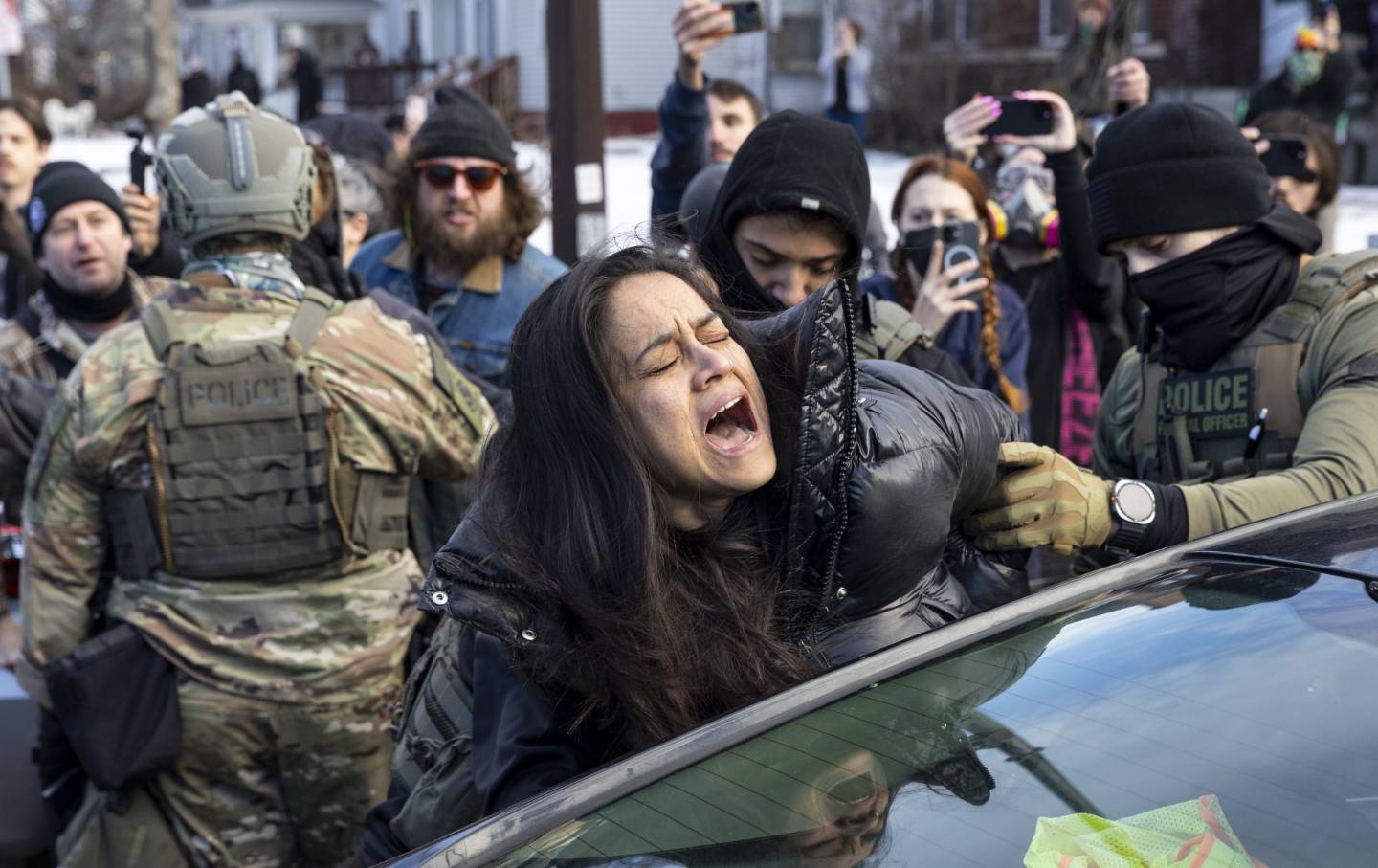
Aliya Rahman being dragged out of her car by ICE agents on January 13, 2026.
(Mostafa Bassim / Anadolu via Getty Images)Over the past two weeks, images of Aliya Rahman, a US citizen, being dragged out of her car by ICE agents as she screamed “I am disabled” have swept across social media. Rahman, a 43-year-old Minneapolis resident, was on her way to a doctor’s appointment at the city’s Traumatic Brain Injury Center on January 13, when masked agents smashed in one of her car windows, opened the driver’s side door, slashed her seat belt, yanked her out of the car, and forcibly took her away. In the seconds before they did so, visuals showed the agents yelling “Move!” at Rahman.
Speaking to The Nation on Tuesday, Rahman recalled the confusion she felt at that moment.
“As an autistic person, it was particularly difficult to understand what the officers wanted me to do,” Rahman said. “I personally experience audio sorting challenges as an autistic person. This makes it so that voices near and far are prioritized in the same way, making it difficult for me to figure out who is talking to me. Because of this, I tend to rely on reading lips. You can imagine how difficult it was for me to try to read lips when ICE officers are completely masked.”
In the videos, Rahman can be heard pleading with the officers to let her go, constantly reminding them, “I am an autistic disabled person, I am trying to go to the doctor.”
But Rahman emphasized that, her disability notwithstanding, this would not have been an easy moment to navigate for anyone. “I think it’s also important to point out that even someone who is not autistic would have trouble handling that situation. It was chaotic and overwhelming. There was a lot going on and it was happening fast.”
The incident occurred just blocks away from where, a week earlier, an ICE agent shot and killed Renee Good. “I constantly wondered if I was going to die,” Rahman said.
After the officers handcuffed her, they lifted her from her hands and her feet and carried her away.
“I do remember facing the ground and feeling pressure on my neck, which, because of my brain injury, was extremely painful for me,” she said.
The viral video ends with Rahman being dragged out and carried away by several officers. What transpired after that wasn’t captured on camera, but Rahman recalled how quickly things unraveled.
“After I was violently dragged from my car, I was put in the back of a car with three federal agents, where they laughed at me and told me this wouldn’t have happened if I was a ‘normal’ human being,” Rahman said.
Rahman was then taken to the Whipple Federal Building, where many people are detained after being swept up by ICE agents. Throughout her detention, Rahman kept reminding the officers that she is autistic and disabled, but no one seemed to care.
“I was repeatedly denied medical care, disability accommodations, and access to a mobility aid when I asked for my cane. Eventually, I insisted that they look for a wheelchair. When they found one and I was placed in it, I was told that my legs must work if I had been driving,” Rahman recalled. No one asked for her ID or proof of citizenship after she was detained, Rahman said, nor was her face scanned.
Rahman eventually fell unconscious, and so does not know what happened next. She knows she was moved to the Hennepin County Medical Center and eventually let go that day.
Rahman is being represented by the MacArthur Justice Center. Her lawyer, Alexa Van Brunt, said that she is “currently gathering evidence in order to pursue legal remedies for the gross violation of Aliya’s rights that day.”
The Trump administration’s immigration crackdown over the last year has led to over two dozen violent or fatal arrests by ICE, as per a report by Documented.
Brunt said ICE agents “have certainly acted as if they are above the law.”
“In Aliya’s case, they also violated every law enforcement standard and protocol governing use of force and the treatment of people with disabilities,” Brunt said. “Rather than using clear communication, they issued conflicting and confusing commands. Rather than de-escalating the scene, they swore at Aliya and broke her car window. And after finding out Aliya had a disability and traumatic brain injury, they increased their use of violence, slamming her into the ground, carrying her like an animal, and continuously denying her medical care.”
Update, 2/2/26: This post initially said Rahman was 42, not 43, and that she was arrested on January 15, not January 13.
Become a Sustaining Donor This September
Between the reemergence of right-wing red-baiting and Donald Trump’s use of the chilling National Security Presidential Memorandum–7 to criminalize left political organizing, we’re seeing McCarthyism reborn before our eyes.
This assault on democracy cannot be ignored or wished away. Resisting it requires bravery in the face of threats and repression, a steadfast commitment to the truth, and the unwavering belief that we can—and will—overcome this darkness.
We must have an independent media that sets the record straight, unearths corruption and abuses of power, and advances a politics of justice and dignity for all if we’re to win this fight.
That’s why I’m writing to you today. This September, The Nation needs to add 100 monthly donors to sustain our progressive journalism. Your contribution makes the next investigative report, the next truth-speaking column, and the next pathbreaking essay all possible.
I hope you’ll support our work with a recurring donation today. If you donate $10 or more a month, we’ll send you a brand new “Hands Off the Free Press!” sticker to recognise your commitment to our cause. Please, donate today.
Onward,
Katrina vanden Heuvel
Editor and Publisher, The Nation