
Meet the Alaska Student Arrested for Eating an AI Art Exhibit
A conversation with Graham Granger, whose combination of protest and performance art spread beyond campus. “AI chews up and spits out art made by other people.”
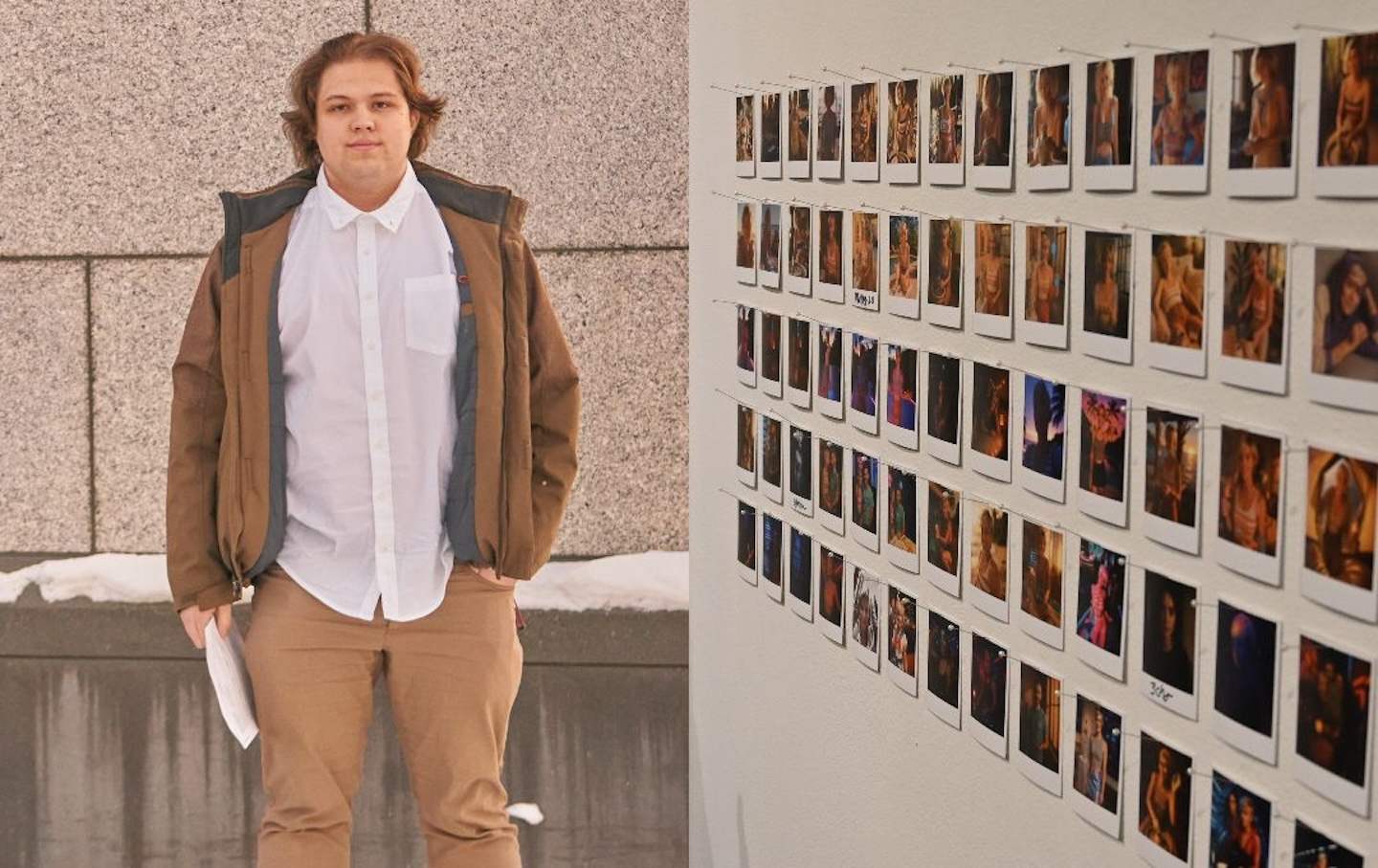
Left: Graham Granger after his arraignment outside the court building. Right: The art exhibit, made with the help of AI, by Nick Dwyer.
(Simeon Ramirez; Colin Warren)
As the use of artificial intelligence in art is hotly debated, one student at the University of Alaska Fairbanks took matters into his own mouth. On January 13, Graham Granger, a film and performing arts major, was arrested for criminal mischief when he ripped the art, made with the help of AI, from the wall of a university gallery and ate it “in a reported protest,” according to the police report.
“He was tearing them up and just shoving them in as fast as he could,” said Ali Martinez, a witness to the event. “Like when you see people in a hot-dog eating contest.” According to the police estimate, around 57 of the 160 images on the wall were destroyed.
In the exhibit, artist Nick Dwyer expressed his struggle with “AI psychosis,” during which he says he fell in love with a chatbot that was acting as his therapist. A series of Polaroid pictures depicts the chatbot, himself, and other versions of them combined. He said the bot represented his “Jungian shadow,” which is the repressed, often negative, yet creative part of one’s personality.
“It would have been an awesome performance piece that literally encapsulates the problems with AI art and artists,” said Dwyer. But he didn’t accept Granger’s protest as an excuse to destroy his work. Dwyer claims Granger’s act was akin to slashing someone’s tires to protest the oil industry. He initially wanted to press charges because Granger’s act “violates the sanctity of the gallery,” but changed his mind, dropping the charges. The state is still proceeding with the case.
Dwyer thinks there has to be room for new technology in the art space. “AI is a lens and it’s viewing humanity. Some people will see it as stealing from artists. The other way to see it is that it’s an extension of humanity,” he said. “AI art might be a tax on the artists. Tax is nonconsensual; some people say tax is theft. That’s something we’re going to have to wrestle with.”
When pressed about the fact that Dwyer was still using AI to create art, even after it led him to psychosis, he smiled. “I’m trying to wean myself off.”
Below is a conversation with Granger, who has since been released from the Fairbanks Correctional Facility. The conversation has been edited for length and clarity.
—Colin Warren
Colin Warren: How did your arraignment go this morning at court?
GG: Fine. I’m hoping since I’m a first-time offender, it won’t be serious jail time. I’m expecting to pay a fine.
CW: How did you come up with this idea, and what led you to the gallery that day?
GG: I walked down with my friend to his class really early, so I was stuck outside for like an hour. I was just wandering around the fine arts building waiting for my class to start. I eventually went into the gallery and I took a look and I was very impressed by almost all the pieces in there.
CW: So your act wasn’t premeditated?
GG: No, I didn’t know about the exhibit before that day. And then I saw the AI piece and it was just—as an artist myself, it was insulting to see something of such little effort alongside all these beautiful pieces in the gallery. It shouldn’t be acceptable for this “art,” if you will, to be put alongside these real great pieces. It’s art that has zero substance. Not zero substance; I mean it’s a very personal work, right? It’s art that takes away from its own substance by not being made by the artist himself.
CW: Do you consider what you did protest, performance art, both, or something else?
GG: Both. It’s a protest against the school’s AI policy specifically and it’s performance art because I needed something that would elicit a reaction. So this could reach more people.
CW: Was it an attempt to go viral?
GG: No, no, not at all. I wanted to bring this to the attention of the school as a whole. I really hadn’t expected this to go past the college campus.
CW: Did you see the story in many media outlets?
GG: I did, yeah. There’s an Italian art magazine. I was contacted by a Russian newspaper. I have friends who I haven’t talked to in years that all started messaging me.
CW: Do you use AI for anything?
GG: I don’t really use it period. I miss the Wikipedia blurbs being at the top of webpages. If I’m looking up a simple math fact that I don’t know—like what the weight of something is—I’ll look at the AI summary, but I never, almost never, hit the expand button.
CW: What are your personal thoughts on AI, specifically in art?
GG: I think artificial intelligence is a very valuable tool. I think that it has no place in the arts. It takes away a lot of the human effort that makes art. If art cannot be improved upon by criticism, it’s hard to call it art. And there is an argument to be made that you can criticize your AI art by changing the prompts and generating more images to pick from, but that work doesn’t compare to the criticisms that a real piece of art would receive if you critique it.
CW: So your main problem with it is that it doesn’t process criticism?
GG: It’s not the only problem. There’s a whole host of things. It depends on your definition of art. I say AI isn’t art. I know a lot of people who would agree with me. I don’t think there’s any perfect argument that can be made for this, because no matter what you say somebody will come up with a counterpoint because at its core art is subjective.
However, the process by which art is made is oftentimes more important than the finished product, and if the process of making your art is just typing a prompt in, it just takes away from the accomplishments of other talented artists. And it really hurts the practice of art by commercializing that finished product.
CW: Do you have any qualms about the fact that AI art is made by scraping other artists?
GG: Yeah, I mean, that’s part of why I spat it out, because AI chews up and spits out art made by other people.
CW: So during your demonstration, you didn’t swallow any of the exhibit?
GG: I swallowed some of it. I had really been spitting it out near the end. I didn’t want to make too much of a mess, but I also didn’t want to have to spit it out in the back of a police car.
CW: What were your thoughts the day after the incident?
GG: I was scared for court. I was surprised I didn’t spend the whole night in jail. I expected to be there for a day or two. I was there for probably six hours.
Popular
“swipe left below to view more authors”Swipe →CW: Do you have any regrets now that you have a criminal record?
GG: No. This is something I feel very strongly about, and I think that it was something that had to be done. I’m not going to say I’m glad I was the one to do it, because I don’t like to make myself the center of attention in this way, but I don’t regret having a criminal record.
CW: Have you ever been in an eating contest?
GG: Yeah, a long long time ago. I did a mashed-potato eating contest at a renaissance fair back in Georgia.
More from The Nation

What’s It Like Inside a Data Center? What’s It Like Inside a Data Center?
Northern Virginia is laden with structures that house data for Fortune 500 companies. I went inside just one of those monstrosities that bothers its neighbors.
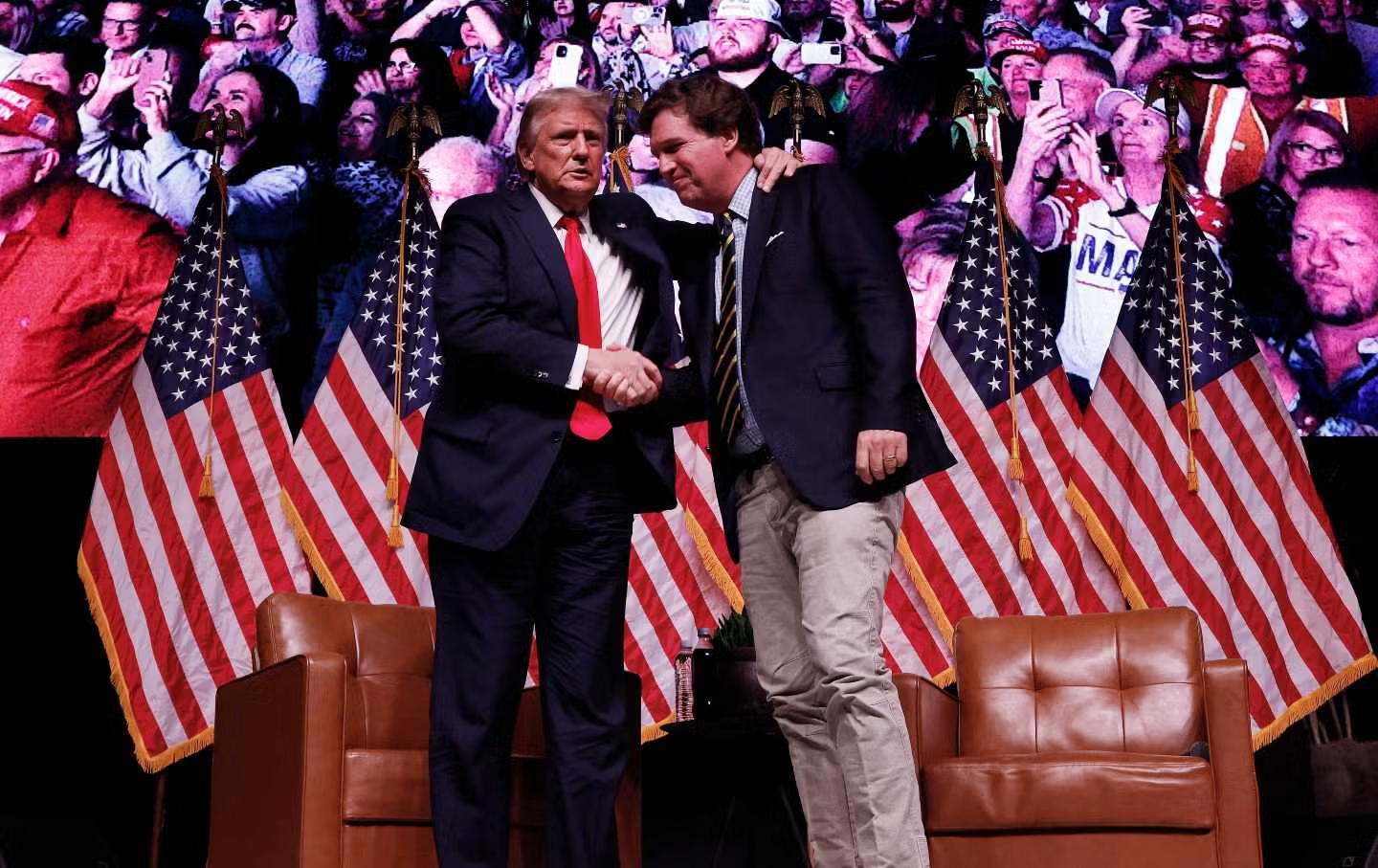
What Trump and Tucker Carlson Have in Common What Trump and Tucker Carlson Have in Common
Carlson has broken with Trump largely over the war in Iran. But on Ukraine and immigration, the two speak very much the same language.

The Jewish Case Against AI The Jewish Case Against AI
Haredi rabbis and the secular left agree: This technology is a threat to the entire social fabric.
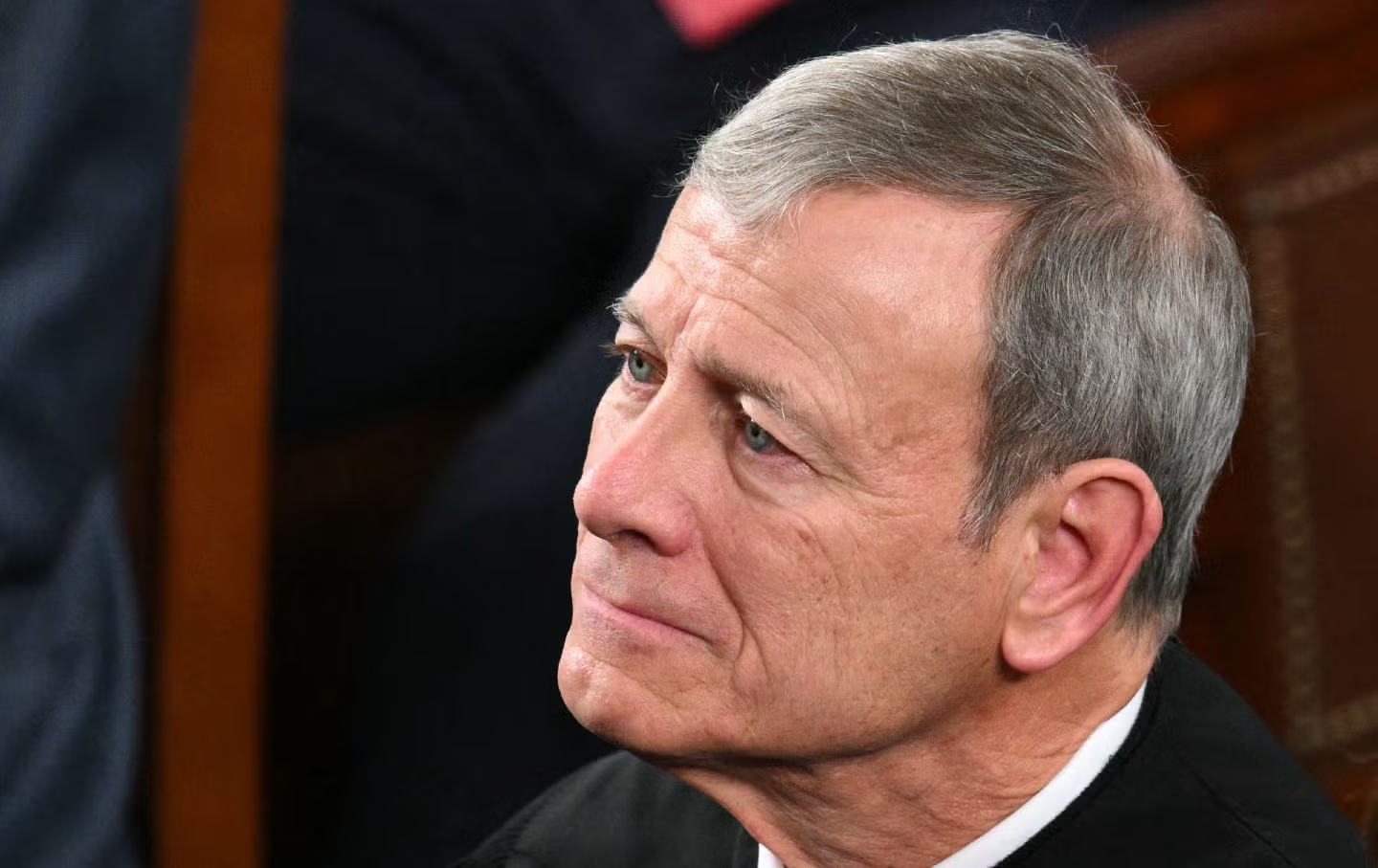
The Fight for Educational Equality Is Also a Fight for a Just Supreme Court The Fight for Educational Equality Is Also a Fight for a Just Supreme Court
The court has severely weakened our ability to make an education system that fulfills the promise of Brown.
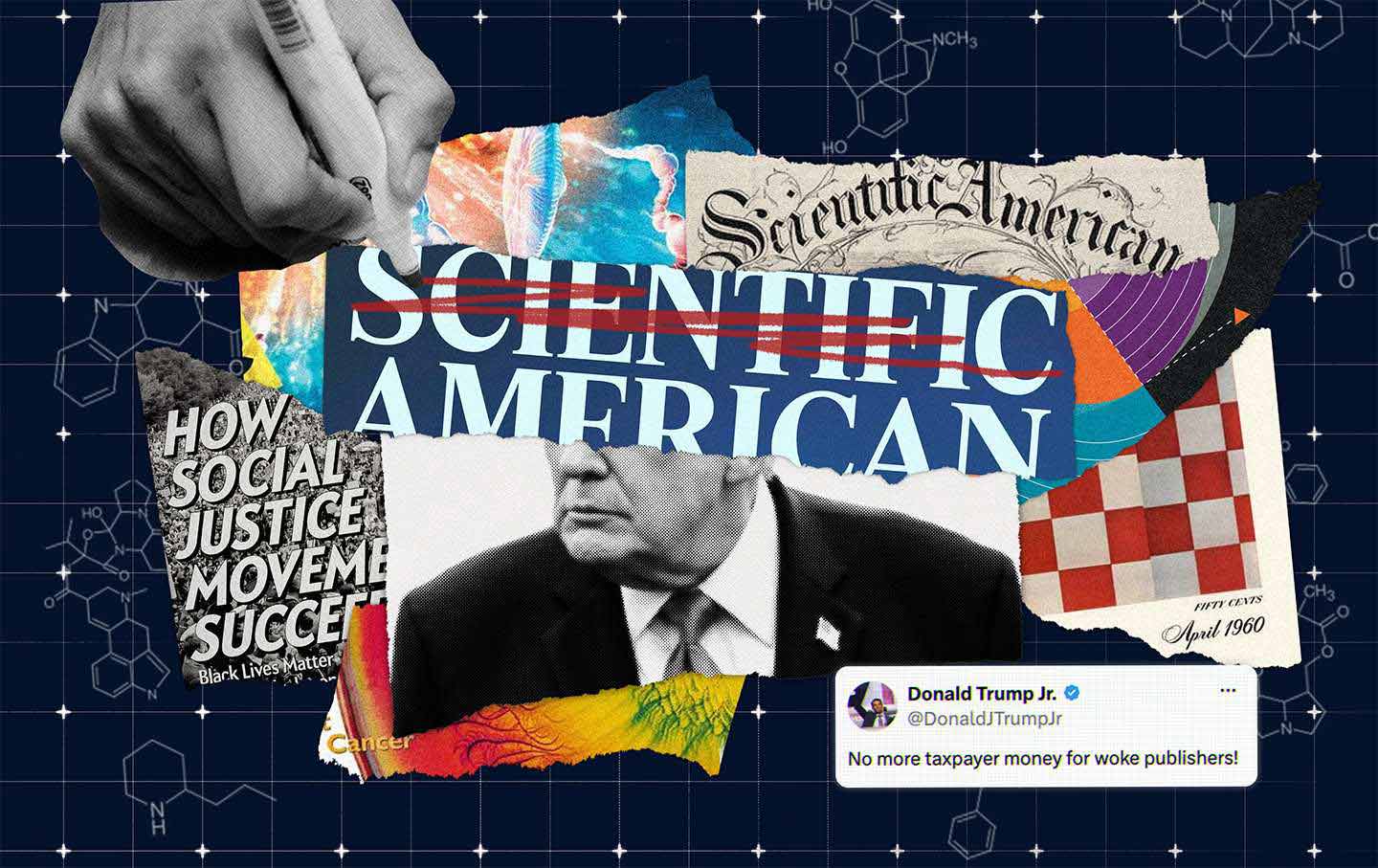
The Fall of “Scientific American” The Fall of “Scientific American”
When the beloved science publication got too political, its corporate owners stepped in. Now its future is uncertain.
The Bookstore Revolution in Taiwan’s Conservative Heartlands The Bookstore Revolution in Taiwan’s Conservative Heartlands
After Taiwan legalized same-sex marriage, gender-themed bookstores are working to build the social acceptance that the law alone couldn’t deliver.

