
What Remains of Riis?
A new members’ club has revived Riis Park’s long-vacant bathhouse, reopening old questions about whom the People’s Beach is really for.
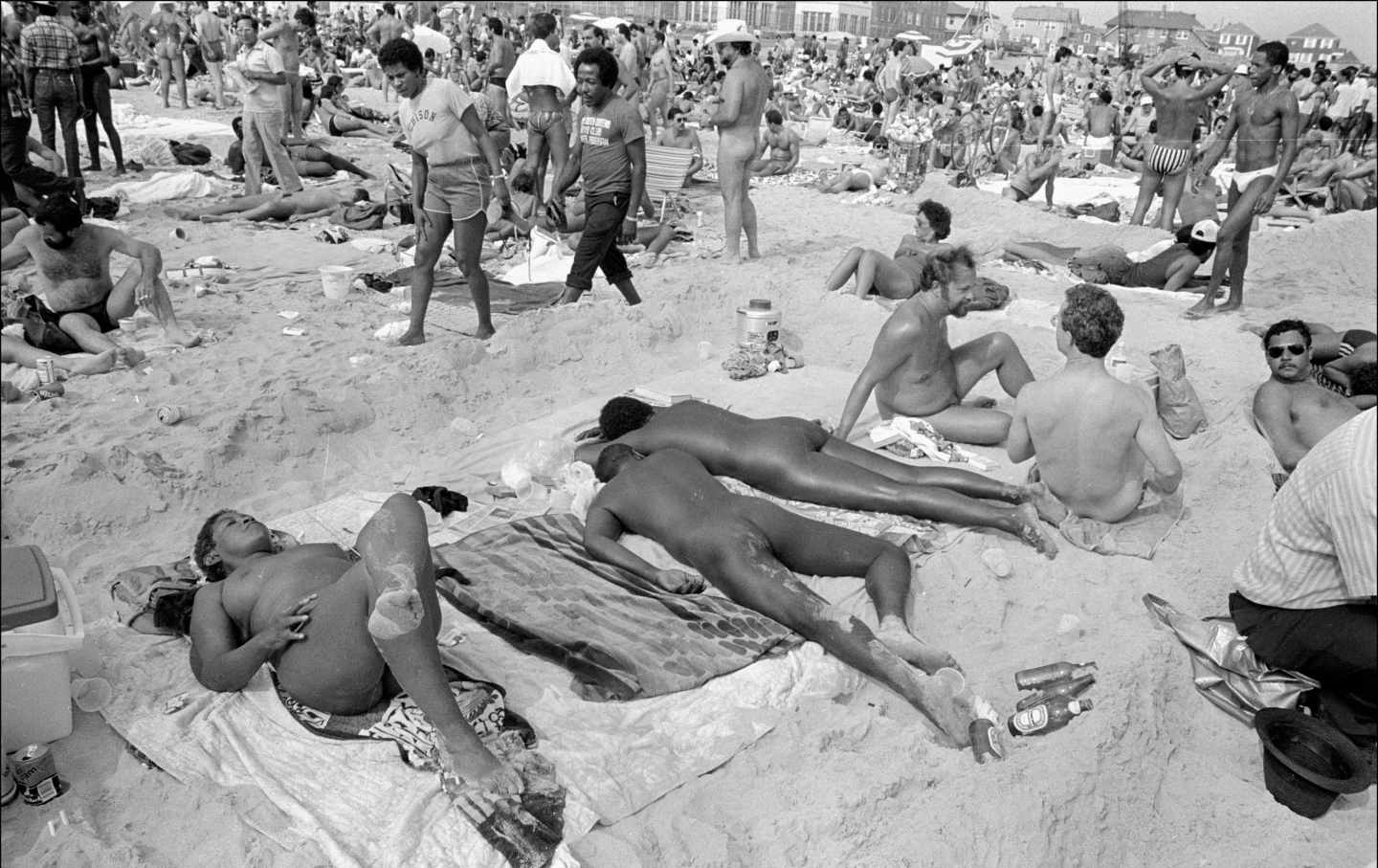
View of nude sunbathers on the beach at Jacob Riis Park in the Rockaways, New York, New York, August 1, 1982.
(Allan Tannenbaum / Getty Images)
I biked to the beach early Sunday morning, from my apartment in Bushwick through South Brooklyn and into Queens, crossing the narrow shared bike and pedestrian lane of the Marine Parkway Bridge, where a sign tells you to walk your bike but no one does. I arrived before nine, when the titular People of the People’s Beach—Riis Beach, or Gay Riis—were not there yet, making it just the beach. So I continued west to Fort Tilden, a wilder stretch of sand hugged by scrub-brushed dunes, where being alone felt intentional, even desirable. I followed a concrete path until it ended at a bike rack, slipped out of my sweaty bike shorts, squeezed into a Speedo, and stretched out on the sand. I was alone until an older man passed me, ventured farther down the beach, stripped down, and settled into his secluded spot.
Suddenly, a Park Police officer appeared on the sand and raised a pair of binoculars, training them on the nesting nudist. After apparently confirming that the man was indeed naked, he stomped toward the unsuspecting sunbather. I thought maybe he would get a warning or a ticket—speed-trap style—for his indecent infraction. Instead, the officer made him gather his things, and the pair started heading back my way. A patrol car arrived as backup. Unsure of what to do, I started recording. I was the only person around as the skinny, sun-weathered man with stringy gray hair was escorted past me, handcuffed, and lowered into the back seat. A few minutes later, it was just me on the beach with several minutes of fucked-up arrest footage on my phone.
Fort Tilden feels like somewhere it should be okay to get naked, even though technically it isn’t. The former military base, now part of Gateway National Recreation Area, is dotted with the ruins of concrete batteries covered in beach grass, giving the coastline the stolen valor of a WWII battlefield. Its emptier reaches, far from the family-friendly amenities of Riis, have long invited topless tanning, full frontal frolics, and the occasional dalliance in the dunes. I had considered a quick skinny dip after the hour-plus ride, but save for a split-second flash of flesh while I changed, I played it safe in my Speedo.
After crossing back over the bridge to bike home, I saw my busted beach buddy waiting alone at a barren bus stop. I stopped and told him I had seen the arrest. He said they had held him for three hours, that they had told him a child could have seen him (if that child had binoculars). He said he was going back to the beach because he didn’t know what else to do. At the time, I was surprised he wanted to return. Looking back, I guess I understood.
I went back too. It was a good summer for a return to Riis. My job of nine years had been reduced from full-time to part-time, which meant more free time but less disposable income. Less disposable income meant I had to back out of a Grecian gay guy getaway, but I had started biking again and set about rediscovering the pocketbook-friendly pleasures of my city’s unsung shoreline. I had frequented Riis and Fort Tilden throughout the 2010s, and I couldn’t tell whether my interest had coincided with a particular cultural moment—post-Sandy, when MoMA PS1 began hosting art events and the satire Fort Tilden came out—or whether I had naturally aged out of A-train-adjacent beaches for more pedigreed havens: the Pines, P-town, Puerto Vallarta, Palm Springs, Purgatory, following the migratory lifecycle of the adult gay male.
But Riis had its own lifecycle of booms and busts. The city acquired the land for a public park in 1912, first called Seaside Park and later Telawana Park, after the last known descendant of the native Rockaway people. After Jacob Riis died in 1914, it was renamed for the muckraking journalist, who had championed its development as a park for the people of New York. Still largely undeveloped, the park became a naval air station during World War I and, in 1919, the departure point for the first successful transatlantic flight. Its Byzantine-inspired brick bathhouse was completed in 1932, then substantially expanded under Robert Moses in 1936 and 1937 using Works Progress Administration labor, adding Art Moderne elements and a 62-acre parking lot with room for 14,000 cars—then billed as the largest paved parking lot in the country.
What wasn’t billed were the boys bound for Bays 1 and 2. By the 1940s, gay men, mostly white, were frequenting the eastern edge of Riis, in front of Neponsit Hospital; lesbians claimed a nearby strip of sand in the 1950s, and by the 1960s the beach had drawn increasing numbers of Black and Latino queer people. Trans beachgoers were part of the community by at least the 1970s. In 1966, the alternative guide New York Unexpurgated called it “one of the best Gay Rivieras in the world,” adding that it was “so crowded, nudes go unnoticed.”
Nudes were eventually noticed. In 1974, as Riis came under control of the National Park Service, The New York Times reported an “effort to restrict the wilder sorts of social nonconformists who like to frequent the beaches of the park,” including the arrest of a nude sunbather and 11 men for disorderly conduct, part of what authorities described as a crackdown on “behavior that might offend families who use the park.” By then, Riis was already in decline. The bathhouse fell into disrepair and would remain largely vacant for decades, despite plans for its rehabilitation being floated as early as 1988.
Decades later, the proposed demolition of Neponsit Hospital raised new concerns about the future of the gay beach. Opened for children with tuberculosis and later converted into a nursing home, it was abruptly evacuated by the Giuliani administration in 1998. For the next 25 years, the abandoned structure shielded the beach from the houses beyond until the city razed it in 2023, erasing one of the beach’s most identifiable landmarks—and with it the “Queer and Trans Power” and “Know Your Power” tags spray-painted across its upper parapets. Around the same time, erosion forced the National Park Service to close Bay 1, pushing the gay beach farther west into Bay 2. And then came the members’ club.
Given all the bad press, I expected to encounter a sea witch when I parked my Prius in front of the soon-to-open Rockaway Ocean Club. Instead, I met Ursula Damani, a cofounder of the new members’ club opening inside the restored bathhouse. She greeted me with a big hug and noted our matching stripes—she wore a red-and-white romper; I wore a faded pink button-down and tennis shorts. She told me she was glad I had dressed for the beach. I admitted that I was wearing a Speedo underneath, revealing the temporary nature of my journalistic intent.
We beelined for the 1932 bathhouse plaque, where Ursula recited: “This building was erected by the City of New York for the recreation of its citizens.” I got the sense this was not her first time at the reporter rodeo. She referred to those words as the project’s “North Star,” though the route from that civic pronouncement to carving out a private members’ club was less straightforward.
Standing next to the refurbished ticket windows where bathers once paid for lockers and dressing rooms, she noted that the old bathhouse had never been entirely free. “Sixty percent of the building is still public access.” The other 40 percent, she said, would be private. In 1940, a locker cost a quarter (about $6 today). For a non-Rockaway resident over 30, like me, annual membership today is $2,000, plus a $750 joining fee—and requires an application.
The architects behind the rehabilitation, Beyer Blinder Belle, described the project as “returning the bathhouse to what it always had been: a place to congregate, eat, drink, and build community.” Inside, the air-conditioned lobby—a welcome upgrade to the original building—offered a respite from the August humidity. Vintage furniture sat waiting to be whisked off to other parts of the building while designers, gardeners, construction workers, and other staff milled about. We passed a café and moved into a courtyard landscaped with native plants, then into the pool area, where Italian beach chairs, marked “R.O.C.” and striped in multicolored ombré, surrounded the recently filled U-shaped pool. Each had an adjustable shade that folded down over your face. Ursula said the Italians had “nailed how to make the good life accessible.”
She was right about the good life. But was the Ocean Club “accessible”? There is a certain appeal to the Italian model of beach access—paying 10 euros for a striped umbrella, ordering Aperol spritzes—that feels civilized and unencumbered. Most American beaches, for being so democratic, are annoyingly amenity-free for those of us without SUVs to lug entire furniture sets and fridge-size coolers to the sand.
The Ocean Club offered another model: membership. Ursula explained that annual fees would provide enough predictable income to keep paying lifeguards and maintaining the pool through a rainy month or a bad season, rather than relying on day-pass sales. Nonmembers would be able to book a room, which would come with pool access, but at a higher price point.
The club had also garnered criticism for describing itself as “family friendly.” Ursula explained that she hadn’t realized the phrase could function as a dog whistle for anti-queer sentiment, adding, “My definition of inclusive is like the true definition of inclusive.” She continued: “Everybody’s welcome.”
The club, with its tasteful renovation, contemporary landscaping, and custom loungers, looked chic, yes, but the Ocean Club’s promise of the bella vita stopped short for me. The stretch of beach directly in front of it was closed due to erosion, fenced off with rusted chain link and controlled by the National Park Service, with no date to reopen. And maybe this is petty, but the pool looked out through metal bars onto the 14,000-car infinity parking lot instead of the ocean. Capri it was not.
Popular
“swipe left below to view more authors”Swipe →Upstairs in the unfurnished members’ lounge, however, the ocean filled the windows. “You feel like you’re on a cruise ship?” Ursula asked. I said I did, though I’ve never actually been on one. Down the hall, the ocean-liner metaphor continued as we peeked into one of the 28 still-unfinished hotel rooms, so small they were calling them “cabins.” On the third floor, we hit the roof deck, which would be open to the public. “We wanted to make sure we saved the best for them,” Ursula told me. It did have gorgeous views stretching far over the Atlantic and back across the skyline. I had been coming to Riis since I was 22, but I had never seen it from this angle. It made me feel special to be seeing it first, my sense of press privilege already bristling against the beach politics I felt compelled to protect.
Before leaving the club, I asked to use the bathroom and was told I would be the first person to use it. I guess part of me had been hoping for a true “bathhouse” moment—vintage group showers, steam rooms, maybe even a sauna—but the bathroom was just a bathroom. I may not have gained membership to the club, but I did have access. Some people throw the first brick; some people take the first pee.
Over the summer, my Speedo and I kept returning to Gay Riis—sometimes with a friend or boyfriend, once to play golf with lesbians at the largely undiscovered pitch-and-putt. On one solo visit, I locked up my bike and walked toward the crowd now filling Bay 2. I don’t particularly like going to the beach alone, but here I was again—on assignment, I guess, but still alone—as I dropped my backpack into the sand. But it’s easy to find friends at Riis. Brandon, a dancer and longtime crush, waved me over and introduced me to his friends.
In the water, I met Michael, a dashing copywriter at Warby Parker, who told me he knew me through my writing. I proceeded to ask him about AI taking his job or something while flirting in the waves. Still in the water, I swam into my friend Adam, who reminded me about the documentary he was working on, which reminded me in turn that I had not yet donated to the GoFundMe for said documentary. Before that summer, I hadn’t been to Riis in years. But I still felt like a member of this lowercase ocean club.
After my visit with Ursula, I continued my reporting, approaching an entrenched beach camp encircled by a perplexing color guard: Pride and Italian flags, plus several variations on the Stars and Stripes—one reading “We the People,” another reading “No One Fights Alone,” with stripes for Corrections, Dispatch, EMS, nurses, firefighters, police, and the military. I introduced myself to a man named Nico, who seemed fried but friendly. He called his friend Rocco over to meet me. They came every day, described themselves as “very gay” and “very Jewish,” and said they lived in South Brooklyn, just over the bridge. I asked what they thought about the Ocean Club, but they didn’t seem concerned: “Honey, if they’re open by Labor Day, it’ll be a miracle.”
After watching the arrest and reading about the history of police suppression at Riis, this We the People’s Beach crew complicated what had been a tidy us-versus-them narrative. Without “Queer and Trans Power” looming over the sand, the messaging had become murkier. Who owned the beach seemed to depend on who had the biggest flag that day.
I hadn’t gone in the water yet. It was hot and humid and I was sick of stalking the sand, trying to talk to people. The sun was getting low, but I decided to head back west along the promenade, past the beach club, the lifeguard stands, and the golf course, before crossing into Tilden, this time on foot. At the end of the path, a few people, mostly men, sat scattered along the beach, some nestled among pieces of driftwood. It was the same stretch of sand where, earlier that summer, I had watched a man get handcuffed for being naked. But with these men standing sentinel, I felt safe, or at least seen. I shed my stripes, slipped off my Speedo, and scurried into the sea.
Become a Sustaining Donor This September
Between the reemergence of right-wing red-baiting and Donald Trump’s use of the chilling National Security Presidential Memorandum–7 to criminalize left political organizing, we’re seeing McCarthyism reborn before our eyes.
This assault on democracy cannot be ignored or wished away. Resisting it requires bravery in the face of threats and repression, a steadfast commitment to the truth, and the unwavering belief that we can—and will—overcome this darkness.
We must have an independent media that sets the record straight, unearths corruption and abuses of power, and advances a politics of justice and dignity for all if we’re to win this fight.
That’s why I’m writing to you today. This September, The Nation needs to add 100 monthly donors to sustain our progressive journalism. Your contribution makes the next investigative report, the next truth-speaking column, and the next pathbreaking essay all possible.
I hope you’ll support our work with a recurring donation today. If you donate $10 or more a month, we’ll send you a brand new “Hands Off the Free Press!” sticker to recognise your commitment to our cause. Please, donate today.
Onward,
Katrina vanden Heuvel
Editor and Publisher, The Nation
More from The Nation

When Texas Sex Ed Falls Short, Gen Z Women Turn to Social Media When Texas Sex Ed Falls Short, Gen Z Women Turn to Social Media
A 2025 study found that 70 percent of adolescents sought reproductive health information through social media platforms.

Justice for Macklemore Justice for Macklemore
The rapper has been dumped from Ed Sheeran’s tour for saying “free Palestine.” That’s a disgrace.

We Are Living Under Roy Cohnian Logic We Are Living Under Roy Cohnian Logic
The political fixer created a career for himself as a self-promoting, ubiquitous hustler. Like Trump, he got away with it by having the right friends.

Time Has Run Out for AI Risk Deniers Time Has Run Out for AI Risk Deniers
The recent spate of reports about the technology’s destructive power underline two prime directives: Be afraid, and regulate aggressively.
Yale’s President Has Become a Shameful Collaborator With Trump Yale’s President Has Become a Shameful Collaborator With Trump
Maurie McInnis has the power to stand up to the administration. Instead, she’s caving.

The Fissures and Fractures Behind the Right’s Pink Facade The Fissures and Fractures Behind the Right’s Pink Facade
After Roe was overturned, some young women are turning more hard-line on abortion—but others are fleeing conservatism altogether.

