
How Franco Ruled Spain
Two new books examine these dark decades in Spanish history.
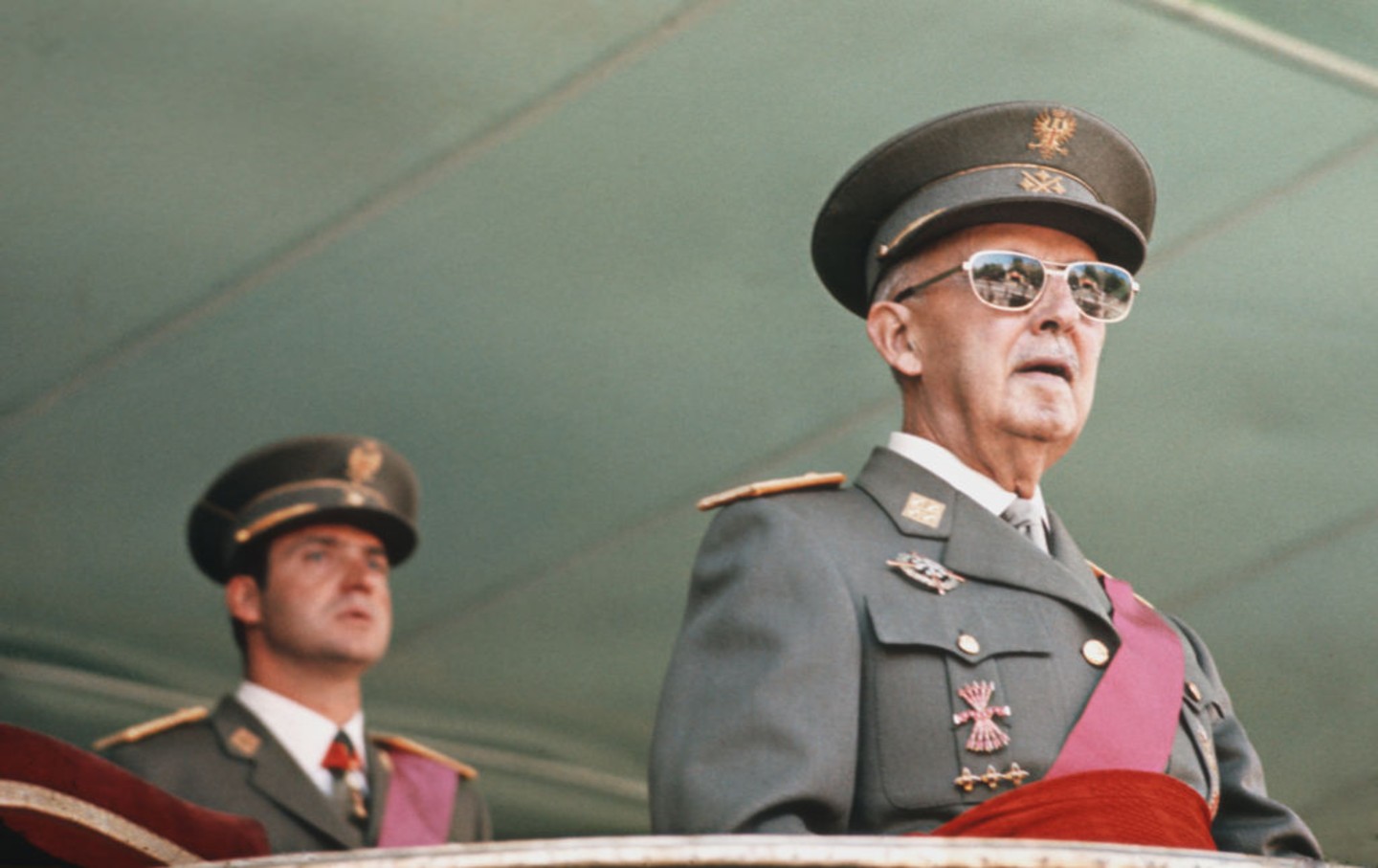
Gen. Francisco Franco with his handpicked successor, Prince Juan Carlos of Spain, in 1975.
(Keystone / Getty Images)Books in review
-
El Generalísimo: A Biography of Francisco Franco
Buy this book -
Ni una, ni grande, ni libre: La dictadura franquista
Half a century after his death, Francisco Franco, the military dictator who ruled Spain for nearly 40 years, still has friends in high places. “The image people have of him is that of a strict and cold man, but in private, at least with me, he was always kind, smiling, and talkative,” Juan Carlos I, the former king of Spain, says in his recent memoir. “My relationship with him was like a son to a father,” he adds. “I became king thanks to him. I have never allowed anyone to criticize him in my presence.” For a monarch who is notorious for his deceptions—financial, marital, and otherwise—these words are curiously honest.
Juan Carlos is not the only prominent Spaniard who sees little reason to distance himself from Franco. “Why would I condemn something in which my father participated?” José María Aznar, Spain’s former prime minister and éminence grise of the center-right Partido Popular (PP), said this past November to explain why his party has always been coy about breaking with the legacy of the dictatorship. Aznar’s lack of embarrassment about his family’s political history—his father and grandfather were both leading figures in the regime—is not surprising: The PP’s forerunner was founded in 1976 by Francoist officials. More alarming is how quickly the Spanish public at large has forgotten what the Franco era was really like.
In fact, the man who in 1926, at age 33, became Europe’s youngest general, who in 1939 defeated the Spanish Republic after a three-year civil war, and who died in 1975, at age 82, after ruling Spain for decades, has a growing number of admirers. According to a poll from last October, over 21 percent of Spaniards believe the years of the dictatorship were “good or very good,” including a majority in both major parties on the right—PP and the far-right Vox. In another poll, run by the newspaper El País, only half of those between 18 and 28 years old were able to correctly identify when Franco ruled, while close to half of far-right voters wrongly believed that the defenders of the Spanish Republic killed more people than their right-wing Nationalist opponents. (In fact, the Nationalists’ victims were triple those of their Republican foes.) Even in the United States, Franco’s reputation has had something of a revival: He is frequently cited with admiration by the likes of Internet commentator Mike Cernovich and Vice President JD Vance.
Last November 20 marked the 50th anniversary of Franco’s death. In 1975, his long-expected demise was followed by the swift coronation of Juan Carlos I, whom Franco had handpicked as his successor in 1969. Although the king had sworn loyalty to the regime, by 1978, mass popular mobilization, international pressure, and his desire to salvage the monarchy convinced Juan Carlos to relinquish the absolute power that Franco had granted him and accept the largely ceremonial role of constitutional monarch. The move helped usher in what would turn out to be the longest-lasting democracy in Spanish history.
How Franco’s legacy should be assessed was a question Spaniards used to be happy to avoid. In 1977, a negotiated amnesty law shielded Francoist perpetrators from prosecution (and also, in effect, from investigation). By the 1980s, as a democratic Spain burst onto the world stage, Pedro Almodóvar boasted that he made movies as if Franco had never existed. But the days when Spain could ignore its dictatorial past are over. For the past 25 years, grassroots pressure from Franco’s victims and their families has pushed left-of-center parties in Spain to address the unfinished business from the country’s transition to democracy. In 2007 and 2022, Spain passed two “memory laws,” which provide state support for families looking to recover the remains of loved ones killed by the regime but stop short of repealing the amnesty law. In 2019, the government finally removed Franco’s body from the massive state-sponsored monument in which he was buried. All of this happened over the objections of the PP and Vox, many of whose supporters see no reason to revisit the past, or who prefer to see Franco as the man who saved Spain from left-wing chaos and subversion.
In the face of these debates, the judgment of longtime Guardian journalist Giles Tremlett is unequivocal. Franco, he writes in his new biography, El Generalísimo, was “a cold-blooded militaristic authoritarian” who ended up at the helm of his country through a combination of “relentless ambition” and “considerable luck.” He is best described as “a giant dam, determined to control the flow of Spanish history—in part by holding back the societal and political changes that brought welfare and freedom to much of the Western world during his life.”
Tremlett portrays Franco as a consummate survivor, driven by boundless ambition, an absurdly inflated self-image, and sharp political instincts. His victory in the Spanish Civil War (1936–39)—a bloody military conflict that caused hundreds of thousands of civilian deaths—was won in large part thanks to support from Hitler and Mussolini, and its ultimate objective was not the country’s liberation, as Franco proclaimed, but instituting a regime with two main goals: to punish his enemies (which included more than half of his countrymen and anyone else who favored communism, liberalism, or democracy) and to return Spain to its former greatness as a crusading Catholic empire. He was much more successful in the first than in the second.
How Franco maneuvered himself into the center of power, where he lasted to his dying breath, is fairly straightforward. Pinning him down politically is a different story: Was he a fascist? A conservative? An antisemite? It’s complicated. Franco’s ideology, Tremlett writes, “does not fit the models of the twentieth century…because Franco’s politics were born out of Spain’s nineteenth-century history of imperial humiliation. His simplistic reactionary ideals were about righting that, as if everything from the French Revolution to the Enlightenment and the fall of the Spanish empire could be reversed.”
Those simplistic reactionary ideals, Tremlett shows, hewed to military and traditionalistic views of honor, sacrifice, discipline, and patriotism—coupled with a steadfast belief in his own and his country’s greatness and including a handful of phobias, including of Jews, Freemasons, and “communists,” a catch-all term for anyone to the left of conservative Catholicism. Beyond that, ideas were not Franco’s thing. His political coming-of-age, in Tremlett’s telling, was born of psychological conflicts that shaped his life from the beginning. That such a simple man might become world-historical, and that his ideas continue to shape Spain, says something about the peculiar place that the country occupies in 20th-century history. While Spain technically remained neutral during both world wars, it became a key US ally during the Cold War. As a result, it was one of the countries where fascism would rule the longest.
Born in 1892, Franco was raised in the “military ghetto” of Ferrol, on the Galician coast; for generations, the Francos were known as naval officers. He was the second of five children, though one of his sisters, Paz, died when she was only 4. Raised mostly by his mother—a doting, conservative, and deeply religious woman—Franco grew to resent his philandering, liberal father, an officer in the Armada who abandoned the family when Franco was young to go live with his mistress in Madrid. Here and elsewhere, Franco’s 19th-century simplicity sometimes seems to seep into Tremlett’s own analysis. To explain the political structure of Franco’s youth, for example, Tremlett resorts to the “two Spains” trope, reducing national political fault lines and the Franco family dynamic to a divide between a conservative mother and a liberal father.
Franco dreamed of following in his forebears’ footsteps and joining the navy. But these ambitions were thwarted in 1898 by Spain’s defeat in the Spanish-American War, and he settled for the army instead. It wasn’t an easy route: “Franquito” was relentlessly bullied by his fellow cadets. He was short, pot-bellied, and had a high-pitched voice, possibly due to a deviated septum. In Tremlett’s telling, these early humiliations hardened Franco and provided him with a lifelong supply of spite. They also made him cautious. When faced with big decisions, he often seemed neurotically hesitant. Over time, his hedging would be reconfigured into a sly disposition: Franco kept his cards close to the vest before setting on a ruthless course of action.
One of the most interesting family dramas that Tremlett traces in the book is Franco’s rivalry with his younger brother Ramón, a pilot who flew the first transatlantic flights from Spain. Politically, Ramón swung far to the left, becoming an anti-monarchist. According to Franco, Ramón betrayed the family’s honor. The enmity, however, ended under mysterious circumstances during the Civil War, when, upon returning from his post as an attaché in the Spanish embassy in Washington, Ramón inexplicably joined his brother on the Nationalist side. Franco quickly promoted him to lieutenant colonel, against the wishes of his air-force chief and personnel. Tremlett chalks up Franco’s change of heart to family loyalty. Yet the story behind Ramón’s political U-turn and Franco’s embrace of the brother he once hated remains a mystery to this day.
Despite his many challenges, Franco’s military career was meteoric. From 1913 through the 1920s, he served in the colonial army, which fought a bloody, drawn-out war against rebel forces in present-day Morocco. His steely approach would allow him to outlast others vying for power. When a fellow general, the hotheaded José Sanjurjo, attempted a military coup in 1932, he failed. Franco’s attempt, four years later, did not.
Yet that’s where the differences stop. Franco shared the paranoid worldview of his fellow generals, indulging in elaborate conspiracy theories. He also shared their penchant for making war as brutal as possible, though he often passed the dirty work off to others. And, like his peers, he had an enormous ego born of an inferiority complex: His social status wasn’t high enough; his religiosity, which he came to later in life, wasn’t pure enough. His manhood, even when he was a general, was constantly questioned; it made him a crueler commander, but it also fed into his cultivated public image—a strict father figure, not afraid to mete out punishment to his unruly nation.
Franco did not launch the July 1936 coup by himself. In fact, he only belatedly joined the plot, which had been concocted by Sanjurjo, who was exiled in Portugal, and Emilio Mola, a fellow general—though everyone involved knew that Franco would eventually have to come on board, given his status in the military and his power over the Spanish colonial army. He would only become the coup’s official leader in September, voted in by his fellow plotting generals and colonels.
Franco avoided risk at all costs, during the Civil War especially. Tremlett usefully unearths a series of moments in which Franco appears to be the least ruthless of the Spanish generals. This was deceptive, Tremlett shows. In practice, Franco’s vindictiveness often came with a delay: He waited until he was certain his actions would not elicit a response that he wouldn’t also be able to crush. A general in Zaragoza who was late to join the 1936 coup, for instance, was arrested and put on trial, where he plausibly claimed that the uprising—which had been quite disorganized—had taken him by surprise. Franco, who had been the general’s mentor, half-heartedly requested a pardon but did not stop the execution of his loyal disciple. According to Ramón Serrano Suñer, Franco’s brother-in-law and a leading figure in the early years of the regime, the episode exemplified Franco’s “coldness and indifference.”
That coldness was also a delaying tactic. During the Civil War, Franco deliberately slowed his advance, allowing him time to methodically purge the zones his army controlled—the same military approach he had honed in colonial North Africa. Just as Franco dithered on the ground, he postponed revealing his political commitments. This, too, was a tactic: It allowed him to claim the upper hand over anyone with whom he was negotiating. Still, his compulsive need for control could also be a weakness. When Hitler suddenly decided to increase his involvement in the war, sending the Nationalists significant military support—everything except for ground troops—it upset Franco. “Franco’s churlishness,” writes Tremlett, “reflected his hatred of others making decisions on his behalf”—even decisions that would prove decisive to winning the war.
The Spanish Civil War ended when Franco entered the capital of Madrid on April 1, 1939. By that point, his authoritarian state had already been up and running across most of the country. Franco then turned his sights abroad. Not long after his victory, he sought to join the Axis war effort, offering Hitler support in exchange for North African territory. But Hitler turned him down. Following a familiar pattern, Franco later recast this embarrassing moment as a brilliant decision to keep Spain out of World War II. In reality, he didn’t begin distancing himself from the Nazis until it became clear that they were losing.
To the disappointment of everyone who had supported the Spanish Republic’s fight against fascism, Franco did not go down with Hitler and Mussolini, the two dictators who had helped him win the Civil War. The Allies’ anti-fascist liberation campaign stopped at the Pyrenees. During the Civil War and in its immediate aftermath, the regime had executed an estimated 140,000 people, held hundreds of thousands in prisons and concentration camps, and exiled a quarter-million Republican supporters. Yet during the postwar period, Franco nonetheless became a coveted ally for the British and the Americans, who were willing to overlook Spain’s bloody postwar repression if it gave them an upper hand in the Cold War.
Even though the Franco regime was formally excluded from the Marshall Plan and international organizations, the logic of the containment eventually justified US President Dwight Eisenhower’s military and economic pact with Spain in 1953 and the country’s admission to the United Nations in 1955. Franco, ever the shrewd tactician, took advantage of these international shifts to strengthen his domestic position, often at the expense of former allies. In the late 1950s and ’60s, this meant opening up the country to tourism, handing the rapidly expanding economy over to technocrats from Opus Dei, and allowing more than 2 million Spaniards to emigrate north as guest workers. The collective memory of this experience helps explain why many Spaniards today feel more solidarity toward immigrants than do other Europeans.
Franco’s dictatorship transformed Spanish society at all levels. If Tremlett’s psychological analysis works reasonably well for capturing Franco the man—even if the upshot is that he wasn’t all that compelling a person—it is less useful for understanding the regime named after him. The dictatorship, in Tremlett’s telling, became over time “a project that was about little more than law, order, repression of dissent and imposition of Roman Catholic morals.” This seems a bit underwhelming. Though Franco’s own ideas may have been limited, Francoism generated plenty of them. Ever on the ideological vanguard, his state-funded think tank the Instituto de Estudios Políticos (Institute of Political Studies) inducted Nazi Germany’s premier theorist of dictatorship, Carl Schmitt, as an honorary member in 1962. In 2024, Nicolás Sesma, a French historian of Catalan Spanish descent who has studied the institute closely, published a nuanced account of Francoism, its roots, and its long-term effects that became an unexpected bestseller in Spain.
Popular
“swipe left below to view more authors”Swipe →Buoyed by compelling storytelling and mountains of historical research, Sesma’s lively cultural and political history shows that Francoism was more complex, more variable, and in a way more interesting than the dictator himself. As it turns out, almost every claim that Franco and his regime made about Spanish culture and history—and their own place within it— was false, beginning with the dictatorship’s very slogan, España: una, grande, libre. As the book’s title indicates, Spain under Franco was Ni una, ni grande, ni libre: not one, not great, and certainly not free.
Among the other myths that Sesma debunks is the notion that Francoism paved the way for democracy; that it played a largely positive role during World War II as a haven for Jewish refugees; and that both Franco and Francoism were in any way inevitable. Instead, he describes how many Spaniards learned to live with an oppressive regime whose overthrow seemed impossible to imagine, even by its enemies. The fact that the democratic transition left Franco’s carefully constructed myths largely untouched—including a convenient minimization of his links with the Axis powers—was a testimony to the continued power of his representatives. But leaving those myths in place also helped mitigate Spain’s collective embarrassment, whether its citizens had actively supported the regime, passively benefited from it, or failed to defeat it.
While Franco has new admirers among the global far right, contemporary scholars of fascism have worked to reconnect his regime to other European and Latin American revanchists and fascists. Here, Franco’s colonialist roots are particularly compelling. In Spanish Fascist Writing, a recent English-language anthology of far-right Spanish texts from the 1920s to the 2010s, Justin Crumbaugh and Nil Santiáñez argue that Francoism was the particular form that fascism took in Spain. Considering Spanish fascism on its own terms rather than focusing on how it deviates from the German and Italian variants, they write, “will enable deeper understanding not only of Spanish fascism but of fascism as a whole,” including its later incarnations elsewhere. Francoism not only inspired right-wing dictatorships in Latin America, as Kirsten Weld has shown, but it has also had admirers among the US Catholic far right, such as L. Brent Bozell, William F. Buckley Jr., Fritz Wilhelmsen, and, more recently, Adrian Vermeule, JD Vance’s longtime mentor.
Although fate played a much smaller role in Franco’s life than he liked to think, it was predictable that a military dictator would come from the northern town of Ferrol. The town had historically been a seat of Spain’s elite naval power and proudly claimed never to have succumbed to enemy invasion or capture.
Still, Ferrol has another side. From the 19th century onward, it has also been a town of shipyards and foundries, of dockworkers and metalworkers, and, before that, in the 18th century, of copper-sheathed ships and galley slaves. Franco is not the only political leader that Ferrol has spawned. Born there, too, was Pablo Iglesias (1850–1925), who in 1879 founded the Spanish Socialist Workers’ Party and corresponded with Friedrich Engels. And Spain’s current labor minister, Yolanda Díaz, was born just across the bridge in a Ferrol suburb. The two faces of Ferrol came to a head in 1972. Franco, who knew his end was near, had appointed the young Juan Carlos I as his successor three years earlier. On March 10, thousands of Ferrol shipyard workers went on strike. They were met with gunfire by the Francoist police force. Two workers died, several dozen were injured, and hundreds more were detained, jailed, and fined. In 1997, the regional parliament officially declared March 10 the Day of the Galician Working Class.
Become a Sustaining Donor This September
Between the reemergence of right-wing red-baiting and Donald Trump’s use of the chilling National Security Presidential Memorandum–7 to criminalize left political organizing, we’re seeing McCarthyism reborn before our eyes.
This assault on democracy cannot be ignored or wished away. Resisting it requires bravery in the face of threats and repression, a steadfast commitment to the truth, and the unwavering belief that we can—and will—overcome this darkness.
We must have an independent media that sets the record straight, unearths corruption and abuses of power, and advances a politics of justice and dignity for all if we’re to win this fight.
That’s why I’m writing to you today. This September, The Nation needs to add 100 monthly donors to sustain our progressive journalism. Your contribution makes the next investigative report, the next truth-speaking column, and the next pathbreaking essay all possible.
I hope you’ll support our work with a recurring donation today. If you donate $10 or more a month, we’ll send you a brand new “Hands Off the Free Press!” sticker to recognise your commitment to our cause. Please, donate today.
Onward,
Katrina vanden Heuvel
Editor and Publisher, The Nation
More from The Nation

The US Had a Choice After 9/11. It Chose Wrong. The US Had a Choice After 9/11. It Chose Wrong.
In this week’s Elie v. U.S., our justice correspondent reflects on September 11. Plus: the stupidity of the "Trump Dividend" and the threat of AI.


Trump Wants Voters to Pretend He’s on the Ballot Trump Wants Voters to Pretend He’s on the Ballot
But Republican midterm candidates are hoping everyone forgets he exists.

Remembrance: 25 Years Since the September 11 Attacks Remembrance: 25 Years Since the September 11 Attacks
On September 11, 2001, coordinated terrorist attacks carried out by the extremist group al-Qaeda killed 2,977 people and injured more than 6,000 others in the United States.

How The Nation Covered 9/11 How "The Nation" Covered 9/11
Our phone lines were down. People were weeping. But we got an issue out the door with morality, justice, and nuance.

How a 26-Year-Old Beat a 42-Year Incumbent—and What It Means for Democrats How a 26-Year-Old Beat a 42-Year Incumbent—and What It Means for Democrats
As the only undergraduate managing a primary campaign in the state, I helped a 26-year-old beat a 42-year incumbent. Here is what Democrats can learn from our win.

