The GOP’s New Red Scare
McCarthyism, the second time as farce.
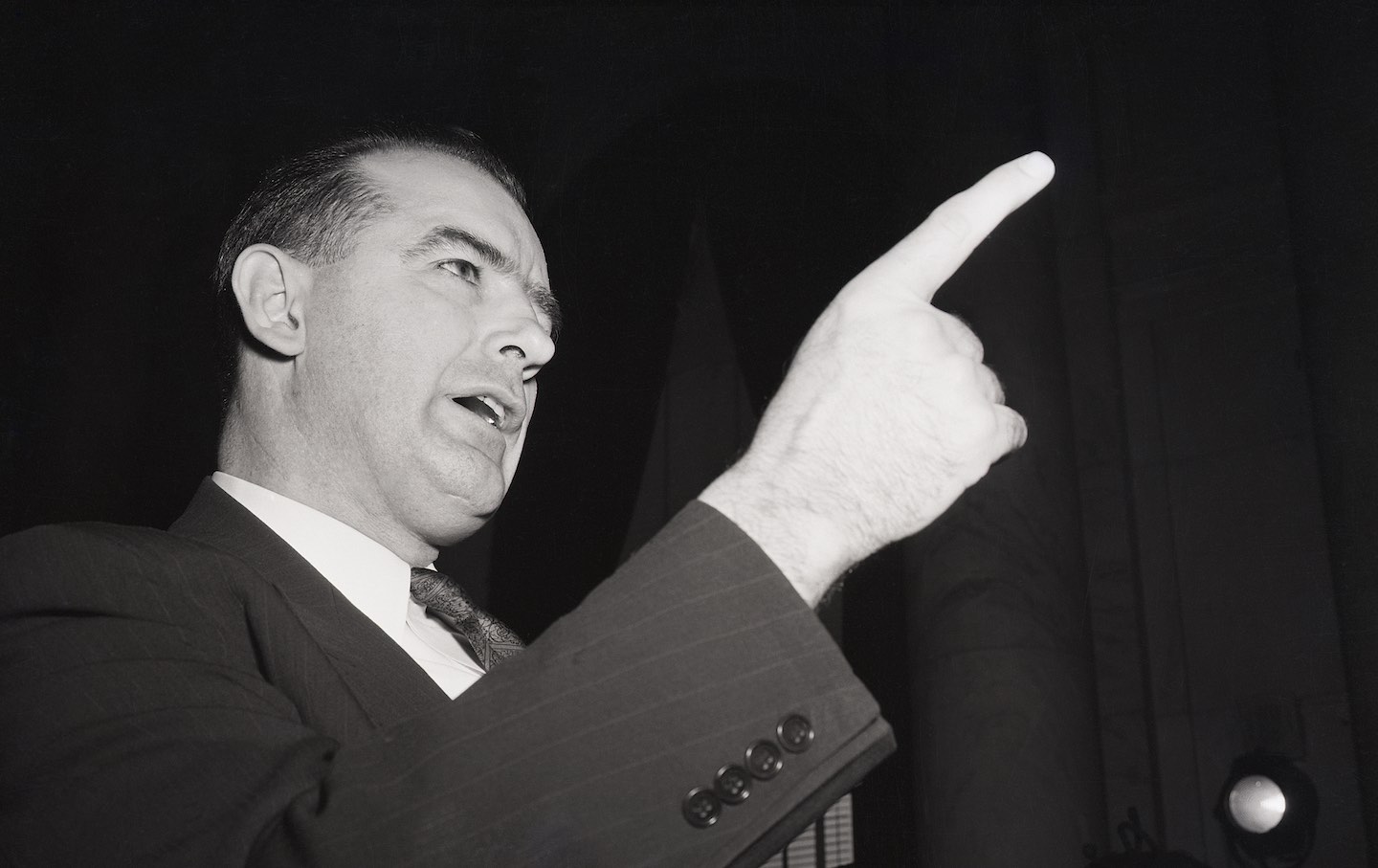
Wisconsin Senator Joseph McCarthy during his second appearance before the Senate Foreign Relations Subcommittee in 1950.
(Bettmann)Shortly after announcing the mission of turning the 2026 midterms into a “hate election,” the campaign brain trust for the Republican Party has settled on the secret-weapon epithet it plans to deploy against its Democratic congressional rivals: “Communism.”
No, really: Three and a half decades after the collapse of the Cold War, the campaign chieftains of the right are planning to revive the paranoid political stylings of Joe McCarthy. The rationale for this round of 21st-century red-baiting stems largely from the recent string of primary wins racked up by Democratic candidates aligned with the Democratic Socialists of America; in the perfervid imaginings of the right, socialists are just genteel stalking horses for Communists, with Marxism serving as the intoxicant of choice for raving leftists of all description. So the thing to do is to call out any and all Democrats as no-good Reds, determined to undermine and overthrow true-blue American individualism and laissez-faire capitalism at every term.
This advice is distilled in a polling memo that the conservative political research firm co/efficient drafted for the House Republican Conference and circulated to GOP House members on July 20. Washington Examiner reporter Hailey Bullis obtained the document, which peddles this spittle-flecked counsel to GOP House candidates: “Call them what they are: Socialists, Marxists, Communists. Communism rings the loudest alarm with constituents (42 percent name it the most dangerous system).… Connect all three, fruit of the same poisonous tree, and let the family name carry the alarm.”
There are a few difficulties with this line of argument, to put it mildly. To begin with, of course, Communism was never anything more than a fringe-minority allegiance in American politics, even during its heyday in the “Red decade” of the 1930s. The penchant for descrying it as a lurking menace in—take your pick—American university classrooms, federal government bureaucracies, diplomatic redoubts, labor unions, and the liberal intelligentsia typically said more about the persecution complexes raging through the id of the American right than it did about the actually existing state of recruitment activities by an American Communist Party that claimed membership in the tens of thousands at its peak. That became the damning consensus view in the wake of the alcoholic and demented McCarthy’s self-implosion on the national stage three years prior to his death.
Yet the primal grievances of the American right are endlessly fungible, and can be repurposed with just a few minor linguistic tweaks or revamped Kulturkampf come-ons. The revival of McCarthyite insinuations and smears is a convenient conceit for a MAGA movement that’s losing any plausible footing in public opinion, thanks to the Trump administration’s pointless and epically unpopular war in Iran and singularly maladroit management of the economy. (The Trump administration’s staggering corruption is also starting to make a noticeable dent as a campaign issue, despite the Democrats’ stupefying inability to make it an election-year crusade.) The GOP’s lurch into red-baiting is the electoral version of the old lawyer’s saw: “If you have the facts on your side, pound the facts. If you have the law on your side, pound the law. If you have neither the facts nor the law, pound the table.”
Then there’s the opinion survey that the co/efficient campaign savants treat as gospel. On the face of things, it’s monumentally incoherent. Start with the poll’s top-line finding that “63 percent of Americans are very or somewhat concerned about socialist candidates taking office.” On inspection, none of the poll’s lead respondents—who are clustered into numbingly broad categories such as “women” and “Americans of color” that disclose almost no useful information about their actual demographic profiles or broader political worldviews—clock majorities in the “very concerned” affiliation, while the “somewhat concerned” designation is so pointedly nonsignifying that Susan Collins has forged an entire political career out of it. It’s reasonable to infer that this 63 percent bloc represents the largely unformed views of voters just tuning into a primary cycle that’s been awash in centrist and right-wing freakouts in the elite media about the alleged specter of a DSA takeover of the Democratic Party. One useful corrective to such frantic hand-waving is this sturdy data point: The most prominent democratic socialists now holding office are among the most popular politicians in the country.
Now consider the findings that prompted these polling wizards to tie up all Democratic candidates in a tidy red bundle. The query to respondents was: “What do you consider the most dangerous system of government for the United States to pursue?”—not exactly a phrasing designed to yield much in the way of thought or reflective nuance. The offered range of response is a further case study in preselected bias: Communism (42 percent), socialism (15 percent), Marxism (6 percent).
That’s it: the whole spectrum of co/efficient-branded government danger. No mention of rampant authoritarianism or fascism, Christian nationalism, tech oligarchy, or Muskism—all far more present threats to the well-being of ordinary American voters, and many of which are polling worse than the Communist specter is among voters. Indeed, a reality check to all this brackish electoral Bircherism is a recent poll conducted by the anything-but-pinko news outlet CNBC finding that voters would prefer a DSA candidate over one endorsed by President Donald Trump or (worst of all) one strongly identified with the MAGA movement. Another reality check comes from a recent Economist/YouGov poll on the communism question, which found that just 18 percent of respondents regarded the moribund ideology as a major threat on the American scene; 25 percent designated the threat level as “minor,” while a 33 percent plurality declared it, on the soundest empirical grounds, not a threat at all.
And here, too, the survey’s historical incoherence is a wonder to behold. To throw the disparate forces of Communism, socialism, and Marxism all together as “fruit of the same poisoned tree” in a decidedly post-Communist global order is akin to ascribing the onset of the Industrial Revolution to the distempers of Greek mythology. In all likelihood, Communism carried the day among the poll’s harangued respondents as a simple exercise in name recognition: It’s the ideology that Americans have been most forcefully instructed to despise for more than a century, whereas socialism has produced many central and tangible improvements to the fortunes of working Americans. The 6 percent of respondents who went out of their way to calumniate Marxism are the rough polling equivalent of a shrug emoji. (It also says everything about the methodology here that Marxism is not a system of government at all but a nearly 200-year-old philosophy; socialism antedates it by about another century—unless, that is, you count the early Christians.)
Still, it’s clear that the red-baiting branding will continue apace on the right as it tries to seize on any and every brand of grievance calculated to distract attention away from its actual governing record. In a July 3 speech at Mt. Rushmore, Trump declared that the “communist menace” is once more stalking the American civitas, and vowed to “vanquish Communism quickly” and send its adherents “into exile.” He also vowed to continue the MAGA purge of dissent from universities and public discourse—a stance his administration is now planning to codify into a series of ideological disclaimers slapped on to American-history installations at the Smithsonian and elsewhere: “As for those who peddle Marxist lies about our heritage, tell our children that we live on stolen land or that our heroes were oppressors, they’re doing something much worse than slandering our past. They are slandering and attacking our future—not going to let that happen.” Trump’s State Department followed up that outburst with a high-paranoid report on the alleged global red threat called “Cuba: the Capital of Twenty-First Century Communism,” which delivered this fantasia of Castroite world dominance: “For nearly seven decades, the Cuban regime has waged a sustained campaign of subversion against the United States.… Today, that network continues to maintain ties to powerful leftist nonprofits, anti-ICE collectives, socialist groups, and Marxist militant organizations across the United States.”
Even during the many derangements of the Cold War, such unhinged conspiracy-mongering was chiefly fodder for public derision and satire. It’s now the everyday discourse of our presidency and State Department—a twist that poor drunken Joe McCarthy could never have envisioned, but that was always plainly in the sights of his far more disciplined lieutenant Roy Cohn, who also doubled as Donald Trump’s political mentor. Yet what neither Trump nor his quisling party seem to understand is that Cohn never had a chance in hell of being elected to anything. Good luck running on his platform in 2026.