Andy Burnham Is Not to Be Trusted
The UK’s new prime minister has promised sweeping change. But his first week in power saw him going down the same failed paths as his predecessors.
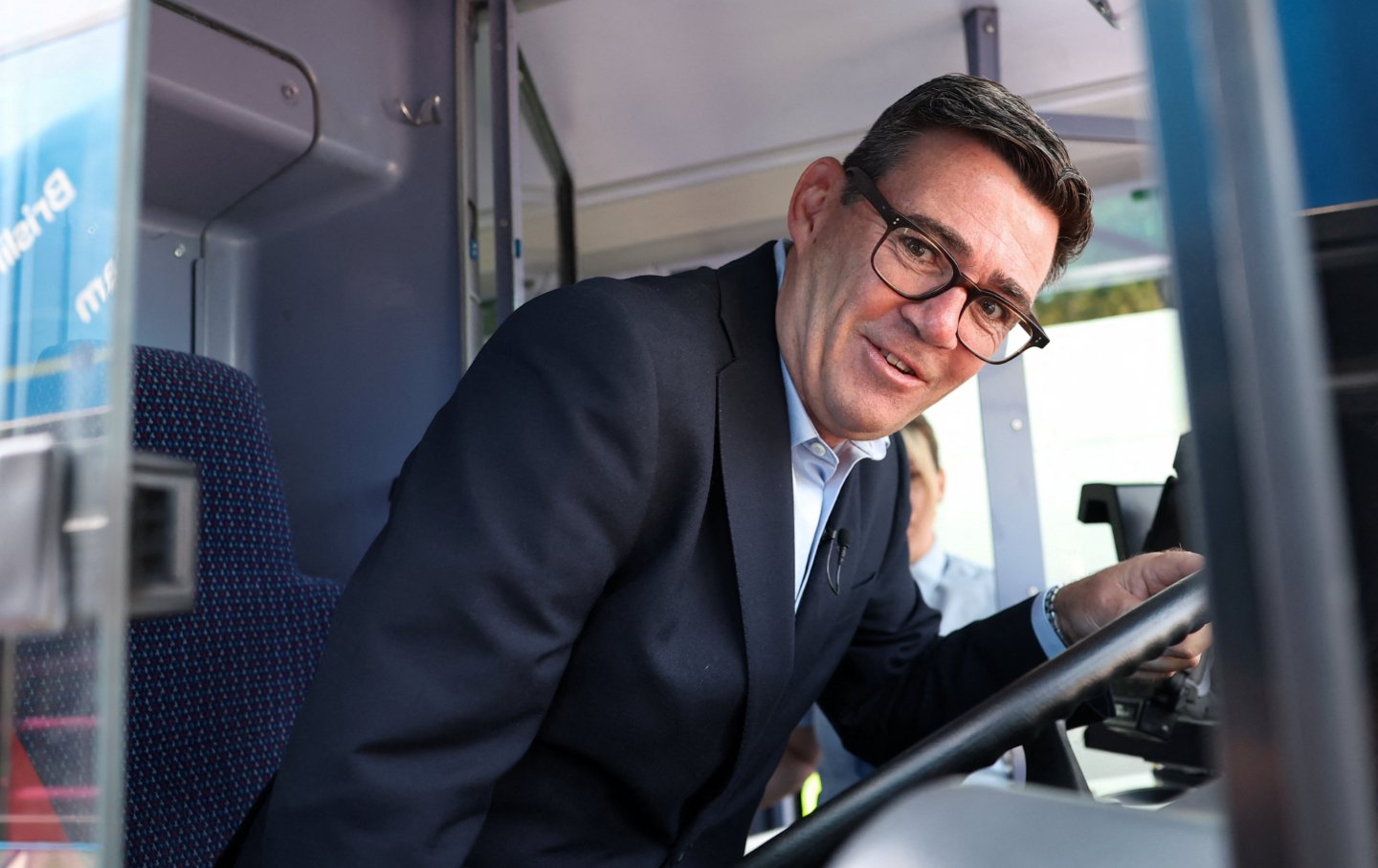
Prime Minister Andy Burnham is shown the driver’s area on a FirstGroup bus at the bus station during a visit to Bath, England, on July 22, 2026.
(Toby Melville / Pool Photo via AP)Britain’s new prime minister, Andy Burnham, began his tenure last week in a country ablaze.
In the Scottish Highlands, hundreds of villagers were evacuated from the path of a raging fire that started in Cairngorms National Park. In the English midlands, the Tintwistle Moor Fire has been burning for over a month. It’s now the size of a small town and is visible from space. Wales, too, is consumed by fire, from north to south. At the end of last week, the Welsh government activated “crisis management arrangements” because there were no helicopters available to provide aerial support in the country’s remote, rugged terrain—they had already been deployed to England and Scotland.
The fires are the most visible sign of a nation on the ropes—a country stuck in a seemingly interminable cycle of political instability (Burnham, who replaced the widely loathed Keir Starmer, is the country’s sixth prime minister in the last seven years, and the seventh in the last 10 years), crumbling living standards, and a lack of direction after decades of immiserating privatization, deindustrialization, centralization, and austerity.
But you wouldn’t know any of this if you only followed Burnham on social media, where he’s yet to acknowledge the UK’s unfolding climate catastrophe. Instead, we’ve been treated to a video of Burnham ranking pub snacks and footage of a new government office in Manchester—dubbed “Number 10 North”—inexplicably set to the theme song of the US version of The Office.
These trivialities are not only at odds with the crises facing Britain. They’re also at odds with Burnham’s supposed reasons for wanting to be prime minister in the first place.
Burnham, who was a long-serving member of Parliament before spending a decade as the mayor of Greater Manchester, says he gets the scale of the UK’s problems—and has proclaimed himself the solution. He has pledged to be “a circuit breaker” for the country, installing “a new political and economic model” to reverse the last 40 years of neoliberalism, devolve power from London to local and regional authorities, and strengthen public control over vital utilities. He’s promised to publish a 10-year plan promoting reindustrialization and social housing later this year.
Yet, so far, Burnham’s action has not matched this ultra-lofty rhetoric. And as his true vision of a hydrocarbon-fueled, “chips and drones” approach to Britain’s future comes into view, there’s less and less reason to believe he’s the right man for the job.
Hours before he became prime minister, Burnham received some unlikely praise.
“The People of Aberdeen, in Scotland, are dancing in the streets because the new Prime Minister, Andy Burnham, has stated that he will be opening up, all the way, the invaluable North Sea Oil!” Donald Trump crowed.
The president was reacting to reports that Burnham would soon announce plans to drill in two oil and gas fields in the North Sea.
The possibility has provoked widespread outrage from environmental groups. Global Witness, an organization that investigates industries fueling the climate crisis, called any plans to intensify fossil fuel production “mind-boggling” at a time when “firefighters battle wildfires across the country and families fear for their kids’ futures after three intense heatwaves.” Critics also point to the fact that the privately operated but publicly subsidized Jackdaw gas field, one of the two sites where drilling could occur, is estimated to create only 27 direct full-time jobs, while Fatih Birol, the executive director of the International Energy Agency, has advised that opening these fields would not improve the UK’s energy security or lower bills for consumers.
In more ways than one, the North Sea question has already rippled through Burnham’s young administration.
In the weeks leading up to his assumption of power, it appeared that Burnham was seriously considering Ed Miliband for chancellor of the exchequer—the second-most-important role in the British government. As energy secretary in Starmer’s government, Miliband (a former Nation intern) opposed oil and gas expansion, supported increased investment in renewables, set net-zero commitments, and called for an era of “clean energy security” in response to the oil shock produced by the US/Israeli war on Iran.
As the party’s left lobbied Burnham to empower Miliband with control of the Treasury, the bond markets signaled a sell-off to discipline the incoming prime minister, and even major trade unions foolishly objected to Miliband’s views on the North Sea and pressured Burnham against the appointment.
Ultimately, Burnham chose John Healey, rather than Miliband, to administer the UK’s public spending. (Miliband was made foreign secretary.) A longtime MP, Healey had recently resigned as Starmer’s defense secretary, saying that Starmer wasn’t prepared to spend enough money on the military.
The decision to install Healey as chancellor quickly revealed the hard limits of Burnhamism. Having already decided to maintain the Starmer government’s needlessly restrictive rules on government borrowing, it’s now clear that Burnham will prioritize warfare over welfare.
On his second day in office, Burnham took control of the Ministry of Defence’s social-media accounts and posted a video addressed to the defense companies at the Farnborough International Airshow, promising that they would be central to the UK’s reindustrialization.
The government then awarded a £708 million contract to BAE Systems, Leonardo UK, MBDA UK, and Rolls-Royce—all companies implicated in the Gaza genocide—for AI and augmented reality-equipped “air combat technology.” Three days later, the ministry of defence announced up to £400 million for a fleet of spy drones from Tekever UK.
The problem, beyond British militarism itself, is that this is a bad economic strategy. As researchers Noah Sylvia and Khem Rogaly have argued, the defense industry is simply not an engine for widespread economic prosperity. Compared to investment in civil infrastructure, public services, or domestic consumption, “defense expenditure is among the least effective forms of government spending for economic growth.” Compared to investment in green energy, healthcare, or education, it provides far fewer jobs.
Popular
“swipe left below to view more authors”Swipe →And yet, new AI minister Kanishka Narayan recently told the Financial Times that to understand Burham’s economic vision, “we should think about chip factories. We should think about drones and defence and we should think about AI being applied to run manufacturing processes better.”
Of course, this all comes at a cost. After a week of small-scale affordability moves, like capping bus fares, announcing a light tax cut on energy bills, and reducing the business-rate taxes for pubs, social clubs, and music venues—announcements to give people “breathing space”—the prime minister announced that he will make it harder for people to claim benefits as he works to reduce the welfare bill. Only some people should breathe, it would seem.
On a host of other issues—from his support for Home Secretary Shabana Mahmood’s relentless campaign against the rights and dignity of migrants, to his wholly inadequate statement on Gaza in which he failed to acknowledge Israeli genocide, and his decision to staff his team and his cabinet with fixtures of the toxic Labour right—Burnham has maintained extensive continuity with the historically unpopular prime minister he deposed, and has shown little desire to forge a new direction.
If it is maintained, the gap between Burnham’s big talk and limited, or even contradictory, execution will define his premiership. If he continues to fail to actually challenge the orthodoxy that sustains neoliberalism and face the urgent crises of this moment, there will be little point to this government—and no Instagram video will save him, or his party, at the next general election.
Become a Sustaining Donor This September
Between the reemergence of right-wing red-baiting and Donald Trump’s use of the chilling National Security Presidential Memorandum–7 to criminalize left political organizing, we’re seeing McCarthyism reborn before our eyes.
This assault on democracy cannot be ignored or wished away. Resisting it requires bravery in the face of threats and repression, a steadfast commitment to the truth, and the unwavering belief that we can—and will—overcome this darkness.
We must have an independent media that sets the record straight, unearths corruption and abuses of power, and advances a politics of justice and dignity for all if we’re to win this fight.
That’s why I’m writing to you today. This September, The Nation needs to add 100 monthly donors to sustain our progressive journalism. Your contribution makes the next investigative report, the next truth-speaking column, and the next pathbreaking essay all possible.
I hope you’ll support our work with a recurring donation today. If you donate $10 or more a month, we’ll send you a brand new “Hands Off the Free Press!” sticker to recognise your commitment to our cause. Please, donate today.
Onward,
Katrina vanden Heuvel
Editor and Publisher, The Nation
More from The Nation

Accountability for the Gaza Genocide Can’t Focus on Netanyahu Alone Accountability for the Gaza Genocide Can’t Focus on Netanyahu Alone
Getting rid of one bad leader won’t bring justice.
How the AfD Benefits Politically From the Ukraine War’s Backlash How the AfD Benefits Politically From the Ukraine War’s Backlash
No election result is monocausal, and there are clearly many factors that have converged to make the AfD Germany’s most popular party.

Cuba: The “Pandora’s Box” of US Humanitarian Assistance Cuba: The “Pandora’s Box” of US Humanitarian Assistance
As the US strangles Cuba economically, Marco Rubio is running a $100 million “hearts and minds” program on the island.

The Palestine of Soraya Antonius and Annemarie Jacir The Palestine of Soraya Antonius and Annemarie Jacir
In The Lord and in Palestine ’36, the story of Mandatory Palestine comes into focus.
Let Them Eat Spreadsheets Let Them Eat Spreadsheets
How the EU is contributing to the rise of Europe’s far right.