Elizabeth Warren’s Plan for a Revived Democratic Party
The Massachusetts senator argues that, in order to prevail in the midterms, the party needs to recover its populist roots—and fighting spirit.
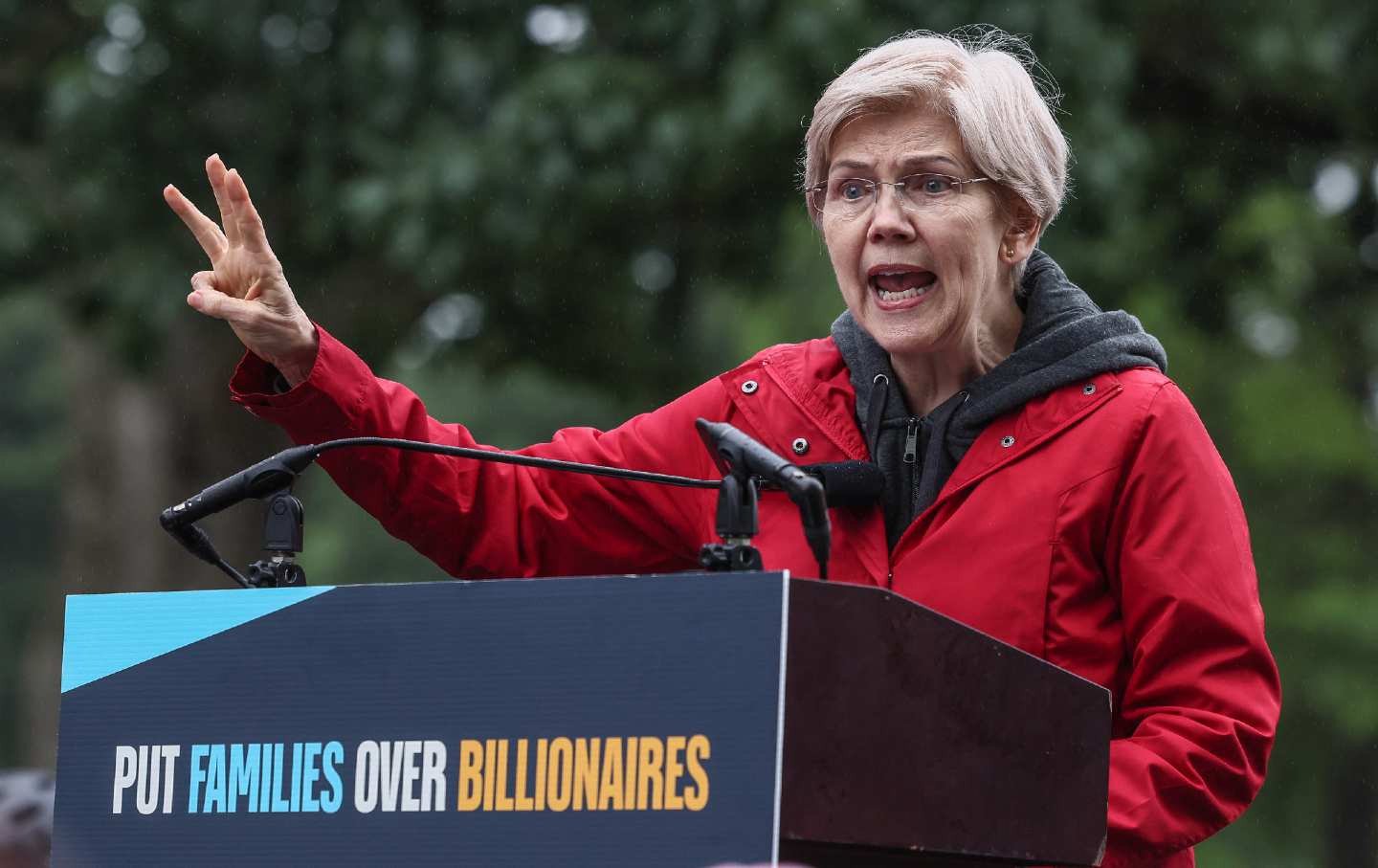
Senator Elizabeth Warren (D-MA) addresses a rally against the Republican spending bill in May.
(Jemal Countess / Getty Images for Families Over Billionaires)This is the full text of a speech Senator Elizabeth Warren delivered to The National Press Club on January 12, 2026.
This is a dangerous moment for America and for the world.
A global contest is escalating between democratic institutions governed by the rule of law and lawless dictators who seek to enrich themselves and their cronies.
Here at home, President Trump’s tariffs are driving up costs for families. Millions of Americans have lost their health insurance so that Republicans could fund tax breaks for rich people. ICE is sowing chaos and terror in our communities, resulting in the tragic killing of Renee Good in Minnesota. And Donald Trump’s view of the First Amendment is that he gets to say whatever he wants, AND he gets to use the power of government to silence, extort, bankrupt, or even prosecute anyone who criticizes him. Acting like the wannabe dictator he is, Trump is trying to push out the chairman of the Federal Reserve Board and complete his corrupt takeover of America’s central bank – so it serves his interests, along with his billionaire friends. And he has invaded Venezuela to boost the profits of oil companies and announced that he will “run the country.”
None of this would be happening if Democrats hadn’t been wiped out in 2024. According to some self-described experts, Democrats lost power because we were too progressive. For a lot of powerful people—wealthy people from Wall Street, Silicon Valley, and Washington—“too progressive” is code used to undermine any economic agenda that favors working people. They put it more politely, but those movers and shakers want the Democratic Party to respond to the 2024 losses by watering down our economic agenda and sucking up to the rich and powerful, claiming that a less progressive Democratic Party will win more elections.
They are wrong. Americans are stretched to the breaking point financially, and they will vote for candidates who name what is wrong and who credibly demonstrate that they will take on a rigged system in order to fix it. Revising our economic agenda to tiptoe around that conclusion might appeal to the wealthy, but it will not help Democrats build a bigger tent, and it definitely will not help Democrats win elections. A Democratic Party that worries more about offending big donors than delivering for working people is a party that is doomed to fail—in 2026, 2028, and beyond.
Let’s start with some basic math. By definition, the top 0.1% of the economic ladder doesn’t have a lot of votes. So when the question is raised whether Democrats should build our tent by sucking up to the rich, it’s sure not about attracting their votes. It’s about attracting their money.
There are, of course, extremely wealthy people who are also deeply public-minded. For some, it’s about living their values. For others, it’s recognition that massive economic instability is ultimately bad for business. Either way, these very wealthy people advocate for better health care and universal childcare. They embrace sensible regulations to stop corporate scammers. They press the government to raise taxes—including on themselves and their businesses. Over and over, they push for an economy that works for everyone.
But there is a different, and frankly much larger, group of extremely wealthy people trying to influence policy. This group might align with the Democrats on some social issues. They certainly are not MAGA Republicans. But they’re also not interested in changing an economic game that is already rigged in their favor. In exchange for their financial support, they insist that the Democratic Party turn its economic agenda in a direction that mostly benefits the wealthy and further undermines the economic stability of tens of millions of families all across this country.
These people push Democrats to embrace candidates who will slow-walk popular economic policies. They lobby for deregulation and special tax breaks that will pad their own bottom lines. They promote making big-time corporate lawyers federal judges. They pressure presidents to appoint tepid leaders at regulatory agencies—people who, once in office, seem positively allergic to enforcing the law when that might make life uncomfortable for big business interests.
In their effort to shape the Democratic agenda, the ultra-wealthy wield outsized power. And we all know why.
● Rich people can fund super PACs to prop up political campaigns for their chosen candidates.
● They can fund their own lobbying efforts.
● They can build or simply buy whole media empires in order to bend the news to their liking.
● And, as we’re seeing right now with AI and crypto, they can try to crush anyone who gets in the way of their business interests.
Over the past generation, the wealthy have avoided accountability time and again. Regular Americans must play by every rule or face real consequences. You don’t need to read every news article about Jeffrey Epstein and his good buddies like Larry Summers and Donald Trump to understand how consistently rich and powerful insiders protect each other, regardless of politics and regardless of how obscene the situation has become. The Epstein scandal is real and enormous, but the slew of white-collar pardons issued in recent months by President Trump reflects the same the-rules-only-apply-to-someone-else mentality that pervades Washington.
So how does this affect winning elections?
After the 2024 election, pundits sliced and diced demographic groups—across race, age, religion, and geography—to show how Democrats need to grow our coalition in order to win again. Yes, we need support from rural voters, men, and voters without a college degree. And yes, in 2025 we won back some of those folks, partly because Democratic candidates from every wing of the party ran against Trump’s betrayal of working people on affordability issues.
But in the long run, to build a strong Democratic party with a sturdy big tent, it is not enough to simply attack Trump. Democrats need to earn trust—long-term, durable trust—across the electorate. Trust that we actually understand what’s broken, and trust that we have the courage to fix it—even when that means taking on the wealthy and well-connected.
Democrats weren’t always just the default option when the other guys were worse. Once, we were trusted by working people to fight for their interests. And we delivered—even against tough Republican opposition. Social Security, strong unions, the 40-hour workweek, overtime, Medicare, Medicaid, homeownership for veterans and first-time homebuyers, the Affordable Care Act. Over and over, we showed that we could fight and we could deliver.
I understand the temptation—in this moment of national crisis—to sand down our edges to avoid offending anyone, especially the rich and powerful who might finance our candidates. But we can’t win unless we rebuild trust. And we can’t rebuild trust by excommunicating Biden administration law enforcers who, for the first time in decades, actually fought to hold corporations accountable for driving up prices. We can’t rebuild trust by calling up Elon Musk when he tussles with Trump and offering him whatever he wants if he’ll come back to our side and kick in a few nickels to our candidates. We can’t rebuild trust by staying silent about abuses of corporate power and tax fairness simply to avoid offending the delicate sensibilities of the already-rich and powerful.
I understand that, because of our broken campaign finance laws, Democrats need to raise a lot of money, and I don’t believe in unilateral disarmament against the Republicans. But money is not the only ingredient for a successful election. When Democrats water down their economic platform to appeal to wealthy donors, whether the transaction is explicit or subtle, we squander trust with working people and the money just isn’t worth it.
Yes, Democrats need a big tent. But there are two visions for what a big tent means. One vision says that we should shape our agenda and temper our rhetoric to flatter any fabulously rich person looking for a political party that will entrench their own economic interests. The other vision says we must acknowledge the economic failures of the current rigged system, aggressively challenge the status quo, and chart a clear path for big, structural change.
If we are going to pick up the broken pieces from the 2024 election and build a durable big tent, we must acknowledge a hard truth: The Democratic Party cannot pursue both visions at the same time. Either we politely nibble around the edges of change, or we throw ourselves into the fight. Either we carefully craft our policies to ensure that the rich keep right on getting richer, or we build a party that ferociously and unapologetically serves the needs of working people. Democrats have a choice to make—and the first step in rebuilding trust is to admit that we have to choose.
Over the past year, I have often been asked about the “abundance” agenda and how it fits into the conversation about our future success as a party.
When this agenda is about making government more effective, count me in. The Consumer Financial Protection Bureau was built in the spirit of “Abundance” before “Abundance” was hip. The agency consolidated scattered authorities and streamlined bureaucratic processes. And best of all, it worked. Every year, the agency rooted out the fraudsters and returned more than a billion dollars to people who had been cheated. The CFPB should be a poster child for government efficiency.
And sure, there are plenty of other places where we can cut red tape. But we should make a clear diagnosis of the problem. Where well-intentioned regulations have simply gone off the rails, we should fix them. But ongoing inefficiencies that we cannot seem to fix often exist because powerful people have captured the regulatory process, and they use those regulations to block improvements that would bite into their own profits.
Look around. For years, I’ve fought for a simple, free government tax filing system so no one has to pay a couple of hundred bucks just to file their taxes. Every step of the way, the giant tax prep companies have thrown up roadblocks to stop it. And when the IRS finally built a free—and wildly popular—filing option for American taxpayers, the tax prep companies swooped in to kill it the minute Donald Trump took office.
Heck, one of my favorite legislative achievements in the Senate is a bipartisan law I got enacted to cut the price of hearing aids by thousands of dollars by overriding a bunch of state-level regulatory hurdles. But even after we got it signed into law, it faced years of delay and nearly died because hearing aid manufacturers mobilized to protect inefficient regulations that kept consumer prices—and corporate profits—high.
And don’t even get me started on the defense industry blocking legislation that would have guaranteed our military the right to repair their own equipment.
So yes, we need more government efficiency—a lot more. But many in the Abundance movement are doing little to call out corporate culpability and billionaire influence in creating and defending those very inefficiencies.
Instead, Abundance has become a rallying cry—not just for a few policy nerds worried about zoning, but for wealthy donors and other corporate-aligned Democrats who are putting big-time muscle behind making Democrats more favorable to big businesses. It looks like the corporate tycoons have found one more way to try to stop the Democratic Party from tackling a rigged system with too much energy.
Consider the case of Reid Hoffman, “one of the biggest donors in the Democratic Party” according to The New York Times. He is the same billionaire who donated $7 million to supporting Kamala Harris and then spent much of the campaign publicly pressuring her to fire Lina Khan as FTC chair. Now remember, the central challenge confronting the Harris campaign was affordability, and chair Khan was doing more in that fight than pretty much anybody else in government. Polling showed that strong majorities supported taking on powerful corporations, and the FTC was leading the charge. Democratic leaders, including labor unions, civil rights groups, progressives like me and Bernie, moderates like Jim Clyburn and John Hickenlooper, all spoke up for Khan. And there was Reid Hoffman—a man with close ties to two of the biggest corporations under fire from the FTC (Microsoft and Facebook) hectoring Harris to promise she would fire the FTC chair. To her credit, the Vice President didn’t promise to fire Lina Khan. But she didn’t promise not to fire her, either.
And it wasn’t just corporate influence at the FTC. In August, Harris proclaimed that she would address high costs facing families by putting in place tough corporate price-gouging laws. Later, according to The New York Times, she “narrowed” those proposals after quote unquote “corporate allies” of the campaign badgered her into doing so. Keep in mind: That story of retreat ran just weeks before Democrats lost an election to Donald Trump who loudly, day after day after day, promised that he would lower costs for families “on Day One.”
We are now in a new election cycle, and according to Axios, Reid Hoffman is sending everyone he knows a copy of Ezra Klein and Derek Thompson’s book on Abundance and backing pro-Abundance candidates. On his podcast, Hoffman has used the framework to argue against regulations that slow down data center construction. That’s right—when families are already getting crushed by rising costs and a data center boom means even higher utility costs, when affordability is front-and-center in voters’ minds, Hoffman wants Democratic candidates to stand with the billionaires for higher costs.
Running on small, vague ideas that may also raise costs for families—instead of on full-throated, economic populist ideas—is a terrible plan for winning elections. That might not be the opinion of all the tech titans with histories of funding organizations that are now tripping over each other to promote Abundance—people like Dustin Moskovitz, Marc Andreessen, and Patrick Collison. But it is the conclusion of every serious person who has looked at data on what voters actually think. A recent poll by Geoff Garin—the pollster for both Kamala Harris and Chuck Schumer—showed how much stronger a populist message performs among voters than an “abundance” one. James Carville and I don’t agree on everything, but I’m with him when he says it’s “clear even to me that the Democratic Party must now run on the most populist economic platform since the Great Depression.” And if you still have doubts, look no further than Mitt Romney—the “corporations are people” candidate. In a recent New York Times op-ed, even he embraced raising taxes on the rich.
If Democrats want to win elections, they need to read the room—or I should say, they need to read literally any room anywhere in America that isn’t filled with big donors.
So what does it mean to focus our agenda on an aggressive economic vision? At its core, the goal is simple and easy to measure.
● It means boosting pay and making life more affordable for working people.
● Building more affordable homes and cracking down on corporate landlords.
● Increasing the size of Social Security checks.
● Providing universal child care.
● Passing price gouging laws with real teeth.
● Guaranteeing the right to repair your own cars, machines, and business equipment.
● Strengthening unions.
● Building universal health care.
● Taxing the wealthy and giant corporations.
● Increasing the minimum wage.
I could go on and on—and in fact I have, with detailed plans and legislative proposals. We are not short on good ideas.
To win, every Democrat should be proposing concrete plans for lowering costs. Zohran Mamdani came from nowhere and took down a political dynasty. How? He ran a campaign tightly focused on the cost of living with an easy to understand platform—free buses, freeze the rent, and deliver no-cost childcare. Mikie Sherrill also focused on cost of living with an easy-to-understand platform, including affordable childcare and a bold promise to freeze utility rates on day one. And she won by 14 points.
Ideas are great, but voters also need to believe that we will fight—and that we have the guts to enact an affordability agenda, even over the objections of other Democrats.
Popular
“swipe left below to view more authors”Swipe →Many voters are rightly skeptical that we’ll really make something happen.
After all, we didn’t even take the extraordinarily obvious and simple step of increasing the minimum wage the last time we had power. Why not? Ask Kyrsten Sinema, the former Democratic senator from Arizona, who curtsied on the Senate floor while rejecting a minimum wage increase in 2021 to raise wages for up to 27 million Americans—and then spent the rest of her time in office protecting hedge fund managers from paying taxes and blocking filibuster reform. Sinema faced no consequences from her president or her leaders in Washington. Eventually, it was her own constituents back home who chased her out of the Senate. But today, she is cashing in from the industries she protected. The Wall Street Journal recently marveled at the “sheer number” of projects Sinema has taken on from crypto, AI, and other wealthy corporate clients. Meanwhile, millions of working Americans who have not seen a minimum wage increase in almost two decades are still waiting for Democrats to deliver on one of our most basic promises.
Democrats win when we show we’re willing to fight. That means that even when we fail, we leave everything on the field. One moment in 2025 when voters actually saw Democrats fighting for them was the government shutdown. We refused to rubber-stamp Trump’s budget unless he rolled back his health care cuts—and we said so loudly and unapologetically every single day. And yeah, a small group of moderate Democrats ended up blinking, so we didn’t get the health care wins we could have. But public polling shows that voters supported us putting up a real fight to actually lower their costs.
We win when we run on the big changes it will take to build an economy for everyone. We win when we call out corruption and bad actors. We win when we stand against the avalanche of corporate money trying to bury our democracy. We win when we stop members of Congress from buying and selling individual stocks and cryptocurrencies while they are writing laws that affect those very assets.
Sure, a tepid, nibble-around-the-edges approach earns praise from Jamie Dimon and other Wall Street and Big Tech CEOs. And, if we’re being honest, that approach has also been a good way to appeal to the Democratic Senatorial Campaign Committee as they decide which primary candidates they will support. But it doesn’t take a political genius to conclude that in a democracy, when the choice is between “make the rich richer” and “help everybody else,” winning elections is about choosing “everybody else.”
I believe in markets and a market economy, and I have spent my entire career trying to make them work better so our economy works for everyone. I celebrate success. I don’t think billionaires are bad people just because they are billionaires. Or that corporations are evil because they pursue profit.
And let me say it again: There is a big difference between a billionaire who spends his fortune to advance the interests of working people and a billionaire who uses his money to entrench a rigged economy. Ideas are not better because they come from a rich person offering to open his wallet and advance his own financial interests—and our leaders should stop acting like they are.
I am deeply worried about the survival of our democracy. Democrats need to win elections across this country, and I will do everything I can to help. Just last week, I donated over $400,000 to 23 state parties that will be fighting for some of the most competitive Senate, House, and governor seats in November. We must, must, must win up-and-down the ballot in these critical midterm elections, and I’ll keep doing my part. And every chance I get, I will also stand up and say that Democrats cannot build a durable, governing majority that actually makes life better for people and rebuilds trust in the Democratic Party by watering down our economic vision.
Democrats must build a big tent based on big ideas that help working people—and now is our time to do exactly that.
More from The Nation
Clarence Thomas Just Struck Another Blow to Black Power Clarence Thomas Just Struck Another Blow to Black Power
In his majority ruling in a sleeper case about mail delivery, Thomas opened the door to a new way for Republicans to suppress the Black vote.
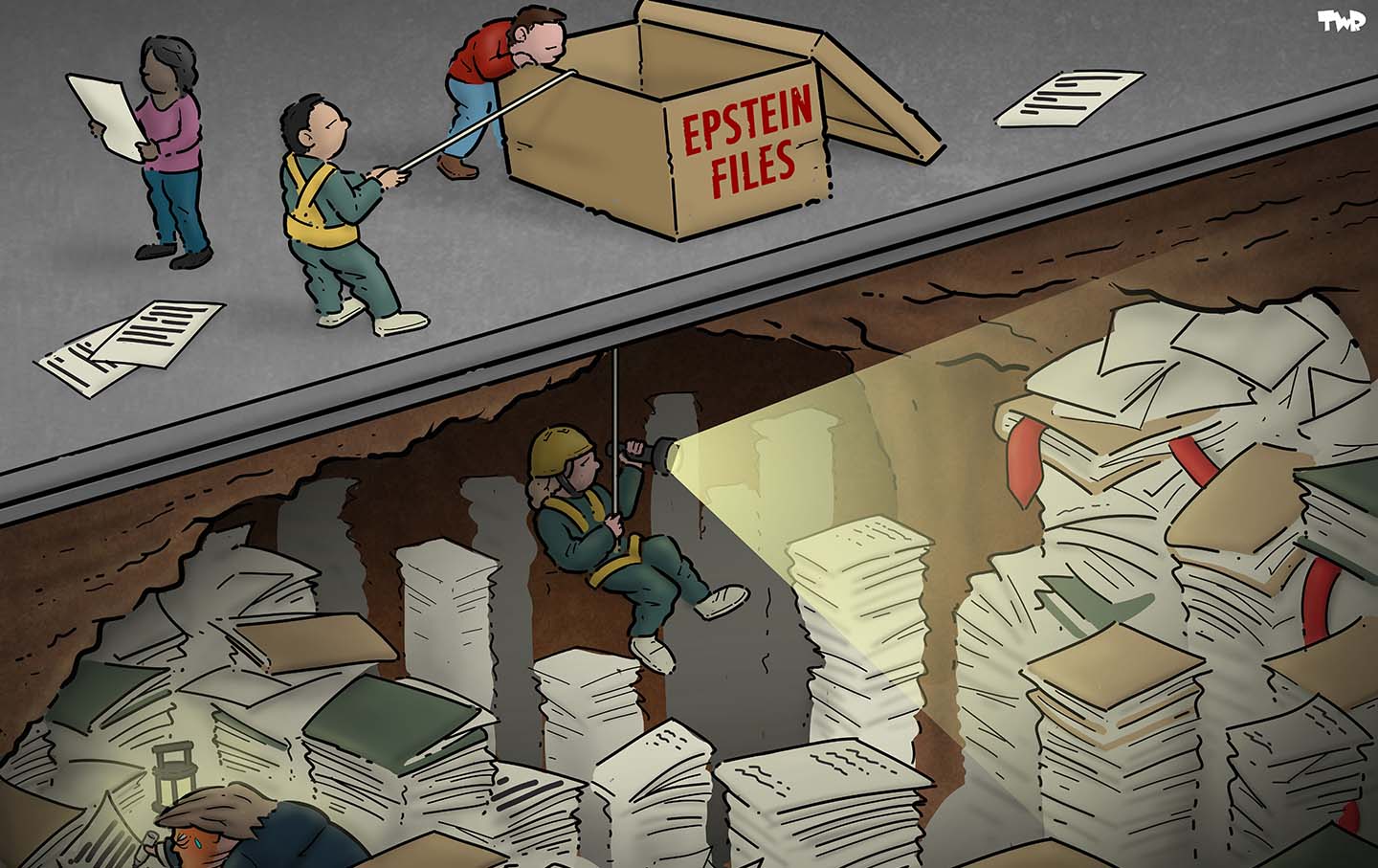
Trump Is in the Epstein Files Over 1 Million Times! Trump Is in the Epstein Files Over 1 Million Times!
They can’t redact deep ties.

How Trump and His Allies Are Working to Depress Turnout, Intimidate Voters, and Steal the 2026 Election How Trump and His Allies Are Working to Depress Turnout, Intimidate Voters, and Steal the 2026 Election
Time to save America from the SAVE America Act.

Democrats Should Launch a “Nuremberg Caucus” to Investigate the Crimes of the Trump Regime Democrats Should Launch a “Nuremberg Caucus” to Investigate the Crimes of the Trump Regime
Administration officials and their collaborators must know that if they break the law they will be punished. There must not be impunity for those attacking our democracy.

Mamdani Meets a Second Snow Crisis With Enhanced Resolve—and a Little Luck Mamdani Meets a Second Snow Crisis With Enhanced Resolve—and a Little Luck
The mayor mobilized New York's resources nimbly and creatively. Now, on to the budget