
Donald Trump’s 21st-Century Colonialism
Trump’s obsession with claiming Greenland and its people for the US is just a new version of the same old imperialist story.
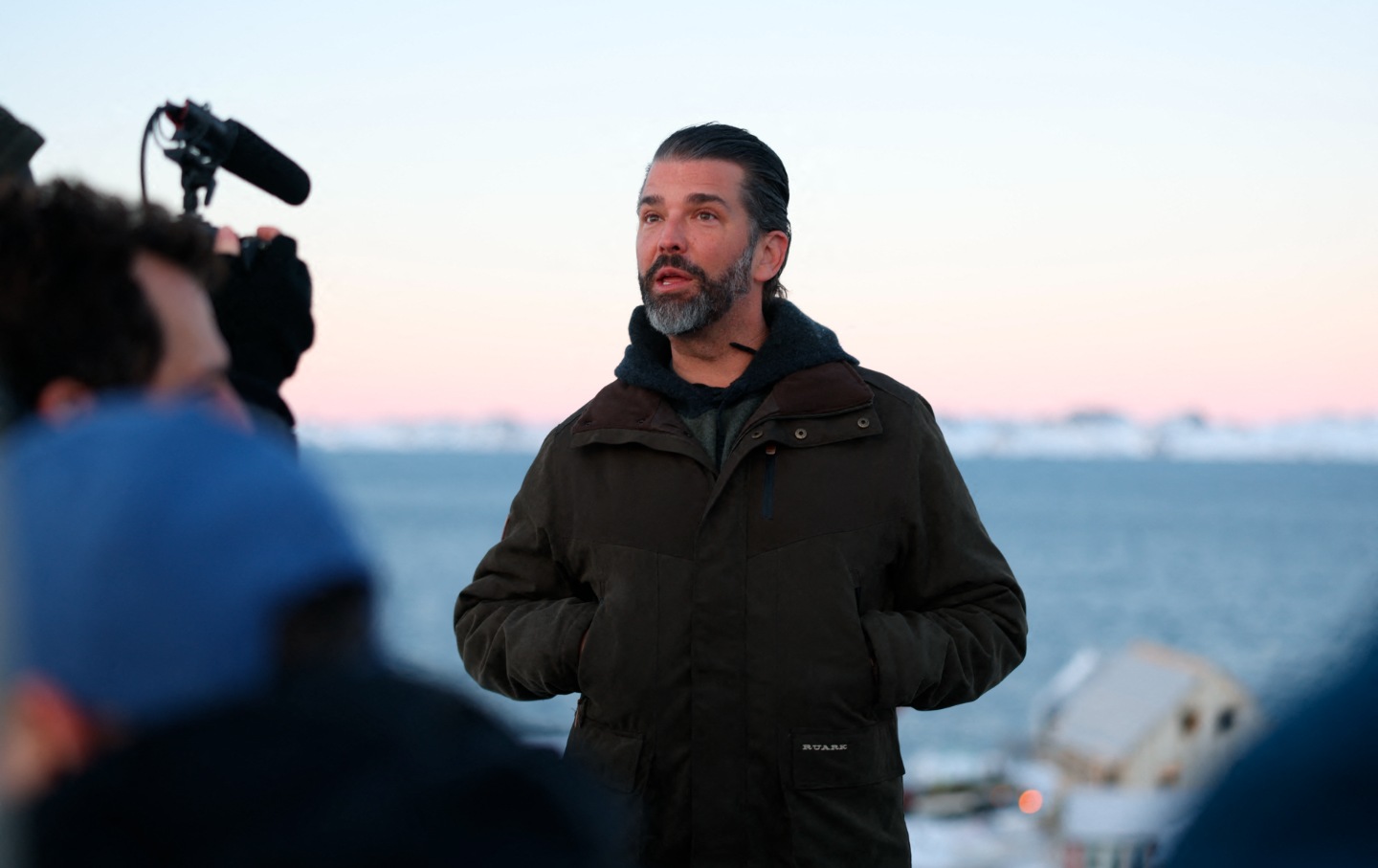
Donald Trump Jr. looks on after arriving in Nuuk, Greenland, on January 7, 2025.
(Emil Stach / Ritzau Scanpix / AFP via Getty Images)Donald Trump dispatched his son Don Jr. on a bizarre real-estate reconnaissance mission Tuesday. The president-elect, who made his name as a developer of “properties” in Manhattan and Atlantic City before business setbacks and controversies steered him toward a steadier career as a reality-TV billionaire, is obsessed with making Greenland a part of the United States—either by purchase or, as Trump suggested in a televised press conference on the same day as his son’s Arctic adventure, by force. So Trump Jr. was dispatched, like some 18th-century prince, to check out the world’s largest non-continental island on behalf of the king.
The trip came amid rising tensions over Trump’s obsession with what CNN refers to as “imperialistic land grabs,” an obsession that in recent months has led him to speculate about adding Greenland, the Panama Canal, and Canada to the United States. Trump’s refusal to rule out the use of force brought quick rebukes from French and German leaders, with French Foreign Minister Jean-Noël Barrot going so far as to say, “There is no question of the European Union letting other nations in the world, whoever they may be, attack its sovereign borders.” Barrot told French media that he didn’t believe the United States would actually seize Greenland, but he warned that “we have entered an era that is seeing the return of the law of the strongest.”
And a new era of imperial tourism, with an eye toward forging empires, appears to have opened.
Trump Jr.’s trip to Greenland was a quick one. The presidential progeny played sightseer for a few hours in Nuuk, the snowy capital city of what remains an autonomous territory of Denmark.
The high point of the visit came when the president-elect called in to talk with his kid. The few locals who were in the vicinity of Trump Jr. when the call came were assured by Trump Sr., with a classic imperial flourish, that “we’re going to treat you well.” Around the same time, the man who on January 20 will become the leader of a global superpower that was founded in revolt against the colonial overreach of King George III, posted a social media recap of the trip and its mission, saying, “Don Jr. and my Reps landing in Greenland. The reception has been great. They, and the Free World, need safety, security, strength, and PEACE! This is a deal that must happen. MAGA. MAKE GREENLAND GREAT AGAIN!”
What was notable about the visit—which extended from a conversation that Trump Sr. has been having with himself since his first term in the White House—is that Trump Jr. and his parka-clad posse did not actually meet with the elected leaders of Greenland’s parliament.
Why? Because those leaders have no interest in being bought and sold by oligarchs or empire builders.
“Greenland is ours. We are not for sale and will never be for sale,” says Múte Egede, the elected prime minister of the island, whose democratic socialist Inuit Ataqatigiit party won the most votes in the last general election. Erik Jensen, the leader of the second-largest party, the social democratic Siumut movement, said. “I can confirm that I have not planned to meet with him.”
Echoing the prime minister, Jensen told Greenland’s Sermitsiaq newspaper: “I say it again that Greenland is not for sale and never will be.”
Both Inuit Ataqatigiit and Siumut favor independence for the island, which is now a self-governing territory of the Kingdom of Denmark. Eighty percent of the votes in Greenland’s 2021 election were cast for pro-independence parties. And Egede now says, “The history and current conditions have shown that our cooperation with the Kingdom of Denmark has not succeeded in creating full equality, It is now time for our country to take the next step.”
The goal, explains the prime minister, is to “remove the shackles of colonialism.”
And nothing says “shackles of colonialism” quite so loudly as the prospect that a self-governing island of 57,000 people might be purchased on the open market or, as was suggested in Tuesday’s press conference, taken under duress. When a reporter asked Trump whether he would rule out using “military or economic coercion” to grab Greenland and pursue another territorial ambition—reclaiming the Panama Canal—the president-elect replied, “No, I can’t assure you on either of those two, but I can say this: We need them for economic security.” Later in the press conference, Trump speculated about imposing high tariffs on Denmark in order to force the longtime US ally to barter off Greenland—no matter what the independence-minded people on the island want.
Why is Trump so determined to make Greenland—a left-leaning Arctic land with its own parliament, a social-welfare state and an Inuit population that refers to the place as Kalaallit Nunaat (Greenlanders’ Land)—a part of the United States?
As in all things imperial, it has nothing to do with the people of the place that Trump has suddenly reimagined as a “parcel” that is up for grabs. It is no secret that Greenland is located in a strategically significant region of the world for the US and neighboring Canada, as well as Russia, China, and a host of other countries. And that significance is growing, according to a Harvard International Review assessment from last year, as “the effects of global warming have thawed Arctic glaciers, thereby increasing the island’s habitable surface area and unlocking new natural resources such as oil and minerals.”
“While Greenland remains closely linked to Scandinavia as an autonomous region of Denmark,” notes the Harvard assessment, “global powers such as the United States, China, and Russia are racing to extend military and economic influence in the region as it becomes more habitable.”
Popular
“swipe left below to view more authors”Swipe →There’s just one catch: For the people of Greenland, the island is already quite habitable. They live there, as did their ancestors before them. They want to continue living there. And they are not enthusiastic about Donald Trump’s imperial ambitions. “I think some people find it quite disrespectful,” Aaja Chemnitz, a Greenlandic member of the Danish parliament, says of the president-elect’s recent rhetoric. “And the way it has been done, and just the fact that you’re saying that you can buy another country.”
Indeed, if election results are any indication, the people of Greenland would very much prefer to go their own way. “Work has already begun on creating the framework for Greenland as an independent state,” says Prime Minister Egede, who has suggested that a referendum on independence could be held this year—as a part of Greenland’s effort to “remove the shackles of colonialism.”
Become a Sustaining Donor This September
Between the reemergence of right-wing red-baiting and Donald Trump’s use of the chilling National Security Presidential Memorandum–7 to criminalize left political organizing, we’re seeing McCarthyism reborn before our eyes.
This assault on democracy cannot be ignored or wished away. Resisting it requires bravery in the face of threats and repression, a steadfast commitment to the truth, and the unwavering belief that we can—and will—overcome this darkness.
We must have an independent media that sets the record straight, unearths corruption and abuses of power, and advances a politics of justice and dignity for all if we’re to win this fight.
That’s why I’m writing to you today. This September, The Nation needs to add 100 monthly donors to sustain our progressive journalism. Your contribution makes the next investigative report, the next truth-speaking column, and the next pathbreaking essay all possible.
I hope you’ll support our work with a recurring donation today. If you donate $10 or more a month, we’ll send you a brand new “Hands Off the Free Press!” sticker to recognise your commitment to our cause. Please, donate today.
Onward,
Katrina vanden Heuvel
Editor and Publisher, The Nation
More from The Nation
A Premature Farewell to the Ignominious Speaker Mike Johnson A Premature Farewell to the Ignominious Speaker Mike Johnson
If Democrats win the House in the midterms, as expected, Mike Johnson won’t hold the gavel in any meaningful way again.

Transphobia Isn’t Winning Votes. But It Is Making Our Lives Much Worse. Transphobia Isn’t Winning Votes. But It Is Making Our Lives Much Worse.
Trans people must now live out another election cycle knowing our friends, family, coworkers, and neighbors are being flooded with agitprop designed to dehumanize us.
Zohran Mamdani Hosts the World Zohran Mamdani Hosts the World
In a meeting with mayors from around the globe, Mamdani argued that the left must fix everyday problems—or the right will find someone to scapegoat for them.
Is There Any Good News Left? Is There Any Good News Left?
Despite what our algorithms suggest, there’s still news worth celebrating.

CEOs Are Losing Control of AI CEOs Are Losing Control of AI
With no slowdown from Trump’s administration.

