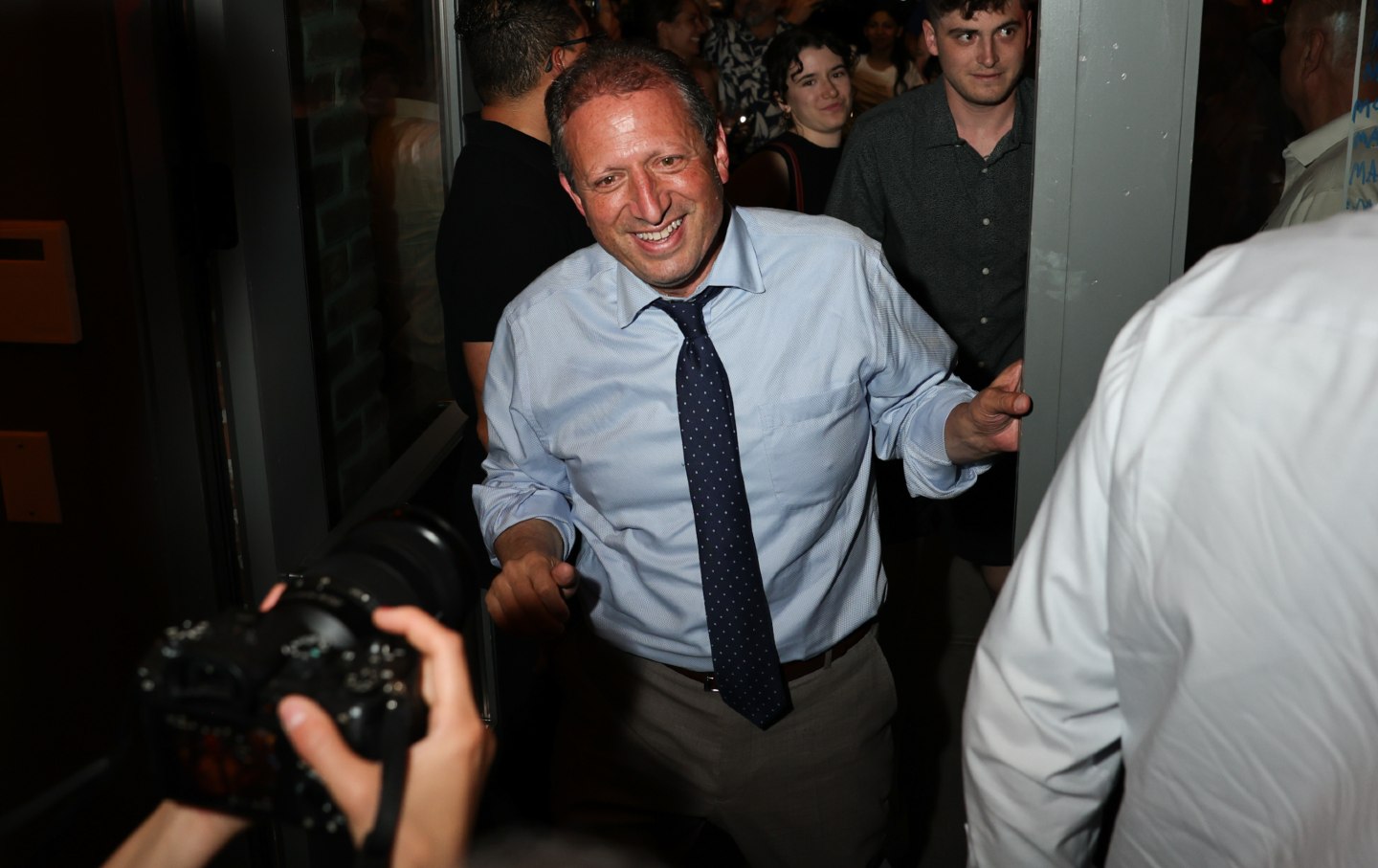
Brad Lander, the outgoing New York City comptroller, is running for Congress against Representative Dan Goldman in New York’s 10th District.
(Christian Monterrosa / Bloomberg via Getty Images)Brad Lander is leaving his post as New York City comptroller and running for Congress in New York’s 10th District, which includes parts of Brooklyn and Lower Manhattan. A longtime progressive, Lander recently mounted a mayoral bid that finished third in the Democratic primary—but under ranked-choice voting, his cross-endorsement and campaigning alongside Zohran Mamdani helped consolidate progressive support and proved pivotal to Mamdani’s victory.
In conversation with Nation president Bhaskar Sunkara, Lander reflects on that race, his years as the city’s chief fiscal watchdog, and the relationship between movement pressure and governing power.
—Bhaskar Sunkara
Bhaskar Sunkara: You spent over a decade in the City Council. When you look back now, what do you see as the through line of your work during that period that most shaped how you view politics?
Brad Lander: You can fight harder, win more, and build a broader coalition when you approach politics as a team sport. When I joined the City Council, we teamed up with the Working Families Party and other allies to create the Progressive Caucus—to bring in the workers, tenants, and community leaders that did not previously have a home in the Council to partner in campaigns for dignity for all New Yorkers. And we did well. We banned stop-and-frisk and strengthened protections for tenants against eviction. We became the first city in the country to guarantee a living wage for Uber drivers and deliveristas, stable schedules for fast food and retail workers, and strong protections for freelancers from wage theft. We desegregated the middle schools of Brooklyn’s District 15 and brought participatory budgeting to New York City.
All of those campaigns were won by “inside/outside” coalitions. They won meaningful material gains, so they built trust and strength for the next fight, and for more genuinely participatory democracy.
BS: Did your time as comptroller change how you think about budgeting and public management and about the practical limits of what progressive governance can do within those constraints?
BL: Serving as comptroller reinforced for me that good progressive governance depends on getting the fundamentals right. The constraints—financial, legal, administrative, personnel—also turn out to be the tools. The nuts and bolts of government, constructed through contracts, public finance, and labor agreements are what actually hold up our schools and subways, public hospitals and housing and services. So you have to really understand how they work, in order to put them together in new ways. Take the pension funds: We grew New York City’s funds to over $300 billion, while divesting fossil fuels and pushing our portfolio companies and asset managers hard on decarbonization, saving 35,000 rent-stabilized apartments through an innovative investment to buy the mortgages on them when Signature Bank failed, and helping tens of thousands of workers win union contracts through neutrality agreements that we insisted on as investors. There are, of course, limits to what you can do, but we so rarely test them.
BS: We last spoke when you were just launching your mayoral run. Tell me about some of the lessons you drew from that race and if there’s something, at either an ideological or practical level, that’s informing how you’re approaching this congressional campaign?
BL: Obviously, the mayoral race didn’t go quite like I planned it! But I feel really proud of the campaign we ran. The cross-endorsement of Zohran not only helped defeat Andrew Cuomo; it also opened up a deep well of solidarity—that politics can be a team sport to win for our values, and also that Muslim and Jewish New Yorkers can organize together. When I was arrested by ICE agents while trying to accompany neighbors seeking asylum, it was as part of a team of organizations bearing witness, in the tradition of nonviolent resistance. So we’ve been back again every week, and the movement to resist ICE and protect neighbors is growing in every corner of the city.
Our democracy is precarious because people feel so precarious. They are constantly treading water, see that the system is rigged, and want bigger change. But our system isn’t delivering it. In moments of crisis, voters want leaders who understand the stakes and are willing to fight like our lives on the line. That’s how I’m approaching this campaign. I’ve spent my life organizing my neighbors to win big fights, from stopping evictions, to building new housing, desegregating our schools, and protecting immigrants from ICE. I recognize this moment, and I’m ready to meet it.
BS: NY-10 spans working-class communities and very wealthy ones—people who experience the city in fundamentally different ways. What rises to the top for you as the district’s most immediate, everyday challenges?
BL: Affordability and housing. It’s just a huge issue for families across the district, whether they’re in Red Hook or in Greenwich Village. These are neighborhoods people truly love, with little leagues and small businesses and schools and religious congregations that people treasure, but they don’t know how their kids will possibly be able to live here. This has been the work of my career. Fighting evictions and building affordable housing at the Fifth Avenue Committee, community planning and organizing for the Gowanus Neighborhood Rezoning, preserving or building over 50,000 affordable homes as comptroller.
I’ll bring this expertise to Congress to help cities build housing people can actually afford, protect tenants, end homelessness, and fix public housing.
BS: What federal interventions would make the most direct difference for renters and working families here?
BL: We need to use every tool in our tool belt—and then construct some new tools as well.
That means combining the abundance agenda with a social housing agenda, as my Local Progress colleagues recently argued in The Nation. For example, federal housing, transportation, and infrastructure subsidies should also come along with requirements that municipalities eliminate restrictive and exclusion zoning, and with incentives to experiment with new housing models, so more housing gets built overall, and more inclusively—this is the idea of Senator Warren’s American Housing and Economic Mobility Act. Congress should repeal the Faircloth Amendment and work with cities and states to set up “public developers” to spark a new generation of experimentation. And the federal government should strengthen tenant protections—as we did creatively with the first-ever Responsible Property Management Standards adopted by a pension fund—because tenants shouldn’t be kicked out of their homes just because rents are rising in their community and because we won’t sustain support for growth if people believe they will be.
BS: Dan Goldman votes with the Democratic caucus almost all of the time. What would you put forward that he hasn’t?
BL: NY-10 voters want a representative who shares their urgency, and their values. They want a representative who will fight like our lives and our country are on the line, because they are. They don’t want a representative who is vacationing in the Bahamas in the same resort as Donald Trump Jr. during the government shutdown. They don’t want a representative trading stock to the tune of $10 million in industries he’s meant to oversee in Congress. They don’t want a representative who voted to censure Rashida Tlaib, but who views Randy Fine as a partner. They don’t want a representative who keeps voting to send 2,000-pound bombs to Netanyahu to continue the genocide in Gaza.
This district needs someone who actually represents them. I am a progressive Democrat, yes, and also a veteran lawmaker. I will organize with this community to protect our neighbors from ICE and fight fascism, and fight for an economy that isn’t rigged against working people. I will also use the experience I have from 12 years on the New York City Council and four years as City Comptroller to build coalitions across ideological differences. I know how to get work done and I will be laser focused on delivering for this district.
This district is full of people hungry to organize with their congressmember to protect neighbors from ICE and fight fascism, but also to fight for an economy that isn’t rigged against working people. I’ll offer bolder leadership, that’s out on the front lines organizing. As I did in the City Council, I’ll lead on workers’ rights and economic justice issues, including protecting freelancers and gig-workers who lack even basic protections or dignity.
BS: What do you see as Congress’s role in pushing for peace and a Palestinian state?
BL: For too long, US foreign policy leadership, including among Democrats, has failed to recognize and advance this clear truth: Israelis will only be safe and free when Palestinians are free and safe. Congress has an important oversight responsibility to ensure peace in the region and ensure that Palestinians and Israelis are each guaranteed security and sovereignty. That means Congress should stop supplying Israel with offensive weaponry contributing to the destruction of Gaza—which I recognize as a genocide, following most international human rights organizations, and after reading the works of Rafael Lemkin, a Polish Jew and Holocaust survivor who developed the term—and insist that Israel follow international law. We should recognize a Palestinian state, while insisting that it too follow international law and reject terrorism. For any of that, we must curb AIPAC’s outsized influence in our politics.
More broadly, I’ll fight for a new Democratic foreign policy vision that defends human rights and international norms, emphasizes global peacemaking over militarism, and defeats authoritarianism through multilateral alliances to combat inequality and poverty. New Yorkers’ hard-earned tax dollars should not be going to fund forever wars and human rights violations—whether by foreign leaders or American ones. I will push to rebuild USAID for a new era, to protect civilians from Ukraine to Sudan to Venezuela, and to roll back the imperial presidency, whichever party is in power, and restore Congress’s constitutional role to set foreign policy.
BS: What does meaningful resistance to Trump look like?
BL: We need a Democratic Party that is not afraid to fight Trump but also is actually committed to creating an economy that does not solely benefit corporate interests. A Democratic Party that is capable of projecting a vision for an economy where working people can thrive, where housing, health care, and childcare aren’t out of reach, and then actually delivering that for people A Democratic Party that can win in a wider range of places, which means trying a wider range of things. We need a Democratic Party that isn’t afraid of innovating, or of holding ourselves and our leadership accountable. We have to seize this moment. Trump is facing record low popularity and Americans are growing impatient with him on affordability. They believe he is going too far on immigration. We already have openings of resistance, and it requires Democrats moving with urgency to escalate the fight, propose new ideas, and be ready to deliver on them.
BS: Even with Biden-era policy wins, Democrats still struggle with working-class voters. What do you think the party is getting wrong—and how would you argue for a different direction?
BL: When heirs to corporate empires hold office, people rightly feel that the party is out of touch. Working class people have watched wealth continue to flow upward, watched corruption run rampant, watch prices grow faster than wages. Democrats need to call this out plainly and propose real, concrete solutions.
I’ve spent decades delivering real economic wins. We won Universal Pre-K and 3K, paid sick leave, living wages and stable schedules for deliveristas, wage theft protections. When people see Democrats deliver on bread-and-butter issues—childcare, healthcare, housing, and better jobs—it rebuilds faith that the party is listening to them.
It also matters who the messengers are. We need a Democratic Party full of younger, working-class people who look like and represent their districts. I have worked hard to recruit and support young, diverse, working-class candidates, not only in New York City through WFP and the Progressive Caucus, like my City Council successor Shahana Hanif, but also through the national organization Local Progress that I helped to build along with Ady Barkan.
BS: What’s your biggest regret from your council years?
BL: While we made some progress in my City Council district by desegregating our middle schools and through the Gowanus Neighborhood Rezoning, where we conducted the first Racial Impact Study for a rezoning, but we fell short on broader policies to combat segregation. Two things I fought for but didn’t win: a bill banning co-op discrimination and a comprehensive planning framework that would further fair housing goals.
BS: And what’s biggest regret as comptroller?
BL: My last big swing is to get our pension funds to drop BlackRock, our biggest asset manager, because they are misaligned with our decarbonization plan. We’ve already divested fossil fuels and taken on big banks and utilities, but BlackRock has retreated in the face of Trump. So far, I haven’t been able to get a majority of the pension fund trustees to vote with me here.
BS: What are you most proud of from your time on the City Council?
BL: Desegregating the middle-schools of Community School District 15 in Brooklyn, the Gowanus Rezoning, and first-in-the-nation living wage and labor protection laws for deliveristas, Uber drivers, fast-food workers, and freelancers.
BS: And how about as comptroller?
BL: The investment that helped save 35,000 rent-stabilized apartments after the Signature Bank collapse. We stepped in to prevent those homes from being snapped up by speculators and preserved them as affordable housing. Every unit is preserved as rent stabilized and delivering strong returns for New York City’s retirees, too.
BS: We’re in a moment of revived big ideas—from Trump’s national populism to Zohran’s democratic socialism. What’s your own larger vision for a just United States? What is “Landerism?”
BL: Like I said in my campaign launch ad, it’s corny, but it’s a vision where democracy is understood as neighbors working together to make our lives in common better. Where Mr. Rogers takes on ICE, AIPAC, and corporate power to build a neighborhood that everyone can afford and where everyone is welcome. Practically, that means making a sharp critique of inequality, building a broad coalition around basic ideas of empathy, and getting into the weeds to make sure government actually delivers the goods.