
The Pentagon’s “Bad-Faith, BS” Review of Women in Combat Roles
Pete Hegseth came to office with benighted views of women in combat. Within a year, he ordered a study on whether having women in combat roles has led to compromised standards.
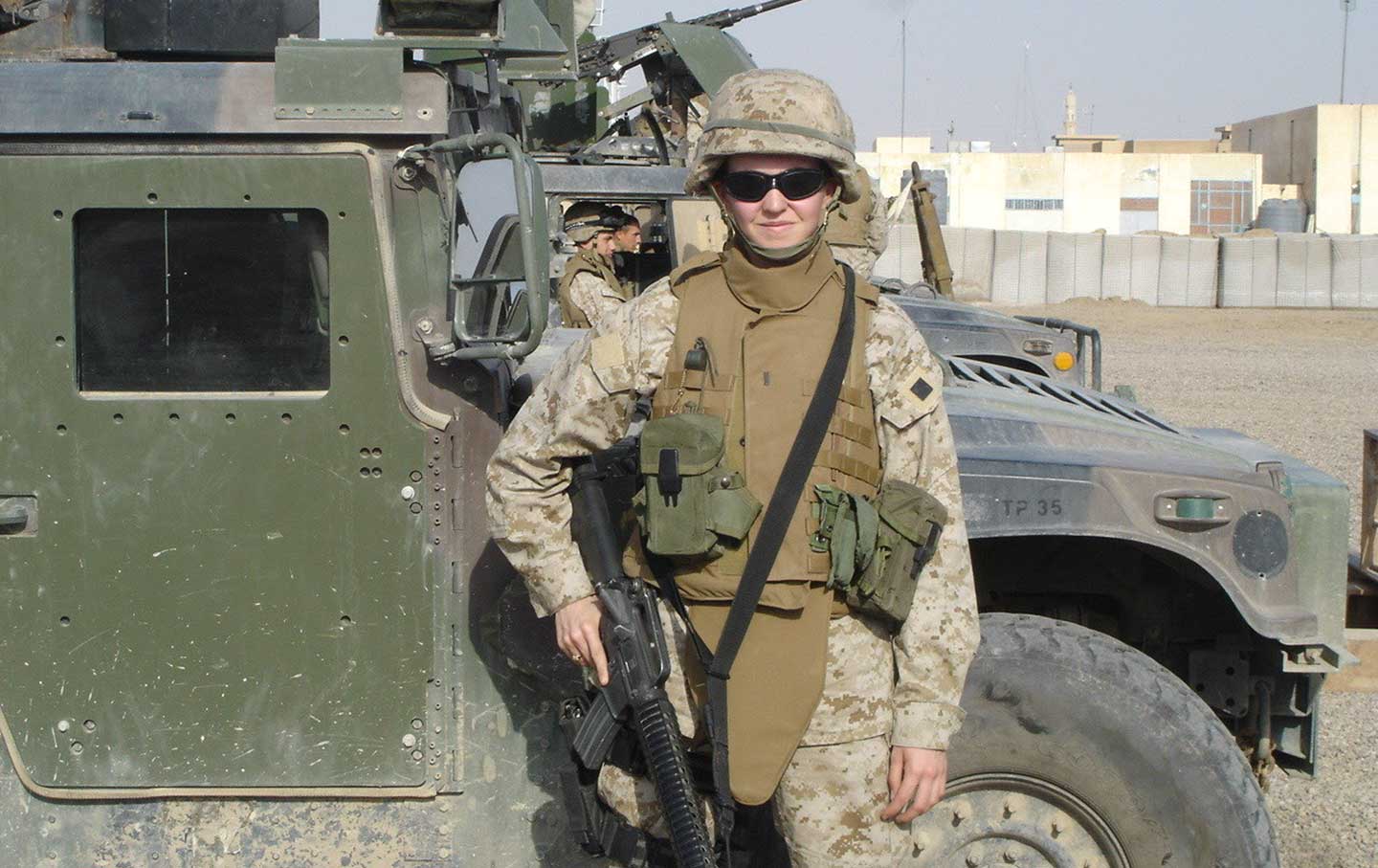
They are remembered as “the lionesses.”
In June 2005, three female Marines died in combat in Fallujah, Iraq, even though women couldn’t yet serve in combat roles. So did three men in their convoy, when a grisly suicide bombing by Iraqi militants sent 13 other Marines, 11 of them women, to hospitals and left some with lifelong injuries. The tragedy underscored a poorly hidden truth: Women were already serving on the dangerous front lines of US wars, and the military’s policy of segregating them from men, and denying them weapons and sometimes equal armor, put men and women alike at risk.
Eight years after that tragedy, Defense Secretary Leon Panetta ordered that combat jobs be open to women, but it would take two more years for Army, Navy, Air Force, and Marine leaders to review the policy and develop training and evaluation protocols to integrate their combat ranks. In 2015, Defense Secretary Ash Carter announced that all combat jobs would be open to women, “as long as they qualify and meet the standards.” Carter acknowledged that the Marine Corps continued to ask to bar women from certain military roles, including infantry, but refused to grant an exception. “We are a joint force, and I’ve decided to make a decision that applies to the entire force,” Carter said.
Less than a decade later, a defense secretary who may be less qualified than many women in combat would begin to try to dismantle that policy. Pete Hegseth came to office with benighted views of women in combat. “I’m straight up just saying we should not have women in combat roles,” he said on a manosphere podcast in November 2024. “It hasn’t made us more effective. Hasn’t made us more lethal. Has made fighting more complicated.” In his book The War on Warriors: Behind the Betrayal of the Men Who Keep Us Free, he said women performed some military roles admirably, but insisted that “women in the infantry—women in combat on purpose—is another story,” adding that “women cannot physically meet the same standards as men.” (Even though it is Defense Department policy that they have to, in order to qualify for combat roles.)
Hegseth tempered some of those views when testifying to the Senate Armed Services Committee during his confirmation hearing last year. “I have never disparaged women serving in the military,” he insisted. “ I respect every single female service member that has put on the uniform, past and present. My critiques, recently and in the past, and from personal experience, have been instances where I’ve seen standards lowered.” Senators reminded him that standards for women have not been lowered, but he persisted: “Commanders meet quotas to have a certain number of female infantry officers or infantry enlisted.” There are no “quotas” for the number of women serving in combat either.
Related Article
“This is a total bad-faith, bullshit argument he’s making,” says New York Representative Pat Ryan, who served two tours in Iraq. “They’re drumming up a ‘study’ to push brave patriotic women, who have risked their lives for this country already, out of the jobs that they’re already very effectively serving in and making our country safer and stronger.”
Less than a year after trying to backpedal on his views, Hegseth began a formal inquisition into whether standards have been compromised to place women in combat. Defense Undersecretary Anthony Tata said the goal is “to determine the operational effectiveness of ground combat units 10 years after the Department lifted all remaining restrictions on women serving in combat roles.” (Tata left the Army in 2009 after an investigation revealed two extramarital affairs, and Trump pulled a first-term nomination when other problems surfaced.) “Putting [Tata] in charge of this told anybody that knows him that this was never a serious data-driven exercise,” Ryan says. “It’s a ‘trying to force people out’ exercise.”
More than one Hegseth critic pointed to that 2005 Fallujah attack as offering a commonsense lesson into how and why the decimation of that unit might have been avoided if the women already placed into combat situations were recognized and protected for those roles.
Speaking of military practice before combat roles were integrated, Janessa Goldbeck, the CEO of Vets Voice foundation and a Marine Combat Engineer Officer officer while the gender integration policy was being implemented, said, “Women were serving on the front lines. They were killed and injured there.” The three women killed and 11 wounded in the 2005 attack are among those who became known as “the lionesses” of Fallujah, Goldbeck told me. (“Lionesses” came to refer to women in noncombat roles in several military branches in those years.)
Those female Marines were crucial to the military policy of searching all Iraqis who entered the so-called Green Zone, to work or shop or meet with US officials. The entire Iraq operation was already unpopular, especially in Fallujah, and the spectre of male military members searching religiously garbed Iraqi women at the checkpoints was unthinkable. So every day, escorted by a convoy, female Marines traveled from their quarters in Camp Fallujah, the extended city secured by the military, several miles to a Marine base where their male counterparts were stationed, near the checkpoints. Because they weren’t considered combatants, they didn’t live on base.
The truck carrying the women was always inadequately armored, with makeshift metal shielding that only rose to their shoulders, leaving their heads and necks dangerously exposed. They had neither weapons of their own, nor a sufficient number of male escorts on their truck or in Humvees to protect them. They traveled the same predictable route at the same times, morning and evening–allowing rebels to use an IED to suicide-bomb the women’s vehicle. “If screening Iraqis did not constitute a combat job, the daily commute between camp and city would amount to one,” a New York Times investigation of the incident concluded.
That’s what Hegseth wants to restore to the military: more danger for male and female service members alike, say the many critics of his policy. “He’s trying to turn the military into a white male Christian nationalist force,” Goldbeck says. “We will be less safe. It’s embarrassing and saddening.”
Former Marine captain Maura Sullivan served as senior adviser to the Secretary of the Navy in 2015 and 2016, and worked on implementing the policy of opening combat roles to women. (She is running for Congress from New Hampshire, as a so-called “Hell Cat,” four female Democratic veterans trying to flip purple seats or hold blue ones in the midterms.) Sullivan served in Iraq in 2005, and clearly recalled the deadly Fallujah attack. “If [the female Marines] could have bunked on the base with the men, there wouldn’t have had to be that twice-daily convoy to get them [to the checkpoints and back],” Sullivan said.
Conservative former Representative Duncan Hunter, chair of the House Armed Services Committee at the time, “threatened to introduce legislation that would have removed women from forward support units in Iraq and Afghanistan, which is exactly what our jobs were,” Sullivan recalled. “We were in a combat logistics battalion in direct support of an infantry regiment. When our commander heard [Hunter’s take], he just kind of scoffed and he goes, ‘I might be mission incapable if they did that.’” So many women were already serving key roles running convoys and security patrols, “where you are exposed to the dangers of small arms fire and roadside bombs, very much in combat,” Sullivan recalled. Hunter’s move failed, and within years military leaders were beginning to explore the possibility of training and equipping women to serve in combat roles.
As female members of the military and their advocates in the Pentagon and Congress ramped up pressure, military leaders articulated two main points of opposition. “What needed to happen was to show [military leaders] that this policy was not going to lower standards, and that there were no quotas involved. That was key,” Sullivan recalled. “All people had to meet the same physical standards. And these standards were incredibly high.”
In fact, Janessa Goldbeck shares that she tried out for a Marine infantry position but didn’t make it. “And there were men who didn’t make it either,” she adds. While the Marines were the most recalcitrant to integrating women, trying to get a waiver from Carter’s integration order, “my male peers were very encouraging,” Goldbeck recalls. “The lack of enthusiasm came from higher-ups and some instructors.” Attrition rates for Marine combat training and certification skyrocketed in those transitional years, Goldbeck notes. “Yes, a reasonable person might assume they increased the standards to make it harder for women,” she adds wryly, “but it affected men, too.”
“I remember standing with the secretary of the Navy in Quantico, Virginia, and saying to an infantry officer,” Sullivan tells me, “‘Look, if two women make it a year, if zero women make it a year—that’s OK. That’s fine. A standard is a standard.’” That happened in certain early training courses, and still happens in the most elite forces. Women serving in demanding Special Operations roles are still scarce. As of the end of 2024, there are no women Navy SEALs and single-digit Army Rangers and Green Berets (accounts vary). Strict standards may not be the only reason why. Women have complained of sexism in Special Ops training, noting that many are equipped with inappropriate, ill-fitting uniforms and face sexual harassment and a lack of equal bathroom facilities.
The initial pushback to integrating men and women in combat roles has historical precedent: It echoes the reaction when President Harry Truman integrated the military by race in 1948. Black soldiers had been kept from leadership and most formal combat roles, even in World War II, but many had wound up in direct combat, just as women would later, and served heroically. “Whenever there’s been significant changes to our fighting force, when Truman integrated the armed forces, when ‘Don’t Ask, Don’t Tell’ was repealed, the initial argument from skeptics was that this would make our military less safe and degrade small-unit cohesion,” Sullivan recalls.
“And change can be hard,” she agrees. “But all these changes were good and positive, and they ultimately gave access to a greater number of people in the talent pool for the Department of Defense and made our military more lethal and effective and made our nation safer.”
Popular
“swipe left below to view more authors”Swipe →Former congressman and Army captain Max Rose agrees. Though he served before women were formally serving in combat roles, he says, “I saw women heroically serving on the front lines every day. Members of ‘female engagement teams’ would do whatever they needed to do, they’d take the gunner position on an armored vehicle if [the male gunner] was wounded. They’re now serving in combat with excellence and heroism. This is just Hegseth’s false nostalgia.”
I asked critics of the Hegseth review, the results of which are due in the summer, whether they expect pushback if his findings try to limit the role of women in combat. “I certainly expect pushback from members of Congress,” Sullivan tells me, where a growing caucus of Democrats, men and women alike, are military veterans. Indeed, House Armed Services committee member Pat Ryan, who served two Army tours in Iraq, expects the same. But he notes that House Democrats have been pushing back against comparable nonsense in Defense Department budget battles, where current UN Ambassador and former Texas Representative Mike Waltz used to try to push amendments related to women in combat roles.
“Yes, we’ll have pushback from Congress,” he says, pointing to female combat veterans like Senators Elissa Slotkin and Tammy Duckworth, and Representative Chrissy Houlahan. “What makes me optimistic is this year we’re seeing another wave of women combat veterans running for Congress,” he adds, not just the four Hell Cats but several more. In a Democratic wave election, the House will have even more muscle to block Hegseth’s agenda.
“Hegseth owes the country an explanation of what will be different from the rigorous and very expensive reviews of a decade ago,” Goldbeck adds. “This is a solution in search of a problem that doesn’t exist.”
Another so-called Hell Cat congressional candidate, Arizona’s JoAnna Mendoza, trained and served as a Marine drill instructor, a role some men didn’t qualify for, before her retirement in 2016. “And those were all my ‘kids.’ I worry about their safety.” Mendoza reminds me that the military is “an all-volunteer force,” and recruitment is already tough. How can the country give up on half its potential recruits? “One of my biggest concerns under this administration is that we are going to put our sons and daughters in harm’s way unnecessarily.” If Hegseth succeeds in sending the military back in time and preventing qualified candidates from holding some of the military’s most demanding positions, that’s exactly what’s likely to happen.
More from The Nation

What Are Democrats Prepared to Do if Trump Rigs the Election? What Are Democrats Prepared to Do if Trump Rigs the Election?
In this week’s Elie v. U.S, our justice correspondent challenges Democrats' lack of a plan if Trump steals the midterms. Plus: the most racist, and honest, AI add ever.
Ramaswamy’s Guide to a Better Vocabulary Ramaswamy’s Guide to a Better Vocabulary
Quotes of the Week.
Why Trump Is Embracing Vivek Ramaswamy’s Vile Ad Why Trump Is Embracing Vivek Ramaswamy’s Vile Ad
The president is leaning into the politics of toxic parenting.
The Shadow Knows The Shadow Knows
High-tech weapons, low-tech intelligence.
Tom Hayden’s Legacy and the New American Left Tom Hayden’s Legacy and the New American Left
It’s been 10 years since he passed away.
The Decades-Long Battle Within the Democratic Party Establishment Between the Heirs of Dean Acheson and Franklin Roosevelt The Decades-Long Battle Within the Democratic Party Establishment Between the Heirs of Dean Acheson and Franklin Roosevelt
The calamitous history of America’s wars of choice.

