
Melania at the Multiplex
Packaging a $75 million bribe from Jeff Bezos as a vapid, content-challenged biopic.
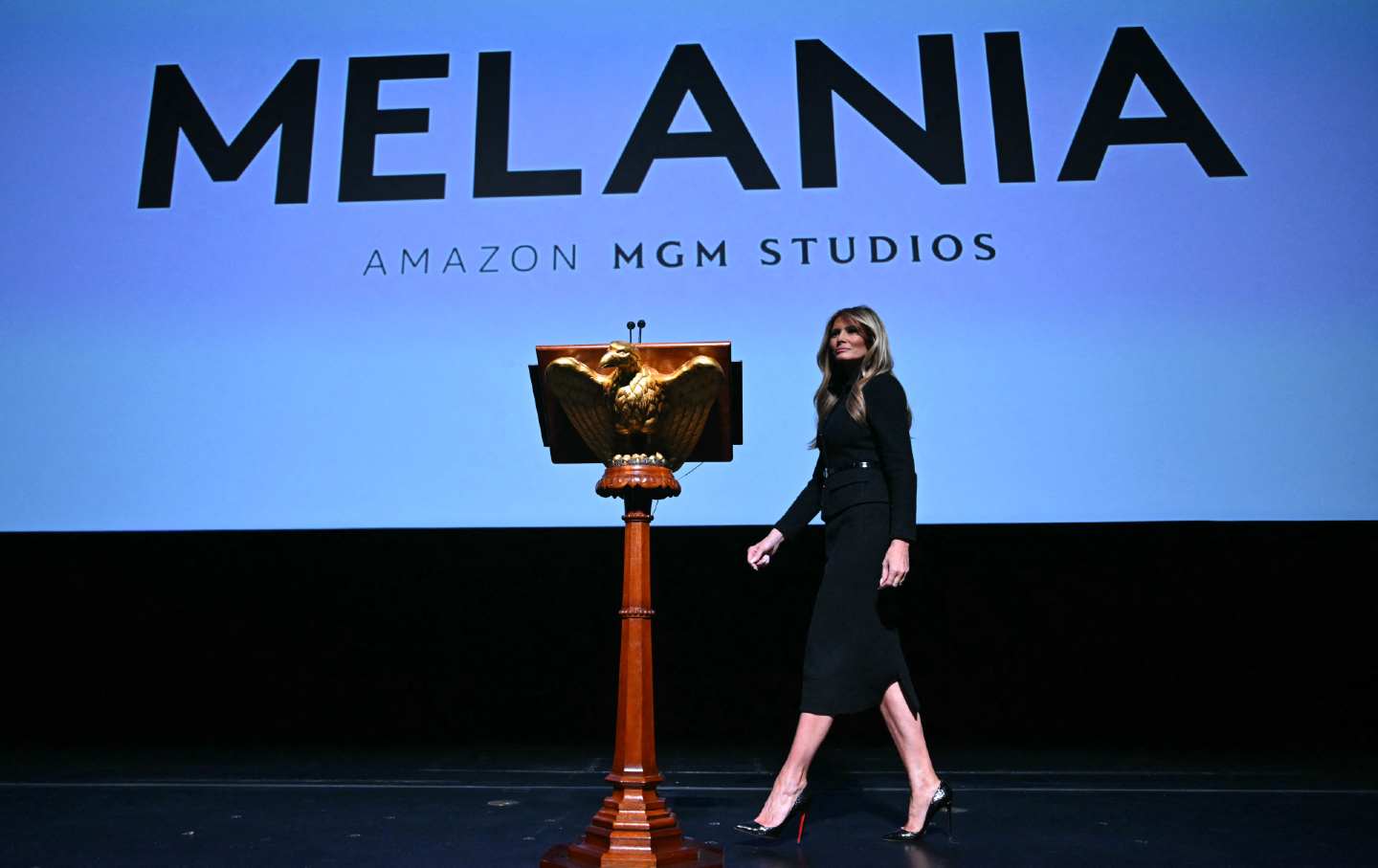
First lady Melania Trump at the Kennedy Center premier of Melania.
(Brendan Smialowski / AFP via Getty Images)When disgraced sex pest Brett Ratner volunteered to be Melania Trump’s cinematic hagiographer, it was clear that the resulting product would be slick, vapid, and disinclined to force viewers to activate more than one brain cell at a time. It was also fitting and predictable that when presented with a choice of documentarians, the Trumps opted for the guy responsible for Rush Hour 3: Get me a Leni Riefenstahl, but without the talent!
Given all that, my expectations for Ratner’s documentary about the first lady in the run-up to the second Trump inauguration were fairly low to begin with. But after having suffered through it for an hour and 44 excruciating minutes in a largely empty theater—15 moviegoers total, at least four of which were journalists—it seems that they were not low enough. On a scale from “fantastic” to “not worth the money,” I’d rank it as “I should be able to sue for personal injury and emotional distress.”
Amazon paid $40 million for the movie, with an additional $35 million marketing budget, and $28 million of that went directly to Melania Trump. In the inauguration scenes, the camera pans to various tech billionaires—Elon Musk, Tim Cook, Mark Zuckerberg, and, most importantly, Jeff Bezos. It is a little surreal to watch an oligarch bribe a president in such a public fashion, and then try to present it to the American public as entertainment—or worse, an important historical document. As the latter, it’s more accurately described as propaganda, and I’ve had root canals that were more entertaining.
It is also not a documentary by industry standards. The subject is also a producer, and she speaks a highly scripted voiceover in a stilted cadence that makes your car’s GPS sound warm and inviting. This is not just my opinion. Melania herself says it’s not a documentary but “a creative experience that offers perspectives, insights, and moments.” This is downwardly defining “creative, ” “perspective,” “insight,” and possibly even “moments.”
The film opens to Melania leaving Mar-a-Lago professionally dressed and made up, striding atop towering stilettos. She steps into a motorcade of black town cars and SUVs, which is then filmed from above via drone, capturing the expanse of the property in a way that will probably be slotted into a real estate ad if Trump decides to sell it. The Rolling Stones’ “Gimme Shelter” is playing, which seems appropriate since that song, whose chorus announces, “Rape, murder / It’s just a shot away,” has been a soundtrack tentpole in many a film about mobsters and corruption. The motorcade proceeds to an awaiting private plane, which proceeds to New York City, then to another motorcade and then to Trump Tower. This takes, by my calculation, forever.
There are many, many shots like this throughout the film, and the multiple motorcade-to-private plane transitions would seem to imply that the first lady spends much of her life in a giant SUV.
The time she does not spend in this fashion is seemingly devoted to trying on clothes and giving her retinue of designers minute instructions to reduce a collar by a millimeter or make a garment tighter around the hips. Her lead designer, Hervé, insists that this is indicative of her fashion expertise, acquired via modeling. This is sort of like saying that if you drive a car you have automotive expertise, but it’s the job of the courtier to flatter the queen.
As it happens, the first outfit Melania is being fitted for is the one she will wear to inauguration festivities: a navy overcoat matched with a wide-brimmed hat with a flat top that I now think of as the Hat of Infamy. The Internet’s consensus about this look and the hat in particular was, “It’s giving Hamburglar.” Comparisons to Zorro were made. Others speculated about whether the brim was designed to prevent Donald Trump from getting too close.
Trump himself makes limited appearances in the film, probably because that would require the first couple to spend time together, which they don’t seem to do much these days. When they turn out for inauguration events, they exchange awkward kisses on the cheek, and she physically reacts the way children do when approached by their least favorite aunt for a big hug. She stiffens and tries to make as little skin contact as possible.
In theory, a documentary about a first lady would be of interest because she is married to the president. But the marriage itself never comes up in Melania, and when the two are together, there are no visible intimacies, no banter, and no suggestion that they enjoy their efforts to present as a normal loving couple. A staged phone call between them features Trump bragging about his “landslide” win, while she stares into space disinterestedly. When they finally arrive at the White House and it’s time for bed, they head in different directions.
Barron Trump is featured heavily toward the end, occasionally nodding at someone or throwing his fist in the air, while towering over everyone in his immediate radius. The proud parents discuss him as if he’s someone they just met. The president says they have cute conversations, and Melania says, “I love him” as if she’s just decided she’ll keep him.
Ratner tries mightily to squeeze some depth out of all this, but it’s like trying to waterski in a kiddie pool. There’s just not enough to work with. As the Trumps prepare to attend Jimmy Carter’s funeral, Melania talks about her mother, who died a year earlier on the same day. Her voice is heard over solemn shots of people mourning Carter, which has the bizarre effect of making it seem like they’re mourning Mrs. Knauss instead.
The biggest swing and miss, however, is an attempt to make it seem like the first lady is busy doing important things for the country. She started a foundation that vaguely aims to help children, and believe it or not, she is continuing the work of the BE BEST campaign she launched during Trump’s first term, whatever it was. To emphasize her solicitude for the young, we see her having conversations with Brigitte Macron over Zoom and later an in person meeting with Queen Rania of Jordan. Macron has a manic vibe, enthusiastically agreeing to help Melania in her efforts (to do… something?) and Melania takes notes on a BE BEST branded notepad. As first lady, Hillary Clinton tried to fix the healthcare system; Melania got stationery printed. The meeting with Queen Rania is even more odd. The two are seated at a table across from each other and the queen seems unsure of what her role in this conversation is, or what it is that Melania does or is doing. Melania says she is meeting with “other world leaders,” and Queen Rania looks like she’s in a hostage video.
Throughout all of this, Melania’s narration tells us nothing of substance about herself, these supposed good works, life in the White House, or even what it’s like to be married to a president. The script is full of vague generalizations and well-worn soundbites—freedom isn’t free, and the like—and things that sound self-aggrandizing and strange coming from the mouth of an actual human. “Every day, I lead with purpose and devotion,” she says, meaning nothing. Melania’s chronicle of her own life in and around the White House has a vague and eerie ChatGPT-like quality—anodyne statements full of clichés seemingly drafted for an educational video for third graders.
At one point the camera pans to portraits of the most well-known first ladies: Eleanor Roosevelt, Mamie Eisenhower, and Jackie Kennedy, with the implication that Melania is now a part of that cohort. But even the film’s sympathetic viewers have to admit this is a stretch, akin to grouping Milli Vanilli with Prince.
All in all, the movie doesn’t even succeed on its own terms. Melania’s icy recitation of her own best qualities makes her seem less knowable rather than more, and reinforce the idea that she is shallow and as nihilistic as her husband. As propaganda, it only works for people who are so bought into the Trump family already that they need no persuading. A woman behind me hissed every time Joe Biden popped up on screen, and hissed even louder at a quick shot that featured Kamala Harris. These are not people who usually see documentaries in the theater, or documentaries anywhere, and that may account for the weekend box office receipts of around $7 million in North America, which would be respectable for an actual documentary, but is still abysmal for a $75 million movie.
Popular
“swipe left below to view more authors”Swipe →For the rest of us, the film represents how detached the first lady’s existence is from the reality that we’re experiencing. She talks about her experience as an immigrant via a hoary, cliché-ridden invocation of the American Dream, and tries to relate her story to that of one of her designers, a Thai immigrant from a modest background. Much of the movie is just vapid and airless, but it is truly galling to listen to the spouse of a hateful demagogue talk about how important immigration is to America as her husband’s administration kidnaps immigrants, separates them from their children, deports people who’ve lived here their entire lives, and just last week enabled federal agents to shoot a man 10 times in the back for daring to defend his neighbors.
Outside the theater where I sat through the film, the streets were full of protesters carrying signs and calling for the abolition of ICE. People on social media were processing another drop of the Epstein files, which include both Donald Trump and Melania, together with Trump’s tech-bro financier Elon Musk lobbying Epstein for party invites. In any true accounting, Melania’s role in supporting and enabling all of this would be the subject of a real documentary, but Trump and Jeff Bezos have, in their shared plutocratic wisdom, decided that the real news we need to know about our first lady is how she customizes her outfits and navigates her way through private planes and fleets of SUVs. Even so, the howling emptiness of Melania: the Movie makes it all too plain that there’s no way to put a nice face on a woman who knows that she’s married to a serial sexual assaulter and bigot who hates immigrants unless they look like her and—to reference one of her most notorious first-term fashion choices—does not care. No pretty dress can disguise an ugly soul.
More from The Nation

The Genius of Charli XCX The Genius of Charli XCX
On her new album, Music, Fashion, Film, the musician embraces rock.
The Architectural Follies of Trump’s Washington, DC The Architectural Follies of Trump’s Washington, DC
The president plans to remake the capital in his own image, but is all he is doing destroying what’s already there?
The Carnival of Venice Biennale The Carnival of Venice Biennale
That so much of the art of “In Minor Keys” is muted in effect is ironic, because so much of it is overproduced, aspirationally eye-catching, and so big.

