
It’s Time to Abolish Legacy Admissions
In our current system, children of college graduates already have a sizable advantage. But removing legacy and donor preferences is only the first step.
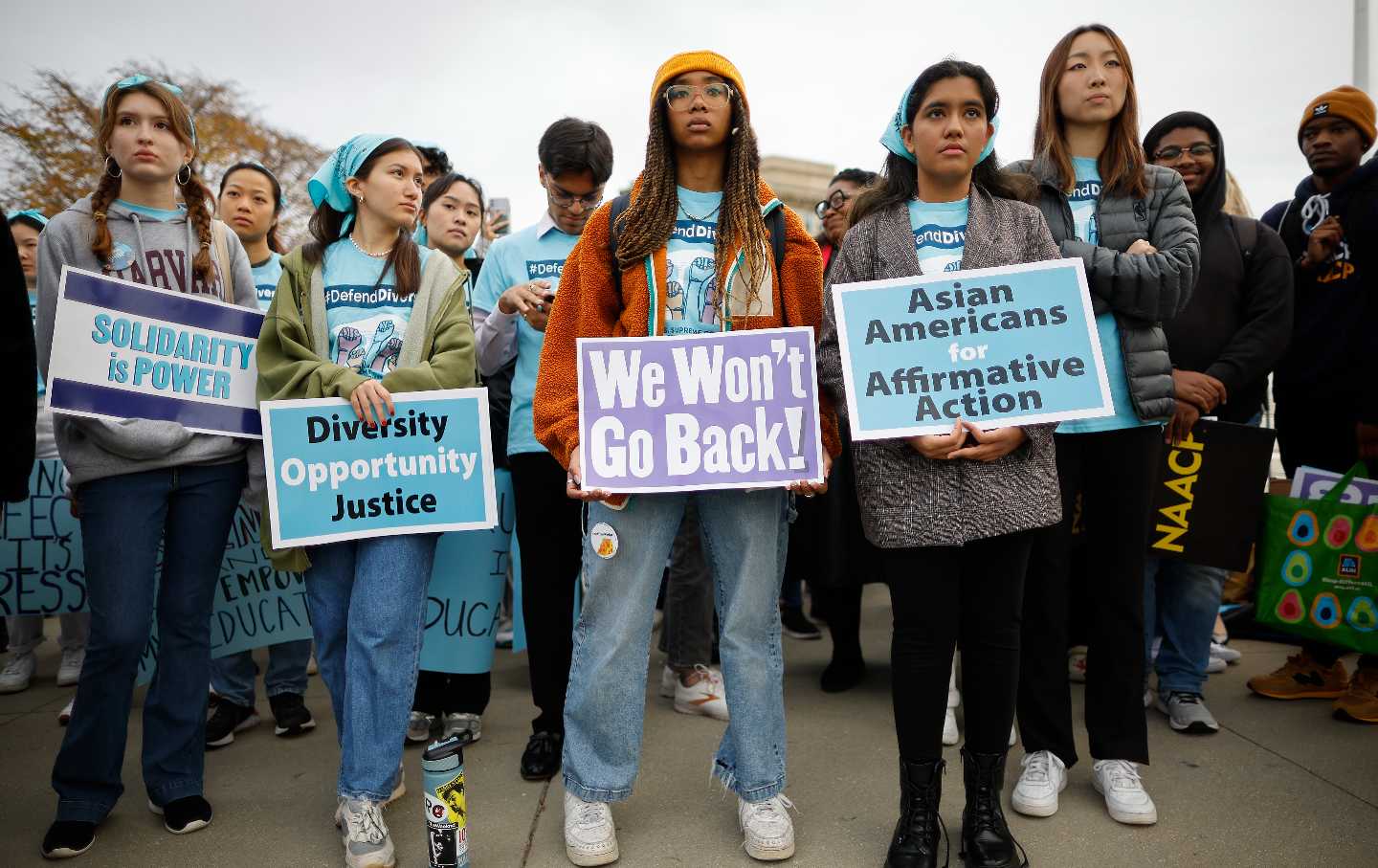
Legacy admissions are, once again, in the limelight. After the fall of affirmative action, colleges are facing renewed pressure to eliminate preferences for the children of alumni and donors. Last month, the Department of Education opened an investigation into legacy preferences at Harvard following a formal complaint from local civil rights groups. In the past few weeks, Wesleyan University and Occidental College have formally ended all preferences for legacy candidates.
As public support dwindles, the walls protecting legacy admissions are starting to cave inwards.
Legacy admissions began at Ivy League schools in the 1920s as a response to the growing number of immigrants—namely, Jews from Eastern Europe—entering elite Protestant institutions. Until the 1960s, legacy status essentially guaranteed admission into many of the top private schools in the country. In 1925, Yale admitted legacies “regardless of the number of applicants and the superiority of outside competitors.”
Legacy preferences were most common at schools in immigrant-dense cities, and were usually implemented in the year following a rise in applications from Jews and Catholics.
While legacy candidates no longer bypass the process entirely, the boost their applications receive remains significant. One study found that at the 30 most selective colleges in the country, having at least one alumni parent is associated with a 45 percent increase in the admissions rate. Another, focused on Harvard admissions between 2014 and 2019, found that the acceptance rate for legacy students was 33 percent, over five times the rate for other applicants.
Beginning in the 1970s, legacy admissions had to coexist with affirmative action in admissions offices. This dynamic allowed colleges to prioritize the representation of racial minorities while simultaneously pleasing alumni. Affirmative action, in a lot of ways, yielded moral cover to legacy and donor admissions.
The seeds of race-conscious admissions relied on the principles of reparations and intergenerational justice. However, the 1978 Supreme Court case Regents of the University of California v. Bakke found that reparation for historical injustice cannot be the constitutional basis for race-based affirmative action.
As such, broad affirmative action programs failed to target individuals with direct connections to past discrimination. A 2007 study found that 41 percent of incoming Black students at Ivy League schools were first or second-generation Americans. Even more striking, some members of the Harvard community claim that only 10 percent of Black students are generational African American, descendants of enslaved Africans in the United States.
Racial diversity as an educational ideal has ended up holding all the legal weight since the 1978 California v. Bakke decision. The educational benefits of racial diversity, colleges said, were large enough to justify admissions boosts to minority students.
While there are obvious pedagogical and social gains from racial diversity, it is unclear why they would eclipse the benefits of other forms of diversity on campus. For example, socioeconomic diversity has been completely overlooked by elite colleges.
At “Ivy-plus” colleges, more than two-thirds of students come from wealthy households. Even affirmative action programs favor the wealthy, rather than the economically disadvantaged. At Harvard, 71 percent of Black and Hispanic students come from the top fifth of their respective income quintiles.
Affirmative action was window dressing. It allowed colleges to costume themselves as diverse while excluding those who most directly face the harms of racial injustice, past and present.
Now, with the old paradigm in pieces, we arrive at an important crossroads: If schools do not change their admissions practices, they will allow the affirmative action ruling to reverse decades of progress toward racial diversity. By doubling down on admissions preferences for economic disadvantage, colleges can avert this catastrophe while finally making good on the unfulfilled promises of affirmative action.
The first step is the removal of admissions preferences for the wealthy. In a world without affirmative action, legacy admissions become unconscionable. Because the wealth, connections, and knowledge that come with well-educated parents directly translate to success, legacies already have a sizable advantage. To give them an extra boost is nothing less than support of a hereditary ruling class in this country.
Proponents of legacy admissions claim that alumni donations, which help all students, would plummet if these preferences were removed. But 2010 research on the top 100 American universities has found that there is no “causal relationship between legacy preference policies and total alumni giving.”. Even so, the moral case against legacy preferences is strong enough in its own right.
Popular
“swipe left below to view more authors”Swipe →The importance of removing admissions preferences for the wealthy is not just an abstract philosophical exercise. Rather, it is a necessary step for colleges to take if they wish to maintain racial diversity in a post-affirmative action world.
In 2014, a group of researchers studied the hypothetical outcomes of class-based affirmative action programs at the top 193 schools in the country. Notably, all simulations presumed the absence of preferential treatment for children of alumni, donors, and faculty.
The exercise assumed 250,000 available spots for the incoming freshman class and used statistics from 2014 as the baseline for racial and socioeconomic diversity. A pure merit-based admissions scheme—one that only looks at standardized testing—led to a decrease in representation among every minority group. Even more discouraging, socioeconomic diversity remained unchanged.
For their second simulation, the researchers estimated the effects of hardship on SAT scores. Disadvantage was quantified, then controlled for. In this model, white and Hispanic representation marginally increased while Black and Asian representation slightly decreased; racial diversity was functionally kept intact. Even more impressive, students from the bottom half of the income distribution made up about half of the admissions pool, compared to the baseline of just 14 percent.
Controlling for familial and geographic hardships barely maintained racial diversity. Simply put, class-based affirmative action cannot be effective if affirmative action programs for the wealthy—such as legacy admissions—exist.
In response to such simulations, Harvard stated that using socioeconomic indicators as a proxy for race would “yield a student body in which many of the non-White students would come from modest socioeconomic circumstances.” This change would hurt “other forms of diversity, undermining rather than advancing Harvard’s diversity-related educational objectives.”
In other words, Harvard does not want to prioritize socioeconomic diversity if it means having more low-income minorities. This view is antithetical to the admissions system we should all want. Race-neutral affirmative action programs, as admitted by this 2018 report from Harvard University, could preserve racial diversity and accomplish what affirmative action should have—increased opportunity for poor minorities.
Many schools have taken the first step towards reaching this goal. Three weeks ago, Wesleyan University ended legacy admissions. President Michael Roth claimed that the alumni response has been almost “uniformly positive.” Occidental College, similarly, axed legacy preferences. These schools now join the ranks of MIT, John Hopkins, and Carnegie Mellon as elite institutions without legacy admissions.
While the Department of Education’s recently-announced investigation could force Harvard and others to remove legacy preferences, elite colleges and universities should not wait to find out.
An opportunity has presented itself: The fall of affirmative action opens the door for an admissions system that doesn’t only favor the wealthy. Practically and symbolically, removing legacy preferences is the first step toward achieving this. Once access to college is no longer heritable, schools can experiment with race-neutral methods to preserve, and even enhance, racial and socioeconomic diversity.
More from The Nation
Jesse Jackson Reshaped the Democratic Party Jesse Jackson Reshaped the Democratic Party
The candidate may have started as a long-shot contender, but The Nation always took him—and his impact on political history—seriously.

The State of the Game Show The State of the Game Show
In this week’s Elie v. US, our justice correspondent explores how Trump’s State of the Union turned authoritarian violence into a titillating event. Plus Kansas’s vile ban on driv...


Cuba’s Oil Crisis Cuba’s Oil Crisis
Much of Cuba goes dark as a US oil blockade chokes the island’s energy supply. Major carriers have halted services now that aviation fuel is no longer available at nine internation...

For 108 Minutes, Trump Gave a Tedious Mussolini Impersonation For 108 Minutes, Trump Gave a Tedious Mussolini Impersonation
It was most mendacious State of the Union in US history. It was also the longest.

Clarence Thomas Just Struck Another Blow to Black Power Clarence Thomas Just Struck Another Blow to Black Power
In his majority ruling in a sleeper case about mail delivery, Thomas opened the door to a new way for Republicans to suppress the Black vote.

